• SUBSCRIBE TO SHIPS IN SCALE TODAY!

    The beloved Ships in Scale Magazine is back and charting a new course for 2026!
    Discover new skills, new techniques, and new inspirations in every issue.

    NOTE THAT OUR NEXT ISSUE WILL BE MARCH/APRIL 2026
  • Win a Free Custom Engraved Brass Coin!!!
    As a way to introduce our brass coins to the community, we will raffle off a free coin during the month of August. Follow link ABOVE for instructions for entering.

Monograph on HM Post Ship Perseus

Joined
May 4, 2026
Messages
27
Points
48

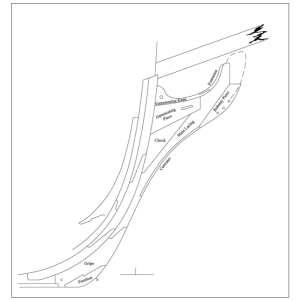
Attached is the latest draft of my monograph I am writing to document my research on HM Post Ship Perseus. This research is the companion to the model I am building and a build log can be found here. For those who were following along with my Perseus log prior to the MSW crash, all of the research I had previously document along with detailed citations can be found in this latest draft.

New in this version:
  • Additional sections on the bollard timbers and armament
  • Updated transcriptions for the text of the sphinx class plans correcting numerous errors and omissions
  • A number of additional potential contemporary depictions of sphinx class ships
  • Numerous fixes and corrections to errors
Please let me know if you have any questions or corrections.
 

Attachments

And now another ship I would love to build considering you did all the research and saved hundreds of hours of work. Maybe one day.....
Thanks for posting this Daniel!!!!!
Allan
Not all the research, much more to come. It is a bit of a patchwork at the moment and I have a massive backlog of primary sources still to transcribe.

I would certainly be interested in your thoughts, particularly on the knee of the head section.
 
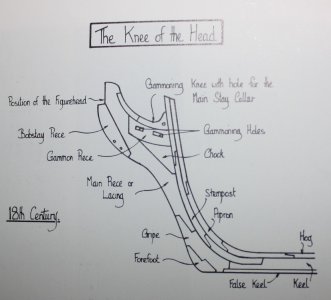
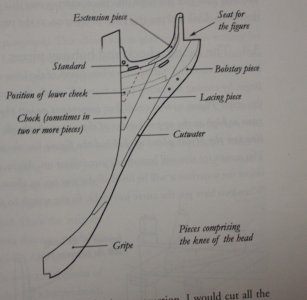
I just read the section on the knee of the head. This in itself is the most thorough examination of this part of the ship that I recall seeing. I doubt that there were two ships exactly the same so it might be anybody's guess as to the details for Perseus or her sisters. In the end, no one can say whatever you choose for that era is wrong. A few that come to mind that SEEM to be somewhat common are below. The second is from Goodwin. The last one is by David Antscherl in volume I, page 137 of The Fully Framed Model. He states that The knee of the head varied, depending on the timber at hand, but there were several principal pieces.
Allan
1779928922241.png
1779928943150.jpeg

1779929494938.jpeg
 
So one of the interesting things that drove me to try and document all the historical examples of the knee of the head was the lack of justification for the designs I saw in most of the secondary sources. The Goodwin example you show above is interesting, because in earlier drafts I actually included it in the discussion talking about how I could find no contemporary examples that looked anything like it. But that style of arrangement I have seen all over the place in secondary sources and modern models. Now it is possible Goodwin was working from some unnamed contemporary example, but I suspect that his arrangement is not consistent with contemporary practice.

The arrangement David A used in the TFFM is I think broadly consistent with the examples I have found, I didn't include it because I was again focused on contemporary examples.

In general I am of the view that the knee of the head in English shipbuilding was generally made with more pieces than most modern models depict. I suspect the use of scarfed joints was also quite common, though not universal.

If anyone is aware of any contemporary depictions or descriptions of the components of the knee of the head that I have not documented I would love to see them.
 
With so many complex elements, is there any accepted practice regarding the direction of grain for the individual pieces, or is it likely to just follow the longest chord of each piece?
So historically I suspect that shipwrights picked out a piece of wood which had the shape of the piece they were trying to cut. This is why to some degree we can never be sure of what any given ship's knee of the head looked like because they were following general practices, not exact plans. The available shapes of wood might dictate how exactly they constructed it on the lofting floor.

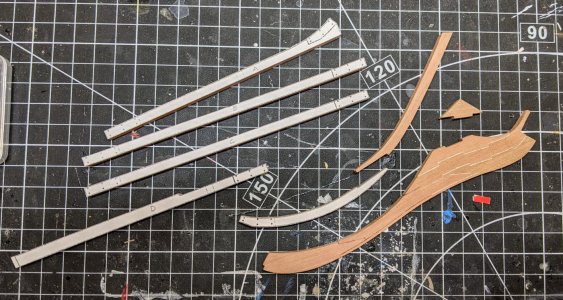
From a modelling perspective I would say just align the shape so the grain runs along the length of the piece to the degree that you can. If you see below for my Perseus build this meant that for the gripe, the piece is curved but I had no pieces of wood that matched that curve. So I had to align it as best I could for maximum strength.
PXL_20250418_230659114.jpg
 
So historically I suspect that shipwrights picked out a piece of wood which had the shape of the piece they were trying to cut. This is why to some degree we can never be sure of what any given ship's knee of the head looked like because they were following general practices, not exact plans. The available shapes of wood might dictate how exactly they constructed it on the lofting floor.

From a modelling perspective I would say just align the shape so the grain runs along the length of the piece to the degree that you can. If you see below for my Perseus build this meant that for the gripe, the piece is curved but I had no pieces of wood that matched that curve. So I had to align it as best I could for maximum strength.
View attachment 607554
Thanks. I suspected that might be the case. Very fine joinery you have done there. Inspiring.
 
Back
Top