• Ships of Scale has incorportated an extra level of security when you log In. Please follow on-screen prompts to acknowledge that you are not a robot via a "Check Box" or a "Pictorial Check Box Puzzle". This is needed due to higher level of AI Activity Security.
  • SUBSCRIBE TO SHIPS IN SCALE TODAY!

    The beloved Ships in Scale Magazine is back and charting a new course for 2026!
    Discover new skills, new techniques, and new inspirations in every issue.

    NOTE THAT OUR NEXT ISSUE WILL BE July/August 2026
  • Win a Free Custom Engraved Brass Coin!!!
    As a way to introduce our brass coins to the community, we will raffle off a free coin during the month of August. Follow link ABOVE for instructions for entering.

Mounting your ship questions.....

Joined
Nov 20, 2021
Messages
44
Points
48

I have a few questions IRT mounting your ship builds:

1) What determines the Length x Width x Thickness of your mounting/display board?

2) Where do you position your ship? Center of hull in center of board or center the ship in regards to overall length from bowsprit end back to farthest part of stern?

3) Should the bowsprit be "covered" (over the board) or extend past the edge?

4) If you place your ship on the board with finials vice a slipway, where do you place them on the keel in relation to the stem and stern?

5) What stage of the build do you finally mount the ship? Prior to beginning rigging, after it is completely built, or somewhere in between?

Thank you in advance for all of your inputs!

 
All of my models reside in glass cases that I build. I mount the pedestals that support them to the bottom of the case which becomes the display board.

I eyeball the case dimensions. Years ago someone wrote in the Nautical Research Journal about some sort of “golden ratio” in art but I’ve long since forgotten what it is. Perhaps you can look it up. I believe that bigger is better. The case should not be”crowd” the model.

The glass case solves the bowsprit issue.

When I build a model I try to have some sort of artistic vision for both model and display. For example, my current project is a Sharpie. These were originally built as humble craft for harvesting oysters, but later were built for racing. My model is one purpose built for racing. Hence my artistic vision is a formal presentation as a Yacht Club display model; no sails, brass fittings, polished paint job, mahogany case and turned brass pedestals. Had I built the oyster tonging version the display would have been different. I might have posed the model on a pair of sawhorses and used a domestic wood like maple for the case.

I try to incorporate structure within the hull of the model early in the build to accept fasteners for displaying it. Drilling a hole and screwing a fastener into a finished hull is a nail biting experience that can end in disaster. Locations where screws will penetrate the hull should be internally reinforced; a block of wood between bulkheads?

Roger
 
When I was investigating case dimensions, several sources said you want at least 2 inches of space beyond the overall length, width and height (why isn't it heigth?) of the model. I think if you put the model in a case the size of the base becomes less important. FWIW, the bases of the kits I have built so far are all shorter than the actual model.
 
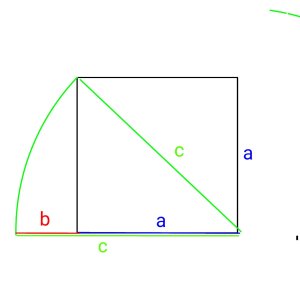
Golden measure is a proportion. 3 lengths are involved, one longer = a, one shorter = b, and the sum of the two = c.

b : a = a : c, turns out to about 1: 0.618.
GoldenRatio.jpg
I don't think that you can follow this strictly with a case, as you'd have to follow the measurements of the model.
 
Approximately fifty three years ago I built the Billings kit Danmark and placed her on the stand provided in the kit. Over that period of time I have found that the model had actually hogged out on the keel due to the stand not being long enough to support the length of ship. I know this is very realistic in scale to what real wooden ships do in the water, but I wish I had put more support under her to keep a level keel. Therefore, I recommend lots of support under the keel of your model, as overtime the change will show.
 
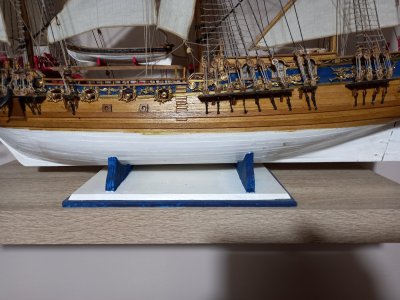
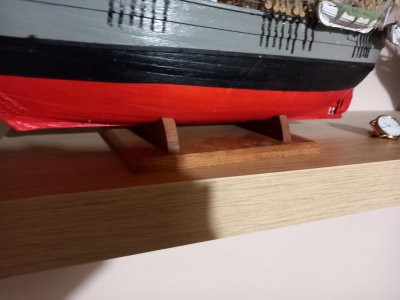
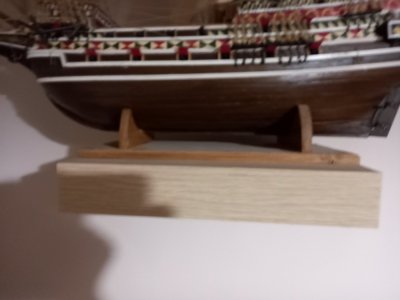
I find that the stands provided by some kit makers are generally flimsy, ugly, and have exposed plywood edges so I usually make my own. I use a couple of holes in the bulkhead sheet to provide a rough template for the cradles. I usually position these about one third of the hull length from stem and stern. The final positions are where I get a best fit to o the hull. The base plate is about the same width as the hull and the length arbitrary - perhaps half a hull length.
I use long, thin brass screws passing up through the base plate and cradles and screwing into the keel. This means that when I pick up the model the base comes with it ready to place on another flat surface. This is easier than trying to move base and ship as separate items. Screws are more reversible than glue.
(A model ship is a complex beam for which calculating the area points to minimise keel bending would be tricky. Perhaps AI could do it)
some examples are:-
base1.jpg base2.jpg base3.jpg
 
Back
Top