
• SUBSCRIBE TO SHIPS IN SCALE TODAY!

    The beloved Ships in Scale Magazine is back and charting a new course for 2026!
    Discover new skills, new techniques, and new inspirations in every issue.

    NOTE THAT OUR NEXT ISSUE WILL BE MARCH/APRIL 2026
  • Win a Free Custom Engraved Brass Coin!!!
    As a way to introduce our brass coins to the community, we will raffle off a free coin during the month of August. Follow link ABOVE for instructions for entering.

New carving project in apple: The Stern Decoration of the Royal Charles

Joined
Aug 8, 2019
Messages
5,737
Points
738

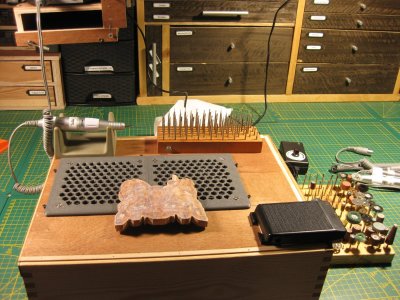
I haven’t been able to do much model building for a while. I’ve been busy with other things, like making rope walks, reorganizing my hobby room, getting the hang of my new 3D printer, writing for *De Modelbouwer*, doing odd jobs around the house, and my health has also been an issue. Now that the weather has warmed up, I’m starting to feel the urge to get back to it. Especially since all the chores—except for one (sanding and refinishing the dining table top)—are now done. I’d been thinking about making a stern decoration for quite some time. Since I’m in a Dutch mood with my ships, I wanted to choose a Dutch one. But after a long search, I came across an image on the museum’s website. That’s where the stern decoration of the Royal Charles is displayed.


Why an English ship instead of a Dutch one, and why woodcarving instead of continuing with my other projects? Simple: I just felt like doing some woodcarving right now, and since it’s a hobby that’s supposed to be fun, the decision was an easy one. Why the Royal Charles instead of a Dutch ship? The Charles is sort of Dutch. It was war bounty and is still an existing original object that can be viewed. This is mentioned on the website:
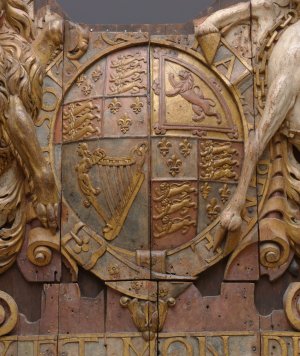
The stern decoration of the Royal Charles has been hanging in the permanent display of the Rijksmuseum since its opening in 1885. By tradition it symbolises the naval successes of the Dutch Republic, most notably those scored over Great Britain. The capture of the British flagship by a Dutch fleet under the command of Michiel de Ruyter during the Raid on the Medway in 1667 was a famous feat of arms.
I contacted the museum and asked for a few more photos and some additional information. I had noticed that this stern decoration wasn't flat but curved, and I needed more information about that.
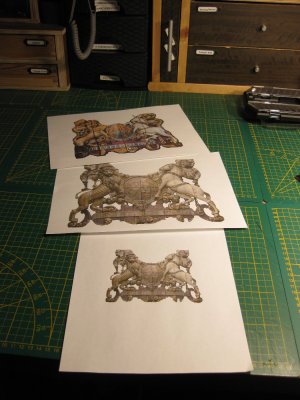
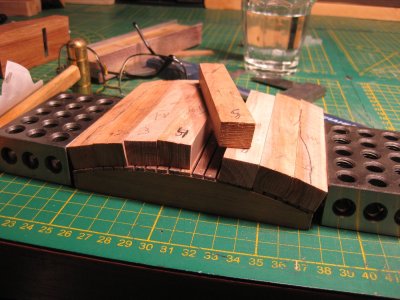
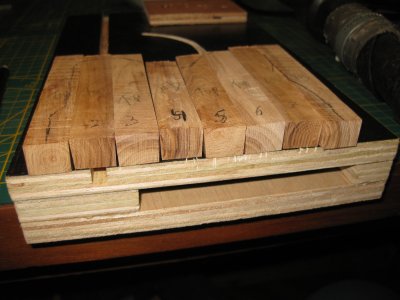
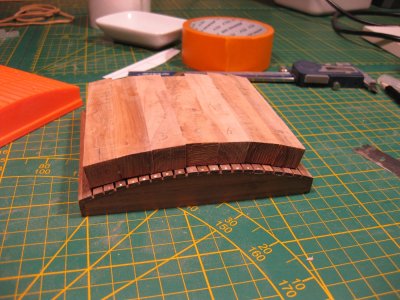
The scale of the project will be roughly 1:34. And using archival photos, I was able to determine the curvature. All roughly measured, because on the model it won’t make much difference if it’s a millimeter thicker or thinner. I have a PDF printout, which I’m using as a template. On the 3D printer, I created a mold into which I can insert slats to produce a wooden frame onto which the stern decoration can be mounted.
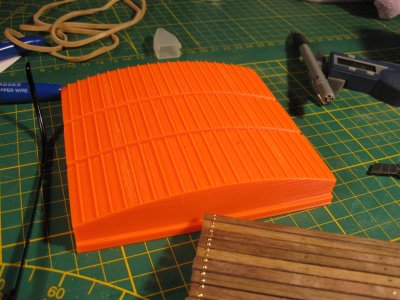
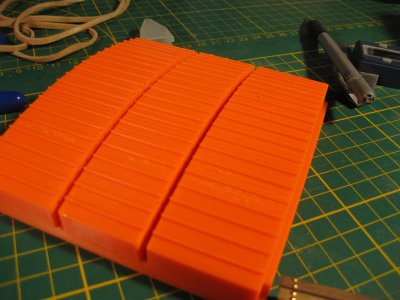
IMG_5860.JPGIMG_5861.JPG


IMG_5857.JPG

IMG_5858.JPG

IMG_5852.JPG

IMG_5862.JPG
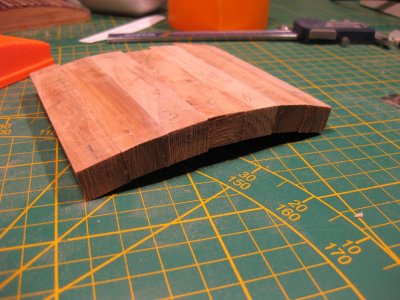
Next, I cut strips of apple wood to size and joined them at an angle to create the curve.
IMG_5863.JPGIMG_5864.JPGIMG_5866.JPGIMG_5867.JPGIMG_5868.JPG
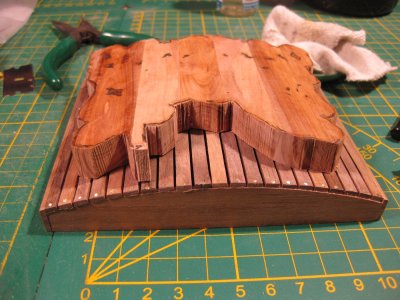
Then I sanded it down to achieve the desired thickness and to fit the yellow trim onto the frame.
I cut out the outer contours. Then I ran it through the disc sander again to make it another 4 mm thinner.
IMG_5869.JPGIMG_5870.JPGIMG_5872.JPGIMG_5874.JPG

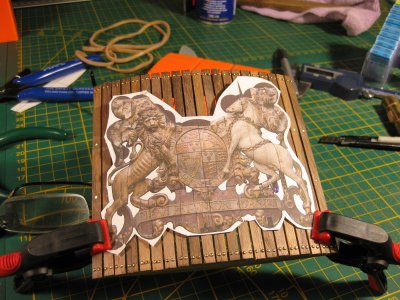
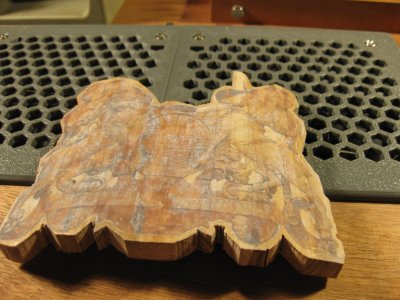
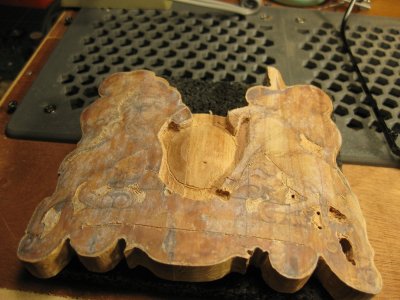
I printed the image in mirror image and, following Maarten’s instructions, transferred it to the wood using varnish.
I was able to start making fabric, but it’s going excruciatingly slowly. That’s because apple wood isn’t as easy to work with as boxwood. But based on my experience, I’m sure I’ll be able to add the details.

IMG_5875.JPGIMG_5876.JPGIMG_5877.JPG
I don't know if I'll be able to pull it off, but I hope I can get you all excited about this adventure by posting regular updates.

The original is in the museum; this photo was found online.

images.jpg
 
Last edited:
I haven’t been able to do much model building for a while. I’ve been busy with other things, like making rope walks, reorganizing my hobby room, getting the hang of my new 3D printer, writing for *De Modelbouwer*, doing odd jobs around the house, and my health has also been an issue. Now that the weather has warmed up, I’m starting to feel the urge to get back to it. Especially since all the chores—except for one (sanding and refinishing the dining table top)—are now done. I’d been thinking about making a stern decoration for quite some time. Since I’m in a Dutch mood with my ships, I wanted to choose a Dutch one. But after a long search, I came across an image on the museum’s website. That’s where the stern decoration of the Royal Charles is displayed.


Why an English ship instead of a Dutch one, and why woodcarving instead of continuing with my other projects? Simple: I just felt like doing some woodcarving right now, and since it’s a hobby that’s supposed to be fun, the decision was an easy one. Why the Royal Charles instead of a Dutch ship? The Charles is sort of Dutch. It was war bounty and is still an existing original object that can be viewed. This is mentioned on the website:
The stern decoration of the Royal Charles has been hanging in the permanent display of the Rijksmuseum since its opening in 1885. By tradition it symbolises the naval successes of the Dutch Republic, most notably those scored over Great Britain. The capture of the British flagship by a Dutch fleet under the command of Michiel de Ruyter during the Raid on the Medway in 1667 was a famous feat of arms.
I contacted the museum and asked for a few more photos and some additional information. I had noticed that this stern decoration wasn't flat but curved, and I needed more information about that.
The scale of the project will be roughly 1:34. And using archival photos, I was able to determine the curvature. All roughly measured, because on the model it won’t make much difference if it’s a millimeter thicker or thinner. I have a PDF printout, which I’m using as a template. On the 3D printer, I created a mold into which I can insert slats to produce a wooden frame onto which the stern decoration can be mounted.
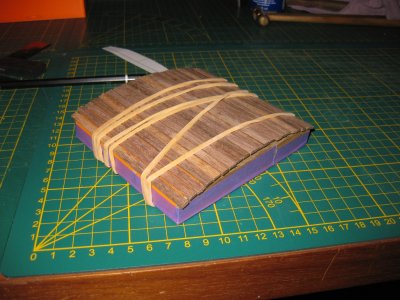
View attachment 611874View attachment 611875


View attachment 611872

View attachment 611873

View attachment 611871

View attachment 611876
Next, I cut strips of apple wood to size and joined them at an angle to create the curve.
View attachment 611877View attachment 611878View attachment 611880View attachment 611881View attachment 611882
Then I sanded it down to achieve the desired thickness and to fit the yellow trim onto the frame.
I cut out the outer contours. Then I ran it through the disc sander again to make it another 4 mm thinner.
View attachment 611883View attachment 611884View attachment 611885View attachment 611886

I printed the image in mirror image and, following Maarten’s instructions, transferred it to the wood using varnish.
I was able to start making fabric, but it’s going excruciatingly slowly. That’s because apple wood isn’t as easy to work with as boxwood. But based on my experience, I’m sure I’ll be able to add the details.

View attachment 611887View attachment 611888View attachment 611889
I don't know if I'll be able to pull it off, but I hope I can get you all excited about this adventure by posting regular updates.

The original is in the museum; this photo was found online.

View attachment 611897
Wow, great work Stephan, very intricate and interesting,
Best regards John,
 
Thanks Paul, John and Shota for the support and the others for the likes and visit.
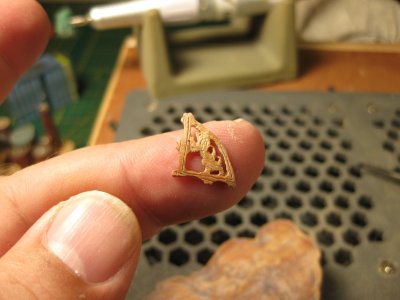
I was experimenting a bit with the small details on the shield.

NG-MC-239-05.jpg

I wanted to do this by smoothing out the shield’s surface and gluing the details onto it. I got the idea from Herman. The details for the shield are very small, and if I were to apply them directly to the shield, it wouldn’t look good against the background. It turns out pretty well when I do it this way. Once again, it’s very small and difficult to handle. But with the small cutters, it’s not an impossible task. The difficulty lay in the curve of the shield and transferring that curve to the lion in this case.

IMG_5879.JPG

(Note: You can see that it's possible to go in small details with apple when you use cutters)

IMG_5878.JPG
(Note: The shine on the wood is after polishing the wood with a brush on a cutter)

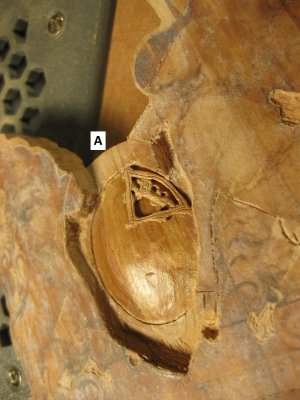
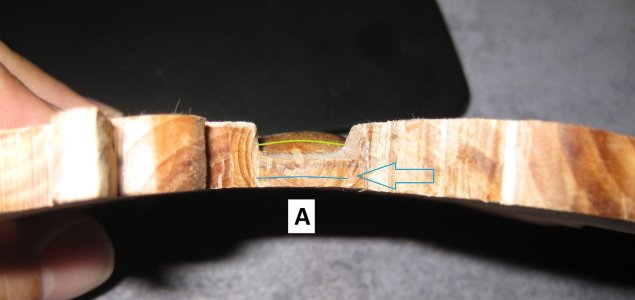
While working on it, I did come to the conclusion that the shield needs to be set deeper and that it’s too high.

IMG_5880.JPG
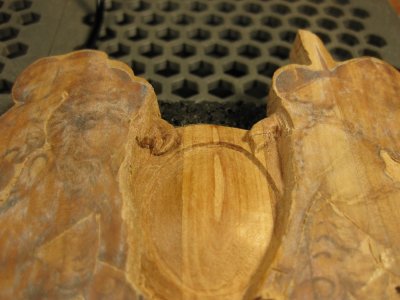
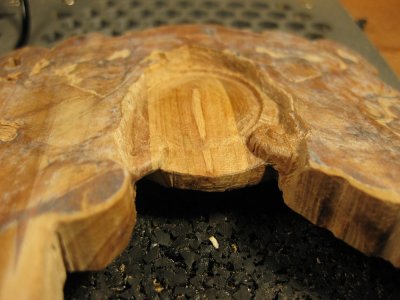
See the attached photos. So A needs to be thinner (just 2,5 mm), which will make the shield sit deeper within the whole piece. Personally, when working on a piece like this, I always find that figuring out how deep to go into the object is best done at the start. So I think I’ll leave this part alone for now; it’s a good solution for adding the letters and details to the shield. With that in mind, I’m now going to continue lower the shield and add the first details of the horse and the lion on the shield.

Thanks for watching!
 
Thanks Paul, John and Shota for the support and the others for the likes and visit.
I was experimenting a bit with the small details on the shield.

View attachment 612529

I wanted to do this by smoothing out the shield’s surface and gluing the details onto it. I got the idea from Herman. The details for the shield are very small, and if I were to apply them directly to the shield, it wouldn’t look good against the background. It turns out pretty well when I do it this way. Once again, it’s very small and difficult to handle. But with the small cutters, it’s not an impossible task. The difficulty lay in the curve of the shield and transferring that curve to the lion in this case.

View attachment 612531

(Note: You can see that it's possible to go in small details with apple when you use cutters)

View attachment 612530
(Note: The shine on the wood is after polishing the wood with a brush on a cutter)

While working on it, I did come to the conclusion that the shield needs to be set deeper and that it’s too high.

View attachment 612532
See the attached photos. So A needs to be thinner (just 2,5 mm), which will make the shield sit deeper within the whole piece. Personally, when working on a piece like this, I always find that figuring out how deep to go into the object is best done at the start. So I think I’ll leave this part alone for now; it’s a good solution for adding the letters and details to the shield. With that in mind, I’m now going to continue lower the shield and add the first details of the horse and the lion on the shield.

Thanks for watching!
Hi Stephan,

Great progress. The carvings on the shield will be tricky.
Another approach could be by cutting these from veneer. Glue them on the apple and then finish them. To me this looks extremely fragile to work with.
 
Maarten and Shota, thanks for the compliments and feedback. And thanks again to everyone for the likes and for stopping by. It’s tricky, just like the whole piece. I’ve positioned the shield deeper into the structure, but I’m not quite there yet. I still need to lower the sides a bit more—about 1 to 2 mm. That’ll be my next task, to get that right first. The top looks good, though, so I’ll leave it as is. Just need to finish that up. I’ve also already placed the upper legs of the unicorn and the lion on the shield. It still looks a bit strange because there’s a lot of work left to do. In any case, the lion’s claws and the hoof are in place.
This might be the most difficult ornament I’ve made so far. Partly because of its size—I can’t always maneuver my cutters the way I want to. I also have to be careful not to remove parts that I might need later. I only have a few photos—which are also blurry—that show the depth. So it’s a lot of guesswork.

Other than that, everything’s moving at a slow pace here; we’re currently experiencing a heat wave here in the Netherlands, and where I live, it’s extremely hot by Dutch standards. 35°C with high humidity. And overall, there’s rain in many parts of the country, along with hail and thunderstorms in the evening, but where I live, we’re lucky again because the rain never crosses the river here. :cool:Beerjust keep it cool.....

IMG_5881.JPGIMG_5882.JPG
 
No doubt, Stephan, you are up to this challenge. I do like your approach, to a complex puzzle. Dialing in the shield, as the central element, to the correct thickness, and then using it as a gauge to work the rest of the carving to the correct scale is, very smart, indeed!

I still don't have a lot of time to devote to the hobby I love, but I will definitely be following you one this one. I'm not one to pass up on a learning opportunity. Great work!
 
Thanks Paul, John and Shota for the support and the others for the likes and visit.
I was experimenting a bit with the small details on the shield.

View attachment 612529

I wanted to do this by smoothing out the shield’s surface and gluing the details onto it. I got the idea from Herman. The details for the shield are very small, and if I were to apply them directly to the shield, it wouldn’t look good against the background. It turns out pretty well when I do it this way. Once again, it’s very small and difficult to handle. But with the small cutters, it’s not an impossible task. The difficulty lay in the curve of the shield and transferring that curve to the lion in this case.

View attachment 612531

(Note: You can see that it's possible to go in small details with apple when you use cutters)

View attachment 612530
(Note: The shine on the wood is after polishing the wood with a brush on a cutter)

While working on it, I did come to the conclusion that the shield needs to be set deeper and that it’s too high.

View attachment 612532
See the attached photos. So A needs to be thinner (just 2,5 mm), which will make the shield sit deeper within the whole piece. Personally, when working on a piece like this, I always find that figuring out how deep to go into the object is best done at the start. So I think I’ll leave this part alone for now; it’s a good solution for adding the letters and details to the shield. With that in mind, I’m now going to continue lower the shield and add the first details of the horse and the l

Thanks for wat are able to achieve.

I haven’t been able to do much model building for a while. I’ve been busy with other things, like making rope walks, reorganizing my hobby room, getting the hang of my new 3D printer, writing for *De Modelbouwer*, doing odd jobs around the house, and my health has also been an issue. Now that the weather has warmed up, I’m starting to feel the urge to get back to it. Especially since all the chores—except for one (sanding and refinishing the dining table top)—are now done. I’d been thinking about making a stern decoration for quite some time. Since I’m in a Dutch mood with my ships, I wanted to choose a Dutch one. But after a long search, I came across an image on the museum’s website. That’s where the stern decoration of the Royal Charles is displayed.


Why an English ship instead of a Dutch one, and why woodcarving instead of continuing with my other projects? Simple: I just felt like doing some woodcarving right now, and since it’s a hobby that’s supposed to be fun, the decision was an easy one. Why the Royal Charles instead of a Dutch ship? The Charles is sort of Dutch. It was war bounty and is still an existing original object that can be viewed. This is mentioned on the website:
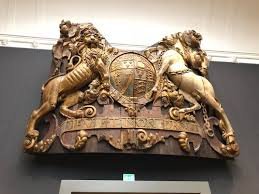
The stern decoration of the Royal Charles has been hanging in the permanent display of the Rijksmuseum since its opening in 1885. By tradition it symbolises the naval successes of the Dutch Republic, most notably those scored over Great Britain. The capture of the British flagship by a Dutch fleet under the command of Michiel de Ruyter during the Raid on the Medway in 1667 was a famous feat of arms.
I contacted the museum and asked for a few more photos and some additional information. I had noticed that this stern decoration wasn't flat but curved, and I needed more information about that.
The scale of the project will be roughly 1:34. And using archival photos, I was able to determine the curvature. All roughly measured, because on the model it won’t make much difference if it’s a millimeter thicker or thinner. I have a PDF printout, which I’m using as a template. On the 3D printer, I created a mold into which I can insert slats to produce a wooden frame onto which the stern decoration can be mounted.
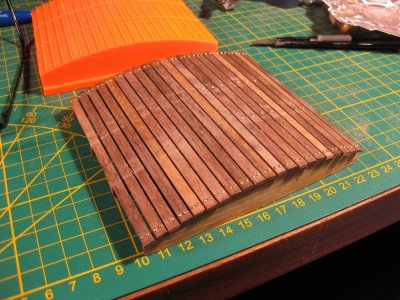
View attachment 611874View attachment 611875


View attachment 611872

View attachment 611873

View attachment 611871

View attachment 611876
Next, I cut strips of apple wood to size and joined them at an angle to create the curve.
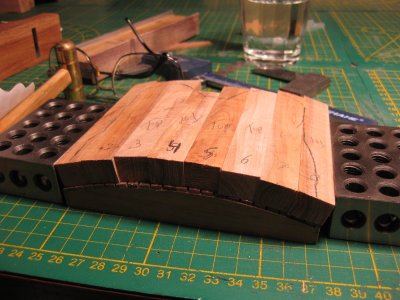
View attachment 611877View attachment 611878View attachment 611880View attachment 611881View attachment 611882
Then I sanded it down to achieve the desired thickness and to fit the yellow trim onto the frame.
I cut out the outer contours. Then I ran it through the disc sander again to make it another 4 mm thinner.
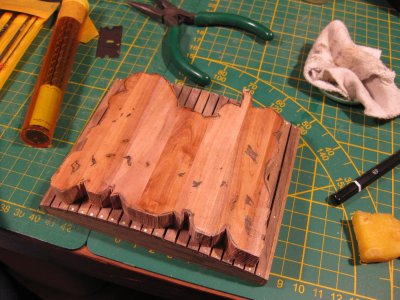
View attachment 611883View attachment 611884View attachment 611885View attachment 611886

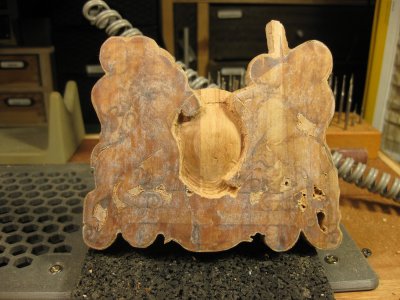
I printed the image in mirror image and, following Maarten’s instructions, transferred it to the wood using varnish.
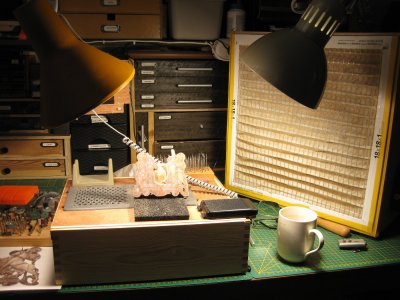
I was able to start making fabric, but it’s going excruciatingly slowly. That’s because apple wood isn’t as easy to work with as boxwood. But based on my experience, I’m sure I’ll be able to add the details.
View attachment 611887View attachment 611888View attachment 611889
I don't know if I'll be able to pull it off, but I hope I can get you all excited about this adventure by posting regular updates.

The original is in the museum; this photo was found online.
View attachment 611897
Thanks Paul, John and Shota for the support and the others for the likes and visit.
I was experimenting a bit with the small details on the shield.

View attachment 612529

I wanted to do this by smoothing out the shield’s surface and gluing the details onto it. I got the idea from Herman. The details for the shield are very small, and if I were to apply them directly to the shield, it wouldn’t look good against the background. It turns out pretty well when I do it this way. Once again, it’s very small and difficult to handle. But with the small cutters, it’s not an impossible task. The difficulty lay in the curve of the shield and transferring that curve to the lion in this case.

View attachment 612531

(Note: You can see that it's possible to go in small details with apple when you use cutters)

View attachment 612530
(Note: The shine on the wood is after polishing the wood with a brush on a cutter)

While working on it, I did come to the conclusion that the shield needs to be set deeper and that it’s too high.

View attachment 612532
See the attached photos. So A needs to be thinner (just 2,5 mm), which will make the shield sit deeper within the whole piece. Personally, when working on a piece like this, I always find that figuring out how deep to go into the object is best done at the start. So I think I’ll leave this part alone for now; it’s a good solution for adding the letters and details to the shield. With that in mind, I’m now going to continue lower the shield and add the first details of the horse and the lion on the shield.

Thanks for watching!
I'm always astounded by the skills and imaginative processes people are able to achieve.
 
This is a real 3-dimensional puzzle. It's good to see you are adequately challenged on this one Stephan!
Thanks Paul, indeed a puzzle, I need to rethink at least 4 times before I put the cutter in the wood.
No doubt, Stephan, you are up to this challenge. I do like your approach, to a complex puzzle. Dialing in the shield, as the central element, to the correct thickness, and then using it as a gauge to work the rest of the carving to the correct scale is, very smart, indeed!

I still don't have a lot of time to devote to the hobby I love, but I will definitely be following you one this one. I'm not one to pass up on a learning opportunity. Great work!
Nice to see you around Ken, hope to see your work soon when you find time for the hobby.
Wow, this is going to be a beautiful experience. I'm looking forward to the next step.
I'm always astounded by the skills and imaginative processes people are able to achieve.
Thanks KMS and Dave you are welcome, maybe I make a video when I carve. It shows how much time that goes in a single part.
Hi Stephan. Just found your new thread with the start of your new carving project. Projecting the 3D image via a print on the would and then make it 3D again ….. my respect!
Regards, Peter
Hi Peter, yes it's a real challenge to go from a picture that is 2D to 3D without reference. If I lived in Amsterdam (thank god it isn't) I would visit the museum everyday. Happy to see you here around.

And thanks to all for the visit and likes.
 
Back
Top