


• Win a Free Custom Engraved Brass Coin!!!
    As a way to introduce our brass coins to the community, we will raffle off a free coin during the month of August. Follow link ABOVE for instructions for entering.
  • SUBSCRIBE TO SHIPS IN SCALE TODAY!

    The beloved Ships in Scale Magazine is back and charting a new course for 2026!
    Discover new skills, new techniques, and new inspirations in every issue.

    NOTE THAT OUR NEXT ISSUE WILL BE MARCH/APRIL 2026

Newbie needing help on Plans

Joined
Feb 17, 2025
Messages
4
Points
3
Hi, so I’ve built a couple of ships from kits (Polaris and HMS Victory) and wanted to try my hand at a self-build, I.e. no kit.

I asked ChatGPT (don’t groan please) and it appeared very helpful pointing me to a site where I could download a Russian tugboat plan. It then told me to scale it based on the original length of the boat, but I can’t see how. I’m told to take the length of the boat and apply a scale of 1:96 then when printing you apply the scale to get the length of the plan to use as a template.

But, I can’t find a reference to the length of the actual boat to be able to apply a scale!?

Anyone here able to offer some guideline please, or point me to a good starter plan?
 
Welcome to the SOS Group. 1st of all I would search for an actual vessel with specifications listed of the type that you want to build, and then work your scale calculations for your model size. Your calculations are going to effect every single component of that build, not just hull size. 2nd be very cautious of a set of internet plans that are asking you to scale and build this way. Since this is your first scratch build you need to start out with an excellent set of drawings that details every component. I am not saying that you can't rescale a set of drawings to the size of ship that you want, but give yourself a fighting chance of success with a good set of plans to begin with.
 
first lets start with what you want to build
go here to get an idea of what is available


then we can walk you through the process of plans how to use them
 
Oh wow! Thanks very h for the pointers but I can’t a reference clearly see that I’m a bit over ambitious, I need to get a couple or more kits under my belt first! Still, great pointers!thank you.
 
Oh wow! Thanks very h for the pointers but I can’t a reference clearly see that I’m a bit over ambitious, I need to get a couple or more kits under my belt first! Still, great pointers!thank you.
Don’t underestimate your abilities / overestimate the work involved in scratch building a model ship.

Successfully, completing Victory is no small task! There are scratch building opportunities that are not as difficult as what you have already accomplished.
 
if your interested in a tug boat check this topic out, it takes you from original plans to converting them to modeling plans, research, and a build.

as far as modeling plans go they are free and available

 
This is a marathon, not a sprint and there are probably well over 1000 ships that are well enough documented for constructing a model. So! what interest you? Building something for which you have a compelling interest will keep you interested over the long haul.

Your interest should determine your model’s category:

Ancient era vessels
Nelson era navy
Merchant sail
Merchant Powered vessels
Fishing vessels
And many more..

Within each category are many choices. For example, let’s say that you have an interest in Nelson era navy. It’s not necessary to build a model of HMS Victory. There are many smaller sailing warships that in my humble opinion are candidates for much more interesting models and built to a reasonable scale will not compete for space in a modern home.

Do some thinking, decide what you want to build, then there are SOS members who can give you advise on sources for plans.

Roger
 
This is my personal take on what you are asking .
Scratch is a different world from kits. It is similar to finding yourself on a different planet. The climate is different. The predators are different. To survive requires that you have a serious prior in depth briefing.
This means reading. Books that explain and demonstrate the different choices for scratch building. It appears that your exposure so far has been the absolute worst build method. Books are best for this. I leave it to others for useful title suggestions. The relevant journals have essentially long ago abandoned scratch as their focus. Even when it was a major focus, lessons in HOW to do it were rare. What you are asking suggests that you are attempting to skip some necessary introductory steps. There is no faculty to fail you. There are no boards. There are no committees to pass judgment. You are alone on this new planet. If you go in without a map, without a firm predetermined objective and destination you will fail you. Gentle slopes will seem to be insurmountable walls.

To be sure, there are those who can bull their way into scratch and thrive. Those who can do this do not ask for advice. They would probably be insulted by the thought that they would need to ask for advice. They probably seldom if ever visit on-line forums. They probably never post, even if they visit.

Watercraft that are possible subjects for modeling encompasses a broad spectrum of possibilities and types. Unless you are in your 20's - a drastic narrowing of type and era is a survival step for doing scratch. You can bounce around all over the field if you stick with kits. Someone else has done all of the design and planning work. Although there is much opportunity to add it, there is not much intellectual effort required You can just DO. You do not need to KNOW. Proper scratch requires a serious intellectual component.

Polaris is a relatively simple wooden two masted schooner. I am not sure that it was even an actual vessel. It looks to be an effective introduction to being able to build using the odious POB method.
Victory 1765 is at the other extreme. A historically accurate scratch build of one its many versions would be a magnum opus. For wooden sail it does not get more complicated. If you have completed kits of both, there is nothing more that a POB kit can teach you.

A near modern tugboat has very little in common with what you have already built. A proper scratch build would involve techniques and engineering that has little in common with vessels from the Golden Age of sail. However - If you build using POB, I guess your prior experience would be enough help. POB has almost zero relevance to how actual ships were built. It is a waste of possibilities involved with scratch to build using POB. It is a way of getting quickly past what should be an interesting part of the build. The swimming body is the scientific part of what makes a ship a ship. The rest of it could just as well be sitting on a floating barge.

A tug is a different category from stick and string. Being that you are new, I advise picking a narrow focus at least when beginning all this. You need to do your homework to discover just what are the possibilities. You can then focus down on a manageable fraction of it.
 
Do you have any type of CAD program? For some of us it is easiest to insert a drawing (jpg, dxf, png, etc) into a new page in CAD then enlarge to full scale. All you need is one confirmed dimension to do this, be it LOL, beam or most anythng else. Redraw/trace the entire drawing if need be. Whether or not you need to redraw or go with the original that is sized to full scale you can then reduce to whatever scale you want with a couple clicks. If the overall size is greater than a normal sheet of paper that you can print at home you can save the drawing to a flash drive/memory stick and take it to any print shop to have them print at your new scale. I like to add a known scale bar pf about 6 or 10 inches, maybe more, on the CAD drawing. When the page is printed you can measure the bar and make sure the printer has it right. About 25% of the time, in my experience, they have had to adjust the printer to be sure the printed pages are spot on.
Good luck
Allan

1769170970971.jpeg
 
Building original scale ship models, if seriously pursued to any degree, requires a good research library. The sooner a modeler starts building their research library with at least the "classic" works on the subject, the better their modeling will become. There have been many, many books written on ship modeling in general and many more written on specific aspects of the hobby. Some of the best reference works are over fifty years old. Some are a couple of hundred years old if you are interested in vessels of that period and before. Some, but not all, of these books are available online at no cost. The best way to build a ship modeling library is to buy used books in decent condition. Otherwise, buying such specialty books can get rather expensive with some of the more esoteric limited edition three or four volume reference sets running into the hundreds of dollars in some cases. Don't worry, though. The essential reference works are far less expensive and readily available from used book dealers online.
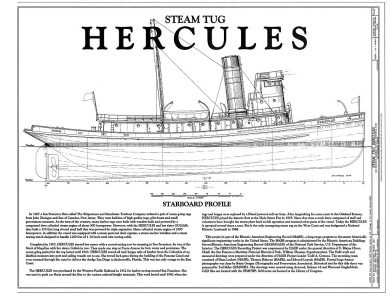
As mentioned by others, it is best to try to focus on a type of vessel and a period of time. The closer to the present your prototype is, the more likely you will be able to find accurate plans and photographs to work from. An 18th century warship is going to take a lot of research and, even then, you may find yourself running into a lot of dead ends. On the other hand, if your interest is an early 20th century tug boat or coastal schooner, there are lots of fully details plans available, some available for free online. (See: https://www.themodelshipwright.com/high-resolution-ship-plans/cargo-ships/steam-tug-hercules/)

1774150875504.png

Here are some basic books that every scratch modeler should have on his bookshelf.

Harold A. Underhill's Plank on Frame Models and Scale Masting and Rigging. (See: https://www.amazon.com/Plank-Frame-...ents=p_27:Harold+A.+Underhill&s=books&sr=1-10) This is a two volume set. Used sets go for more than used single volumes. Buying singly they can be had for as little as $10.00 USD each volume. A treasure trove of modeling techniques!

The Built-up Ship Model (Conway's Ship... book by Charles G. Davis. A bit dated, but good basic instructions.

The Ship Model Builder's Assistant ... book by Charles G. Davis. A companion to the one above.

Ship Models: How to Build Them by Charles G. Davis and Paul K. Davis is a trade paperback book published by Dover Publications, Incorporated in 1986. It is part of the Dover Woodworking Series and features illustrations by the authors.

I also consider The Techniques of Ship Modeling, by Gerald Wingrove to be a valuable basic reference work for technique.

Howard I. Chapelle's Boatbuilding and Yacht Planning and Designing, while addressing full sized boat building, are invaluable references for how boats and ships are built from plans. You will find Chapelle's treatment of manual naval architectural drafting and lofting (drawing plans to scale for patterns used to build boats and ships) will be invaluable.

Shop around online for these books used. They are frequently available for less than ten bucks each.

If you are interested in period sailing ships, you will have to acquire some essential "encyclopedic" reference works on rigging, armament, and so on. I wouldn't suggest a novice get into this area of ship modeling until they have a good grounding in the basics. Building a few kits, even sailing warships, aren't going to do it for you. You must have reference works at hand to answer the many question that will arise. The older the ship, the less detailed the original plans will be.

I would recommend any ambitious period sailing ship modeler equip their ship modeling research library with the following period reference works in addition to the "primers" listed above. We're talking about reference resources here, so it's best to spend a little bit more if necessary and obtain the equivalent of The Oxford Dictionary of the English Language instead of trying to save money by buying a copy of Merriam-Webster's Collegiate Dictionary. (Which reminds me to mention that every scale ship modeler ought to have a copy of The Oxford Companion to Ships and the Sea, the definitive dictionary of all things maritime compiled by the OED. See: https://www.amazon.com/Oxford-Companion-Ships-Reference-Collection/dp/0198800509) All these books are available online and if price is a consideration used copies of all are sometimes available at substantially less cost.

John Harland's Seamanship in the Age of Sail which is a great resource on how sailing ships are sailed and why they are rigged the way they are.

James Lees' Masting and Rigging of English Ships of War which is a complete compendium of British naval sailing rigs and rigging practices throughout the period when "Britania ruled the waves."

Harold A. Underhill's' Masting and Rigging the Clipper Ship and Ocean Carrier which focuses on merchant sailing rigs and rigging practices from approximately 1850 through the end of commercial sail.

Allan Yedlinsky's Scantlings of the Royal Navy 1719-1805 Comparisons of 1719, 1745 Establishments, Ship Builders Repository and Steel’s Elements and Practice (Published by Seawatch Books) This book contains spreadsheets listing the standard "scantlings" (measurements) of English warships of all types issued by the Admiralty between 1719 and 1805, which covered vessels into the mid-19th century. American vessels were quite similar. This is where you will find the diameter of a mast, the size of rigging lines, and on and on, for all sizes of vessels in the English navy. There is also a reprint of "Steele's Elements and Practice," a period shipbuilding treatise.
 
Back
Top