
• Win a Free Custom Engraved Brass Coin!!!
    As a way to introduce our brass coins to the community, we will raffle off a free coin during the month of August. Follow link ABOVE for instructions for entering.
  • PRE-ORDER SHIPS IN SCALE TODAY!

    The beloved Ships in Scale Magazine is back and charting a new course for 2026!
    Discover new skills, new techniques, and new inspirations in every issue.

    NOTE THAT OUR FIRST ISSUE WILL BE JAN/FEB 2026

Newbie with HMS Endeavour

Joined
Feb 4, 2026
Messages
6
Points
13

This is my first time. I have completed the hull of my Occre Endeavour, and am now creating the masts. I am puzzled by the fact that the lower main mast and its junction with the intermediate main mast requires a part which has a round hole and a square hole in it. It seems as though I am required to carve a square section at the bottom of the intermediate main mast that means carving about two inches of the mast. The part that connects the intermediate main mast with the topmost section of the main mast has two round holes in it which is what I would have expected. In summary, why has the part at the junction of the lower main mast and the intermediate main mast got a square hole in it? Cheers, Richard T.Mast puzzle.JPG
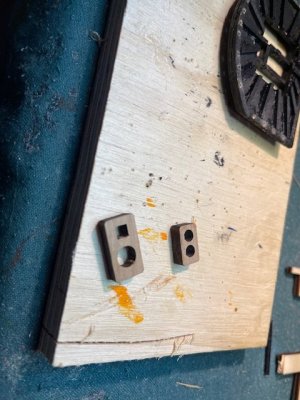
 
The masthead between topmast and topgallant mast has to get one out of the two holes squared. As the joint will be visible (not much, though), my advice is to have a fresh masthead from scratch. Regards, Alberto
 
The part that connects the intermediate main mast with the topmost section of the main mast has two round holes in it which is what I would have expected. In summary, why has the part at the junction of the lower main mast and the intermediate main mast
The top mast cap with two round holes is incorrect. There should be one round and one square hole. It would have had a square hole for the square heel of the topgallant mast and the round hole for the top mast to pass through to the topmast trestle trees and cross trees. The heels of the masts were square so they would not turn. This includes the square opening in the lower mast steps as well as the square opening in the trestle trees/cross trees and caps. (NB: In the 19th century, the heels were sometimes octagonal or similarly shaped rather than square.) There are drawings with dimensional information for the masts, caps, heels, fid hole locations, etc. in Lee's Masting and Rigging book that are nicely detailed. There were cap shores on large ships as well, but I doubt they would be on a small ship like Endeavour.
Allan
 
Back
Top