
• Win a Free Custom Engraved Brass Coin!!!
    As a way to introduce our brass coins to the community, we will raffle off a free coin during the month of August. Follow link ABOVE for instructions for entering.
  • SUBSCRIBE TO SHIPS IN SCALE TODAY!

    The beloved Ships in Scale Magazine is back and charting a new course for 2026!
    Discover new skills, new techniques, and new inspirations in every issue.

    NOTE THAT OUR NEXT ISSUE WILL BE MARCH/APRIL 2026

Oil/Varnish question

Joined
Mar 24, 2025
Messages
9
Points
43

Location
Sydney
Hi,

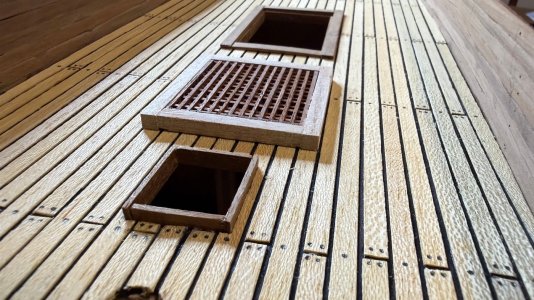
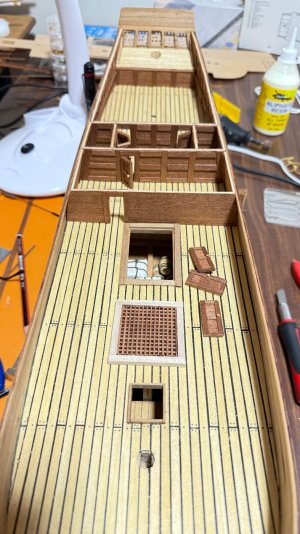
I'm about half way through finishing the cabins on my 1:48 HMAV Bounty and thinking I will need to seal everything before the next deck goes on. I'm not sure what to use. Boiled Linseed, Tung or Danish oil - or perhaps a matte acrylic varnish. In any case, what is the easiest method to apply the finish - especially for the finer bits like the grate hatches.
I think the oil would be pretty thick and I am also concerned about the black marker pen between the planks possibly running. Whatever I use on this deck I will use for everything else, Hull Masts, etc.

P.S. I don't know why they go to such detail for items that will be mostly covered up by the next deck. Each small cabin door is 23 individual pieces of wood.
IMG_0678.jpeg
 
Well, if you are looking for the easiest way to seal wood on a model, I would suggest a thin coat of clear shellac (3-pound cut - as it comes out of the can.) BUT beware! Shellac is dissolved in alcohol and some "marking pen" inks are also soluble in alcohol. The ink may run and would likely smear if it is alcohol-based. Test the dried ink to see if it is "alcohol proof" before applying shellac or any coating containing alcohol, as do some acrylic coatings!

If your marking pen passes the "alcohol proof" test, you will find shellac a perfect sealer. It does not build up on the surface if you only apply a single coat and it soaks in and leaves the wood appearing as if nothing is on it. Shellac was used as the finish on the British Admiralty "Navy Board" models. Shellac is a wonderful coating and sealer. It is one of the most moisture-resistant coatings available and it is reversible, as it is soluble in alcohol. It's also great for sealing knots in rigging to prevent their untying, yet applying alcohol to the dried shellac will soften it so that a knot can be untied if need be. Shellac is also a great adhesive in thicker "cuts." ("Cut" is expressed in pounds of shellac to a gallon of alcohol.) Lastly, shellac "plays well" with all other coatings. Paints and varnishes can be applied without risk of incompatibility.

You're doing some very crisp, clean woodwork there! I will offer one gratuitous comment about your deck. I don't know if your marking pen soaked into the bare wood of the deck or not. If not, you may want to do some research about deck planking "schedules" and revise your deck presentation after sanding or scraping off what you've got there now. There were rules for how decks were to be laid, particularly with respect to the lateral distance required between plank butts. The reason for these rules was to ensure the strongest construction of the decks. Lining up the plank butts too closely and regularly together creates a weak area in the deck.

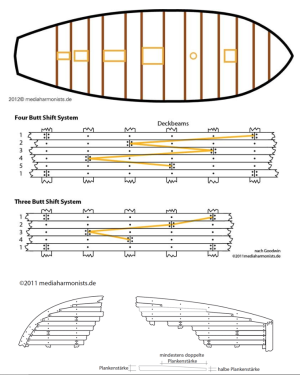
Additionally, the deck fasteners (black dots on your deck) are never visible at "scale viewing distance" because whether the planks are fastened with trunnels (wood pegs) or nails, which are always covered with wooden plugs of the same species as the planks, there's little or no noticeable color contrast between the trunnel ends or the countersunk plugs. Moreover, the lines of your plank butts as shown indicate an unrealistic deck beam structure with too few beams in places no beam would ever have been placed. (See generic deck framing schematic drawing below.)

Upon review, you may wish to sand down the bright "yellow wood" decks to minimize the black "nail heads" and bold black seam stopping and then stain the decks bit darker to achieve a more realistic appearance. That's an aesthetic choice, I suppose. My comment is only based on the general presumption that most want to build as accurate a model as possible. I realize, however, that some don't.

See: https://shipsofscale.com/sosforums/threads/deck-planking.13956/

1774928684532.png


What you've drawn on your model's deck is what might be called a "one butt shift system" with only one plank crossing the deck beam between every two plank butts on the same deck beam. The "nibbing" of the covering boards shown in the above diagram is applicable only to nineteenth century vessels. It was not known to have been done prior to 1800, so would not have been done on Bounty. The fastening "dots" on the above diagram only indicate the placement of the fasteners on the deck beam and covering boards, but not their appearance on the prototype vessel's deck nor on a model built to look like it. In "real life" they are virtually invisible.

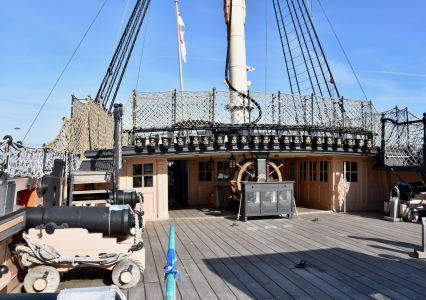
See actual deck of HMS Victory below.

1774973443624.png
 
Last edited:
Hi,

I'm about half way through finishing the cabins on my 1:48 HMAV Bounty and thinking I will need to seal everything before the next deck goes on. I'm not sure what to use. Boiled Linseed, Tung or Danish oil - or perhaps a matte acrylic varnish. In any case, what is the easiest method to apply the finish - especially for the finer bits like the grate hatches.
I think the oil would be pretty thick and I am also concerned about the black marker pen between the planks possibly running. Whatever I use on this deck I will use for everything else, Hull Masts, etc.

P.S. I don't know why they go to such detail for items that will be mostly covered up by the next deck. Each small cabin door is 23 individual pieces of wood.

View attachment 588549
Hi, I will not comment on your question about oil, as i don't know what wood is the kit made off. On my Artesania Latina Bounty I just varnished mate all the ship. That pops up the diferent woods.

A tip : When I use black marker between the deck plank, I varnish the planks before applying the marker. In that way you will avoid the ink spreading as hair line.

Build a small deck sample and try your varnish on it to verify if it has an effect on the ink.

Best
Daniel
 
I would use acrylic mat finish. Any oil based type varnish will prevent any further glueing.
It isn't 100 % correct that statement. Use any oil based varnish, or any other oil on 2 scrap pieces of wood and then glue them . Or on just 1 piece of wood and then glue another untouched piece over. Then let us know the results.
 
You're doing some very crisp, clean woodwork there! I will offer one gratuitous comment about your deck. I don't know if your marking pen soaked into the bare wood of the deck or not. If not, you may want to do some research about deck planking "schedules" and revise your deck presentation after sanding or scraping off what you've got there now.
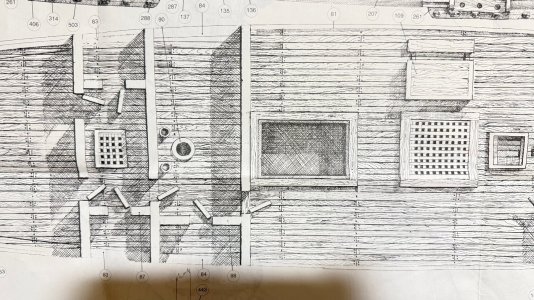
Thanks everyone. This is my first build and I have been following the plans as best I can. The deck plan (attached) shows a "one butt shift system". I agree that this is historically incorrect but I didn't know that at the time.
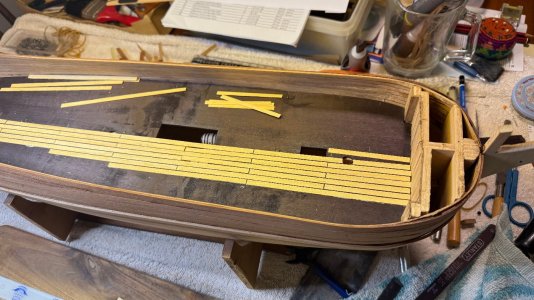
I can't sand them back to change to a 3 or 4 butt system as each deck plank is a separate piece of 0.6 x 5mm Mukali. I used a permanent marker on the 1.5mm prefab plywood deck and then glued the planks onto this using a spacer to keep them even. I know that the gaps are too wide as well. The plans called for 22 planks but the gaps were ridiculous so I increased to 26 planks. I'm too far down the track to scrape them off.
I marked the deck fasteners with a sharp lead pencil. I can use an eraser or fine sandpaper to make these less noticeable.

There is another deck to go above this and I don't know weather to do that the same as the lower deck or "correctly".

As well as various oils and varnishes I can now throw shellac into the equation. It will be a very expensive exercise to get a pot of each option to test.


IMG_0679.jpegIMG_0068.jpegIMG_0113.jpeg
 
I have been following the plans as best I can. The deck plan (attached) shows a "one butt shift system"
I'm not surprised. Historical accuracy isn't OcCre models' strong suit if issues like this one are as frequent as they seem to be. It sounds like you've done your best to de-emphasize it. It just drives me nuts when I see what they charge for some of these models and don't take the time to design them accurately, but advertise how accurate they are! These are small details, but what's a ship model after all but a collection of small details?

As well as various oils and varnishes I can now throw shellac into the equation. It will be a very expensive exercise to get a pot of each option to test.

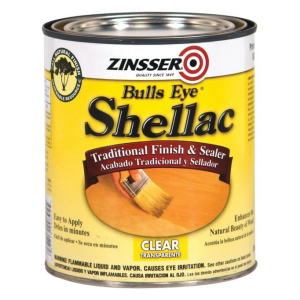
Fortunately, clear shellac is less expensive than paint, especially "model" paint in 1.5-ounce bottles that dry up a week after you open them! Even if the alcohol evaporates from the open can over time, it shellac won't "skin over" in the can like paint. It will just get thicker. Adding more alcohol to the mix immediately restores it to its former consistency. Zinsser "Bull's Eye" clear shellac mixed in the can runs about $25 a quart these days, but all coating prices have gone through the roof these days. It seems the "Big Box" hardware stores only want to seel quarts and gallons these days, but I used to see it in paint stores in pint and even half-pint cans, so if you look around, it shouldn't break the bank. Get some white alcohol (not the blue stuff for camp stove fuel) to use to thin it and clean your brushes, etc.

1775036352900.png
 
Back
Top