


• Ships of Scale has incorportated an extra level of security when you log In. Please follow on-screen prompts to acknowledge that you are not a robot via a "Check Box" or a "Pictorial Check Box Puzzle". This is needed due to higher level of AI Activity Security.
  • SUBSCRIBE TO SHIPS IN SCALE TODAY!

    The beloved Ships in Scale Magazine is back and charting a new course for 2026!
    Discover new skills, new techniques, and new inspirations in every issue.

    NOTE THAT OUR NEXT ISSUE WILL BE July/August 2026
  • Win a Free Custom Engraved Brass Coin!!!
    As a way to introduce our brass coins to the community, we will raffle off a free coin during the month of August. Follow link ABOVE for instructions for entering.

Opinions on which glue to use for the 2nd layer of planking

Joined
Sep 1, 2026
Messages
4
Points
1
HI All- I am new to the forum so my apologies if this question has been raised before. I did some search in the forum regarding my question but couldn't really find a good answer.

I am looking for your opinion as to which glue to use for the 2nd layer of planking. I typically use wood glue for the 1st layer. However, I have seen different options for the 2nd layer:
- CA-based glues (super glue): sticks immediately (well after 10 secs or so), but can be messy. And you can only do part of the plank each time because of the fast drying tie. Can be messy when dripping, depending on the vicoscity and how you apply it.
- Contact Adhesive - seems to work nice (I am trying this for my current boat).
- Wood glue - I used this for the two ships I built. It works but main disadvantage is the clamping as it takes a few minutes to dry (dry enough to hold). I have used painter's tape for clamping and it works. But not ideal.
- Contact cement - never used it. From what I can tell is that it bonds instantly which makes adjusting the plank almost impossible.

What do you think/can you share?
Thanks!
Willem
 
Welcome aboard from Connecticut.
I used PVA glue (wood) on my second layer of the Black Swan and it seemed to work well. The video instructions from Occre seem to indicate they use some kind of contact cement what I would call rubber cement. I have heard that does not have the ability to last for many years.

Rob
 
Hi Rob - thanks for the quick reply. As to Occre, ironically, in their video, they mention that they use contact cement. But if you look closely they actually use contact adhesive, which they call shoemaker glue. That's also what I use now and works actually pretty good. I think the reason why they mention contact cement is that contact cement and contact adhesive are used interchangeably by a lot of people. They are related, yet different.

Can I ask how you deal with the clamping of the 2nd layer of planks when you use wood glue? Do you use temporary pins/nails to hold the plank in place until the wood glue has hardened?
 
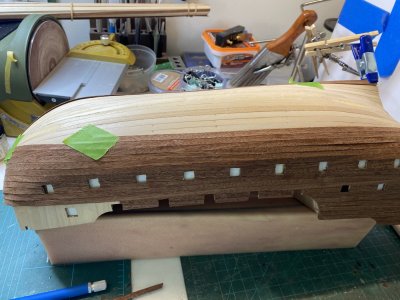
I did not use any pins or nails for the second layer. I found the best way to deal with it was to let the veneer lay as it would. It (at least with the veneer I was using) was impossible to bend the veneer sideways without breaking it. When I put the veneer down I would hold it for a bit to let the glue set. I also used tape to hold it in place. I understand there is a quick setting titebond PVA glue that has been recently introduced. That may be of help.

IMG_2399.jpeg
 
Brilliant minds think alike :) I used the same green painters tape exactly as you showed in the picture when using wood glue. Thanks for the Titebond new glue tip - will take a look. Thanks again for your response!
 
I have always used Titebond for my planking. I hold the plank for say a few minutes, by which time it will have "tacked" and wild horses will not move it!

May I say something about planking generally.It sounds as if you are planking over Bulkheads, not frames? Is that right? I found a long time ago that what I thought was a section of planking with a shallow curve was anything but! I never have used POB since and use POF instead, (or blocking) . It is all work,I know but you will see the difference.:cool:
 
I have found that if if you are 2nd planking with anything 1mm or less regular pva will cause the planks to curl and no amount of pins or clamps will keep it flush with the hull. I found a product called "WeldBond" that has a very high tack right off the bat. It dries fast within minutes giving you plenty of time to position your plank. It also dries clear is water soluble and is easily sanded. I use regular painters tape to keep it down for the few minutes it takes to harden. When you have finished a planking row on the starboard side, by the time you finish the port side you can go back, remove the tape, and start your next row on the starboard side again. As with any glue use just enough so that you dont have it oozing out to keep clean up to a minimum. It obviously will work for other wooden parts as well as metal and ceramic.
 
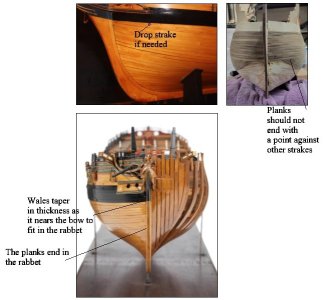
Rob, do you want the planking to look like a real ship so the planks end in the rabbet at the stem or like the first layer of planking in your photo above? If your ship gets a copper bottom it won't matter as it will be covered, but makes for good practice for the future.
1789237457256.jpeg
 
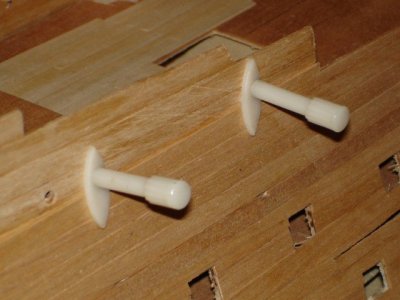
I'd highly recommend using carpenters wood glue. It's strong and you can wipe off the excess unlike with some of those other solutions. As far as the setting time, you can use these clamps which you can screw into the first layer of planking. I got them from Model Expo years ago.7.1 Aug 22, 2006.JPG
 
Hi Gandalf I use UHU ALL PORPOSE wich is a synthetic resin that act as a one way glue or a contact adhesive as well. Once applied it remains temporarily adjustable shortly after application. One important thing it’s cristal clear.
 
I have found that if if you are 2nd planking with anything 1mm or less regular pva will cause the planks to curl and no amount of pins or clamps will keep it flush with the hull. I found a product called "WeldBond" that has a very high tack right off the bat. It dries fast within minutes giving you plenty of time to position your plank. It also dries clear is water soluble and is easily sanded. I use regular painters tape to keep it down for the few minutes it takes to harden. When you have finished a planking row on the starboard side, by the time you finish the port side you can go back, remove the tape, and start your next row on the starboard side again. As with any glue use just enough so that you dont have it oozing out to keep clean up to a minimum. It obviously will work for other wooden parts as well as metal and ceramic.
I'm in the advanced beginner stage, and I agree with the Weld Bond. I use it in a 15-guage syringe for better control and running a very thin bead of glue then spreading it with my finger, not to the edges as it will ooze to the edges on its own when the plank to be glued is attached--wipe any ooze with a damp cloth.

Blessings,
JJ
 
Hmmm...I use one of two options. First is a high tack PVA. In this case "high tack" is the preference no matter what brand of PVA glue you choose. My choice is Aleene's Quick Dry Tacky glue. Go to Amazon to find it. Second, depending on the severity of the curve, I use gel CA. The gel viscosity tacks the plank while the CA cures. I have not had any issues using these glues for planking. I have not experienced warping or curling of thin planks.
 
I’ve had good results using Titebond and a technique that I found either on this forum or some other one (sorry, can’t remember ) on my Cutty Sark project. Paint a strip of glue on the hull and on the plank and hit it with a hair dryer until it looks dull. At this point there is some tack when you apply the plank but it can be repositioned if necessary. I then used a heated plank bender ( I have an Aeropiccola model 1950) to “activate” the glue. It gives a permanent bond without the need for clamps or pins.
 
I find pva as good as anything and I use a small iron to apply some heat it makes is as quick as using a contact adhesive.
I have tried contact adhesive but it is very messy and difficult to apply just enough on the Hull for one plank width,also once its on it is on there is no wiggle room
 
Since you asked for opinions, here’s one. The best glue for the second layer of planking? None!

First, if you buy a kit, buy one with enough bulkheads to properly define the shape of the hull.

Next, do a good job of fairing them.

Then, throw away the kit supplied planking; both layers.

Using quality wood, correctly plank the hull; one layer.

That’s it! Real ships were not double planked.

Roger
 
Rob, do you want the planking to look like a real ship so the planks end in the rabbet at the stem or like the first layer of planking in your photo above?
This is the essential question that a modeler should answer before planking a model. If the planking is meant only to establish the shape of the vessel, it can be planked with any material in any direction, filled with some sort of putty, sanded to shape. and painted. If the planking is meant to recreate the planking of the prototype vessel, the appropriate pattern of laying planks should be followed, which requires rabbeting and spiling the planks. Fair winds!
 
Polyvinyl adhesives and heat as described in two replies above is the best solution of all. The heat causes the water in the PVA to evaporate faster.

Note that there are two types of polyvinyl adhesive and Titebond actually isn't the better one of the two. Ship modelers seem to universally use the abbreviation "PVA" when referring to Titebond and similar products. This is actually a misnomer. "PVA" is the abbreviation for "polyvinyl alcohol." The abbreviation for Titebond-type wood glues is actually "PVAc," which stands for polyvinyl acetate. The difference is that PVAc (Titebond) is a much less archival material because it contains acid which can destroy the bonded material and off-gas acid within a closed case which can attack the entire fabric of a model, particularly delicate rigging thread. (Which is, among other good reasons, the main reason why stiffening rigging thread with thinned PVAc (Titebond) isn't recommended if you intend your model to realize its maximum potential life expectancy.) PVA (also called "archival PVA") has a neutral pH and does not adversely affect the materials it bonds. It's commonly available from art supply stores and companies that sell bookbinding materials. Modelers have been using PVAc (Titebond, etc.) for a long time, usually without a lot of apparent adverse effects in the short term, so you can pay your money and take your chances. If you are one of the probable minority of modelers who are intending to produce a long-lasting high-quality model, it would likely be worth your while to use PVA adhesive.

See: See: https://www.nbinno.com/article/other-adhesives/pva-glue-conservator-archival-restoration-hn and https://www.amazon.com/s?k=archival...a46dbd3d84&tag=mh0b-20&ref=pd_sl_3qyn76xg6f_e
 
Last edited:
Back
Top