



- Joined
- Sep 20, 2025
- Messages
- 27
- Points
- 58

I am originally from West London, then moved to north west UK in 1979 for work, where I have maintained my permanent home base. I am a Naval Architect by education and training but been working mainly in the offshore industry on floating production systems in various countries until I finally retired at the end of March 2026.
From secondary school, I have been keen on ship modelling. I started with a couple of Billing kits (Dragon yacht and North Sea cutter), then scratch built semi-scale ships from plans available at that time through Model Boats magazine (including a Castle class corvette and working radio controlled HMS Brave Borderer fast torpedo boat). Of these, only Brave Borderer is still around but its deck fittings are quite badly damaged.
After these, I started onto what were planned to be scale models. The following are presentations of these as they are at present.
Grand Banks Schooner Elsie
This is built as plank on bulkhead using Model Shipways drawings. Keel and bulkheads are plywood, hull planking is lime strips, and deck planking is lime strips laid on plywood sub-decks. This was intended to be a radio controlled working model so is fitted with ducts for the running rigging, with the sail winch planned to be under the foredeck and radio under the deck cabin. The hull was reinforced internally with fibreglass mat and resin for watertightness and strength.
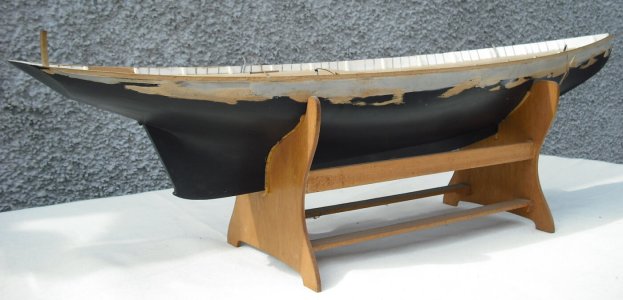
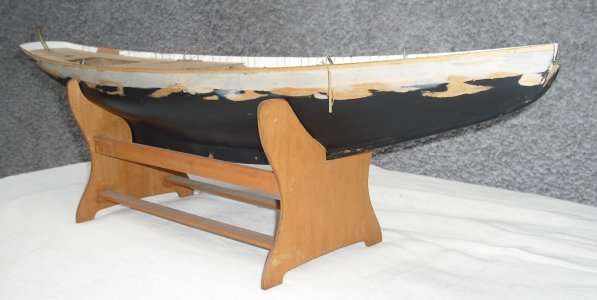
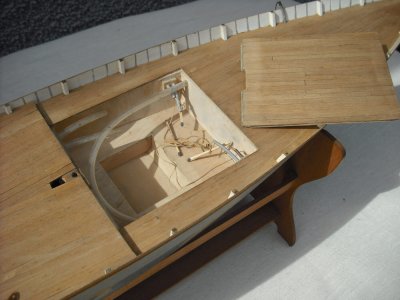
The bare areas in way of the bulwarks are correction of a mistake, as I misread the drawings and did not notice that the bulwarks were thinner than the hull planking. I found this mistake when I bought a copy of Howard Chapelle’s “American Fishing Schooners” and found a complete set of Model Shipways drawings and instruction book for the “Benjamin W Latham” schooner in a maritime bookshop.
This is the state of completion as of end 1978. Progress halted after I moved north, bought a house, got married and started working abroad.
Hunt Class Minesweeper HMS Northolt (1918)
This is a static model and is built as bread and butter construction using the shipbuilder’s as-fitted arrangement plans bought from the National Maritime Museum, London. These comprise profile, deck plans and a range of sections which provide enough information to develop templates to shape the hull. There was also a model of one of the class in the Imperial War Museum, London from which I was able to make notes. I also bought a photo of the actual vessel from the maritime museum.
The hull is plated with thin file divider card. Each plate is embossed from behind to simulate rivets, using the pointy end of a blunt marlin spike, rivet by rivet (very tedious). Looking at this fresh, and with 50 year’s hindsight, I don’t think the riveting is correct. The heads scale up to 2”-3” diameter which is probably too large. Plus the rivets project out too far and are flat topped rather than domed. Also I think the vertical lapped seams for each strake should have double rows of rivets.
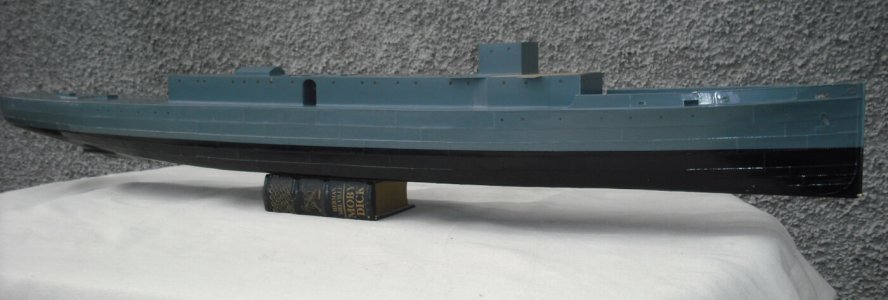
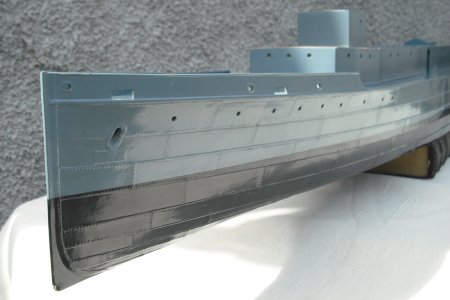
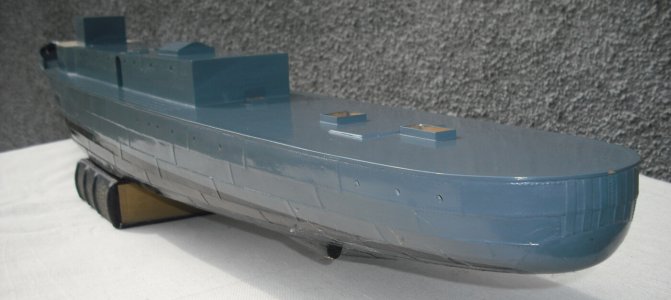
This is also the state of completion as of end 1978, for the same reasons as noted above. Unfortunately the model suffered some damage during a later house move, principally to the starboard forward bulwark, bridge wing, and general dents & paint chips.
Steam Yacht
This is a static model built from a French kit, bought while I was working in Paris in 1990 and wanting something small enough to put in a shipping tube for when I moved around. Only the hull and decks are from the kit. The cabin was scratch built as inspired by the yachts in the Lake Windermere Steamboat Museum, and the steam engine was scratch built using plasticard, wood, brass and aluminium, based on photos and drawings found on-line.
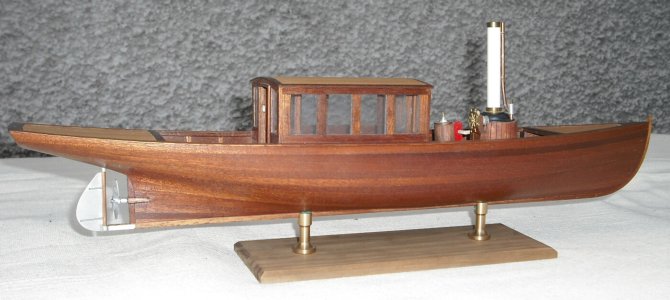
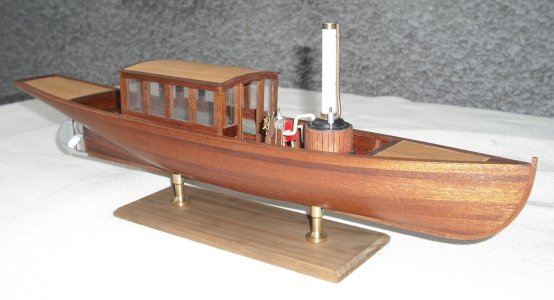
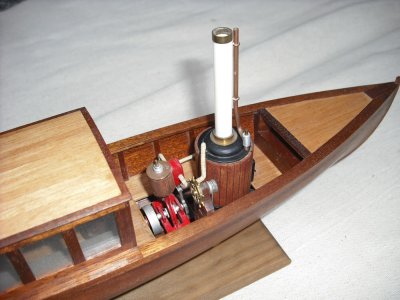
This model was progressed in various countries as I moved around, reaching this stage in 2002.
Future
Now that I have retired, I intend re-starting my ship modelling, along with my general hobby of woodworking. The obvious plan of action is to actually complete the above models. But I want to do something else first.
When I first went to Paris on holiday in 1982 I went to the Musée National de la Marine, where I was drawn to a model of a Chebec. I bought the monograph of the “24 gun Chebec (1750)” from the museum shop intending to use the drawings as a basis for a model. In 1990, when I was working in Paris, a work colleague introduced me to Ancre monographs and showed me his copy of the monograph for Le Requin. I finally bought my own copy in 2009 after it became available with an English translation, intending to use this as the basis for a model rather than using the museum monograph.
Six months or so ago, I started lurking on MSW and SOS forums to get inspiration for my retirement projects, and joined SOS in September last year. I read the reviews of the ZHL and SC kits for Le Requin and the general positive opinions, so bought one of the ZHL kits. I have also bookmarked the Requin build logs of Crypton, Daniel20, Kidsgalore, and Alessandro63 for reference.
I also bookmarked two scratch build Requin logs on MSW (by Daniel Forlani and Jeronimo) Unfortunately these latter two logs have disappeared due to the MSW hack. Fortunately, Daniel Forlani ran a parallel build log on Gerard Delacroix’s French forum so the information is still generally available, and Jeronimo has a photo record of his completed (aft half) model here on SOS.
I have not had time to properly check the kit materials, but so far there are two changes I plan to make: build the stern grating (aft of the stern post) so it is tapered to aft rather than parallel sided as per feedback on some of the build logs, and also to bend and plank the weather decks from raw strip material rather than use the kit provided sheet material so that the grain of each plank follows its shape and differs plank to plank.
I won’t be doing a build log given my previous (lack of) rate of progress but hopefully can provide useful contributions to this forum.
Thanks for reading.
Ken
From secondary school, I have been keen on ship modelling. I started with a couple of Billing kits (Dragon yacht and North Sea cutter), then scratch built semi-scale ships from plans available at that time through Model Boats magazine (including a Castle class corvette and working radio controlled HMS Brave Borderer fast torpedo boat). Of these, only Brave Borderer is still around but its deck fittings are quite badly damaged.
After these, I started onto what were planned to be scale models. The following are presentations of these as they are at present.
Grand Banks Schooner Elsie
This is built as plank on bulkhead using Model Shipways drawings. Keel and bulkheads are plywood, hull planking is lime strips, and deck planking is lime strips laid on plywood sub-decks. This was intended to be a radio controlled working model so is fitted with ducts for the running rigging, with the sail winch planned to be under the foredeck and radio under the deck cabin. The hull was reinforced internally with fibreglass mat and resin for watertightness and strength.
The bare areas in way of the bulwarks are correction of a mistake, as I misread the drawings and did not notice that the bulwarks were thinner than the hull planking. I found this mistake when I bought a copy of Howard Chapelle’s “American Fishing Schooners” and found a complete set of Model Shipways drawings and instruction book for the “Benjamin W Latham” schooner in a maritime bookshop.
This is the state of completion as of end 1978. Progress halted after I moved north, bought a house, got married and started working abroad.
Hunt Class Minesweeper HMS Northolt (1918)
This is a static model and is built as bread and butter construction using the shipbuilder’s as-fitted arrangement plans bought from the National Maritime Museum, London. These comprise profile, deck plans and a range of sections which provide enough information to develop templates to shape the hull. There was also a model of one of the class in the Imperial War Museum, London from which I was able to make notes. I also bought a photo of the actual vessel from the maritime museum.
The hull is plated with thin file divider card. Each plate is embossed from behind to simulate rivets, using the pointy end of a blunt marlin spike, rivet by rivet (very tedious). Looking at this fresh, and with 50 year’s hindsight, I don’t think the riveting is correct. The heads scale up to 2”-3” diameter which is probably too large. Plus the rivets project out too far and are flat topped rather than domed. Also I think the vertical lapped seams for each strake should have double rows of rivets.
This is also the state of completion as of end 1978, for the same reasons as noted above. Unfortunately the model suffered some damage during a later house move, principally to the starboard forward bulwark, bridge wing, and general dents & paint chips.
Steam Yacht
This is a static model built from a French kit, bought while I was working in Paris in 1990 and wanting something small enough to put in a shipping tube for when I moved around. Only the hull and decks are from the kit. The cabin was scratch built as inspired by the yachts in the Lake Windermere Steamboat Museum, and the steam engine was scratch built using plasticard, wood, brass and aluminium, based on photos and drawings found on-line.
This model was progressed in various countries as I moved around, reaching this stage in 2002.
Future
Now that I have retired, I intend re-starting my ship modelling, along with my general hobby of woodworking. The obvious plan of action is to actually complete the above models. But I want to do something else first.
When I first went to Paris on holiday in 1982 I went to the Musée National de la Marine, where I was drawn to a model of a Chebec. I bought the monograph of the “24 gun Chebec (1750)” from the museum shop intending to use the drawings as a basis for a model. In 1990, when I was working in Paris, a work colleague introduced me to Ancre monographs and showed me his copy of the monograph for Le Requin. I finally bought my own copy in 2009 after it became available with an English translation, intending to use this as the basis for a model rather than using the museum monograph.
Six months or so ago, I started lurking on MSW and SOS forums to get inspiration for my retirement projects, and joined SOS in September last year. I read the reviews of the ZHL and SC kits for Le Requin and the general positive opinions, so bought one of the ZHL kits. I have also bookmarked the Requin build logs of Crypton, Daniel20, Kidsgalore, and Alessandro63 for reference.
I also bookmarked two scratch build Requin logs on MSW (by Daniel Forlani and Jeronimo) Unfortunately these latter two logs have disappeared due to the MSW hack. Fortunately, Daniel Forlani ran a parallel build log on Gerard Delacroix’s French forum so the information is still generally available, and Jeronimo has a photo record of his completed (aft half) model here on SOS.
I have not had time to properly check the kit materials, but so far there are two changes I plan to make: build the stern grating (aft of the stern post) so it is tapered to aft rather than parallel sided as per feedback on some of the build logs, and also to bend and plank the weather decks from raw strip material rather than use the kit provided sheet material so that the grain of each plank follows its shape and differs plank to plank.
I won’t be doing a build log given my previous (lack of) rate of progress but hopefully can provide useful contributions to this forum.
Thanks for reading.
Ken

 .
.