• SUBSCRIBE TO SHIPS IN SCALE TODAY!

    The beloved Ships in Scale Magazine is back and charting a new course for 2026!
    Discover new skills, new techniques, and new inspirations in every issue.

    NOTE THAT OUR NEXT ISSUE WILL BE MARCH/APRIL 2026
  • Win a Free Custom Engraved Brass Coin!!!
    As a way to introduce our brass coins to the community, we will raffle off a free coin during the month of August. Follow link ABOVE for instructions for entering.

Perseus by Thukydides - 1:64 - 1776 20-gun 6th rate

Joined
May 4, 2026
Messages
27
Points
68

Last edited:
Log #1 - Construction of the Bulkheads

My build log was lost in the 2026 MSW crash and rather than try to reconstruct it, I have attempted to summarize the work up until the time of the crash in a few posts. I will be focusing on the actual construction of the model in these summary posts as the research is available in my monograph. Once I have brought the log up to date I will continue from that point in more detail.

HM Post Ship Perseus was a 20 gun 6th rate that was launched in 1776 and so service during both the American and French revolutionary wars. She was converted to a bomb ship in 1798 and then broken up in 1805. I will be attempting to depict her as she looked around 1780-1781 when she was under the command of Captain Richard Dacres.

The plans for the model were developed based on a combination of the contract for Perseus, Sphinx (the lead ship of the class) plans I purchased from Alex M, as well as plans for Perseus available online at the National Maritime Museum.

IMG_0920.jpeg

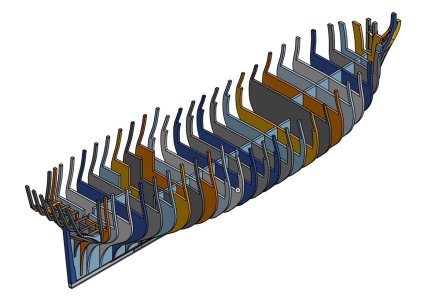
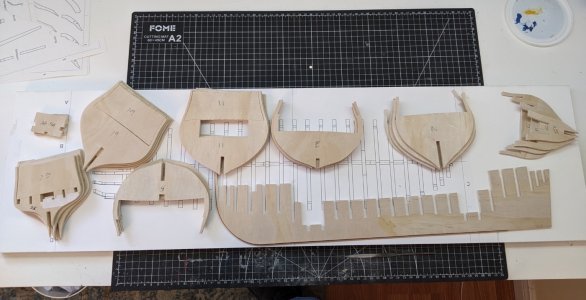
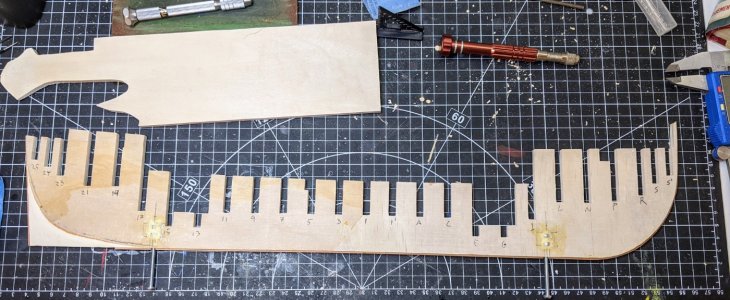
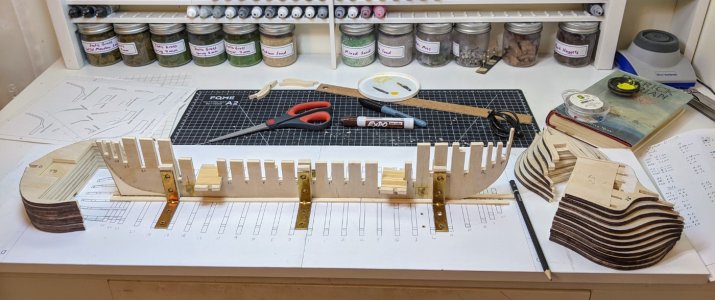
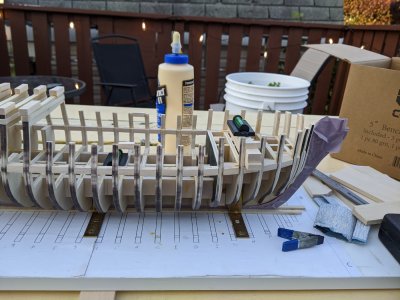
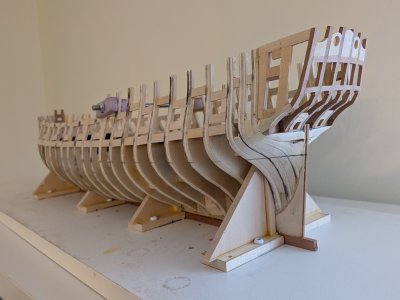
The construction method for the model is broadly based on the Winchelsea instructions published by the Syren Ship Model Company. A build board was constructed and the bulkheads cut out of plywood. Hex nuts were glued in the centre bulkhead to allow the ship to be secured to a base.

PXL_20250323_174603707_Original.jpeg

PXL_20250406_001717838_Original.jpeg

PXL_20250406_215421222_Original.jpeg

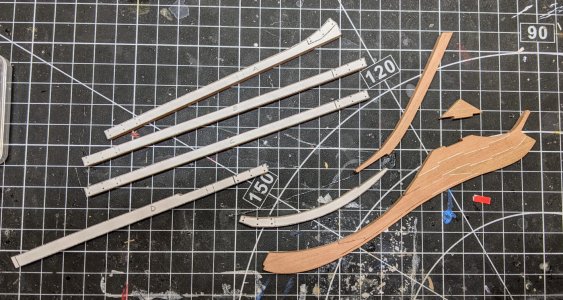
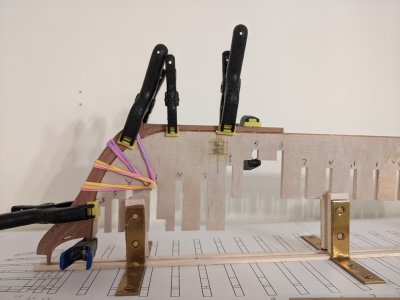
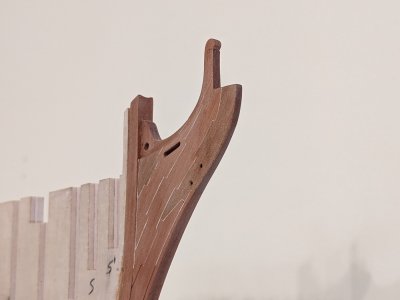
The Stem, knee of the head and keel were cut from pear wood and attached to the centre bulkhead.

PXL_20250418_230659114_Original.jpeg

PXL_20250506_231048032_Original.jpeg

PXL_20250511_223930353_Original.jpeg

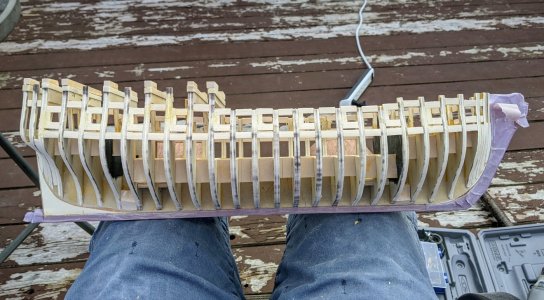
The bulkheads were glued in place.

PXL_20250520_014018752_Original.jpeg

PXL_20250605_235346341_Original.jpeg
 
I love that you are building POB but including the correct keel, head, and post assemblies, including the taper at the knee of the head. I am sure that there are those that will disagree but to me this shows that a fantastic and accurate model can be built POB as well as POF.
Allan
 
I love that you are building POB but including the correct keel, head, and post assemblies, including the taper at the knee of the head. I am sure that there are those that will disagree but to me this shows that a fantastic and accurate model can be built POB as well as POF.
Allan
Thanks Allan, the idea is to make everything you can ultimately see as accurate as possible (with a few small cheats that will be pretty much impossible to notice).

Also lots of unknowns with Perseus so I will be making a few decisions on an “artistic basis”, a model is a piece of art after all so it is important to understand the composition of what you are making.
 
Log #2 - Framing & Faring

Continuing my brief summary of the work predating the MSW crash…

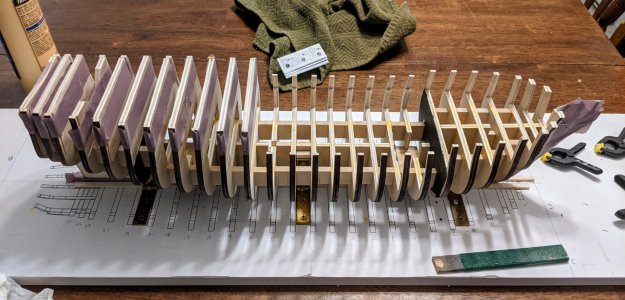
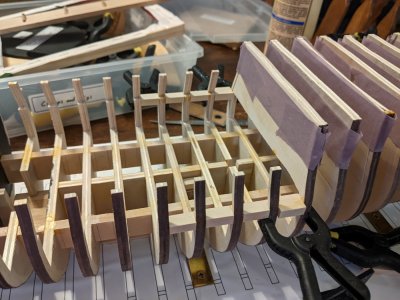
With the bulkheads secured in place it was time to add some additional structural support on the outside along the the line of the upper deck. I also added filer pieces to the bow and the stern. The model was then given a preliminary faring. I continued to fare the model as I went after this point but will likely not comment on it as it reflects small adjustments I was making all the time.
PXL_20250608_231935237_Original.jpeg
PXL_20250706_192335104_Original.jpeg

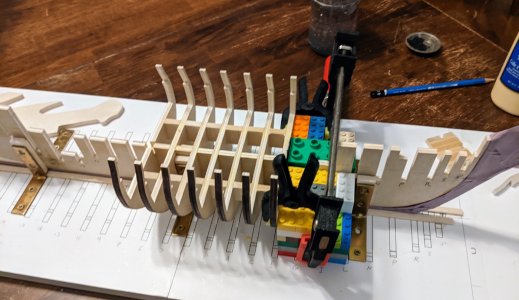
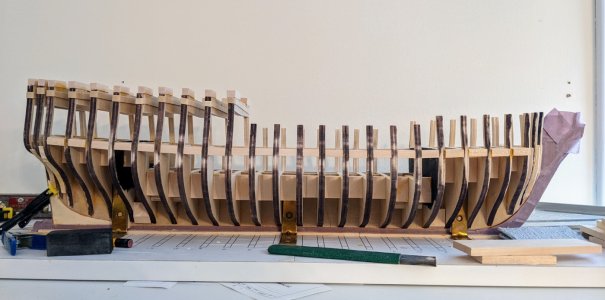
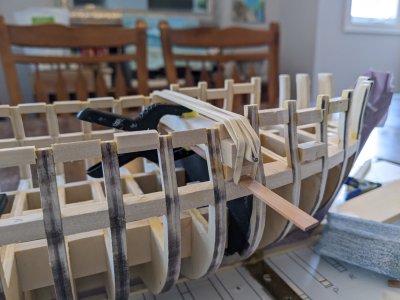
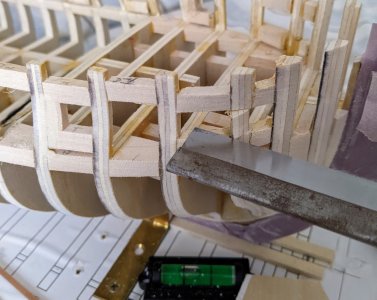
Then it was time to frame the gunports. The run of the ports was measured and checked with a batten and a spacer was used to frame the upper sill. Then another space was held against the upper sill with elastic bands and the lower sill was glued in place. Finally the sides of the ports were added. I had designed the bulkheads so that one side of each port was always agains a bulkhead so I only need to add the side once for each port.
PXL_20250710_222214131_Original.jpeg
PXL_20250714_153816855_Original.jpeg
PXL_20250729_200005706_Original.jpeg

The forward ports could not however be done in this manner and so I needed to cut one of the bulkheads to allow space for them. These ports are on the cant frames and so need to be at an angle. Note: This is also technically true of the sternmost pots, but the angle is not very large so that it will not really be noticeable and so in the interest of simplicity I cheated a little.
PXL_20250730_113340653_Original.jpeg
PXL_20250913_122229811_Original.jpeg
 
I admire the way you make port openings. With template rectangular bar and level.
Thanks YT. I will say that this version of the log is skipping over many of the frustrations and problems I ran into. So the process is not nearly as smooth as I depict it here.
 
Log #3 - The Stern Framing

In order to compress these summary log entries down to a manageable size, I am grouping things together by theme and so not all of this is in chronological order. I am also skipping over much of the mistakes, false starts and corrections that I had to make along the way.

So in this log entry I am going to talk about the stern framing. This began with adding the stern frames which were made of pear to give them strength and also to give me the option of not painting the frames around the lights if I chose.
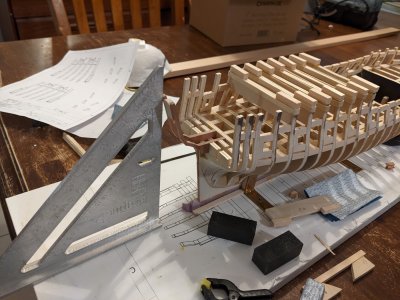
PXL_20250817_002946442_Original.jpeg

Space pieces were added between them to mark the location of the upper transom. These will ultimately be completely covered and so were made out of basswood.
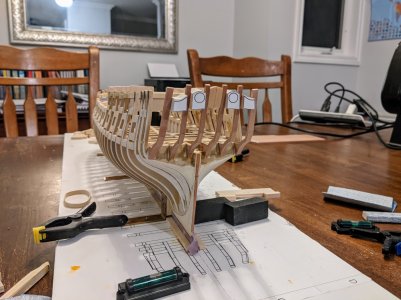
PXL_20250821_235929091_Original.jpeg

The outer frames have a curve at the lower counter. To since none of this will be seen, I simulated this in a similar manner to the Winchelsea practicum by adding a filler piece on the outside which I then sanded down to size.
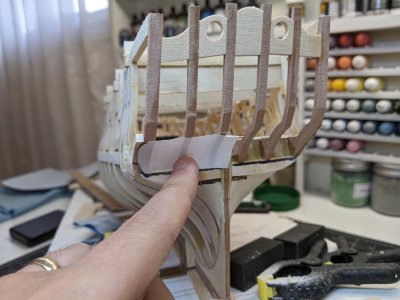
PXL_20250906_120030054_Original.jpeg

There was little to know primary records I could find on the size of the stern ports, so I just estimated their size based on models and the marshall painting. You can see them in the below picture before being sanded back to the line of the lower counter.
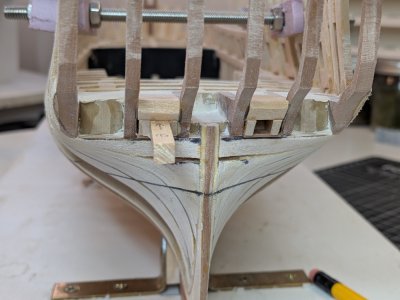
PXL_20260223_130043102_Original.jpeg

The quarter gallery doors gave me a bit of trouble as the various plans were not in agreement as to their size. I had to go with a reasonable compromise in the end which I think will best reconcile the differences. The spacing was accomplished using a spacer block much as I did for the gun ports.
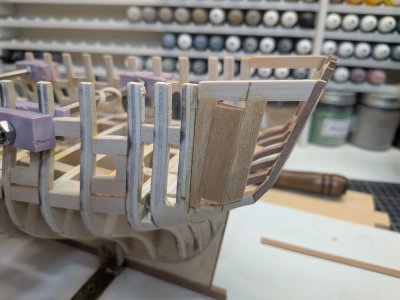
PXL_20260308_190221345_Original.jpeg

The sills for the lights gave me a bit of trouble as getting a good bond with end grain and positioning them in the exact right place and angle was tricky. In the end I settled for getting the piece glued in place and then adding small reinforcing support pieces below them. Again since this area will be fully covered by the planking, the key is to make it structurally sound, not to look pretty.
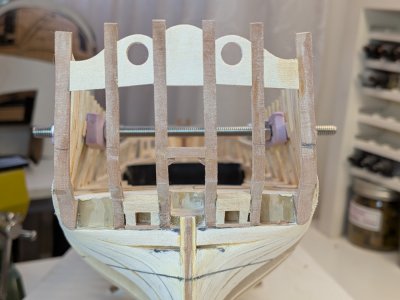
PXL_20260228_192804895_Original.jpeg

The upper sills were put in place using spacers I cut. Note that from this angle it appears that they are not lined up correctly. The reason for this is that the problem is actually with the original transom spacers. To make the upper sills more secure I filled in the space between them and the upper transom spacers and the uneven nature of the upper spacers means that some of the upper sills are thicker than others.
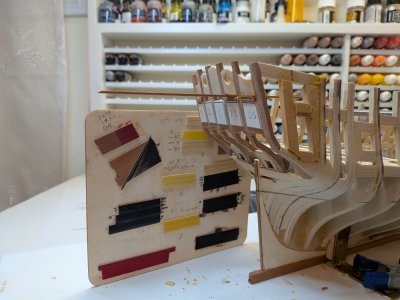
PXL_20260321_005338933_Original.jpeg

And here you can see the stern with the framing complete.
PXL_20260328_190246492_Original.jpeg

It will probably take two more posts to bring us up to the present date. Once we get caught up, I am planning on doing a post on a survey gun port and gun port lid related mentions in primary sources I have been conducting over the past few weeks along with the modelling implications.

 
Just a minor update. I got a revised version of the monograph on Perseus done and I posted it here. This contains all of the research I previously discussed in my build log before the crash along with numerous transcriptions and documentation of primary sources. Anyone building a sphinx class ship will find much of the research contained within useful especially if they plan on depicting them them based on their appearance some time after launch.

Some of the things I cover include:

  • A review of every plan available for every sphinx class ship along with transcriptions of all text on the plans.
  • A review of every possible artistic depiction of the sphinx class
  • A detailed history of Perseus
  • Research on specific structural components such as the knee of the head
  • Research on carronades specifically when and how many were on the sphinx class
  • Detailed Appendixes containing numerous transcriptions of primary sources including
    • Captains Logs
    • Admiralty Orders
    • Ordnance Records
    • The Contract for Perseus
    • French privateer accounts
    • Steel's rigging tables
    • And more...
My goal with this document has been to link every conclusion back to primary sources. Though in many cases I think my conclusions are not definitive, I hope they at least are supported by the evidence. I am always up for a good research discussion so if you have any questions, disagreements, or additional information to add please reach out.
 
Back
Top