• Win a Free Custom Engraved Brass Coin!!!
    As a way to introduce our brass coins to the community, we will raffle off a free coin during the month of August. Follow link ABOVE for instructions for entering.

Pichler Hand Drill Set

For 50 years I have used a Dremal drill for most of my drilling needs. I also have a half dozen pin drills but find all rather unwieldy to use, especially in tight places. Last month I did an internet search for a small battery powered drill and purchased an ARROWMAX drill. This drill is powered by an rechargeable battery and comes with 9 drill sizes from 0.2mm to 2.0 mm, all packaged in a very compact and nice plastic case. The drill is about 100 mm long and10 mm square (won't roll off your bench). Its shape and satin stainless steel construction make it very easy to control. It has five speeds (500, 600, 700, 800,and 900 rpm). All drills feature the same size shank making bit changing a breeze and, in addition, each drill is marked in size on the shank (in millimeters). The drill even has a reversing mode and LED lights on it tip! Addition drill bits are available, as are many other attachments such as grinding and polishing. I love this new tool and it has already solved a number of previously difficult tasks with ease. Only negative is that it is fairly expensive. Bottom line -- best new tool I have bought in years!
I bought the Arrowmax too. Unfortunately, after about a year's usage, the chuck has a good amount of wobble. I can physically move the chuck by hand. It's no longer useable. Hope you get better use. (there are a lot of posting on the internet about this problem)
 
For 50 years I have used a Dremal drill for most of my drilling needs. I also have a half dozen pin drills but find all rather unwieldy to use, especially in tight places. Last month I did an internet search for a small battery powered drill and purchased an ARROWMAX drill. This drill is powered by an rechargeable battery and comes with 9 drill sizes from 0.2mm to 2.0 mm, all packaged in a very compact and nice plastic case. The drill is about 100 mm long and10 mm square (won't roll off your bench). Its shape and satin stainless steel construction make it very easy to control. It has five speeds (500, 600, 700, 800,and 900 rpm). All drills feature the same size shank making bit changing a breeze and, in addition, each drill is marked in size on the shank (in millimeters). The drill even has a reversing mode and LED lights on it tip! Addition drill bits are available, as are many other attachments such as grinding and polishing. I love this new tool and it has already solved a number of previously difficult tasks with ease. Only negative is that it is fairly expensive. Bottom line -- best new tool I have bought in years!
For small to tiny drilling like the holes in a block I got an electric screw driver and tiny chuck for small bits. Works great at slow or high speed and is very controllable.
 
While we are talking about an Arromax brand, here are my thoughts: For some reason, the rotary tool I received (a long time ago) is not good quality and wobbles. It does a dirty job drilling the holes. But let's not talk about my tool, I might be one of the luckiest. :cool: Let's talk about this device in general. Again, this is only my observations, others may have a different one.

Pros:
Stylish and handsome. Small and ergonomic, comes in the plastic carrying case alone with set 'A' drillbits held by magnets. Some models come with an LCD display (extra cost) that shows the drill rotation and selected speed. USB C charging outlet. Optionally, you can purchase set 'B' to have the entire drillbits set range from 0.5mm to 2.3mm with 0.1mm increments (storing both sets A and B in the same case).

Cons:
The major disadvantage is the proprietary collet of 2.35mm. This means the only drillbits you will use are based on 2.35mm shanks. You can remove the collet, but no other collets will fit! I hear you saying that it is a standard shank and you can find many varieties of drill bits. This is true, but if you search for quality drill bits replacement, it is not easy to find.
Operation is cumbersome. There are two buttons: an ON/OFF switch, also a speed selector, and the second button operates on the rotary tool: You press it once, and it will start rotating the drillbit forward. You press it again, and ... you would guess it will stop the tool, then guess it again; it will rotate reverse, and only if you depress it the third time it will stop. This is so weird and inconvenient, IMHO, specifically if you require a sudden stop only.
Also, with a top speed (of 4) is kinda slow for most of our needs and most importantly doesn't have torque.

Bottom line: A very stylish device and will feel great in your hands, but it is hard to call it a tool. BTW, it is an expensive toy.

 
While we are talking about an Arromax brand, here are my thoughts: For some reason, the rotary tool I received (a long time ago) is not good quality and wobbles. It does a dirty job drilling the holes. But let's not talk about my tool, I might be one of the luckiest. :cool: Let's talk about this device in general. Again, this is only my observations, others may have a different one.

Pros:
Stylish and handsome. Small and ergonomic, comes in the plastic carrying case alone with set 'A' drillbits held by magnets. Some models come with an LCD display (extra cost) that shows the drill rotation and selected speed. USB C charging outlet. Optionally, you can purchase set 'B' to have the entire drillbits set range from 0.5mm to 2.3mm with 0.1mm increments (storing both sets A and B in the same case).

Cons:
The major disadvantage is the proprietary collet of 2.35mm. This means the only drillbits you will use are based on 2.35mm shanks. You can remove the collet, but no other collets will fit! I hear you saying that it is a standard shank and you can find many varieties of drill bits. This is true, but if you search for quality drill bits replacement, it is not easy to find.
Operation is cumbersome. There are two buttons: an ON/OFF switch, also a speed selector, and the second button operates on the rotary tool: You press it once, and it will start rotating the drillbit forward. You press it again, and ... you would guess it will stop the tool, then guess it again; it will rotate reverse, and only if you depress it the third time it will stop. This is so weird and inconvenient, IMHO, specifically if you require a sudden stop only.
Also, with a top speed (of 4) is kinda slow for most of our needs and most importantly doesn't have torque.

Bottom line: A very stylish device and will feel great in your hands, but it is hard to call it a tool. BTW, it is an expensive toy.

What you say is true, but I have found that as structures are added to the model, it becomes impossible (almost) to use the Dremel.due to its size (you forget to add a bulkhead eyebolt, for instance). As to the speed, 900 rpm or less, is fine for me and is far far faster than I can turn my fingers using a pin vise. Torque, although low, seems adequate for wood or soft brass. Drills are not going to be a problem because I wont be using it too often and the selection (0.6 to 2.2) seems where most of my needs lie. I am not worried about the 2.35 collet on the machine because I only intend to use their bits which are also available at Amazon. If I were to make any change at all to the drill, it would be to roughen the exterior a little bit as it can become slippery. Finally, I made the purchase on Amazon and believe I paid less than $60 plus tax. Bottom line, it is a specialty tool for me and I certainly will depend mainly on my Dremel for, probably, 99% of my drilling, grinding, sanding and polishing needs.
 
That electric screwdriver idea is a good one, particularly for wood. The famous Dremel tools turn way too fast.

Roger
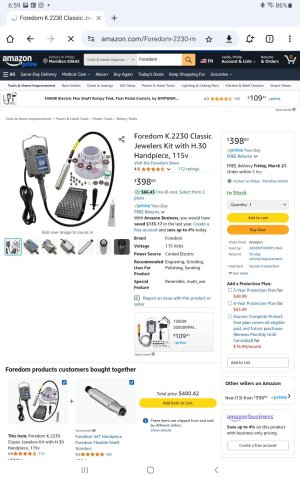
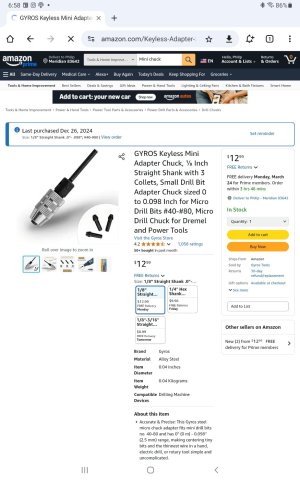
They make Dremels with speed controls you know? The Dremel chuck can easily be extended with an additional chuck installed. That'll give easier accees where using the Dremel itself up close can be too big to fit smaller opening. My answer to all that is a Foredom.Screenshot_20250319-185913_Chrome.jpgScreenshot_20250319-185829_Chrome.jpg
 
Last edited:
As I posted above almost all of my drilling is done with a drill press. I have a rotary tool but seldom use it.

Roger
 
They make Dremels with speed controls you know? The Dremel chuck can easily be extended with an additional chuck installed. That'll give easier accees where using the Dremel itself up close can be too big to fit smaller opening. My answer to all that is a Foredom.

I strongly agree! Dremel mototools are okay for things like polishing and wire-brushing small metal bits or cutting metal with ceramic cutting wheels, but they aren't really suitable for much of what people try to use them for. (Don't ask me how I know this! :rolleyes:) The Foredom flex-shaft tool does what most people think a Dremel is for and does it properly and much more accurately.
Everybody knows a Dremel isn't very ergonomic for doing detail work and it runs too fast for close work. The Dremel's problem is this: it depends upon speed to get the work done, not torque. If one runs a Dremel at slow speed with a speed controller, they quickly find that it loses power. The Foredom flex-shaft machine, which also happens to be head and shoulders above anything Dremel makes in quality of materials and fit and finish, provides sufficient torque to get the job done at slow speeds, affording the user much better control. Similarly, a belt-driven dental engine will do the same. If you have trouble understanding this, just imagine your dentist trying to drill your tooth with a Dremel mototool! :D
 
Last edited:
Those adapters are a waste of money. The chuck jaws should be self-centering, but they are not. The centering mechanism is controlled by individual springs and will not guarantee a center. This will wobble the drillbit and defeat the entire purpose of micro-drilling. The hole, let's say 0.5mm, becomes 0.6mm. Any adapter will also add to the wobble (as the extension).

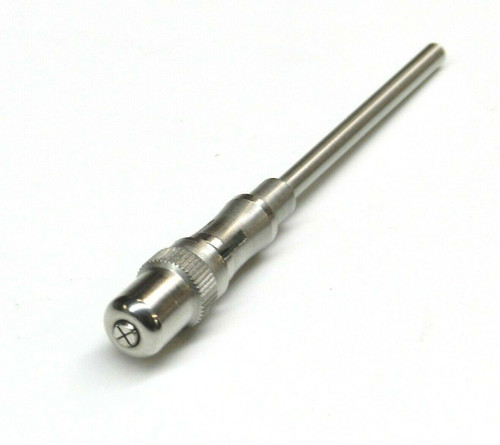
If you require to use micro drills (0.2 -0.4mm) then I would recommend this mandrel-adapter. It is also not ideal, but there are no jaws, it works as a collet chuck. You can find them with a standard 2.35mm shank or 3.00mm.

View attachment 508003 View attachment 508004
View attachment 508005


Here is another variation of this

View attachment 508006

I agree! I pictured the less expensive wire drill chucks because 1) I figured some people would be put off by the high prices of the very accurate ones made for horologists and, 2) I couldn't find the ones you've pictured above. Like any fine machine tooling, high-tolerance accuracy costs money and you get what you pay for. Thanks for the link. Those ones you've shown look quite suitable.

I note that the JETS Mini Mandrel Chuck Adapter Rotary Tool Handpiece Flexshaft Accessory Holder you've linked above has a 3/32" shaft which is exactly what is required for a standard dental engine handpiece. Most are 1/8" and may need some turning down to fit in some dental handpieces.
 
Last edited:
That electric screwdriver idea is a good one, particularly for wood. The famous Dremel tools turn way too fast.

Roger
You are so right Roger. I started using an electric screw driver when I was building the Revell plastic clipper ships. All the blocks had to be drilled and also holes through some of the spars and masts. The drill bit always walked off the piece until I got the driver. Wouldn't be without it now.
 
If you have trouble understanding this, just imagine your dentist trying to drill your tooth with a Dremel mototool! :D
Frankly, it is not the brand name; it is a tool. Dentists use high-speed rotary tools, also known as high-speed handpieces, for efficient and precise tooth preparation and restoration procedures. These tools offer faster cutting, reduced vibration, and minimized heat generation, ultimately improving patient comfort and treatment outcomes. The key to success is the high speed and reduced vibration as the outcome. Depending on their mechanisms, handpieces are classified as air turbine or electric (including speed-increasing). Depending on their mechanisms, rotary tools are classified as air turbine or electric (including speed-increasing). Air turbine dental handpieces can reach speeds of up to 400,000 rotations per minute (RPM), but the actual cutting speed during procedures is typically lower, around 200,000 to 350,000 RPM. Can any hobby rotary toll deliver such speed? Do our hobbies require such speed? That's the question.
 
Frankly, it is not the brand name; it is a tool. Dentists use high-speed rotary tools, also known as high-speed handpieces, for efficient and precise tooth preparation and restoration procedures. These tools offer faster cutting, reduced vibration, and minimized heat generation, ultimately improving patient comfort and treatment outcomes. The key to success is the high speed and reduced vibration as the outcome. Depending on their mechanisms, handpieces are classified as air turbine or electric (including speed-increasing). Depending on their mechanisms, rotary tools are classified as air turbine or electric (including speed-increasing). Air turbine dental handpieces can reach speeds of up to 400,000 rotations per minute (RPM), but the actual cutting speed during procedures is typically lower, around 200,000 to 350,000 RPM. Can any hobby rotary toll deliver such speed? Do our hobbies require such speed? That's the question.

This is quite true. Dentistry is presently transitioning to what might be called "ultra-high-speed rotary dental tools, generally water-cooled burrs in thin and lightweight handpieces powered by air turbine or "micro-motor" technology. These new handpieces give the user much greater control of the cut than the heavy old Dremel tool. There is a world of difference between a Dremel Mototool and an old-fashioned belt-driven dental engine and handpiece, and an additional improvement between the old belt-driven handpiece and the lightweight ergonomically designed state-of-the-art handpieces we're seeing now. I would be interested in seeing whether the new high-speed handpieces are better for modeling than the old belt-driven handpieces. There are also new burrs that have become current for dental work. These, I'm told, are diamond abrasive coated burrs. They are designed to be relatively disposable after a single use, as the diamond abrasive wears down very quickly.
 
Sorry, but I don’t understand all of the angst about drilling. Supposedly 90+ percent of ship modelers build kits, and I suspect that the vast majority are building European POB or Model Shipways kits. These kits feature very soft woods; basswood, European lime, etc. These woods are easily drilled with simple hand drills.

The remaining 10 percent of us building from scratch have better equipped workshops and have figured out a system that meets our needs. Scratch building covers such a wide range that no one solution works for everyone.

Roger
 
Sorry, but I don’t understand all of the angst about drilling.

I'm afraid we're showing our age. I don't get it, either, although if anybody tries to put a #78 bit in a Dremel Mototool and has problems with bits breaking... I think the problem stems from the demise of high school wood shop. Cautious
 
Fellas, this thread was started by a gentleman looking to share his experiences with an inferior product. It's true that folks took the conversation in a direction of their own choosing (present company included) - but let's not frown on the sincerity of the author or its value to the contributors. I too once agonized over something so simple as drilling a hole.
 
Last edited:
My grandson bought me a Ryobi cordless screwdriver and I love it for general drilling, with its low speed and high torque. I have a range of collet chucks which I also use with my Dremels.

For fine drilling (say on the model itself) I use a moderately priced nail drill or a pin vice. I always punch or prick the material first to prevent bit drift.
 
Fellas, this thread was started by a gentleman looking to share his experiences with an inferior product. It's true that folks took the conversation in a direction of their own choosing (present company included) - but let's not frown on the sincerity of the author or its value to the contributors. I too once agonized over something so simple as drilling a hole.

"Thread drift" can be a problem, but I think there's value in providing some latitude in that direction because that's how we share information and learn. If everyone limited their responses to the often-narrow parameters of an original post, oftentimes the answer could be given in a single sentence without further elaboration, nuance, or detail.

I think it is relevant to note the deterioration of basic manual arts skills in our society and to consider whether this is something to be corrected or ignored. In the context of ship modeling, it's quite obvious. The old "yellow box" Model Shipways kits provided a set of plans and perhaps a page or two of "instructions." They assumed the kit builder had a command of basic woodworking and painting skills and whatever else was necessary to construct their model. Building those "yellow box" kits was virtually indistinguishable from what is not considered "scratch building," a level of competence so many inaccurately believe is beyond their ability or comprehension. Now, even with the greatly expanded instructions in many kits, there is still a lot of skill that even a kit builder needs to bring to the table if they want to do a good job. I note that there is widespread ignorance of basic tools and their uses and of materials and their properties. This often greatly limits the builder's options for solving the challenges that come along. "Back in the day" (nostalgia being "not what it used to be,") every boy acquired a pocketknife by age seven or eight, learned how to keep it sharp, and carried it to school in his pocket every day. Today, a kid who brought a pocketknife to school would occasion police intervention! It's not about "frowning on sincerity of the author" at all. It's about "how do we convey these basic life skills to the present generation?" Our technology has advanced well past the point where my father's maxim that "If you can't fix it, you have no business owing it." can apply, but I think there's still value in teaching kids the basics so they won't see "doing the common thing uncommonly well" as an impossibility.
 
Kits are so expensive nowadays that it’s understandable that someone doesn’t want to waste $$$$ making a mistake. On the models that I build making, scrapping, and remaking something several times is no big deal as only a few cents of material is involved, and I learn from my mistakes.

Roger
 
Now, after about 3 months of use, I can say that I am completely satisfied with the ARROWMAX mini drill (about $50 on Amazon). I am using it almost exclusively now that I am at the rigging stage of the Ontario (opening up block holes, pegging spars to masts, etc). I have broken the smallest drill bit that I have not yet replaced, but the ARROWMAX had proved indispensable to me. My Dremel and drill press are not to be forgotten, but the pencil sized ARROWMAX is far better for many of the jobs that I run across.
 
Now, after about 3 months of use, I can say that I am completely satisfied with the ARROWMAX mini drill (about $50 on Amazon). I am using it almost exclusively now that I am at the rigging stage of the Ontario (opening up block holes, pegging spars to masts, etc). I have broken the smallest drill bit that I have not yet replaced, but the ARROWMAX had proved indispensable to me. My Dremel and drill press are not to be forgotten, but the pencil sized ARROWMAX is far better for many of the jobs that I run across.
I have both versions of this, the multispeed one is better as the one speed is a bit too slow.
 
Back
Top