

• Win a Free Custom Engraved Brass Coin!!!
    As a way to introduce our brass coins to the community, we will raffle off a free coin during the month of August. Follow link ABOVE for instructions for entering.
  • PRE-ORDER SHIPS IN SCALE TODAY!

    The beloved Ships in Scale Magazine is back and charting a new course for 2026!
    Discover new skills, new techniques, and new inspirations in every issue.

    NOTE THAT OUR FIRST ISSUE WILL BE JAN/FEB 2026

Practice makes perfect

Joined
Aug 26, 2020
Messages
520
Points
308

Location
UK Dorset
This may be a statement of the obvious but I shall post it anyway.
If a task is to be performed on both sides of a model then be consistent with which side is done first. If, say, ten gun port lids are added to the first side then the experience gained should mean that those on the second side are neater and more uniformly angled. Ditto planking, dead eyes, ratlines etc. Exceptions are items on the inner side of the bulwarks such as pin rails. If the completed model is displayed on a shelf with the first side placed towards the wall then the learning glitches are not too visible. To retain the ancient significance of port and starboard, side one (against the wall) should be the port side.
 
I have a slightly different opinion and approach, but not about your statement. In my modeling life, I have established an approach, called acceptance level. This is where I have to agree with myself about the level of quality of my work before the work is accepted. My acceptance level standard is most likely less critical than the standards of some of us, but I will not move forward and often re-do until I am happy and ready to accept the work. It's just me...

However, I do agree: Practice makes perfect! My next model should be better, I think ;)
 
This may be a statement of the obvious but I shall post it anyway.
If a task is to be performed on both sides of a model then be consistent with which side is done first. If, say, ten gun port lids are added to the first side then the experience gained should mean that those on the second side are neater and more uniformly angled. Ditto planking, dead eyes, ratlines etc. Exceptions are items on the inner side of the bulwarks such as pin rails. If the completed model is displayed on a shelf with the first side placed towards the wall then the learning glitches are not too visible. To retain the ancient significance of port and starboard, side one (against the wall) should be the port side.

Having never done a wooden ship build before this has been a critical strategy for me. Most of my mistakes have been on the port side, but then I sometimes find I make a mess of the starboard piece or section as well and have to keep re-doing it (as Jim says) until I am satisfied I can sit and look at it its case without cringing.
 
I love this topic SJB. On my Vasa I definitely had a side that I wanted to display. The other side wasn't bad, but as the build progressed, I became increasingly aware that one of the sides was going to face the people and the other side was going to face the wall. I was not aware that the public side is traditionally the starboard side - my 'presented' side is the port side.

Right now I am building a model that will have both sides visible - the pressure is ON!
 
I love this topic SJB. On my Vasa I definitely had a side that I wanted to display. The other side wasn't bad, but as the build progressed, I became increasingly aware that one of the sides was going to face the people and the other side was going to face the wall. I was not aware that the public side is traditionally the starboard side - my 'presented' side is the port side.

Right now I am building a model that will have both sides visible - the pressure is ON!
I have a whole wall of armored fighting vehicles built over decades all displayed facing left (meaning left side is visible). When I started building ships, I just naturally envisioned them displayed in the same manner. Maybe I have to re-think that.
 
In almost all construction descriptions I've read, it usually says that you should put one or two planks on one side and then the same on the other side when planking the hull.
Otherwise, it can warp.
But maybe it's a myth?
For my own part, I'm happy if what I build looks decent from a normal viewing distance. :)
It would be good to have some kind of filter on the mobile camera that does not so mercilessly reveal the smallest mistake.


These days, good enough is my motto. I'm past the age where things I build get better, now I get to accept that and sit back and just enjoy building for fun.
 
In almost all construction descriptions I've read, it usually says that you should put one or two planks on one side and then the same on the other side when planking the hull.
Otherwise, it can warp.
But maybe it's a myth?
I had the same thought myself, but after reading the original post a couple of times, I don't think that was actually what he was getting at. I don't think he meant plank one whole side first, then the other side. Rather, for each successive step of the build, one should start on the same side as you did the previous step. That way, your beginner's mistakes are all on the same side and all of your "good work" is on the other side so that you have one side fit for display and your "practice side" facing the wall.
 
Well, maybe I misunderstood, but I've actually given some thought to whether planking one side first means a big risk of the hull being warped.
If you want to plank one side first, it should work if you fill in between the frames with, for example, balsa?
 
I think you are probably correct. However, alternating sides as you plank might allow you to keep the appearance of planks symmetrical on both sides when viewed from the bow or stern. This would be important if you don’t plan to paint the hull.
 
This may be a statement of the obvious but I shall post it anyway.
If a task is to be performed on both sides of a model then be consistent with which side is done first. If, say, ten gun port lids are added to the first side then the experience gained should mean that those on the second side are neater and more uniformly angled. Ditto planking, dead eyes, ratlines etc. Exceptions are items on the inner side of the bulwarks such as pin rails. If the completed model is displayed on a shelf with the first side placed towards the wall then the learning glitches are not too visible. To retain the ancient significance of port and starboard, side one (against the wall) should be the port side.
SJB have you been reading my mind or watching my build with a hidden camera. I was not aware of any customs, but as my build progressed and I botched the copper plates on the port side, I have definitely worked with the mindset you elegantly describe.
Practice on port, stay on starboard.
Scary how we all have similar thinking without coordinated intentions.
 
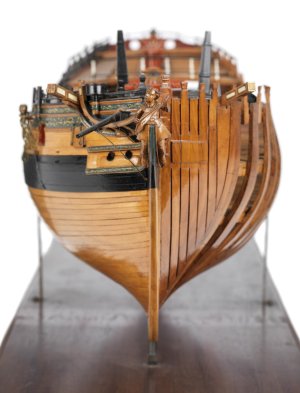
I planked one side of a fully framed model of Euryalus over 10 years ago. It went through crating and shipment to Switzerland from the US and no warpage has occurred up to now so I am confident it is static in shape. The photo below is a contemporary model with planking on one side only and it looks OK after a few hundred years. Note the beautifully tapered knee of the head.
Allan
1733406597869.jpeg
 
Last edited:
At the risk of teaching Granny to suck eggs:
Before the advent of the rudder, ships were manoeuvred with a steering oar or "steer board" mounted on the right hand quarter. to avoid compromising this, ships were docked with the other side against the harbour wall. Hence the obscure reference in my original post to displaying ships with the port side against the wall.
And yes, in referring to planking, I did mean sections not the entire side.
 
I have a whole wall of armored fighting vehicles built over decades all displayed facing left (meaning left side is visible). When I started building ships, I just naturally envisioned them displayed in the same manner. Maybe I have to re-think that.
Well which way the ship is displayed in your house will depend on how the winds blow there!

Your house your display!
 
Back before CAD, when naval architecture students learned how, or attempted to learn how to hand draw lines drawings and to trace them with ink on to vellum, the convention was that the bow of the ship always faced the right side of the drawing.

Roger
 
Can we please not start with politics? I’ve already all but left one modeling site because the focus shifted from information and fellowship to ideology and mockery. So far, Ships of Scale has steered clear of that reef.
 
All good! And you may be onto something there. I am left-handed so perhaps it's no coincidence I display everything on the left. ;)
 
Last edited:
Back
Top