Thx ever so much. Any chance you can repost it as a doc file or pdf somewhere so that I can put it into a translation site as I do not speak whatever language this is (Italian???)? Thx in advance....Dan
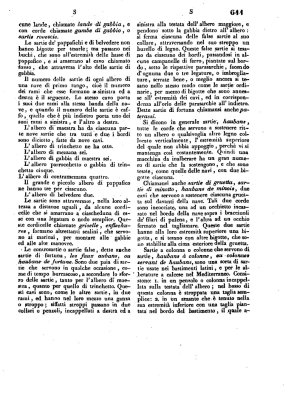
I cut and pasted the text into Google Translate and here’s the result:
...certain platforms, called *landle di gabbia* (top platforms), situated to port at the head of the mainmast; and by means of ropes called *gambe di gabbia* (topmast shrouds), they hang beneath the top behind the mast:
Backstays.
Each of the backstays is secured to its respective collar, passing a wooden toggle through its eye-splice. These backstays are set up from each of the ship's sides, passing through iron rings—called *campanelle*—fixed to the gunwale beneath their respective chain-plates; two or three tight lashings or seizings are applied to each, or—better still—they are set up in the same manner as the ordinary shrouds, by means of dead-eyes attached to the ends of the ropes, and positioned opposite the edge of the chain-plates toward the stern.
These emergency shrouds are also referred to as *paterazzi* (backstays).
In general, they are simply called shrouds (*sartie* or *haubans*). The shrouds for the topgallant masts (*pappafichi*) and royal masts (*belvedere*) do not utilize dead-eyes for setting up; instead, they pass through holes located at the lower ends of the respective topgallant shrouds, and are secured to a rope called a *tasso* (futtock stave), which runs across the upper section of the topmast shrouds.
The number of shrouds for each mast on a first-rate ship—that is, the number of individual ropes forming the rigging to port and to starboard—is as follows: A single rope forms two separate legs, both leading to the same side of the ship; however, when the total number of shrouds is odd, the aftmost shroud leads one of its legs to port and the other to starboard.
The mainmast carries... Shrouds are ropes used to support an upright mast—or any other timber placed vertically—at its upper extremity, where it lacks other support, ensuring it remains steady and constant in its position.
Thus, a sheer hulk (a vessel used for masting) requires a large number of shrouds for support; these are set up—much like those on ordinary ships—using deadeyes, with two deadeyes per shroud.
These ropes are also referred to as *sartie di gruetta* or *sartie di minotto* (or *haubans de minois*); they consist of two cables used to support a small crane (*gruetta*) located at the forward part of the ship. These two ropes are secured—one to a small eyelet embedded in the ship's hull above the figurehead knees, and the other to an eyelet fastened into the cutwater. At their upper extremities, these two shrouds are fitted with a deadeye and are tensioned using corresponding deadeyes at the lower end.
The mainmast has nine shrouds—eighteen ropes in total, formed from nine cables—distributed across both sides of the ship.
The foremast has eight.
The mizzenmast has six.
The main topmast has six.
The fore topmast (or fore-topgallant mast) has five.
The bonaventure mizzenmast has four.
The main and fore topgallant masts each have three shrouds.
The royal mast has two.
At equal intervals along their height, the shrouds are crossed by small ropes—called *griselle* (or *enflechures*)—which are secured to each shroud using a simple lashing or knot. These small ropes form a series of steps, enabling sailors to ascend to the tops and the upper rigging. ...secured at the outer tip of the crane.
• The *controsartie* or "false shrouds"—also known as
"column shrouds" or "columns," serving as emergency shrouds—are a type of shroud
used on lateen-rigged vessels, and for other
• mast configurations in the Mediterranean. They consist: 1. of a pendant or "column"
fitted over the masthead; at the lower end of
this column, a single block is stropped in place; 2. of a fall (*amante*) secured at its
lower extremity by a block
mounted on the vessel's gunwale, which...
...shrouds that serve on certain occasions—
such as during stormy weather—to assist in
countering the strain on the main shrouds,
for both the mainmast and the foremast.
These cables are—like the other shrouds—
divided into two legs, and feature an eye
spliced into their midsection; these eyes
pass through two collars or pendants
fitted over the masthead to starboard and to...