

- Joined
- Oct 22, 2018
- Messages
- 157
- Points
- 253

The Sharpies used for oyster fishing in New Haven evolved from the early dugout canoes and skiffs used for oyster fishing in the early 19th century.
The Sharpies originated on the Connecticut coast in Long Island Sound, driven by technological advancements in response to the changing needs of fishermen who had to travel farther to obtain oysters because nearby beds were becoming depleted, and for this they needed better sailboats.
The Sharpies, with their shallow draft, flat bottom, and centerboard, were agile and fast sailboats that could also be easily propelled by oars when not using their sails.
Economical and easy to handle, the larger Sharpies proved popular not only with Connecticut fishermen but also with those on the Chesapeake Bay and the South Atlantic coast. Their characteristics and performance soon attracted the interest of competitive boating and racing enthusiasts.
Racing Sharpies were built on the same slipways and construction lines as workboats and were, by common agreement, of roughly the same dimensions. They did have some minor differences: the hull was usually flatter, giving a deeper stern than workboats, and the beam was often wider amidships. The hulls were generally better finished, approaching the standards for marine paintwork.
The sails on racing Sharpies were much larger than those on any workboat. These boats could carry up to 12 crew members, many of whom served as human ballast, positioned on stabilizing boards as a counterweight to keep the boat upright, proving essential for adjusting the rigging and maintaining balance during turns and gusts.
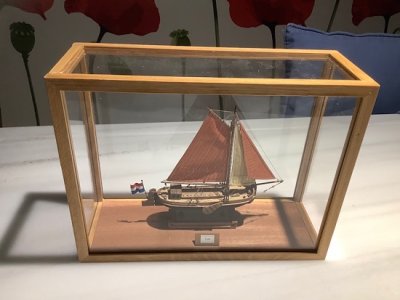
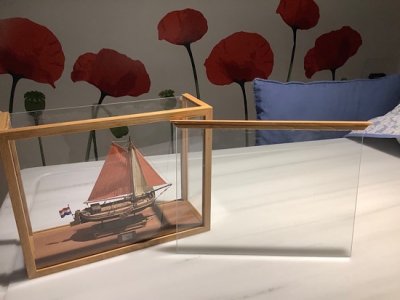
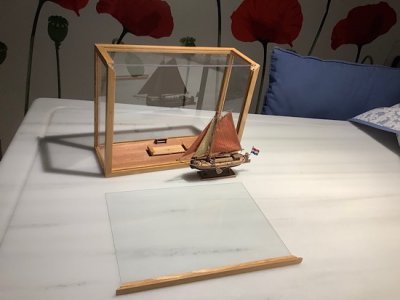
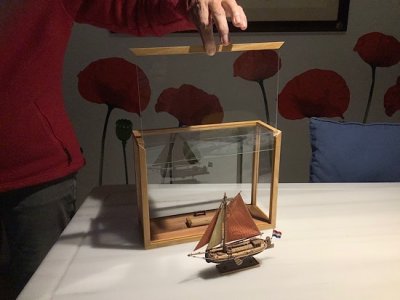
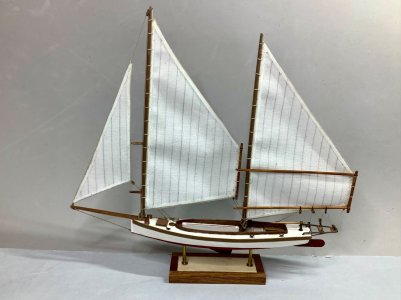
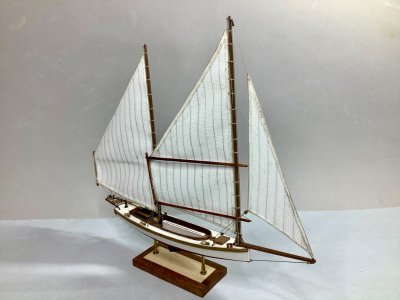
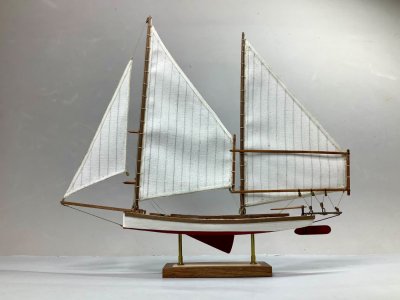
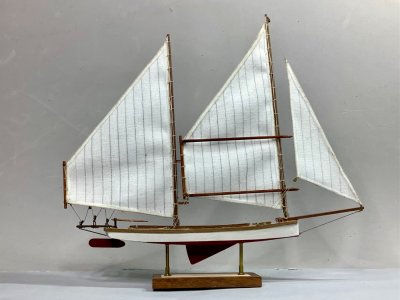
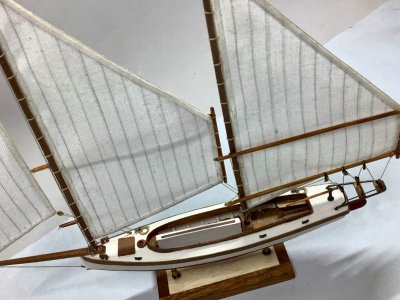
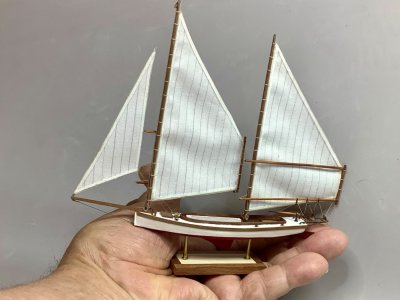
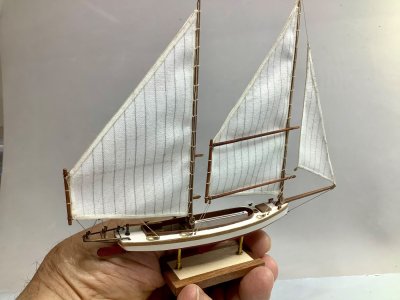
The model, based on a plan by Howard I. Chapelle, represents a racing Sharpie from the early 1880s and features a muzzle rig with double spars on its two masts.
At 36 feet in length, it is one of the earliest examples of the fastest racing Sharpies, which competed fiercely in regattas. In fact, full-throttle racing boats evolved from them, reaching speeds of around 20 knots, with performance close to that of today's multihull racing yachts. What is truly impressive is that all of this occurred long before the invention of fiberglass, epoxy, plywood, nylon, Dacron, and carbon fiber.
Model specifications:
• Length: 110 mm
• Overall length: 175 mm
• Beam: 25 mm
• Scale: 1:100
The Sharpies originated on the Connecticut coast in Long Island Sound, driven by technological advancements in response to the changing needs of fishermen who had to travel farther to obtain oysters because nearby beds were becoming depleted, and for this they needed better sailboats.
The Sharpies, with their shallow draft, flat bottom, and centerboard, were agile and fast sailboats that could also be easily propelled by oars when not using their sails.
Economical and easy to handle, the larger Sharpies proved popular not only with Connecticut fishermen but also with those on the Chesapeake Bay and the South Atlantic coast. Their characteristics and performance soon attracted the interest of competitive boating and racing enthusiasts.
Racing Sharpies were built on the same slipways and construction lines as workboats and were, by common agreement, of roughly the same dimensions. They did have some minor differences: the hull was usually flatter, giving a deeper stern than workboats, and the beam was often wider amidships. The hulls were generally better finished, approaching the standards for marine paintwork.
The sails on racing Sharpies were much larger than those on any workboat. These boats could carry up to 12 crew members, many of whom served as human ballast, positioned on stabilizing boards as a counterweight to keep the boat upright, proving essential for adjusting the rigging and maintaining balance during turns and gusts.
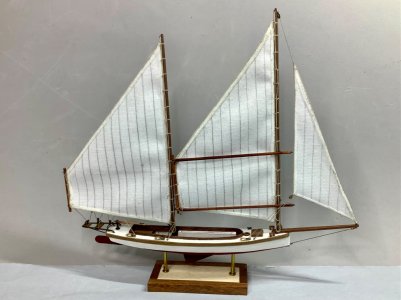
The model, based on a plan by Howard I. Chapelle, represents a racing Sharpie from the early 1880s and features a muzzle rig with double spars on its two masts.
At 36 feet in length, it is one of the earliest examples of the fastest racing Sharpies, which competed fiercely in regattas. In fact, full-throttle racing boats evolved from them, reaching speeds of around 20 knots, with performance close to that of today's multihull racing yachts. What is truly impressive is that all of this occurred long before the invention of fiberglass, epoxy, plywood, nylon, Dacron, and carbon fiber.
Model specifications:
• Length: 110 mm
• Overall length: 175 mm
• Beam: 25 mm
• Scale: 1:100