
-

SUBSCRIBE TO SHIPS IN SCALE TODAY!
The beloved Ships in Scale Magazine is back and charting a new course for 2026!
Discover new skills, new techniques, and new inspirations in every issue.
NOTE THAT OUR NEXT ISSUE WILL BE July/August 2026 -

Win a Free Custom Engraved Brass Coin!!!
As a way to introduce our brass coins to the community, we will raffle off a free coin during the month of August. Follow link ABOVE for instructions for entering.


You are using an out of date browser. It may not display this or other websites correctly.
You should upgrade or use an alternative browser.
You should upgrade or use an alternative browser.



The term Tar here is a bit confusing to most of us more familiar with the tar used in paving roads (coal tar). Tar used in ropes is NOT THAT. It is Stockholm tar, more generically Pine tar. It can be very dark, but also ranges from brown to a honey color hue. It is warmed and/or diluted with alcohol to be brushable, and is absorbed by the rope when applied (I'm not saying some doesn't stay on the surface). The brushed appearance on the rope lightens, and without multiple coats can weather to a gray-brown appearance. But again, this depends largely on the color of the actual in the first place, because that varies. The main standing rigging cables would receive multiple coats and/or a thicker coat, and are not subjected to wear, so would stay a darker color.I’m a little confused: I’ve read in several sources that ratlines and most running rigging weren’t tarred because crewmen would get their hands and feet full of tar and track it all over the deck and it would not come off their hands easily (I know that from experience lol). I would imagine that leaving rigging bare without tar or a concoction of fat and pitch etc would subject the lines to more rapid deterioration. I guess that most times it would depend on what was available and cost effective. What’s the real story?
Like a newly tarred road, climbing on freshly tarred ropes would remove some residue, but that surface portion quickly wears off and they are dry to the touch. The sailors would not be tracking tar everywhere. Sailors might be covered with pine tar just from their maintenance in constantly coating the ropes, but their feet weren't covered more than their hands.
Here is a video showing some varying colors of different pine tars when applied to rope. I think it's a bit deceiving, as instead of brushing the pine tars on the rope, they soak the rope in it, which applies a far thicker coat, but you still get the idea.
Hope this helps.
There is a reason that an English sailor was called a jack tar.Like a newly tarred road, climbing on freshly tarred ropes would remove some residue, but that surface portion quickly wears off and they are dry to the touch. The sailors would not be tracking tar everywhere. Sailors might be covered with pine tar just from their maintenance in constantly coating the ropes, but their feet weren't covered more than their hands.
Apparently several, from the tar used in their waterproof clothes, to the tar they used on their hair, and of course the tar on the rigging. I guess they were sticky with the stuff pretty much all over. Not the "day at sea" I'd like to have.There is a reason that an English sailor was called a jack tar.

- Joined
- May 3, 2026
- Messages
- 191
- Points
- 78

I find this youtube of Olha Batchvarov very explaining with clear instructions how to aply ratlines,
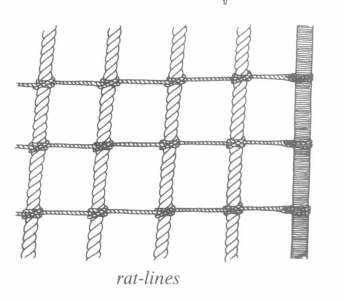
Nice video, but ratlines were not tied to the outer shrouds with a clove hitch.
They were seized with an eyesplice.
Modeling this could be as tedious as all the clove hitches put together, but it can be faked with an overhand knot and and carefully trimming away the end.
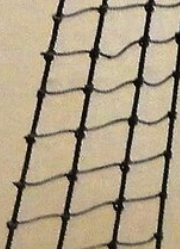
When done with a clove hitch you often see that little nib sticking out.
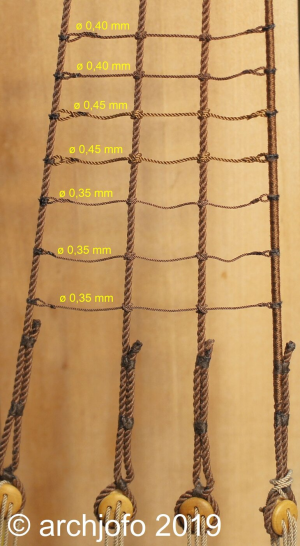
Here, we see it not faked by archjofo on LaCreole
coated ropes would also foul up blocks..I’m a little confused: I’ve read in several sources that ratlines and most running rigging weren’t tarred because crewmen would get their hands and feet full of tar and track it all over the deck and it would not come off their hands easily (I know that from experience lol). I would imagine that leaving rigging bare without tar or a concoction of fat and pitch etc would subject the lines to more rapid deterioration. I guess that most times it would depend on what was available and cost effective. What’s the real story?
Right, but 1) I'm not archjofo, and 2) even in his incredible work, the loop is more prominent than it should be, so a smallish knot at normal viewing distances is fine for me. Don't you wish some parts of your model could be made 5 times larger to work on, while others could be made 1/5 the size?View attachment 632289
Here, we see it not faked by archjofo on LaCreole
Right, and so they had to be constantly maintained. When an area near a pulley wore, they would reverse the rope, wearing a different area. They also could replace sections of ropes not running over blocks. And of course because they were not coated, they did rot, and needed replaced. There were hundreds of men on larger ships, and they were kept busy with constant maintenance.coated ropes would also foul up blocks..
- Joined
- May 3, 2026
- Messages
- 191
- Points
- 78
I wasn't really trying to say if we cant be perfect don't even bother.Right, but 1) I'm not archjofo, and 2) even in his incredible work, the loop is more prominent than it should be, so a smallish knot at normal viewing distances is fine for me. Don't you wish some parts of your model could be made 5 times larger to work on, while others could be made 1/5 the size?
I was just trying to say that somewhere between ..
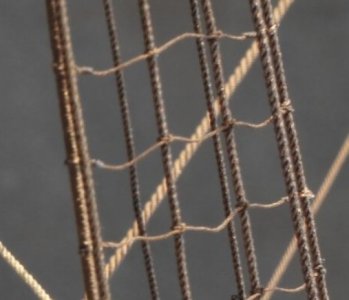
This..
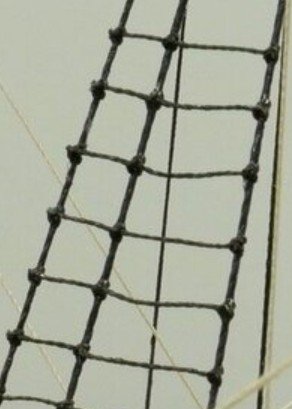
..and this.
We could do something we feel better about.

- Joined
- Apr 2, 2021
- Messages
- 733
- Points
- 198

I go with what I'm given with the model kit supplies. All models I build have their shortcomings. iI is what it is. I do ratlines with clove hitches and eyeball it the whole way. I'm happy with the result. I can see where thinner thread would present a more authentic view. BUT...the Ratlines and Shrouds are...
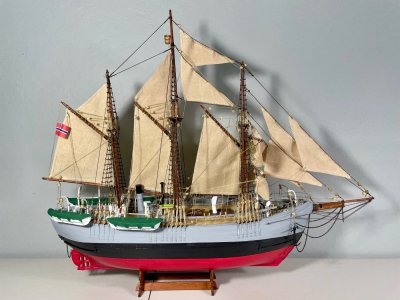


Those look very good.I wasn't really trying to say if we cant be perfect don't even bother.
I was just trying to say that somewhere between ..
View attachment 632338
This..
View attachment 632339
..and this.
We could do something we feel better about.
- Joined
- Jun 11, 2026
- Messages
- 67
- Points
- 78

Just to put a finer point on it, beginning in the late 1600's, pine tar was often cut with coal tar for reasons of economy and difficulty in sourcing pine tar. This practice caused much of the tar used to be unquestionably black in the first place. "Naval stores" such as pine tar were essential naval "war materials" which were not universally available. The Scandinavian nations had something of a lock on quality pine tar and good diplomatic relations with them was critical to European nations wishing to maintain effectively equipped naval forces. England broke the Scandinavian monopoly with the development of her American colonies, which, like Scandinavia, were rich in pine forests. North Carolina became the Admiralty's prime source of pine tar and turpentine, earning North Carolinians the nickname, "tar heels."
- Joined
- Jun 11, 2026
- Messages
- 67
- Points
- 78
coated ropes would also foul up blocks..
Is there some historical authority for this? I've got more than the average bear's experience with full-scale traditional sailing vessels, and I've never seen nor previously heard of blocks getting fouled with tar. Running rigging isn't heavily tarred in use like standing rigging is. Running rigging cordage is lightly tarred when it is made, not only for preservation, but also to hold the twist tighter when it's made, but this tar is thinned quite a bit so that the tar soaks into the line. (This is why rope made of naturally white hemp and sisal fibers looks "golden" when new.) Because the tar is so thinly applied and soaked into the rope, there's really no tar there to foul anything. Besides, even if there were tar on a sheave or axle, it would quickly abrade away in ordinary use and not interfere with the operation of a block at all.
from my experiance on a schooner, the lines were probably oiled in manufacture but certainly not tared.
- Joined
- Jun 29, 2024
- Messages
- 2,140
- Points
- 488

A somewhat related for POPEYE DA SAILOR ( or anyone else)
During my teenage years and into my twenties I owned sequentially two sailboats; a Sunfish and a Thistle. Both had white cotton sails and were rigged with white braided line for running rigging. The Sunfish had no standing rigging and the standing rigging on the Thistle was stranded wire cable.
I seem to remember that the running rigging line was cotton but have been unable to find any current reference that this was ever the case. AI claims that cotton fibers were too weak for this service. So what is the correct line to be used for rigging a model yacht of the era prior to widespread use of synthetic materials?
Roger
During my teenage years and into my twenties I owned sequentially two sailboats; a Sunfish and a Thistle. Both had white cotton sails and were rigged with white braided line for running rigging. The Sunfish had no standing rigging and the standing rigging on the Thistle was stranded wire cable.
I seem to remember that the running rigging line was cotton but have been unable to find any current reference that this was ever the case. AI claims that cotton fibers were too weak for this service. So what is the correct line to be used for rigging a model yacht of the era prior to widespread use of synthetic materials?
Roger
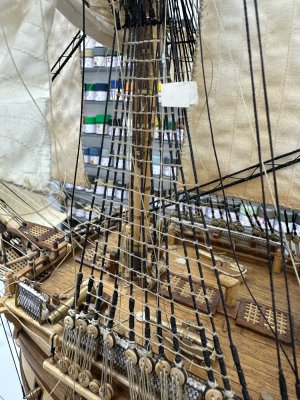


As a beginner myself I have watched a lot of youtubes on ratlines and am learning what is important is that you can be happy with what you put in and learn from your mistakes as I have plenty of them.

RE Top Down
If I apply ratlines top down then the loop of thread hangs out of the way and voids disturbing the previous ratline. The passes of the needle between and around the shrouds can be made where the shrouds a widely spaced then drawn upwards; this reduces the likelihood of catching two shrouds at once.
Expanding on my use of spacer clips described above I often use the following sequence.
position clip A
Tie a ratline below it
add clip B below and push the ratline up against the bottom of clip A to straighten and protect it.
Tie a ratline below clip B
push up with clip C
Squeeze clip B and carefully draw out clip A
Continue.
As an aside: a cow hitch on the end shrouds will leave the end of the ratline cord pointing inwards rather than outwards though it is a bit of a faff.
If I apply ratlines top down then the loop of thread hangs out of the way and voids disturbing the previous ratline. The passes of the needle between and around the shrouds can be made where the shrouds a widely spaced then drawn upwards; this reduces the likelihood of catching two shrouds at once.
Expanding on my use of spacer clips described above I often use the following sequence.
position clip A
Tie a ratline below it
add clip B below and push the ratline up against the bottom of clip A to straighten and protect it.
Tie a ratline below clip B
push up with clip C
Squeeze clip B and carefully draw out clip A
Continue.
As an aside: a cow hitch on the end shrouds will leave the end of the ratline cord pointing inwards rather than outwards though it is a bit of a faff.

- Joined
- Feb 15, 2019
- Messages
- 457
- Points
- 168

Hey all.
Ship: Harvey
Scale: 1:96
Ive been researching about my ratlines and stays as i work on them for the first time. I decided to go with the clove hitch method and really learned the benefit of the beeswax here. But as you can see im getting some variance in my knots and width which i assume will come in practice. The instructions for the harvey im using show using the rigging tool and just gluing them across and my question for that would be, is that more preferable for smaller scales and the clove hicht for larger scales?
Curious yalls opinion. Thanks!
View attachment 631410
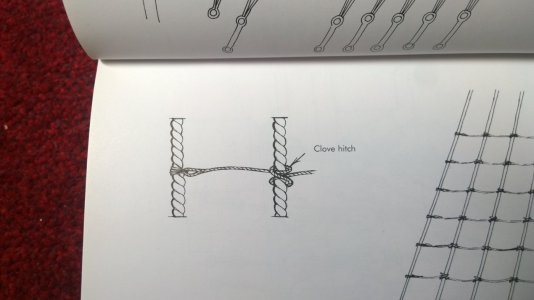
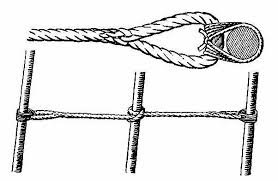
I doubt many of us go to these lengths but it give an idea of the visual image we try to achieve. I personally use the technique in the first image (from Petersson I think in his books on model ship rigging)
Have you glued your rattlin clove hitches? If not I recommend you remove them, make sure the shrouds are tight enough to prevent them from being pulled out of true and tie the rattlins with a thread about 1/3 the thickness of the shrouds. I would personally opt for a light grey/brown line, not the black. Up to you. A paler line is more than likely more historically accurate. A heavily tarred ratline would leave tar over the crew's feet which would be trampled all over the nice clean deck!
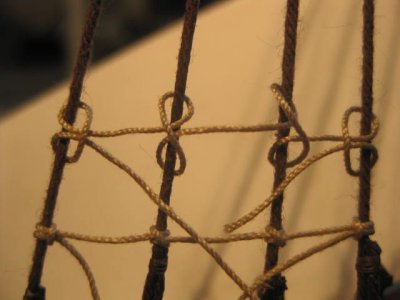
There is also a different knot you can use on the outer shrouds which looks better than a clove hitch.
Rigging line you can buy online or in the shop you bought the kit? Get the best quality you can to avoid the cheap furry appearance. For a basic mass produced line, not premium hand made, Caldercraft or Amati rigging is decent enough.
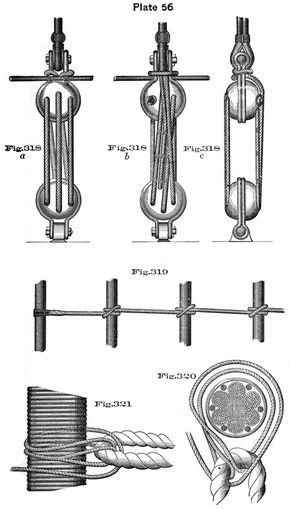
The clove hitches of ratlines can loosen as Bob Ellis showed above if the tension of the ratline is not tight and if the thread used for the ratline is thick or stiff. Using thing thread can make the ratlines closer to scale and reduce the stiffness which can cause clove hitches that are not cinched up tightly to unravel a small bit. Using glue on the clove hitches is a fix that fixes the symptom but does not solve the stiffness problem.
The ratline should not be taut between shrouds, but have a very, very shallow arc. Ohla is particularly skilled at making the arc of each ratline segment consistent. When tying ratlines, making them very taut will pull the shrouds out of position as you make more ratlines.
The ratline should not be taut between shrouds, but have a very, very shallow arc. Ohla is particularly skilled at making the arc of each ratline segment consistent. When tying ratlines, making them very taut will pull the shrouds out of position as you make more ratlines.