
• Win a Free Custom Engraved Brass Coin!!!
    As a way to introduce our brass coins to the community, we will raffle off a free coin during the month of August. Follow link ABOVE for instructions for entering.
  • SUBSCRIBE TO SHIPS IN SCALE TODAY!

    The beloved Ships in Scale Magazine is back and charting a new course for 2026!
    Discover new skills, new techniques, and new inspirations in every issue.

    NOTE THAT OUR NEXT ISSUE WILL BE MARCH/APRIL 2026

Saito steam for Midwest Seguin Tug?

Joined
Mar 5, 2026
Messages
6
Points
3

Greetings! I’m new here. I have been a model builder since the 1970s, mostly airplanes. This is my first foray into live steam. I recently found a 36” Midwest Seguin tugboat kit, in pristine, untouched condition at a swap meet, and I couldn’t refuse… Getting ready to get started. Any thoughts on a good steam power plant? I have a Saito T2DR and B2F boiler that I found online at a great price, but I am not sure this boiler will fit into the hull properly. Do you think a BT-1 or BT-1L boiler will work with the T2DR engine? Seems a vertical boiler is more suited to the hull and superstructure.

 
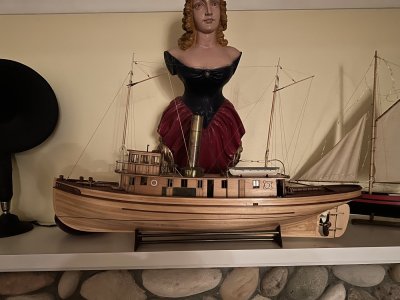
My boiler is vertical unlike the picture on the Krick manual. If you want to keep everything inside the footprint of the deckhouse, I think a horizontal boiler will be difficult.
 
My boiler is vertical unlike the picture on the Krick manual. If you want to keep everything inside the footprint of the deckhouse, I think a horizontal boiler will be difficult.
Beautiful Seguin! Thank you for responding!

That is exactly what I am thinking. Saito makes a smaller vertical boiler (BT-1L) that can work, though it is a smaller capacity and a little lower pressure than their horizontal boiler.

The krick vertical boiler looks good. I bet one could be made to work with my 2 cylinder Saito engine? This is my first live steam model, so I am having fun sorting out how to put it all together.
-Christian
 
The Krick engine is kind of a rattle-trap compared to the Saito - similar in build quality to a Mamod toy. But it works fine and actually makes kind of a nice sound when running on the pond.

I would have preferred a Stuart two-cylinder but it wouldn’t have fit this model.
 
I really like the Saito engine. It’s a beautiful piece of brass machinery.

Now that the Saito engine and used (horizontal) boiler have arrived, I overlaid the system on top of the Seguin plans. Looks very tight, but I might be able to get the burner tank to fit partially under the deck, just forward of the pilot house. This might require some modification of deck and superstructure, possibly a small locker or storage bin…
 
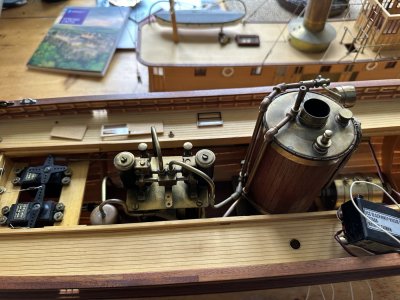
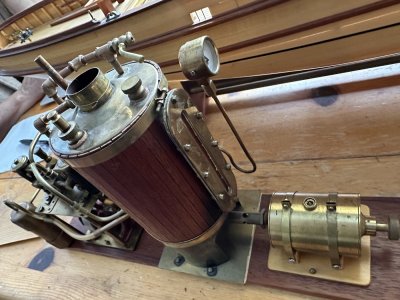
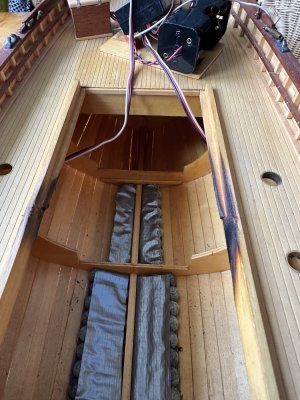
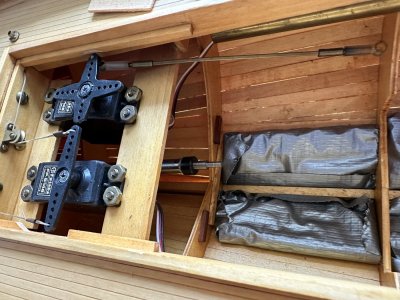
Here's a photo of my steam plant. I mounted all of it on a 1/4" piece of mahogany so the whole thing can be lifted out. The below deck area forward of the deck house is where I keep the batteries and RC receiver. In case you're wondering, the ballast along the keel is .36 cal. lead balls duct taped into removable bunks.

BTW, the charred wood in the second photo happened when I accidentally set the burner too high and couldn't see it well because of bright sun. Luckily I was running it with the deck house off. I had to jump in the pool to splash the fire out. You can also see a little but of charring of the lagging on the bottom of the boiler. That was a scary day.

IMG_2201.jpeg

IMG_2207.jpeg

IMG_2199.jpeg
 
Last edited:
I am not an RC ship model builder but enjoy reading about other’s efforts. I am also fascinated by steam power having been involved with it throughout my career.

At one time, I was also interested in U Control gas powered airplanes (ending in a disaster). Years later I was surprised to learn that model airplanes today are often electric powered. I’m still amazed that enough energy can be stored in a compact battery to fly a model airplane.

Reading your post gave me an idea. I wonder if it would be possible to build a boiler using an electric heating element? Would this be more compact than the boiler that you are using?

Roger
 
Here's a photo of my steam plant. I mounted all of it on a 1/4" piece of mahogany so the whole thing can be lifted out. The below deck area forward of the deck house is where I keep the batteries and RC receiver. In case you're wondering, the ballast along the keel is .36 cal. lead balls duct taped into removable bunks.

BTW, the charred wood in the second photo happened when I accidentally set the burner too high and couldn't see it well because of bright sun. Luckily I was running it with the deck house off. I had to jump in the pool to splash the fire out. You can also see a little but of charring of the lagging on the bottom of the boiler. That was a scary day.

View attachment 584624

View attachment 584625

View attachment 584628
Beautiful craftsmanship. Glad it didn’t end up in flames! Another question for you: Thinking about control of the engine and boiler with R/C…. The Saito system has a throttle on the boiler that controls steam to the engine, and the engine has a lever that controls direction and RPM. I see you have 2 servos… Rudder and throttle? Does the throttle control steam to the engine, or the engine, itself?
 
On the Krick engine a single lever controls both engine rpm and direction, so that's one servo. (There is no separate valve at the boiler to control steam flow.) The other servo controls the rudder.
 
As to Roger's question, I imagine it's possible to make an electric boiler, but from a purist standpoint it wouldn't be as satisfying as firing the boiler like real life.

Accordingly you could just power the boat with an electric motor, but where's the fun in that?

Live steam sounds and smells like Heaven.
 
Hotspur, I’m at heart a traditionalist so I completely agree with you. Electric boiler; Just daydreaming!

For the past several months I have been building a 1:96 scale non-functional soldered brass steam winch for my ship modeling project. The design is based on photographs of on in an American Shipbuilding Company Catalog posted here on SOS. These “deck engines” as they were called on the Lakes did not have conventional reversing gear. Instead, they had a reversing valve; a cylindrical shaped object with internal disc shaped plates. An outside lever rotated the plates and holes in directed the steam flow. Same thing as the Krick engine?

Roger
 
Hotspur, I’m at heart a traditionalist so I completely agree with you. Electric boiler; Just daydreaming!

For the past several months I have been building a 1:96 scale non-functional soldered brass steam winch for my ship modeling project. The design is based on photographs of on in an American Shipbuilding Company Catalog posted here on SOS. These “deck engines” as they were called on the Lakes did not have conventional reversing gear. Instead, they had a reversing valve; a cylindrical shaped object with internal disc shaped plates. An outside lever rotated the plates and holes in directed the steam flow. Same thing as the Krick engine?

Roger
That's precisely the way the Krick works. I built a Stuart 10V engine with a reversing gear but it is fiddley to adjust and it's more moving parts to lubricate. plus it requires two servos to run the engine.
 
Back
Top