



• Win a Free Custom Engraved Brass Coin!!!
    As a way to introduce our brass coins to the community, we will raffle off a free coin during the month of August. Follow link ABOVE for instructions for entering.
  • PRE-ORDER SHIPS IN SCALE TODAY!

    The beloved Ships in Scale Magazine is back and charting a new course for 2026!
    Discover new skills, new techniques, and new inspirations in every issue.

    NOTE THAT OUR FIRST ISSUE WILL BE JAN/FEB 2026

Santìsima Trinidad 1:84 by Artesania Latina - Build log

Having completed the installation of the first deck (you will see it in the next post...), I am faced with a problem I have already faced but never fully resolved: the reproduction of nails on the planking.
I had already addressed this problem when building the Victory and had come to the conclusion of doing nothing, that is, leaving the finished planking without simulating nails.
The choice took the following elements into account:
1. It is reasonable to assume that the heads of the nails used to fasten the deck planks had a diameter no greater than 2 cm.
2. On a scale like that of the Victory (1:78), this would have meant creating points 0.25 mm wide.
3. The various models photographed on the forum do not convince me in this respect, as the presence of the nail simulation, in my opinion, makes the decks appear less realistic, as the points are too large.
I therefore think I will follow this approach also for the current yard, as a 1:84 scale would require even smaller points.
I would however like to have your opinions, thanks.
 
Hey Ismaele,

On a scale of 1:84, that would be 0.238 mm, or 0.24 mm. I think if you really want to represent the dowels, you could drill the planks with a 0.2 mm drill bit, for example, and then seal them with wax or wooden splints. Or you could make a stamp and press the tips into the wooden planks. To do this, you would need a drill stand so that you can press the planks in using leverage. It would also be advisable to use a template so that all the planks are spaced evenly. I would just try it out with a few planks and then decide.

Sure, it's not always nice when the dowels are too big. But there are options. It also depends on your craftsmanship and whether you're willing to put in so much effort...

So it's up to you. Thumbsup
 
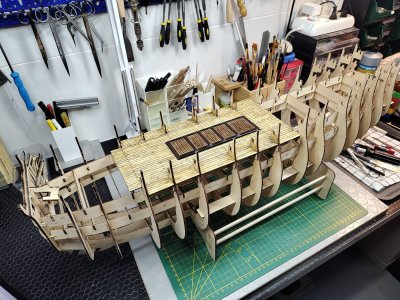
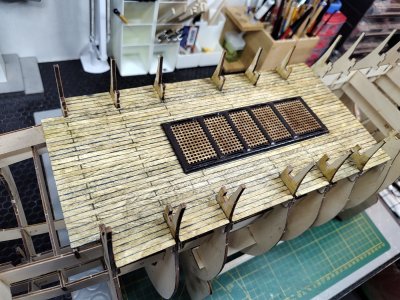
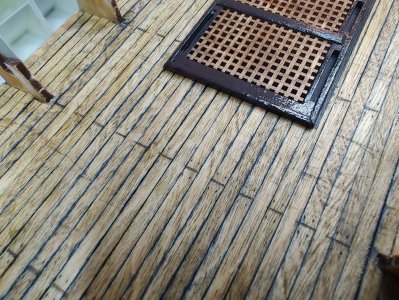
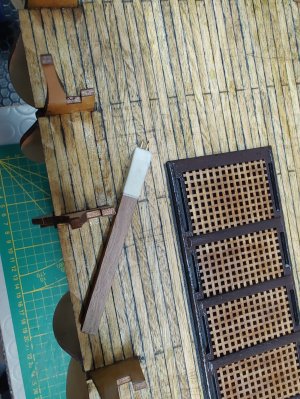
Here are my thoughts on the first deck I built:
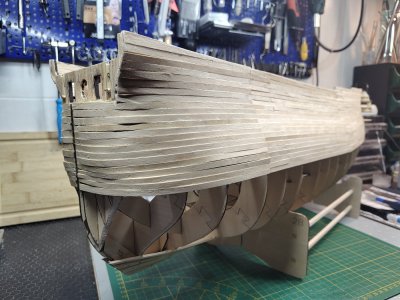
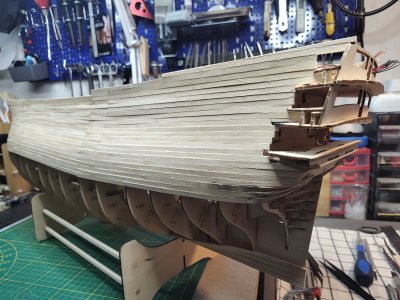
1. My fears about this new, never-before-used construction technique proved unfounded. Instead of having a plywood board onto which very thin strips were glued, this model involves gluing thicker strips (1 mm) directly onto the frames and beams, one at a time. This technique, besides being clearly more faithful to traditional methods, is not at all complicated, and the use of the right glue allows for a quick and clean job. I am therefore completely satisfied.
2. Naturally, I first smeared the edges of the strips with a black marker to simulate the presence of tar between the planks.
3. As for the problem of reproducing the nails, I solved it by making a punch with two small nails placed at a distance compatible with the width of the strip, hitting it lightly with a hammer to obtain two small holes in the wood, smearing the inside of the holes with a fine-tipped pencil, and cleaning the surface with an eraser.
4. Then I proceeded to sand the deck, scratch it irregularly to simulate wear, varnish it all with three coats of shellac, and polish it with very fine steel wool.

I'm satisfied with the overall result, which seems essential to me...

1000019732.jpg

1000019731.jpg

1000019730.jpg

1000019729.jpg
 
As I noted at the beginning, the plywood panels are very well cut, but quite thin, especially the 2 mm ones. This means that the individual pieces, while conveniently flexible, are also fragile and must be handled with great care.
Otherwise, the result could be like this transom...

1000021502.jpg

Fortunately the repair was very simple and since it is a part that is covered or hidden I was able to apply a reinforcement!

1000021501.jpg
 
Here are my thoughts on the first deck I built:
1. My fears about this new, never-before-used construction technique proved unfounded. Instead of having a plywood board onto which very thin strips were glued, this model involves gluing thicker strips (1 mm) directly onto the frames and beams, one at a time. This technique, besides being clearly more faithful to traditional methods, is not at all complicated, and the use of the right glue allows for a quick and clean job. I am therefore completely satisfied.
2. Naturally, I first smeared the edges of the strips with a black marker to simulate the presence of tar between the planks.
3. As for the problem of reproducing the nails, I solved it by making a punch with two small nails placed at a distance compatible with the width of the strip, hitting it lightly with a hammer to obtain two small holes in the wood, smearing the inside of the holes with a fine-tipped pencil, and cleaning the surface with an eraser.
4. Then I proceeded to sand the deck, scratch it irregularly to simulate wear, varnish it all with three coats of shellac, and polish it with very fine steel wool.

I'm satisfied with the overall result, which seems essential to me...

View attachment 563199

View attachment 563200

View attachment 563201

View attachment 563202
Hi Ismaele, congrats on your work on such a big and complex POB model so far. If I may, I would humbly obeserve the real issue here is the planking wrong pattern. Joints should recur just every 3 o 4 streaks, not less. Also consider that decks were always immaculate at that time, as they were washed with salt water and scrubbed with stones any single day, at dawn, until they turned into a kind of "pale white" color ( light gray in fact). No stains or scratches would be admitted by the watch leutenant.
 
Thanks for your comments! There are two problems:
1. I agree about the alternating planks, so much so that in my previous models I followed a joint pattern every three or four planks. But in those cases the planks were glued to a lower board, so you could arrange them as you like, while in this case you have to follow the frames, which are relatively few compared to reality, so I wasn't able to do any better
2. You're right about the deck I made; it was a test, and I got carried away with the shellac. I don't really like the effect either, but in the end, very little of this deck will be visible, as it's almost entirely hidden by the large hatch, the guns, and the upper deck. I'll try to do better with this...
 
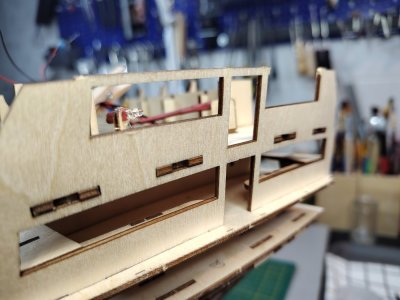
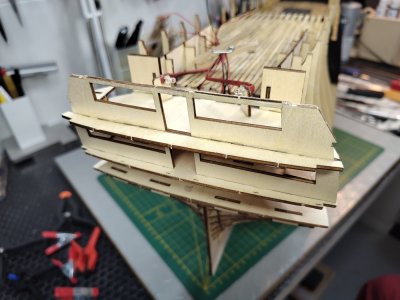
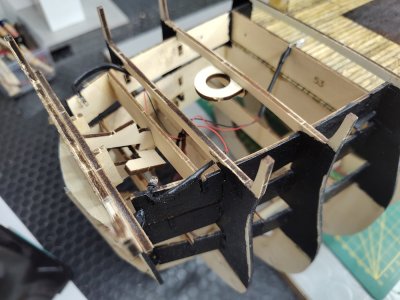
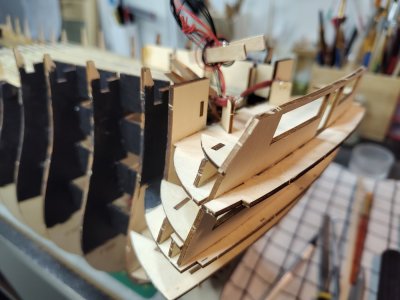
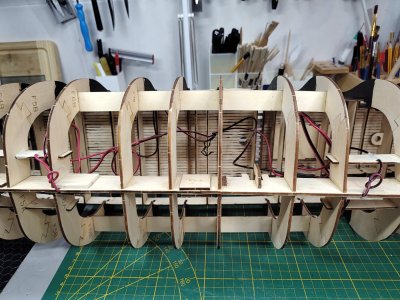
I completed the LED installation, obviously excluding those that will be inserted into the three stern lanterns. At the same time, I prepared the wiring for the two electrical contact points on the keel, which will serve to connect the system to the batteries and the switch, which will be placed at the base. Special thanks to Omega, who provided me with valuable guidance on this matter.

1000021578.jpg


1000021579.jpg

1000021577.jpg
 
Back
Top