

Hello Les here. I am building the ships boats for the Endeavour. They were supplied with .05 x 3 walnut planks. Way out of scale for something this small. I would imagine that they would have been built from oak. I have purchased a roll of birch veneer. Will work excellent for this application. My question is what was a British Admiralty approved treatment for the outer side of the boats?

-

SUBSCRIBE TO SHIPS IN SCALE TODAY!
The beloved Ships in Scale Magazine is back and charting a new course for 2026!
Discover new skills, new techniques, and new inspirations in every issue.
NOTE THAT OUR NEXT ISSUE WILL BE July/August 2026 -

Win a Free Custom Engraved Brass Coin!!!
As a way to introduce our brass coins to the community, we will raffle off a free coin during the month of August. Follow link ABOVE for instructions for entering.
You are using an out of date browser. It may not display this or other websites correctly.
You should upgrade or use an alternative browser.
You should upgrade or use an alternative browser.

I have no idea if the finish on the boats was part of the Admiralty's rules. Looking at contemporary models they all appear to have white bottom planking unless left unfinished altogether. All of Bob Lightley's boat models and Ken Britten's boat models at RMG are white up to the landing strake or gunnel. One contract from September 9th, 1790 for a yawl and pinnace describes the covering as follows:
to be graved and primed to the water line and paid with stuff in the inside to ye Riseing
I am guessing when they wrote ye riseing, they are referring to the risers on which the thwarts rested. Which boats are you building? There are scantlings from David Steel for the size of everything on all types of boats if you are interested in these kinds of details.
Allan
to be graved and primed to the water line and paid with stuff in the inside to ye Riseing
I am guessing when they wrote ye riseing, they are referring to the risers on which the thwarts rested. Which boats are you building? There are scantlings from David Steel for the size of everything on all types of boats if you are interested in these kinds of details.
Allan
These would be the ships boats such as the pinnace and Mr Banks skiff etc. The ship itself will be payed and varnished as per Admiralty instructions. The supplied walnut is very dark, so after finishing they would be too dark for my liking.I have no idea if the finish on the boats was part of the Admiralty's rules. Looking at contemporary models they all appear to have white bottom planking unless left unfinished altogether. All of Bob Lightley's boat models and Ken Britten's boat models at RMG are white up to the landing strake or gunnel. One contract from September 9th, 1790 for a yawl and pinnace describes the covering as follows:
to be graved and primed to the water line and paid with stuff in the inside to ye Riseing
I am guessing when they wrote ye riseing, they are referring to the risers on which the thwarts rested. Which boats are you building? There are scantlings from David Steel for the size of everything on all types of boats if you are interested in these kinds of details.
Allan
- Joined
- Jun 11, 2026
- Messages
- 50
- Points
- 48

While I have no contemporary authority to reference, practical maritime experience would dictate that the outside of hulls on wooden ship's boats carried "bottom up" on deck or skids would be painted white. Not only was white paint less expensive than colors, but it lasted longer because it reflected the UV rays of the sun. Most practically, however, white paint would keep the boat bottoms cooler than any other color and this would best reduce plank shrinkage when out of the water and thus reduce leaking when launched. (When at sea, it was standard practice in any event to tow the ship's boats or a regular basis to keep the planking swelled tightly so they wouldn't leak when used.)
You bring up an interesting point. When did the RN start carrying the ships' boats upside down on the skid beams? The closest I could find with AI (which is not something I trust yet) was 1820.practical maritime experience would dictate that the outside of hulls on wooden ship's boats carried "bottom up" on deck or skids would be painted white
Allan
I don't know. My main concern is the correct colour and stowage of the ships on deck. AI is the becoming the monster in our group and else where. So be careful.You bring up an interesting point. When did the RN start carrying the ships' boats upside down on the skid beams? The closest I could find with AI (which is not something I trust yet) was 1820.
Allan


This contemporary longboat (build date 1742) should guide us.
 www.rmg.co.uk
From my experience I think modern model builders are following this, or similar, design.
Small craft (1742); Longboat | Royal Museums Greenwich
From my experience I think modern model builders are following this, or similar, design.
- Joined
- Jun 11, 2026
- Messages
- 50
- Points
- 48
While contemporary models are certainly some of the better sources of information on period models, they are far from conclusive historical records. The best practice is to do your own research in contemporary written references as well. Relying on allegedly "contemporary" models in museums is with surprising frequency not always the last word in every instance. The older the model may be, the more likely it is that they've been subject to ham fisted restorations and repairs that included glaring errors. The model cited here is one of my favorite examples of why museum exhibits, and especially quite old ones, while in the main invaluable resources, must be taken with a grain of salt. It is incumbent upon the modeler to bring to his task as much general knowledge of how the subjects of his modeling were built and sailed, and for warships, how they were fought, in their day. In my experience, contemporary written records are far more reliable than a model of questionable provenance and, where a disparity existed between a contemporary model and the relevant contemporary written records, absent any other contemporary explanation in the historical record, the contemporary written records should trump the contemporary model.
[Note that one of the most valuable reference books in existence on the subject of contemporary records on the construction of period warships is Allan Yedlinsky's Scantlings of the Royal Navy 1719-1805 Comparisons of 1719, 1745 Establishments, Ship Builders Repository and Steel’s Elements and Practice, published by Seawatch Books. All the essentials in one volume. See: https://seawatchbooks.com/products/...el-s-elements-and-practice-by-allan-yedlinsky]
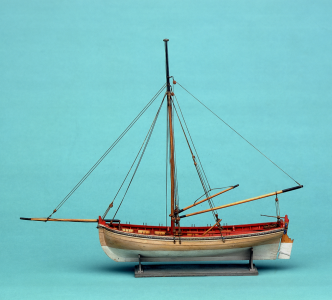
The above RMG "contemporary" model, mentioned above and which I believe was the one copied by a popular kit manufacturer, along with at least two other similar contemporary models of ship's boats in the RMG collection, all contain the same glaring error. I suspect that these models were worked on by the same curator or restorationist at some time in their long existences and, thus, his mistake was repeated in each one of them. The mistake may have been "inherited" when they were at some point rerigged or missing rudders and tillers were replaced.
The mistake is immediately apparent to any sailor who examines the model: The tiller is installed to run on top of the mainsheet horse. For anyone who is interested in building a sailing boat model without having ever sailed a similar boat, the problem with this arrangement is that the whole purpose of a mainsheet horse is to lift the lower block of the mainsheet tackle above the tiller so that the lower mainsheet block can move on the sheet horse over the tiller without fouling it when the mainsail is tacked or jibed. It's not possible to sail the boat when the mainsheet fouls the tiller every time the boat tacks or jibes. This arrangement would never under any circumstances exist in real life.
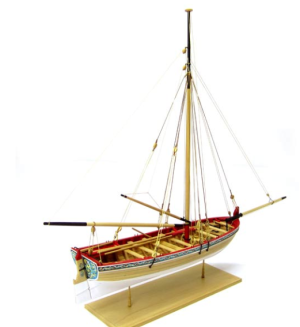
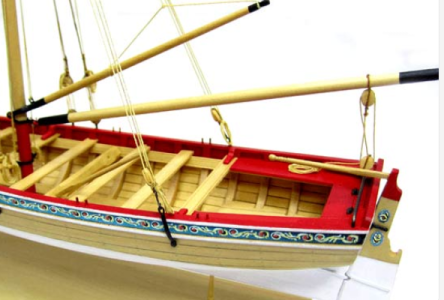
Above are photos of Model Shipways' 18th Century Longboat kit from their online advertising. As you can see, just as with the NMG's prototype, the tiller is run over the sheet horse. In the bottom picture it is easy even for a farmer to see that when the boom swings from one side to the other, that block is going to pull the tiller with it. It's the nautical analog to running an automobile's turn signal indicater lever through the outside rim of the steering wheel!
I had occasion to mention this error to the designer of the Model Shipways kit as "collegially" as I could, since I didn't want to offend him. Regrettably, he was greatly offended by my observation and became arrogantly defensive, quite pointedly informing me that he had closely studied the actual contemporary model in the NMG and that the model he designed (which was otherwise a rather good model, all else considered) was an exact copy of the NMG's prototype. (I bit my tongue and did not pursue with him my further observation that I found his adamant assertion of its being an exact copy somewhat inconsistent with his being an aggressive opponent of "pirated" ship model kits!) In order to assuage his ire, I conceded that his model kit was indeed an "exact copy" of the prototype of the NMG's "contemporary" model and, based on my own experience with the NMG's collection, there were also two other very similar contemporary longboat models in that collection with the very same misplaced tiller which could not possibly be considered accurate at any point in history for obvious reasons, but I certainly could not dispute the fact that his kit produced an entirely accurate "model of the model" in the NRG's collection. That ended the conversation, but not his apparently undying enmity. So it goes.
The moral of the story is that period models in museums, while often the very best of the best on must accounts, do not infrequently contain errors, some made perhaps in their initial construction, but most frequently thereafter, when they are rerigged and otherwise repaired over the centuries of their existence.
[Note that one of the most valuable reference books in existence on the subject of contemporary records on the construction of period warships is Allan Yedlinsky's Scantlings of the Royal Navy 1719-1805 Comparisons of 1719, 1745 Establishments, Ship Builders Repository and Steel’s Elements and Practice, published by Seawatch Books. All the essentials in one volume. See: https://seawatchbooks.com/products/...el-s-elements-and-practice-by-allan-yedlinsky]
The above RMG "contemporary" model, mentioned above and which I believe was the one copied by a popular kit manufacturer, along with at least two other similar contemporary models of ship's boats in the RMG collection, all contain the same glaring error. I suspect that these models were worked on by the same curator or restorationist at some time in their long existences and, thus, his mistake was repeated in each one of them. The mistake may have been "inherited" when they were at some point rerigged or missing rudders and tillers were replaced.
The mistake is immediately apparent to any sailor who examines the model: The tiller is installed to run on top of the mainsheet horse. For anyone who is interested in building a sailing boat model without having ever sailed a similar boat, the problem with this arrangement is that the whole purpose of a mainsheet horse is to lift the lower block of the mainsheet tackle above the tiller so that the lower mainsheet block can move on the sheet horse over the tiller without fouling it when the mainsail is tacked or jibed. It's not possible to sail the boat when the mainsheet fouls the tiller every time the boat tacks or jibes. This arrangement would never under any circumstances exist in real life.
Above are photos of Model Shipways' 18th Century Longboat kit from their online advertising. As you can see, just as with the NMG's prototype, the tiller is run over the sheet horse. In the bottom picture it is easy even for a farmer to see that when the boom swings from one side to the other, that block is going to pull the tiller with it. It's the nautical analog to running an automobile's turn signal indicater lever through the outside rim of the steering wheel!
I had occasion to mention this error to the designer of the Model Shipways kit as "collegially" as I could, since I didn't want to offend him. Regrettably, he was greatly offended by my observation and became arrogantly defensive, quite pointedly informing me that he had closely studied the actual contemporary model in the NMG and that the model he designed (which was otherwise a rather good model, all else considered) was an exact copy of the NMG's prototype. (I bit my tongue and did not pursue with him my further observation that I found his adamant assertion of its being an exact copy somewhat inconsistent with his being an aggressive opponent of "pirated" ship model kits!) In order to assuage his ire, I conceded that his model kit was indeed an "exact copy" of the prototype of the NMG's "contemporary" model and, based on my own experience with the NMG's collection, there were also two other very similar contemporary longboat models in that collection with the very same misplaced tiller which could not possibly be considered accurate at any point in history for obvious reasons, but I certainly could not dispute the fact that his kit produced an entirely accurate "model of the model" in the NRG's collection. That ended the conversation, but not his apparently undying enmity. So it goes.
The moral of the story is that period models in museums, while often the very best of the best on must accounts, do not infrequently contain errors, some made perhaps in their initial construction, but most frequently thereafter, when they are rerigged and otherwise repaired over the centuries of their existence.
Last edited:
Yep. When I built that longboat I automatically ran the tiller under the horse. It was only when I looked back at the plans that I realized that having been a sailor of sorts helps!While contemporary models are certainly some of the better sources of information on period models, they are far from conclusive historical records. The best practice is to do your own research in contemporary written references as well. Relying on allegedly "contemporary" models in museums is with surprising frequency not always the last word in every instance. The older the model may be, the more likely it is that they've been subject to ham fisted restorations and repairs that included glaring errors. The model cited here is one of my favorite examples of why museum exhibits, and especially quite old ones, while in the main invaluable resources, must be taken with a grain of salt. It is incumbent upon the modeler to bring to his task as much general knowledge of how the subjects of his modeling were built and sailed, and for warships, how they were fought, in their day. In my experience, contemporary written records are far more reliable than a model of questionable provenance and, where a disparity existed between a contemporary model and the relevant contemporary written records, absent any other contemporary explanation in the historical record, the contemporary written records should trump the contemporary model.
[Note that one of the most valuable reference books in existence on the subject of contemporary records on the construction of period warships is Allan Yedlinsky's Scantlings of the Royal Navy 1719-1805 Comparisons of 1719, 1745 Establishments, Ship Builders Repository and Steel’s Elements and Practice, published by Seawatch Books. All the essentials in one volume. See: https://seawatchbooks.com/products/...el-s-elements-and-practice-by-allan-yedlinsky]
View attachment 637375
The above RMG "contemporary" model, mentioned above and which I believe was the one copied by a popular kit manufacturer, along with at least two other similar contemporary models of ship's boats in the RMG collection, all contain the same glaring error. I suspect that these models were worked on by the same curator or restorationist at some time in their long existences and, thus, his mistake was repeated in each one of them. The mistake may have been "inherited" when they were at some point rerigged or missing rudders and tillers were replaced.
The mistake is immediately apparent to any sailor who examines the model: The tiller is installed to run on top of the mainsheet horse. For anyone who is interested in building a sailing boat model without having ever sailed a similar boat, the problem with this arrangement is that the whole purpose of a mainsheet horse is to lift the lower block of the mainsheet tackle above the tiller so that the lower mainsheet block can move on the sheet horse over the tiller without fouling it when the mainsail is tacked or jibed. It's not possible to sail the boat when the mainsheet fouls the tiller every time the boat tacks or jibes. This arrangement would never under any circumstances exist in real life.
View attachment 637383
View attachment 637382
Above are photos of Model Shipways' 18th Century Longboat kit from their online advertising. As you can see, just as with the NMG's prototype, the tiller is run over the sheet horse. In the bottom picture it is easy even for a farmer to see that when the boom swings from one side to the other, that block is going to pull the tiller with it. It's the nautical analog to running an automobile's turn signal indicater lever through the outside rim of the steering wheel!
I had occasion to mention this error to the designer of the Model Shipways kit as "collegially" as I could, since I didn't want to offend him. Regrettably, he was greatly offended by my observation and became arrogantly defensive, quite pointedly informing me that he had closely studied the actual contemporary model in the NMG and that the model he designed (which was otherwise a rather good model, all else considered) was an exact copy of the NMG's prototype. (I bit my tongue and did not pursue with him my further observation that I found his adamant assertion of its being an exact copy somewhat inconsistent with his being an aggressive opponent of "pirated" ship model kits!) In order to assuage his ire, I conceded that his model kit was indeed an "exact copy" of the prototype of the NMG's "contemporary" model and, based on my own experience with the NMG's collection, there were also two other very similar contemporary longboat models in that collection with the very same misplaced tiller which could not possibly be considered accurate at any point in history for obvious reasons, but I certainly could not dispute the fact that his kit produced an entirely accurate "model of the model" in the NRG's collection. That ended the conversation, but not his apparently undying enmity. So it goes.
The moral of the story is that period models in museums, while often the very best of the best on must accounts, do not infrequently contain errors, some made perhaps in their initial construction, but most frequently thereafter, when they are rerigged and otherwise repaired over the centuries of their existence.
- Joined
- Jun 29, 2024
- Messages
- 2,093
- Points
- 488

Getting the mainsheet tangled up with the tiller while tacking leads to dramatic results. Enough that you’re unlikely to forget!
Roger
Roger