- Joined
- Aug 15, 2026
- Messages
- 3
- Points
- 3
Built this for myself because converting Steel's and other sources mast and spar tables by hand was eating an evening at the start of every build. I build in smaller scales like 1/700 but it should work for most common scales, 1/64 and so on.
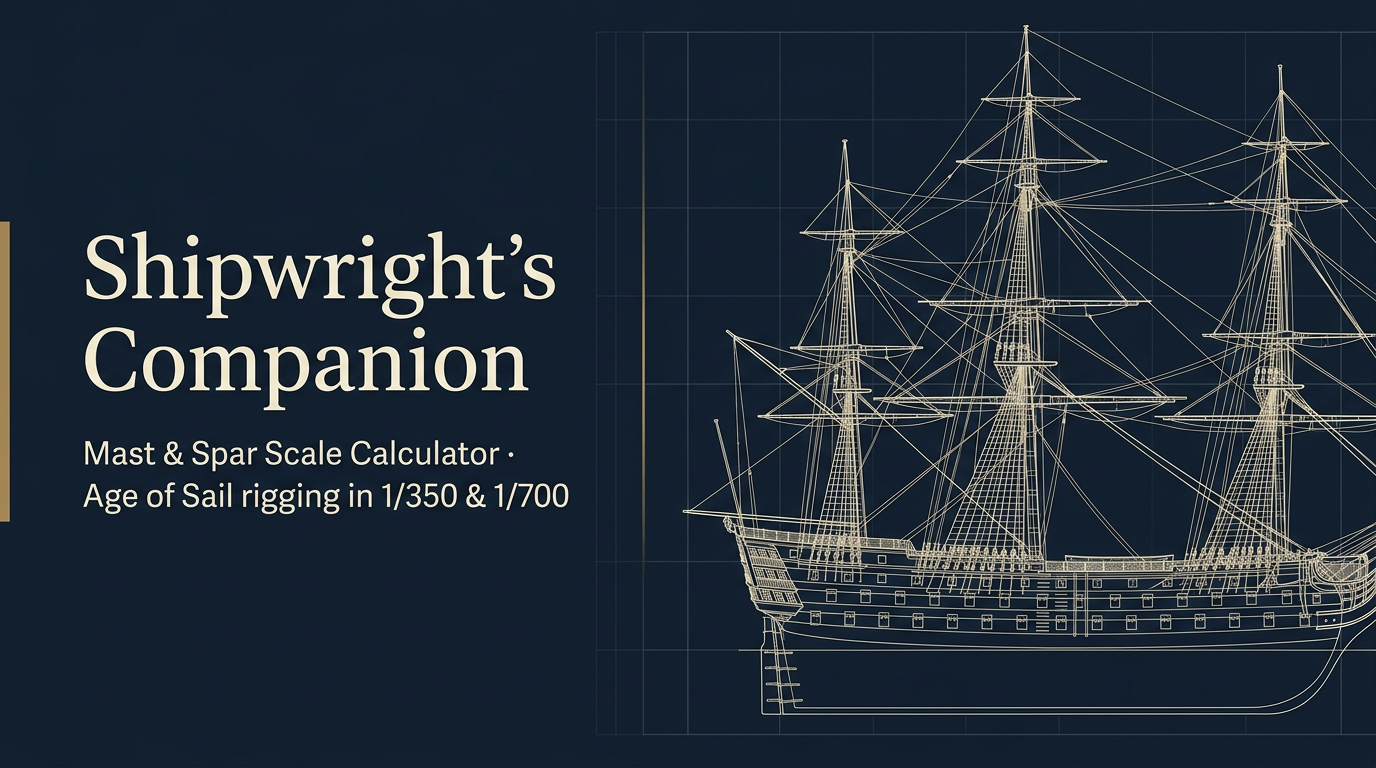
Free, browser-based, no sign-up. Enter ship dimensions and rate, set your scale, and get scaled mast/spar/yard lengths plus the nearest commercial dowel or brass rod diameter for each spar. Works from 1/700 brass through dowel sizes for 1/72, 1/48 and larger.
Sources are flagged per-ship in the app and laid out in full on the Data Provenance page. Principal references:
- Steel (1794 and 1799) for British warships, with Lees as cross-check.
- Fincham (1829) for British cutters and as the post-Napoleonic comparison.
- Boudriot & Berti and Boudriot's The 74-Gun Ship for French ships; Forfait (1788) where ship-specific tables aren't available.
- Chapelle and the USS Constitution Museum's 1817 inventory for American.
- Lavery's The Ship of the Line for the national scaling factors used to approximate Spanish and Dutch vessels — the app flags these as proportional rather than primary.
Spar values are cross-checked against a historian friend's 2026 workbook (RMG draughts, Gardiner, Chapelle, USS Constitution Museum); David Vadas' Excel implementation of Lees was used as an independent peer reference for the rigging code.
Still a work in progress — there'll be errors, missing ships, and rough edges. I'm not a rigging specialist or a great coder, and the app is only as good as the sources behind it. If anyone here works mainly from Lees, Marquardt or another reference and sees the calculator disagreeing with what you'd expect, I'd genuinely want to hear about it. Same for sources or features you'd want added or for errors.
For more check out the projects section on my page https://linusnapoleonicshipyard.github.io/napoleonic-shipyard/
Versions
Shipwright's Companion: September 2026 update II
British spar dimensions for ships from the 90 down to the 20-gun now come directly from Steel's printed tables (1794, Vol. 1, pp. 49–50).
Main corrections
https://linusnapoleonicshipyard.github.io/shipwright-s-companion/
Shipwright's Companion — Mast & Spar Scale Calculator
Age of Sail rigging dimensions for scale modelbuilders. Steel's 1794 tables converted to 1/350 and 1/700 brass rod sizes.Free, browser-based, no sign-up. Enter ship dimensions and rate, set your scale, and get scaled mast/spar/yard lengths plus the nearest commercial dowel or brass rod diameter for each spar. Works from 1/700 brass through dowel sizes for 1/72, 1/48 and larger.
Sources are flagged per-ship in the app and laid out in full on the Data Provenance page. Principal references:
- Steel (1794 and 1799) for British warships, with Lees as cross-check.
- Fincham (1829) for British cutters and as the post-Napoleonic comparison.
- Boudriot & Berti and Boudriot's The 74-Gun Ship for French ships; Forfait (1788) where ship-specific tables aren't available.
- Chapelle and the USS Constitution Museum's 1817 inventory for American.
- Lavery's The Ship of the Line for the national scaling factors used to approximate Spanish and Dutch vessels — the app flags these as proportional rather than primary.
Spar values are cross-checked against a historian friend's 2026 workbook (RMG draughts, Gardiner, Chapelle, USS Constitution Museum); David Vadas' Excel implementation of Lees was used as an independent peer reference for the rigging code.
Still a work in progress — there'll be errors, missing ships, and rough edges. I'm not a rigging specialist or a great coder, and the app is only as good as the sources behind it. If anyone here works mainly from Lees, Marquardt or another reference and sees the calculator disagreeing with what you'd expect, I'd genuinely want to hear about it. Same for sources or features you'd want added or for errors.
For more check out the projects section on my page https://linusnapoleonicshipyard.github.io/napoleonic-shipyard/
Versions
Shipwright's Companion: September 2026 update II
British spar dimensions for ships from the 90 down to the 20-gun now come directly from Steel's printed tables (1794, Vol. 1, pp. 49–50).
Main corrections
- Crossjacks and mizzen topsail yards on the large ships were 10–16% too long.
- Driver booms on the frigates and the 50 were about 15% too short.
- Upper masts on the 32 and 20-gun ships were too short. The 20-gun now has Steel's 72 ft mainmast and 63 ft main yard (previously 69 and 57).
- From 1773 the main yard is seven-eighths of the mainmast, following Steel.
- Mast thickness scales with ship size. Yards can no longer be thicker than their masts, and French spars stay about a tenth stouter, following Boudriot.
- British mizzens follow Steel (about 0.85 of the main), with a mizzen royal from the 1790s.
- Brigs have their own rig, and cutters are masted off the beam following Fincham.
- Ship data fixes for USS Congress, the razee, Constitution and Chesapeake.
- Where the historian's workbook disagrees with Steel, Steel is the default, but the workbook value can still be selected.
- The Boudriot calculator has corrected upper spars, plus bowsprit detail and yard taper.
- The build sheet now draws masts and yards to one scale.
- New automatic checks catch copied ship data and spar proportion errors.
Last edited: