



• Win a Free Custom Engraved Brass Coin!!!
    As a way to introduce our brass coins to the community, we will raffle off a free coin during the month of August. Follow link ABOVE for instructions for entering.

Shrouds, lanyards and deadeyes: adjusting shroud tension

Thanks Bob,
The San Francisco Maritime National Park Association is a source of a number of great pieces of information, including all 425 pages of David Steel's 1794 book The Elements and Practice of Rigging and Seamanship which is a free download and should be in anyone's library that is doing rigging on 18th century ships.
Allan
 
like the two tone wood stand on 1714
I do not remember where I read this, but if I see it again, I will post it. I am glad to see that you are a researcher. Most people today seem to just buy a kit and put it together without checking any other resources. My interest is primarily in late eighteenth ships. One contemporary source are paintings, and the question of whether the rigging is black or dark brown is difficult to determine at times. However, I cannot recall ever seeing light colored "natural" used in standing rigging. Your comments seem to support my original post.
 
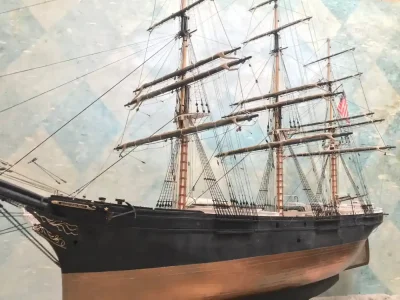
Thanks for the in-depth analysis of the necessity of the use of pine tar on shrouds and their lanyards. In my experience, far too many modelers fail to properly stain or use the appropriate colored line for the representation of these structures on their models. Generally using tan rigging line for lanyards....making for quite unrealistic appearing lines.

As a general rule I always recommend using dark or black line for these standing rigging lines(shrouds are considered part of the standing rigging make-up. NOT the running rigging.

Again, thanks for the fine description. I hope more modelers pay head.

Rob
 
As a general rule I always recommend using dark or black line for these standing rigging lines(shrouds are considered part of the standing rigging make-up. NOT the running rigging.)

Yes, indeed! For some reason, perhaps erroneous kit instructions, the myth of deadeye lanyards being "running" rigging persists and is promulgated by the present-day ship modeling fraternity. As one who owned and sailed a traditionally gaff rigged vessel with deadeyes and lanyards, I've never considered deadeye lanyards to be running rigging, and I know firsthand that it's simply impossible to set up shroud tension by hauling on lanyards. (A tackle is clapped onto the shroud above the upper deadeye and the shroud tensioned with the tackle. The lanyard is then rove tightly and tied off. Then the tackle is removed.)

The purpose of deadeyes of all kinds is not to create a purchase for hauling, but, albeit employing the same basic mechanical principle, to distribute tension at a connection point which otherwise cannot be mechanically connected to another point due to the size of the primary cable involved. Shrouds must be sufficiently strong to handle the loads imposed upon them. This means, in the case of fiber cordage, that they must be large. Thus, a cable strong enough to serve as a shroud, especially if it is wormed, parceled, and served, it just too big and stiff to connect it to any of the usual terminal connections which might be fashioned in the end of a chainplate by tying a knot in it. Even were it possible to do so, the bend in the large cable around a much smaller terminal, such as a ring, would create a small point concentrating all the friction at a point at which the cable would quickly chafe and break. The deadeye, properly sized, creates a terminal connection point around which a thick, stiff, shroud cable can be bent so that the dead end of the cable can be turned up and seized to the standing part without creating a chafe point.

The usual arrangement of three-hole deadeyes and lanyards permits the tension of the shroud to be distributed through the combined strength of the multiple lanyard turns running through the deadeye. In this fashion, the lanyard in a three-hole deadeye is able to handle six times the breaking load of a single length of the lanyard cordage (in theory, at least.) In this fashion, a thick shroud can be fastened to the chainplate without creating a weak point at which the shroud might become disconnected. On earlier period vessels, we see the same engineering principle applied in mainstay connections where "deadeyes" with more than three holes are employed to handle stronger cable than that used on the shrouds by dividing the tension with a greater number of lanyard turns while keeping the lanyard cordage of manageable size.

Lanyards were regularly tarred, just as all standing rigging, in order to preserve them from weathering and, after a few applications, if not initially, they would appear "black." Even if newly tarred rigging were to appear somewhat "brown," the critical fact for the purposes of modeling it is that at scale viewing distances if would appear "black" in any event. The greater the viewing distance, the darker a color appears. All a skeptical modeler has to do is look out the window and see that the farther away it gets, the darker green the grass gets until far in the distance it may even appear dark grey or "black" even though his brain tells him it must be green. If he paints a picture of that view and makes the hills in the distance the same "green" he used for the grass in the foreground of his landscape painting, it isn't going to look "realistic" at all.

As for pine tar, I've been there, done that, and got the tee shirt, too. One can spend all day arguing whether pine tar is "brown" or "black" and how dark "brown" has to be before it's "black" but, as anybody who has ever worked with the stuff will attest, regardless of whatever color it might be when applied out of its container, anything and everything with which it comes in contact will indisputably be "black" in a hot minute and, absent the greatest care, it will come in contact with everything within a twenty-foot radius as soon as it is applied, or so it seems. It smells wonderful, but it is nasty messy stuff. It's not for nothing that sailors in the Age of Sail were called "Jack Tars." They were literally covered with it.

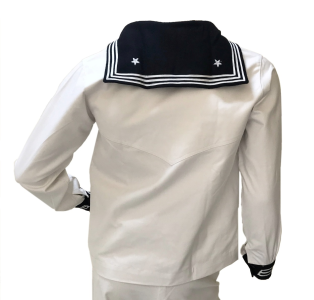
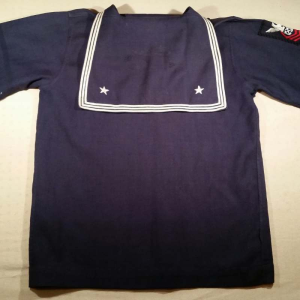
As some period ship modelers with an interest in history may know, old time sailors would let their hair grow long at sea, braiding it in a pigtail to which they applied pine tar as it grew. At the end of their customarily long voyages, they would cut off their pigtails and sell them to the wigmakers ashore. This practice was the genesis of the detachable collars on naval uniform middy blouses. The blouses were white for working in the heat of the sun, but would stain from the tar on their pigtails, so the middy collars were made to extend far down the back. In the U.S. Navy, at least, the summer "dress whites" uniform retained its dark navy-blue collar until the 1930's, long after sailors were wearing pigtails!

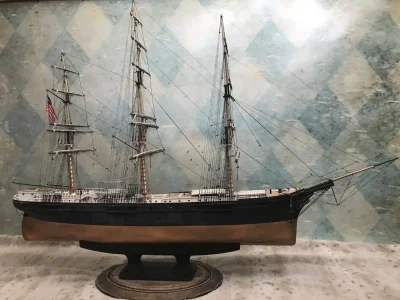
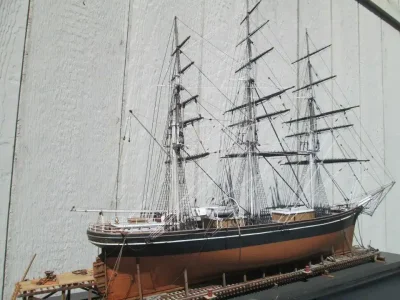
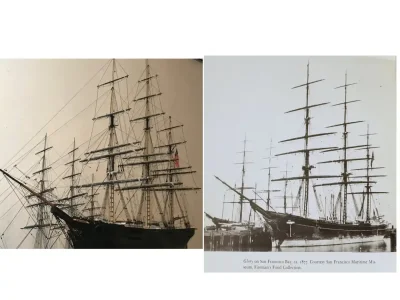
1766018945823.png


1766019962124.png
 
Last edited:
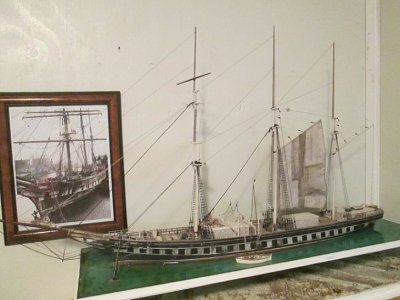
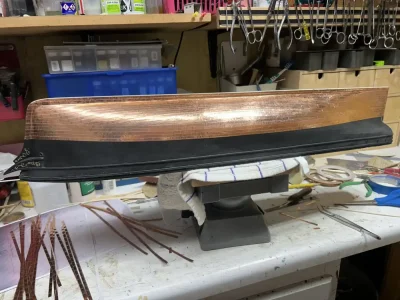
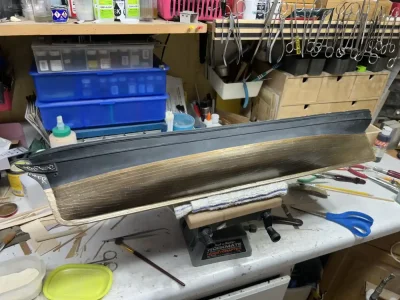
I agree completely. Deadeye lashings are dark brown or black. Now, how about copper? It was never bright and polished, and the nails were Flat headed, and pounded in flush. Also, they could never use Iron Pintles and gudgeons on a copper bottom, due to dissimilar metal contact corrosion.
 
Hi Bob. good to see you here. Your comments are so true, concerning this subject. I can only hope that the most discriminating modeler, who does not overlook the slightest of details when building the hulls of their models...would carry that same attention, to properly representing the lanyards as well. It is always a disappointment to see such mistakes on an otherwise accurate model.

I always weather my models...applying appropriate discoloration and oxidization...representing actual conditions. Makes for a more believable representation IMHV.

Rob
 
Hi Bob. good to see you here. Your comments are so true, concerning this subject. I can only hope that the most discriminating modeler, who does not overlook the slightest of details when building the hulls of their models...would carry that same attention, to properly representing the lanyards as well. It is always a disappointment to see such mistakes on an otherwise accurate model.

I always weather my models...applying appropriate discoloration and oxidization...representing actual conditions. Makes for a more believable representation IMHV.

Rob

Hi Rob! Good to see you here, too. I was one of those "muzzled" by that other forum about a year or so ago, I guess. You have to pay homage to the kit-selling gods who run that place these days, or they won't let you post in their forum.

We don't seem to hear much about weathering in ship modeling. It seems the current presentation styles run more to the "as built," somewhat sterile presentations. I'm not highly experienced with weathering. (The model railroad guys have elevated it to an artform!) Most of what I know about it is that "less is more." I think in ship modeling the problem is that so many people don't understand the basics of scale modeling. There are so many errors perpetuated by kit manufacturers and people ooo-ing and ahh-ing at "finished" posts of what are decidedly inaccurate and out-of-scale mediocre models. It's not the modeler's fault, (except to the extent they refuse to educate themselves on the subject.) They don't know what they are modeling really looks like and all can only "follow the instructions." I wonder what they'd do with "weathering" if it ever "became a thing," considering what they've done with out of scale copper sheathing jobs, "bowling pin" shaped belaying pins, white deadeye lanyards, and trunnel-poxed decks and topsides.
 
Back
Top