
-
SUBSCRIBE TO SHIPS IN SCALE TODAY!
The beloved Ships in Scale Magazine is back and charting a new course for 2026!
Discover new skills, new techniques, and new inspirations in every issue.
NOTE THAT OUR NEXT ISSUE WILL BE July/August 2026 -

Win a Free Custom Engraved Brass Coin!!!
As a way to introduce our brass coins to the community, we will raffle off a free coin during the month of August. Follow link ABOVE for instructions for entering.
You are using an out of date browser. It may not display this or other websites correctly.
You should upgrade or use an alternative browser.
You should upgrade or use an alternative browser.

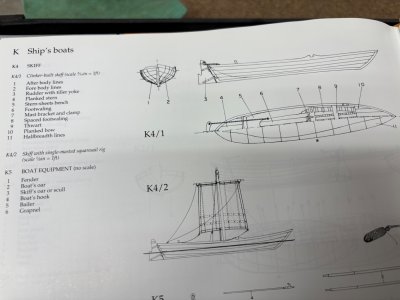
Thanks for the info. I have these boats built. What I require is a Skiff as per my picture. Does anyone know of a supplier?
- Joined
- Oct 2, 2025
- Messages
- 488
- Points
- 158

This can be seen as an opportunity to expand perspective and skill set.
Rather than assembling already completed components, it could involve adding a bit of sweat equity.
A synthesis of the techniques in the above three threads shows one HOW to get a skiff.
Several old general ship modeling books have a couple of pages devoted to carving a boat from a small block of Sugar Pine.
If it is a wood component and tool problem, you could contact Ev at the Lumberyard and see if a timber set from there is a possibility. Get lots extra to allow for multiple attempts for the learning of it. I am betting that the planking would be best done using archival paper or card and maybe the Lumberyard can help with that. A hand fretsaw, files, micro sanding block, a chisel and a gouge or two . this project is not at all tool heavy.
Rather than assembling already completed components, it could involve adding a bit of sweat equity.
A synthesis of the techniques in the above three threads shows one HOW to get a skiff.
Several old general ship modeling books have a couple of pages devoted to carving a boat from a small block of Sugar Pine.
If it is a wood component and tool problem, you could contact Ev at the Lumberyard and see if a timber set from there is a possibility. Get lots extra to allow for multiple attempts for the learning of it. I am betting that the planking would be best done using archival paper or card and maybe the Lumberyard can help with that. A hand fretsaw, files, micro sanding block, a chisel and a gouge or two . this project is not at all tool heavy.

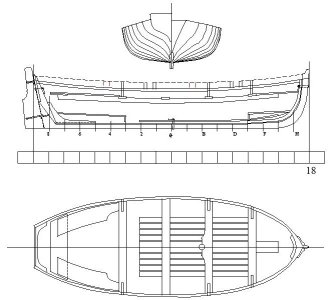
Do you know if the drawing you posted is based on historic information of her skiffs? John Gathrey and Joseph Banks. both had private skiffs on board in addition to her other three boats. I would be surprised if there is any detailed information on what either one of them looked like, sizes, etc. Hope someone finds details. There are several contemporary plans of skiffs on the RMG Collections website but they are late 19th century when keels were seen on some the contemporary drawings. Still might be useful. They have others but not available on-line so a guess as to how appropriate they would be. From what I could research skiffs generally, not always, featured a flat bottom with no keel and a squared-off transom unlike the drawing you have. Like most things in our hobby, there are very few absolutes. Cutters were predominantly lapstrake built, not carvel built which does seem to match up with the drawing you have. If you know the lengths of the two skiffs, a yawl or cutter drawing might work if you modify the drawing to have more of a flat bottom, reduce the breadth and leave off the keel. There are about 2000 contemporary English cutter plans on the RMG website.
Allan
Allan
Last edited:
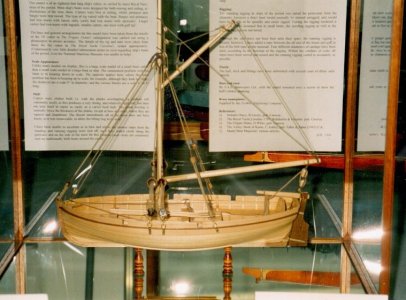
In Marquards book it makes mention of Mr. Banks skiff. A clinker built wherry type boat. As you can see in the photo it has a distinct side profile.Do you know if the drawing you posted is based on historic information of her skiffs? John Gathrey and Joseph Banks. both had private skiffs on board in addition to her other three boats. I would be surprised if there is any detailed information on what either one of them looked like, sizes, etc. Hope someone finds details. There are several contemporary plans of skiffs on the RMG Collections website but they are late 19th century when keels were seen on some the contemporary drawings. Still might be useful. They have others but not available on-line so a guess as to how appropriate they would be. From what I could research skiffs generally, not always, featured a flat bottom with no keel and a squared-off transom unlike the drawing you have. Like most things in our hobby, there are very few absolutes. Cutters were predominantly lapstrake built, not carvel built which does seem to match up with the drawing you have. If you know the lengths of the two skiffs, a yawl or cutter drawing might work if you modify the drawing to have more of a flat bottom, reduce the breadth and leave off the keel. There are about 2000 contemporary English cutter plans on the RMG website.
Allan
View attachment 582647
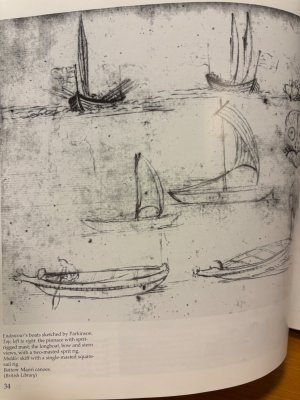
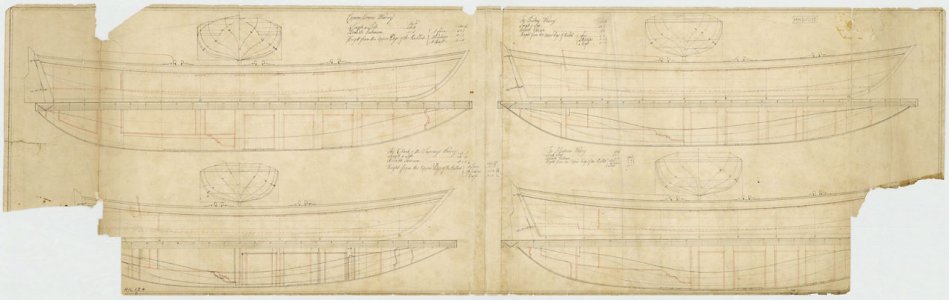
You probably already have these but just in case,.... If you are OK with low resolution drawings there are drawings of wherries on the RMG Collections website that may be helpful.A clinker built wherry type boat.
Go to the website and type wherry plans in the search box and several drawings will come up including the below which is mid to late eighteenth century
https://www.rmg.co.uk/collections
Allan
Last edited:

Yu probably already have these but just in case,.... If you are OK with low resolution drawings there are drawings of wherries on the RMG Collections website that may be helpful.
Go to the website and type wherry plans in the search box and several drawings will come up including the below which is mid to late eighteenth century
https://www.rmg.co.uk/collections
Allan
Thanks for that. I have zero experience in scratch building wooden boats. However I do have a Midwest products Canadian Canoe that I haven't got to. Maybe I could take the plans to Staples and have them resize to something I could work with. Also I built the Billings Oseberg but don't have the plans anymore. It is a clinker build. I'll contact them to see if I could get them.Yu probably already have these but just in case,.... If you are OK with low resolution drawings there are drawings of wherries on the RMG Collections website that may be helpful.
Go to the website and type wherry plans in the search box and several drawings will come up including the below which is mid to late eighteenth century
https://www.rmg.co.uk/collections
Allan
View attachment 582972
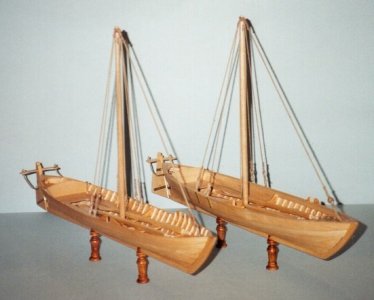
Those look great. Do you know where I could get plans for them? Thnx.I have made both of these to a scale of 3/4":1':
View attachment 583061
The nearest of Banks' skiffs was finished as a Thames skiff and the other hull as a Shetland yole.
View attachment 583063
It seems like the term skiffs has applied to a lot of different small boat designs over the years. FWIW Thames skiffs were heavily produced, but about 120 years or more after the Endeavour sailed with Cook and Ron Bankes' skiffs were built starting in 1968 so maybe not the best design match for what would have been on the Endeavour without a lot of modifications. Your choice of course, and I bet it will be a fun project no matter what you decide. Looking forward to your build. 
Allan
Allan
Both come from Anatomy of the Ship series of books. The Banks' skiff is in the Endeavour book and the 18ft cutter in the HMS Diana book. The lines can be scanned and produced at whatever size you want on your PC/Laptop.Those look great. Do you know where I could get plans for them? Thnx.
Good luck,
Mike
I'm going with the sweat equity option because there's no other choice. I'm girding my loins as we speak.This can be seen as an opportunity to expand perspective and skill set.
Rather than assembling already completed components, it could involve adding a bit of sweat equity.
A synthesis of the techniques in the above three threads shows one HOW to get a skiff.
Several old general ship modeling books have a couple of pages devoted to carving a boat from a small block of Sugar Pine.
If it is a wood component and tool problem, you could contact Ev at the Lumberyard and see if a timber set from there is a possibility. Get lots extra to allow for multiple attempts for the learning of it. I am betting that the planking would be best done using archival paper or card and maybe the Lumberyard can help with that. A hand fretsaw, files, micro sanding block, a chisel and a gouge or two . this project is not at all tool heavy.
- Joined
- Oct 2, 2025
- Messages
- 488
- Points
- 158
Now for the cliche:
It looks more difficult than it is for the first time.
It is not a whole boat. It is a series of much small parts that need fabricating.
Now for what probably should oughta be cliche:
Pretend someone you resent just told you that you can't do it.
Get angry! Get determined! Grit your teeth and show them they are FOS!
It is only wood, It does grow on (in actually) trees. If something is not quite right and your choice is use it anyway or do it over? Just know, if you use the faulty part anyway, it will be about the only thing that you see every time you look at the boat.
It looks more difficult than it is for the first time.
It is not a whole boat. It is a series of much small parts that need fabricating.
Now for what probably should oughta be cliche:
Pretend someone you resent just told you that you can't do it.
Get angry! Get determined! Grit your teeth and show them they are FOS!
It is only wood, It does grow on (in actually) trees. If something is not quite right and your choice is use it anyway or do it over? Just know, if you use the faulty part anyway, it will be about the only thing that you see every time you look at the boat.
Both come from Anatomy of the Ship series of books. The Banks' skiff is in the Endeavour book
Hi Wilk
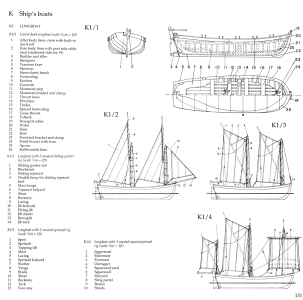
We may be talking about different things. There are the Ron Bankes skiffs from the Bankes company and there are also the English banks and Thames skiffs. The 18th century English banks boats were hard chined and/or flat bottomed, often without a keel. Does this match up with either of the AOS Endeavour book skiffs? Can you please post the drawing of the skiff? A one page or partial page post should not be a copyright problem. The long boat drawings are easy to find from the book but neither of the skiffs.
Thank you very much
Allan
Longboat page
Well, old age and persistence sometimes pays off. After some more inter web searching I was looking at the pictures of the Jotika Endeavour. Lo and behold it comes with the 4 ships boats. Most importantly Mr. Banks skiff. I contacted John Wright at shipwrightshop.com and he was gracious enough to send me the materials including a sheet plan for building. Nice little plank on bulk head models. So if you are looking for the most accurate to date version of the Endeavour, this is a kit to seriously consider.