



• Ships of Scale has incorportated an extra level of security when you log In. Please follow on-screen prompts to acknowledge that you are not a robot via a "Check Box" or a "Pictorial Check Box Puzzle". This is needed due to higher level of AI Activity Security.
  • SUBSCRIBE TO SHIPS IN SCALE TODAY!

    The beloved Ships in Scale Magazine is back and charting a new course for 2026!
    Discover new skills, new techniques, and new inspirations in every issue.

    NOTE THAT OUR NEXT ISSUE WILL BE July/August 2026
  • Win a Free Custom Engraved Brass Coin!!!
    As a way to introduce our brass coins to the community, we will raffle off a free coin during the month of August. Follow link ABOVE for instructions for entering.

Soleil Royal by KevinW - Heller 1:100

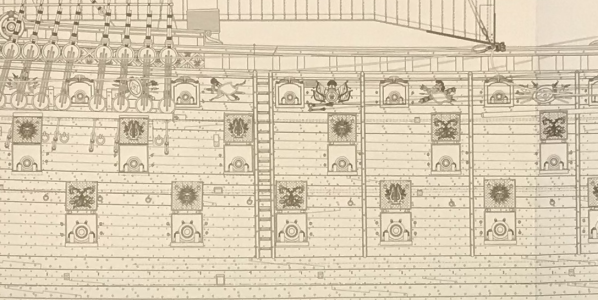
I'm about ready to start rivetting now and would appreciate views on my logic on the spacing and positioning before I get going. I would think the planking and wales would have been principally nailed and rivetted to the frames, so one would see a series of vertical rows, much as you see on aircraft. Looking at this drawing, that's what I do see, along with the odd non-pattern for sundry items which would be also be typical of this method of assembly. Then I also see the four much larger heads two either side of the gunports, whose purpose I don't know - would they have been much beefier bolts to stop the recoil tearing the frames from the planking, or even through-bolts with eyelets on the other end, for the gun rigging?
1792672735313.png
 
Your idea to approach this incrementally with plenty of breaks is the way to go!

Those through-bolts to either side of the port opennings are, indeed, for securing the rings that the breaching rope and haul-in tackles connect with.

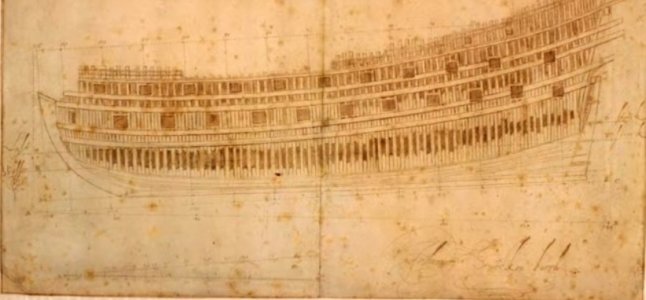
On a warship of this size, frame spacing would have been very close, and the futtocks would overlap along the wale belts, so a more or less even distribution of fasteners checks the plausibility box.

Dutch, and from somewhere within the 1650s - 60s, but you get the idea:

IMG_6244.jpeg
 
Hi Kevin

On French ships of this period, the gun rigging eyebolts passed completely through the hull and were secured with a washer and wedge that passed vertically down through a slot in the protruding part of the eyebolt.
I may be wrong, but I am sure English ships of the period used the same method, however the eyebolt ends were secured underneath the hull planking so not visible.

French ships of this period used one square iron nail and one square treenail per connection between plank and frame placed diagonally in the contact area

Kind Regards

Nigel
 
Back
Top