• Win a Free Custom Engraved Brass Coin!!!
    As a way to introduce our brass coins to the community, we will raffle off a free coin during the month of August. Follow link ABOVE for instructions for entering.
  • SUBSCRIBE TO SHIPS IN SCALE TODAY!

    The beloved Ships in Scale Magazine is back and charting a new course for 2026!
    Discover new skills, new techniques, and new inspirations in every issue.

    NOTE THAT OUR NEXT ISSUE WILL BE MARCH/APRIL 2026

Soleil Royal

This seems backwards. Basswood is soft (410 pounds force on the Janka scale, whereas birch is 1260 lbf, three times harder, and less prone to dents and such. I wonder why they have the better modeling wood for the first layer that will be covered over with a soft species.
Allan
I agree. Just about any pale hardwood would be an improvement, especially if you were not going to paint the bottom of the hull. Holly would be a great choice since it is bright white. Of course, you would have to cut the planks at the interface where they meet the dark planks above.
 
This seems backwards. Basswood is soft (410 pounds force on the Janka scale, whereas birch is 1260 lbf, three times harder, and less prone to dents and such. I wonder why they have the better modeling wood for the first layer that will be covered over with a soft species.
Allan
You are probably right, and the order is backwards, I was trying to answer Darivs architect and found the information in the build log of someone in the club!
 
Hi everyone!! I didn't write sooner because I was doing my other boat, the Sovereign of the seas, and because I decided to
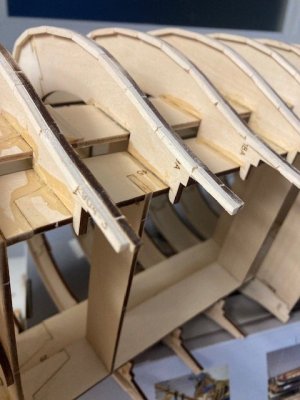
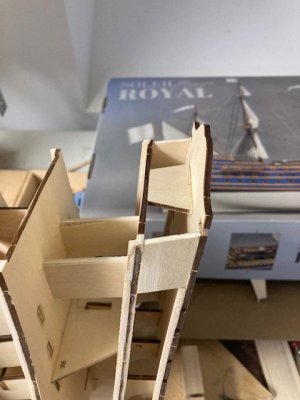
enlarge the ribs of the boat to 6 MM because the 3 MM ribs (original width) is not wide enough to my taste! quite long and tedious work , considering their are 12 pieces per rib, 18 ribs, and two sides! I secured the little pieces of wood with fibreglass Epoxy. The pieces of wood I used are scraps from the boards on which were the large frame parts. I enclose a few pictures of the different steps. Also, I strengthened the last Rib of the boat with additional timbers for more strength for the later steps, because I work with the boat on my laps a lot of the time. I enclose also a picture of the reinforcements I did.

IMG_2774.jpeg

IMG_2776.jpeg
 
Hi everyone!! I didn't write sooner because I was doing my other boat, the Sovereign of the seas, and because I decided to
enlarge the ribs of the boat to 6 MM because the 3 MM ribs (original width) is not wide enough to my taste! quite long and tedious work , considering their are 12 pieces per rib, 18 ribs, and two sides! I secured the little pieces of wood with fibreglass Epoxy. The pieces of wood I used are scraps from the boards on which were the large frame parts. I enclose a few pictures of the different steps. Also, I strengthened the last Rib of the boat with additional timbers for more strength for the later steps, because I work with the boat on my laps a lot of the time. I enclose also a picture of the reinforcements I did.

View attachment 581084

View attachment 581085
Did you enlarge the frame width to make it a little easier to glue the planks to them, or to hit the frame with pins to hold the planks down, or for some other reason? After first planking on on the hull, one usually has made vertical pencil lines on the planking to show where the centerline of each frame is. That way, you can locate the ends of strakes of the final planks directly on the frames.

If you are worried about f;at spots and hard bend lines wherethe planking has increase curvature near as you get closer to the bow, balsa filler blocks glued to the frames and sanded to the desired shape can help you maintain port-starboard symmetry of the hull in those areas. I found it saves a few steps of filling/sanding of the first planking layer.

Assembling the skeleton of frames on a model is one of the more fun parts of building. Your hull looks really good so far.
 
Last edited:
Did you enlarge the frame width to make it a little easier to glue the planks to them, or to hit the frame with pins to hold the planks down, or for some other reason? After first planking on on the hull, one usually has made vertical pencil lines on the planking to show where the centerline of each frame is. That way, you can locate the ends of strakes of the final planks directly on the frames.

If you are worried about f;at spots and hard bend lines wherethe planking has increase curvature near as you get closer to the bow, balsa filler blocks glued to the frames and sanded to the desired shape can help you maintain port-starboard symmetry of the hull in those areas. I found it saves a few steps of filling/sanding of the first planking layer.

Assembling the skeleton of frames on a model is one of the more fun parts of building. Your hull looks really good so far.
Allô!!
Thanks for your comments!! Actually, I only glue the planks on the frames. I never pegged them, I like to let the boards shine by their natural beauty without the pegs heads interfering, that's wy I enlarged the frames, I want a good contact spot. I started fairing the frames last night, which is the most important step in a nice Hull, but I HATE doing that.....I might put balsa in the nose of the boat, you're right, it helps a lot. If you have time, go in the Forum on "help with models", I posted a trick I do with Rudders.
My post is : the lucky charm rudder... talk to you soon.

 
Allô!!
Thanks for your comments!! Actually, I only glue the planks on the frames. I never pegged them, I like to let the boards shine by their natural beauty without the pegs heads interfering, that's wy I enlarged the frames, I want a good contact spot. I started fairing the frames last night, which is the most important step in a nice Hull, but I HATE doing that.....I might put balsa in the nose of the boat, you're right, it helps a lot. If you have time, go in the Forum on "help with models", I posted a trick I do with Rudders.
My post is : the lucky charm rudder... talk to you soon.

Will do! I could use a new trick or two, even one for the rudder! :D
 
Back
Top