
• Win a Free Custom Engraved Brass Coin!!!
    As a way to introduce our brass coins to the community, we will raffle off a free coin during the month of August. Follow link ABOVE for instructions for entering.

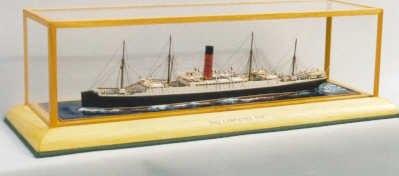
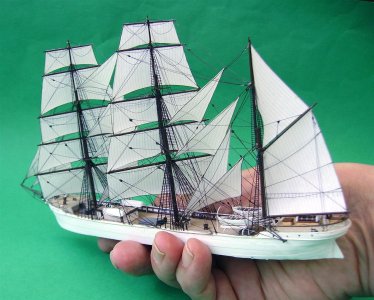
Some of my model ships

It would seem that Wyoming was measured like a monkey measures the length of his privates... from the end of his tail. She may be the "largest wooden hulled sailing ship ever built, but she is not the largest wooden hulled ship ever built. Wyoming was 450 feet long "overall," meaning "including sparing protrusions, i.e., boom and bowsprit overhangs, but her hull was actually 350 feet long "on deck," and 329 feet long between perpendiculars. She had a beam of 50.1 feet.

The record for the largest wooden hulls ever built is shared by the Central Pacific (later the Southern Pacific) Railroad's train ferries, Solano (1879) and her near sister, Contra Costa (1914), which carried entire railroad trains across the Carquinez Strait between Benicia and Port Costa in California daily for 51 years, from 1879 to 1930. Solano's hull was 425 feet long on deck with a beam of 116 feet, seventy-five feet longer that Wyoming and almost two and a half times as wide as Wyoming. Contra Costa, built later to the same plans as Solano, had a hull that was "stretched" 13 feet longer than her sister's to a total of 438 feet on deck or eighty-eight feet longer than Wyoming's hull.

See: https://en.wikipedia.org/wiki/Solano_(ferry)#Operation

No matter how one might measure Wyoming's hull, these two steam powered ferries were the largest wooden hulled ships ever built.

View attachment 560081

View attachment 560083
View attachment 560082

View attachment 560093
Contra Costa:
View attachment 560094


[td width="43.8586%"][/td]
I would imagine that the description of the Wyoming meant the largest wooden "sailing ship". The Solano was a ferry boat trading in enclosed waters and certainly not subject to the massive stresses and strains that the Wyoming had to contend with in the open sea!
 
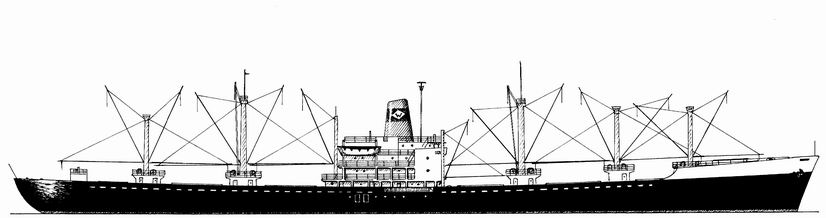
I keep thinking about making an attempt at a model of the C4 African Comet or Pioneer Myth, both of which still bring back fond memories of my time aboard each of them. Time to look for drawings....... If anyone has places to look, I would be grateful.
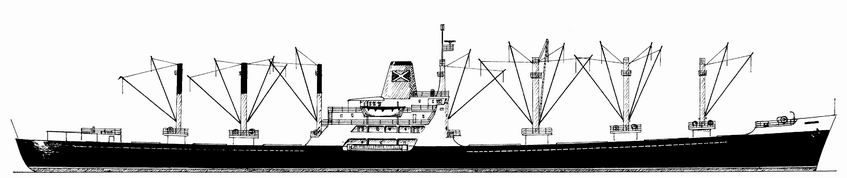
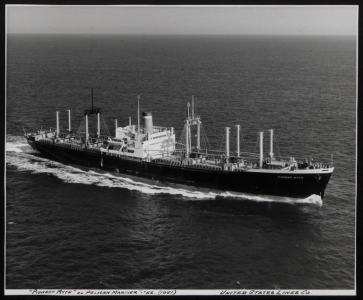
Obtaining builder's plans for these vessels should be relatively easy. If you can't obtain the specific plans in the Smithsonian's plans collection, then MARAD should have them or be able to give you a running head start on ordering builder's plans from the National Archives which should have copies pursuant to the National Historic Preservation Act.

(AI generated answer in italics)

The Maritime Administration (MARAD) has a rich collection of ship plans that date back to the 1930s and include plans for various types of vessels. This collection is part of the MARAD Vessel History Database, which provides detailed information about the vessels owned, operated, or subsidized by MARAD and its predecessor agencies. The database includes vessel characteristics, images of vessel status cards, and for select vessels, photographs, milestones, documents, and narrative histories. MARAD also documents NDRF vessels in compliance with Section 106 of the National Historic Preservation Act to ensure a record of their legacy remains after they are recycled.

https://www.bing.com/ck/a?!&&p=31fc...y93b3JrLWFuZC1pbmR1c3RyeS9zaGlwLXBsYW5z&ntb=1

See: Smithsonian Institution


For those interested in exploring the MARAD collection of ship plans, the National Museum of American History offers black-line reproductions of many of the plans for sale. The collection includes plans for historic American watercraft, American sailing and early steam warships, and various designs from the 1950s and 1960s.


See generally: https://www.maritime.dot.gov/outreach/history/maritime-administration-history-program


C4-S-58A (MA-103) AFRICAN COMET

1764371742097.png


C4-S-1a (MA-9) PIONEER MYTH - EX PELICAN MARINER
1764372314416.png

Drawing of C4-S-1a sistership in Waterman colors.
1764372785778.png
See also online plans at: https://vamosarema.com/

Also search https://www.themodelshipwright.com/ for "mother lode" of free scratch-building plans online.
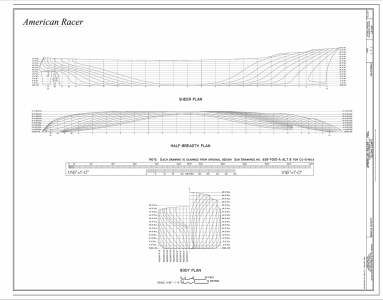
Also search https://www.maritime.dot.gov/sites/...dministration/856/americanracerhaerreport.pdf for HAER survey plans, as well.

HAER report on C4 series cargo vessel hull lines:


1764376312711.png
 
Last edited:
Bob,
I went through much of what you sent. I wish I had sailed on the American Racer, the plans are VERY detailed. One question (for now) :) .......The following site that you listed looks to be an interior decorator site. https://vamosarema.com/ ??????
Thanks again
Allan
 
Bob,
I went through much of what you sent. I wish I had sailed on the American Racer, the plans are VERY detailed. One question (for now) :) .......The following site that you listed looks to be an interior decorator site. https://vamosarema.com/ ??????
Thanks again
Allan

Sorry about that! I should have checked that link instead of just copying it from the AI response. It's actually the correct link, but you'd never know it by looking at what you get. As is obviously from the layout, it's a rather early internet file layout. Nobody seems to know why, but the Smithsonian seems to be way behind the curve in terms of digitalization. I expect they are still buying index cards by the pallet-load. If you try this link, you'll probably get much the same result: https://www.americanhistory.si.edu/about/departments/work-and-industry/ship-plans. Scroll down and you will get an old-fashioned link list for "Ship plans" information. It's all there.

There is another link that will get you to the latest version of the Smithsonian's ship plan ordering information: https://americanhistory.si.edu/about/departments/work-and-industry/ship-plans

You'll find the MARAD plans file information there, such as it is. It's maddening, but the "drill" when ordering vessel plans from the Smithsonian requires one to first buy a printed copy of the desired "plans catalog" from them, then to order the desired plans copies as they are referenced in the catalog. It's a two-step, two-pay, process. It's really quite a PIA compared to the "museum state of the art" that we see from other museums where not only are their plans catalogs readily available online, but, increasingly, so are the plans digitally available online at no charge. Apparently, the Smithsonian, (and Mystic, for that matter,) considers their plans collections to be profit centers rather than public resources available at cost, if at all. Obviously, we can't expect these institutions to be copying ships plans on demand on their own dime, but I do think it's a bit cheeky for public, nonprofit educational institutions, to manage access to their resources, most of which have been donated, or purchased with donated funds for preservation in the public interest, in such archaic ways for the obvious purpose of maximizing their monetization. It would be lovely if someone would have copied the full set of Smithsonian ships plans catalogs and posted them in PDF format somewhere, but the Smithsonian is very explicit in reminding one and all that they hold the copyright to anything you purchase from them.

From all reports as well as my own firsthand experience, the staff at the Smithsonian are very knowledgeable and helpful, but not available to do your research for you in the first instance. The main difficulty is that their online access is not "user friendly," if it exists at all. I am sure there are contract research services available covering the Smithsonian, as there are for most major institutional repositories, but they do come at what is probably a price which would be sufficient to cause one to patiently slog through the bureaucracy via "snail mail" on their own dime.

Fortunately, the HAER survey documents are online in both PDF and TIFF format at no cost whatsoever. (TIFF being far better because the plans can be enlarged without the lines widening correspondingly and reducing their accuracy. I believe but am not absolutely certain that the American Racer represents a basic C4 series MARAD hull without modifications. I believe the variations on the C4 series MARAD design involved the deck layouts (size and location of cargo hatches and cargo handling gear, both break bulk and intermodal containerized) and the configuration of the midships superstructure while the hull shape remained standard throughout the C4 series.

The grand irony is that I'm betting that the Smithsonian would sell a lot more ship's plans at ten bucks a sheet if they would post their catalogs online instead of charging $25 (plus shipping) per catalog just for the privilege of seeing what they've got!
 
Last edited:
My experience is that all of these non profit entities (and the US Government is certainly one) are highly dependent on the personal interests of who is in charge. Us old guys all remember when Chapelle was that guy. Recently, they decollected (their term, not mine) all of the materials that he used to make his drawings and to write his books. Fortunately Texas A&M University agreed to archive them. The current maritime collection guy has retired with reportedly no interest in replacing him.

Everyone would be better off if they would license someone to digitize their collection and to sell plans with the Smithsonian receiving a royalty.

Roger
 
I sent a response and received one in return that they may not be able to respond about the plans I am looking for. Lack of staff/time/etc.

I can't think of a better example of the difference between working for the government and working for private industry! How long would a private provider remain in business if they gave the same response to customer orders as the Smithsonian has! :rolleyes:

There's probably a lot of truth to the observation that management emphasizes their own interests, although there is in addition to that the paradigm shift museums are experiencing (or rather their patrons are experiencing) to emphasizing "entertaining" interactive exhibits over playing the role of a research resource collecting and conserving records and artifacts for academic purposes. Look no further than what passes for "history" on the History Channel. The public is more interested in extraterrestrial abductions and nonconsensual anal probes that in real history, so that's what they get.
 
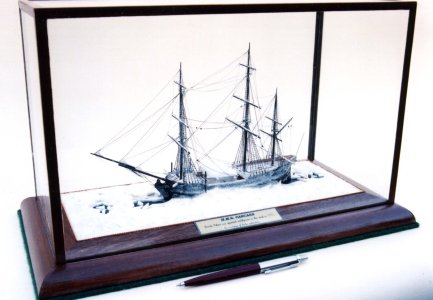
Carcass was about three inches long on the waterline. I built it very quickly (on request) for a specialist Nelson sale in London. But they said it wasn't suitable because no-one was interested in his smaller ships. So it was entered in a normal sale and went for an astonishing price, almost £800. It remains my greatest success in £s per hour building time. I didn't even like it much, as these Napoleonic type vessels appear quite ugly to me. I prefer the big iron and steel sailing ships of the late 19th century, although I realise that I am very much in a minority.
If it had been entered in th Nelson sale, it could have gone for a lot more.
It was not very detailed, because the decks were mainly covered in ice and snow. Neither did I like the dark wood case that they requested as well!


Best picture.jpg
 
Back
Top