
• Ships of Scale has incorportated an extra level of security when you log In. Please follow on-screen prompts to acknowledge that you are not a robot via a "Check Box" or a "Pictorial Check Box Puzzle". This is needed due to higher level of AI Activity Security.
  • SUBSCRIBE TO SHIPS IN SCALE TODAY!

    The beloved Ships in Scale Magazine is back and charting a new course for 2026!
    Discover new skills, new techniques, and new inspirations in every issue.

    NOTE THAT OUR NEXT ISSUE WILL BE July/August 2026
  • Win a Free Custom Engraved Brass Coin!!!
    As a way to introduce our brass coins to the community, we will raffle off a free coin during the month of August. Follow link ABOVE for instructions for entering.

standing rigging rope color

Joined
Nov 26, 2021
Messages
394
Points
238

Location
Virginia
Question for the group...
I'm searching for thread for the standing rigging on my OcCre Endurance. The thread they supplied is cotton. It's good thread and easy to work with, but I wanted to go with Gutermann polyester to avoid the fuzziness with cotton thread. I found these 2 spools. From what I've seen, kit thread for standing rigging is usually brown to represent tar build up on the rope. Seems the consensus on SoS is that black is too black. Of the 2 thread colors below, which do you think is more realistic looking? The one on the right is straight brown. The one on the left looks more tar-like in my opinion, but looks like there's some green in it. What are your thoughts? Hope the photos are good enough.
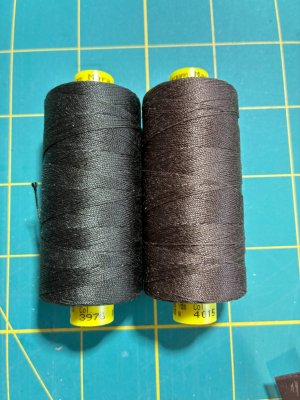
IMG_1311.jpg
 
this would indicate that the first is closer. However, I'm wondering if with distance and time (bleaching)... would it turn into #2?
1771169928168.png
 
this would indicate that the first is closer. However, I'm wondering if with distance and time (bleaching)... would it turn into #2?
View attachment 578317
Great picture and insightful statement. I thought the first looked more like tar, but since my Endurance will ultimately be in a diorama depicting it's last days afloat, I wonder if the brown would be better because, as you said, it would be weathered and sun-bleached.
 
Another way to look at it, which is practical, is there a range of size of Mara treads for the given color (from 120 to 30, for example)? I found that for me that was one limitation.
 
either one will look fine but i like the black better. after your model collects dust over time it will look very authentic.
 
Question for the group...
I'm searching for thread for the standing rigging on my OcCre Endurance. The thread they supplied is cotton. It's good thread and easy to work with, but I wanted to go with Gutermann polyester to avoid the fuzziness with cotton thread. I found these 2 spools. From what I've seen, kit thread for standing rigging is usually brown to represent tar build up on the rope. Seems the consensus on SoS is that black is too black. Of the 2 thread colors below, which do you think is more realistic looking? The one on the right is straight brown. The one on the left looks more tar-like in my opinion, but looks like there's some green in it. What are your thoughts? Hope the photos are good enough.
View attachment 578316
New tarred ropes look like the right ones.
 
But standing ropes (nets) were tarred on board, over and over again, so they were black. Now black seems to be to black on a model. Black with a brown shade ?
 
This is really flippant but here goes. What was the exact location of the trees that the tar for your ship came from and how long was the tar stored before it was used?

Not only does the local area and environment for the trees have an effect on the color but also, a fresh batch of Stockholm tar typically has a light amber or golden-brown hue and tar that has aged for several years in a container will drastically darken. It seems there is a wide range of color from light brown to dark brown that would be appropriate.

Allan
 
This is really flippant but here goes. What was the exact location of the trees that the tar for your ship came from and how long was the tar stored before it was used?

Not only does the local area and environment for the trees have an effect on the color but also, a fresh batch of Stockholm tar typically has a light amber or golden-brown hue and tar that has aged for several years in a container will drastically darken. It seems there is a wide range of color from light brown to dark brown that would be appropriate.

Allan
Dear Allan, I never said you were wrong. I say what I lived and saw. In my days Stockholm Tar (Archangel tar) or pine tar, came from"Stockholm" (Sweden). It came in 200 liter (52 gallons) drums. The stuff itself was, not black (but smelly), but as said all standing rigging was tarred and retarred on board against rot and it showed "black". I never saw a ship with "new" rigging. I did 2 Atlantic crossings, 17 years old, on a 3 masted square rigger. As I was the youngest, my dedicated job in port was the (re)tarring of the bowsprit netting and rigging. Half a day job. No warm water, no saop, sand and sailcloth to scrape most off, before going ashore. You don't have to believe me, people (and the girls) smelled me before I was in sight. No "white" lines (sisal) on board. After about 3 months all running rigging (hemp, manilla ((not seen on board)) was "grey", not sanded decks were "grey". All paint (and the tar) got salt on them. Sails get "grey", but a different one. Not polished copper (under water) is brownish (with a pink shade). Actual schoolschips and museum pieces are showcases only. Navy ships had to keep people bussy, commercial ships were short of people. I like models as the real ships looked (from afar) , some like them "as built". And they are right.
 
In case you're interested.
Russian 19th-century manuals on seamanship also emphasized the need for the constant restoration of the protective coatings on spars and rigging—not merely as a way to "keep the crew busy," but to safeguard the spars and rigging against the damaging effects of the environment. It was especially hard for the sailors in equatorial waters, when tar poured down from the rigging and masts like rain. :)
 
Hubrecht, I was just joking, but wanted to point out that the tar varied in color so there really is no way to know how dark brown or grey it really was on any given ship on any given day. For a change we all get to have choices on what we put on the model. :)
Cheers
Allan
 
Did the world of tar start to change in 1859?
Once petroleum started being pumped on a large scale, would vessels start using asphalt based tar? Would it be essentially be 000 000 000 black?

The salt spray coating - that would make a difference in how an asphalt coated line would look on a working vessel and the pure black in the museum docked ones?
 
Back
Top