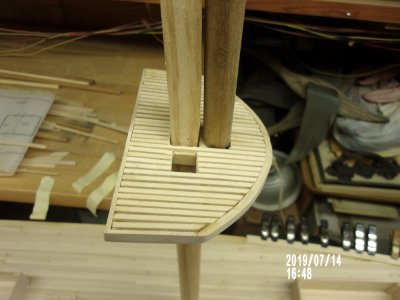
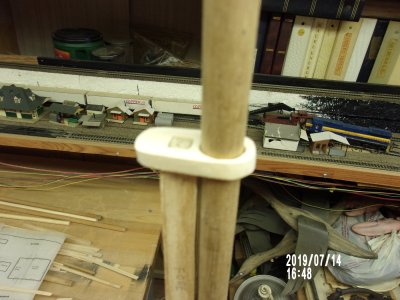
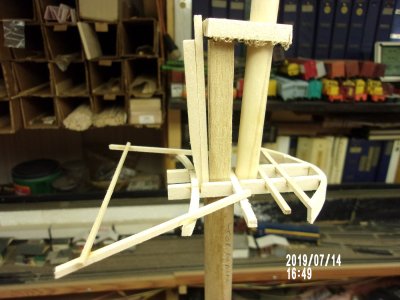
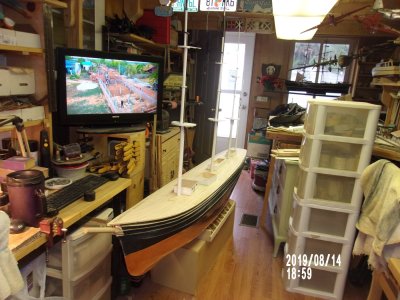
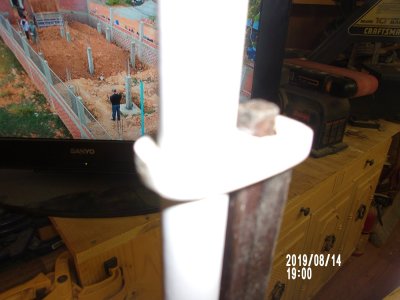
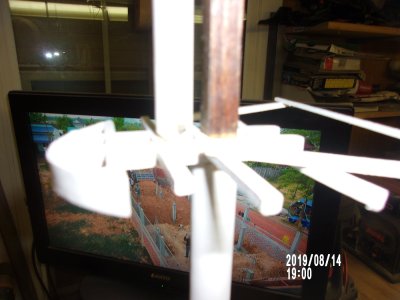
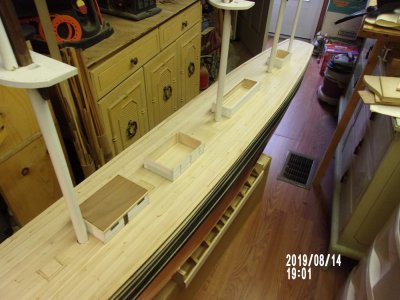
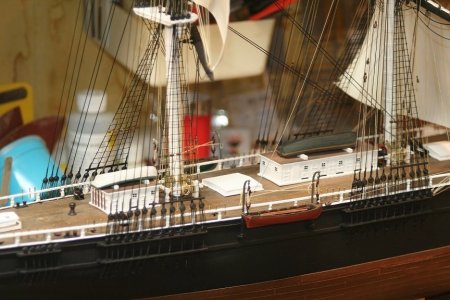
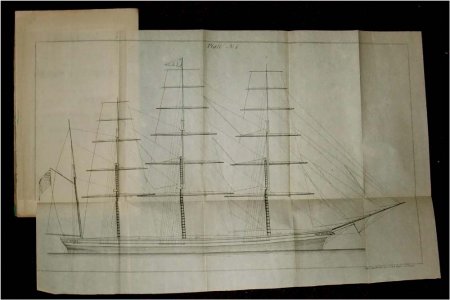
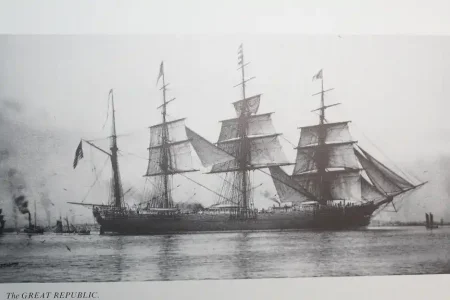
OK...after rattling this subject around in my brain for what seams like years....I would like to point out an area of misunderstanding...most have, concerning the double topsail configuration. To begin with...prior to 1853 the double topsail issue had been partially tackled by Forbes...in or around 1844. Up to that point, The large single topsail was standard on clippers. The topsails root was just under the topmast topgallant mast doubling. The sail would be lowered about half way down the mast to reduce its area...causing the topsail to be double reefed....permitting the topsail to flop over the main course. Forbes idea was to split the topsail and have both the Upper and lower portions to be lowered separately. The image above shows the GR having the Forbes extra long main mast doubling...so the lower topsail could run down the topmast doubling. Remember the topsail proper is both sails....because the old designed topsail went from topmast doubling to main mast doubling.
Now if we count the sails in the above image...we count...the main course, the split double topsail, a topgallant and a royal. That's it.
Since this image is of GR when she was first build...due to the main rail present...we can conclude the topsails are of a modified Forbes design....which matches Duncan McClean's description. Again...in this image GR has no higher sail then Royals, on all masts.
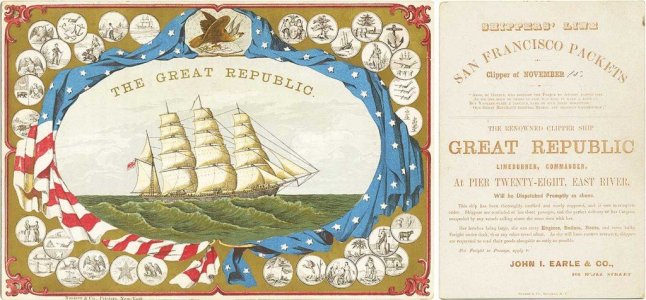
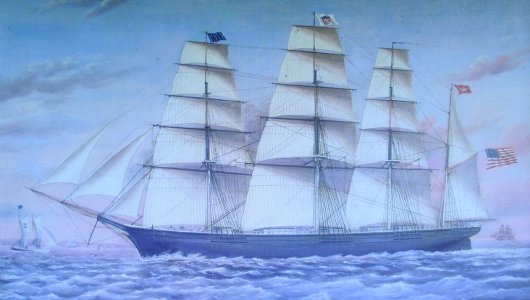
The confusion comes...when GR was converted to the now more modern Howes design(after 1853)...which spit the topsail into the upper and lower topsails(Like Forbes...but). Difference is that Howes made fast the lower via an iron crane mounted to the lower mast top....preventing its movement. You then reduced the upper topsail by simply lowering it to the lower. At this time, in her modification, came the addition of a skysail...making 6 sails per mast.
Knowing the evolution and time frame of GR's course of modifications....you can properly interpret the different images and paintings we see her rigging represented differently in. This process, helps eliminate as much error that has been falsely introduced over time.
I hope this analysis helps.