


- Joined
- Jan 9, 2020
- Messages
- 10,740
- Points
- 938

Zeeuws Archief
 www.zeeuwsarchief.nl
As a direct result of the excellent and comprehensive archival records of the Zeeuws Archives, I was able to obtain one of the rarest build contracts (bestekken) of a late sixteenth century Dutch vlieboot, De Zwane. De Zwane was built in 1592 in Vlissingen by master shipwright, Bastian Antonisz and was one of the ships which participated in the 1594 and 1595 expedition voyages of Willem Barentsz to find a Northern Passage. In 1594 the ship was captained by famous Dutch explorer, Cornelis Cornelissen-Nay, while the 1595 command fell to the fastest sailor in Zeeland, Lambert Gerritsz Oom.
Central to the success of finding these records, was Mr. Michiel van Wijngaarden, the Head of Information at the Zeeuws Archives. who went beyond the call of duty to assist me in this.
As such, I thought it fit to pay homage to Michiel by means of an article that was published about him and his work at the Zeeuws Archives.
Employee in focus
Thursday, November 10, 2022
Carolien van de Kreeke, communications officer
Who works at the Zeeuws Archives? What are they involved in, what do they actually do? And what is needed for that? We are happy to introduce our employees. This time we get to know Michiel van Wijngaarden, information manager.
Michiel joined the Zeeuws Archive in 2017. He was employed to help inventory the archives of the former Walcheren municipalities (1790-1966). “In 1966 there was a municipal reorganization. Until that time, many villages were independent municipalities, with their own mayor and aldermen and, of course, their own administration.” Those papers, photos, reports, building plans, and more – the archives of those municipalities – are housed at the Zeeuws Archive, and Michiel has inventoried a number of them. “That means that I organize the archive and describe what is contained in such an archive. It is a systematic description of the structure and the connections between the different items. In fact, it is a kind of guide to the archive, so you know roughly what you can find in it.”
The Archives provide a connection with Zeeland
Michiel got to know Zeeland well through this work. In his free time, he enjoys cycling and visiting the villages of Walcheren. He saw all kinds of things that seemed familiar to him, such as street names, roads, or buildings. 'For example, in Serooskerke I saw the swimming pool De Goudvijver. There is a lot to be found about it in the archive of the former municipality of Serooskerke; from the discovery of the gold coins to the speech at the opening of the swimming pool. And there was a contest; come up with a name for the swimming pool. All submissions, handwritten on a note, are in the archive.' By visiting the villages and recognizing many things, Michiel quickly felt connected to Zeeland.
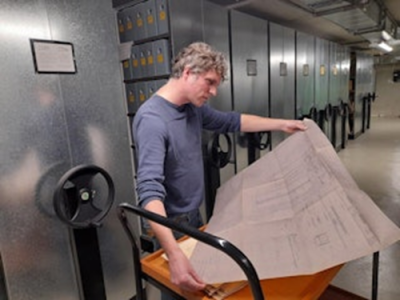
Michiel examining the construction drawing of the De Goudvijver swimming pool in the depot.
And Michiel finds that very enjoyable. Even though he is not originally from Zeeland, he quickly felt at home there thanks to his work. Michiel comes from Overijssel. After high school, he studied Civil Engineering, with a focus on architecture. Because he could not find a suitable job, he went on to study history at the University of Groningen. “Actually, I had wanted to do that earlier because at school it was my favorite subject. Seeing though that the job prospects were not so favorable, I let go of this idea.” Initially, Michiel planned to study history for one year. But he liked it so much that he completed the program. In his master’s, he specialized in Medieval history, focusing in particular on the Hanseatic League, a cooperative association of merchants and cities. “For that, I did a lot of research. I found working with the original sources fascinating.”
"By working with the municipal archives, I quickly got to know Zeeland and developed a connection with it.”
— Michiel van Wijngaarden
Zeeuwse parents
After his education, Michiel started working at the Gelders Archive as a project employee for 2.5 years. After that, he worked at Achmea, but in the meantime, he was looking forward to a job in the archival world. When he saw a vacancy at the Zeeland Archive, he didn’t have to think long and applied. He was invited for an interview, and he immediately found the contact very pleasant. He was subsequently employed.
‘How do you cope with living in Kampen and working in Zeeland?’ was a question that was regularly asked of him. Michiel’s answer is that he still lives in Kampen, but also in Middelburg. And that suits him perfectly. “In Kampen I have many contacts and a social life, I feel at home there.” But he also feels at home in Middelburg. Through a family member, he came into contact with the people with whom he lives from Tuesday to Friday. “Initially it was temporary. But by now they are ‘my Zeeland parents!’
Varied Work
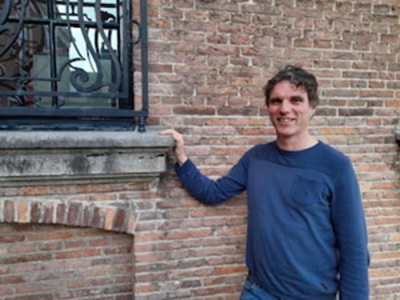
Michiel at the building of the Zeeland Archive.
After the former Walcheren municipalities, Michiel is now working on former municipalities in Zeeuws-Vlaanderen. “It is very nice to get to know another part of Zeeland. In such archives, you really come across very unique items!” In the meantime, the municipality of Hoek from 1800 to 1970 has been completed and Michiel is working on Koewacht. “That is a beautiful archive, very complete!”
In addition to the old sources, Michiel is also working with a modern application: Transkribus, a program that can automatically transcribe and tag handwritten texts. “I do that for the MCC archive. The scans are online, but they cannot be searched for words such as people, place names, or ship names. If you have transcriptions, that is possible, and it simplifies searching the archives. I create models so that Transkribus can make transcriptions.”
Michiel also works in the reading room of the Zeeuws Archives. You can find him there three half-days a week, as he registers the info emails. Every email that comes in gets a number, and Michiel distributes the questions among the colleagues. Sometimes he deals with them himself. And he keeps an eye on whether the emails have been handled. "Very diverse questions come in. We help the enquirer as best as we can by indicating which archives could be searched."
Sources which tell their own stories
“The most beautiful aspect of my work is working with old sources - old documents, once handwritten by someone. Sometimes they neatly written, sometimes less legible. Sometimes they are very detailed, other times very concise. In any case, they are always different and individual.” Michiel is also involved with the PaiZ, the Paleography working group in Zeeland. These are volunteers who, mostly at home, transcribe old sources/manuscripts. I make sure they get the required rights so that the work they perform can be displayed on our website.
Michiel is also involved in a project with 17th century letters from Suriname to the States of Zeeland. He describes these as "Very beautiful documents and letters which are full of stories. That is what I find so fascinating in my work; the stories you encounter in the archives."
****************END****************
I am happy to report that the build contracts have already been put to good use as the design process of De Zwane has already started. For those of you who are interested in how an old transcript is transformed into a tangible design and subsequent model, please see the link below:
Vlieboot »De Zwane« 1592 — Barents discovers the Arctic
. Encouraged by @Heinrich , who also provided me with interesting and essential source material — in particular, relevant contracts for the construction of vlieboots from the last decade of the 16th century, transcribed by Werner Ulrich — I decided to undertake a conceptual reconstruction of the...
shipsofscale.com
Kindest greetings
Heinrich