
-

SUBSCRIBE TO SHIPS IN SCALE TODAY!
The beloved Ships in Scale Magazine is back and charting a new course for 2026!
Discover new skills, new techniques, and new inspirations in every issue.
NOTE THAT OUR NEXT ISSUE WILL BE MARCH/APRIL 2026 -

Win a Free Custom Engraved Brass Coin!!!
As a way to introduce our brass coins to the community, we will raffle off a free coin during the month of August. Follow link ABOVE for instructions for entering.
You are using an out of date browser. It may not display this or other websites correctly.
You should upgrade or use an alternative browser.
You should upgrade or use an alternative browser.


YouTube is your friend...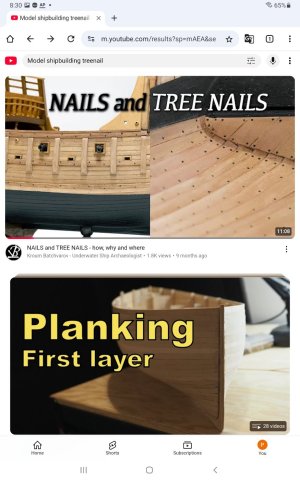

- Joined
- Mar 13, 2025
- Messages
- 644
- Points
- 268

Thanks so much Phil. Now I have something to watch at lunch time.YouTube is your friend...View attachment 516946

The keys to treenails is to make the correct sizes. Oversized treenails give an appearance of the ship having the measles. The hull planking treenails were typically no more than 2" in diameter. Decks were not treenailed. They had metal spikes that were covered with flat pieces of wood. For appearance sake, treenails look like the covers and would be easier than making the tiny inserts so make a perfect substitute. They were about 1 inch in diameter.
Making these is tedious but not difficult. There are several methods that work, but the most consistent and cheapest method some have found is to use a HIGH QUALITY draw plate. Bamboo skewers can be split numerous times then drawn and when finished leaves a subtle appearance. It can be drawn down to about 0.016" diameter without too much problem.
A fully framed model with a completely planked hull needs upwards of 10.000 treenails just for the hull, so be aware of the task ahead of you.
I am not sure if Byrnes Model Machines is fully up and running since Jim passed away, but you can give them a try. Again, a high quality plate with good cutting edges is needed. Like most things, for draw plates you get what you pay for. https://www.byrnesmodelmachines.com/drawplate5.html
Allan
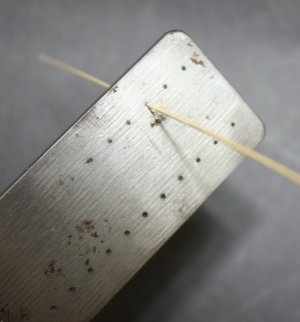
Making these is tedious but not difficult. There are several methods that work, but the most consistent and cheapest method some have found is to use a HIGH QUALITY draw plate. Bamboo skewers can be split numerous times then drawn and when finished leaves a subtle appearance. It can be drawn down to about 0.016" diameter without too much problem.
A fully framed model with a completely planked hull needs upwards of 10.000 treenails just for the hull, so be aware of the task ahead of you.
I am not sure if Byrnes Model Machines is fully up and running since Jim passed away, but you can give them a try. Again, a high quality plate with good cutting edges is needed. Like most things, for draw plates you get what you pay for. https://www.byrnesmodelmachines.com/drawplate5.html
Allan
- Joined
- Mar 13, 2025
- Messages
- 644
- Points
- 268
The keys to treenails is to make the correct sizes. Oversized treenails give an appearance of the ship having the measles. The hull planking treenails were typically no more than 2" in diameter. Decks were not treenailed. They had metal spikes that were covered with flat pieces of wood. For appearance sake, treenails look like the covers and would be easier than making the tiny inserts so make a perfect substitute. They were about 1 inch in diameter.
Making these is tedious but not difficult. There are several methods that work, but the most consistent and cheapest method some have found is to use a HIGH QUALITY draw plate. Bamboo skewers can be split numerous times then drawn and when finished leaves a subtle appearance. It can be drawn down to about 0.016" diameter without too much problem.
A fully framed model with a completely planked hull needs upwards of 10.000 treenails just for the hull, so be aware of the task ahead of you.
I am not sure if Byrnes Model Machines is fully up and running since Jim passed away, but you can give them a try. Again, a high quality plate with good cutting edges is needed. Like most things, for draw plates you get what you pay for. https://www.byrnesmodelmachines.com/drawplate5.html
Allan
View attachment 517111
Alan thanks for the info about treenails. I checked on the Byrnes Draw plate. They are not accepting orders at this time. For the cross-section model I plan on doing, it will just be for two frame faces. I am covering the frames with veneer pieces and would like to treenail them versus nails as I have seen on some examples. Want to make the frames appear as though they are assembled versus being just two pieces. So a much smaller project. But I will place an order later for a draw plate I'm sure.


- Joined
- Mar 13, 2025
- Messages
- 644
- Points
- 268
Thanks for letting me know they do take some orders. For what I'm going to do I can roughly figure about 200. So I may need to buy a new tool. Just doing research right now and also learning/planning ahead. Must finish the Buccaneer I'm working on first. Ratlines, rigging, and sails left oh my!@Rebus if you go past the message that they are "not taking orders now" and go to products and then click on the drawplate, you can order one. If you are hesitant to do that, call them and order it that way. They are taking some orders.

- Joined
- Nov 24, 2025
- Messages
- 61
- Points
- 78

Alan thanks for the info about treenails. I checked on the Byrnes Draw plate. They are not accepting orders at this time. For the cross-section model I plan on doing, it will just be for two frame faces. I am covering the frames with veneer pieces and would like to treenail them versus nails as I have seen on some examples. Want to make the frames appear as though they are assembled versus being just two pieces. So a much smaller project. But I will place an order later for a draw plate I'm sure.
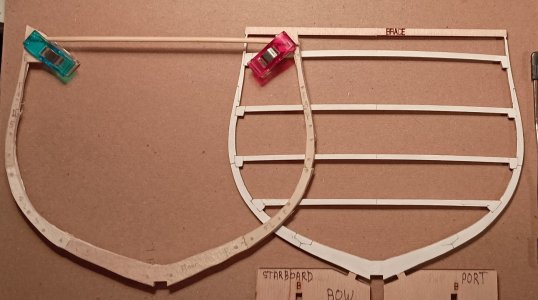
Based on Charles Davis' book about built-up model ships, my first attempt was to replace the kit-supplied bow frame on a USS Constitution cross-section model with a built up tree-nailed frame in 1/76 scale.
I began with 1/16 inch thick basswood strips, 1/2 inch wide for the sides, 1-inch wide for the floor.
The pieces were glued together, then tree nailed using split bamboo skewers that were draw-plated down to a suitable diameter. (Soaking them in water first really helps, as noted elsewhere in these forums.)
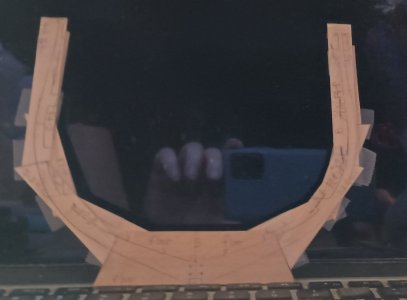
The original kit bow frame was used to outline the frame shape onto the rough pieces.
When carefully cut out and sanded, the result was an open frame that seems much sturdier than the original plywood frame.

At most common scale viewing distances, trunnels and plugs over metal fastenings are not visible. Portraying them seems to be something of a stylistic affectation, rather than an appropriate scale detail. Out of scale details on a model ruin the compelling effect of reality in miniature that the miniaturist necessarily must seek if their model is to succeed.
Moreover, if one portrays fastenings of any kind on a model they must be placed accurately as in the full-scale subject. The frequent haphazard depiction of treenails on many models without any regard for the number or positioning in full-size practice is a very poor practice that destroys the compellling impression of reality essential to a successful model. If fasteners are depicted, not only must they be in scale but also they must be depicted as having been placed properly, i.e. in the correct number, spacing, and placement.
Moreover, if one portrays fastenings of any kind on a model they must be placed accurately as in the full-scale subject. The frequent haphazard depiction of treenails on many models without any regard for the number or positioning in full-size practice is a very poor practice that destroys the compellling impression of reality essential to a successful model. If fasteners are depicted, not only must they be in scale but also they must be depicted as having been placed properly, i.e. in the correct number, spacing, and placement.
Last edited:

Well said Cap'n Cleek! It depends on the scale of the model, but most fastenings on a full-size vessel are not visible at the actual distance that would represent the "scale viewing distance" of a model. Therefore, model treenails may be added not to portray how a vessel would look but for, as you say, "stylistic affectation" or to educate the viewer about how a vessel was constructed. If the latter is intended, the modeler should locate the planking and fasteners accurately and should provide some explanation of the building process being illustrated. I think that a viewer should be able to assume that a model shows what a real vessel looked like unless told otherwise. Fair winds!.At most common scale viewing distances, trunnels and plugs over metal fastenings are not visible. Portraying them seems to be something of a stylistic affectation, rather than an appropriate scale detail. Out of scale details on a model ruin the compelling effect of reality in miniature that the miniaturist necessarily must seek if their model is to succeed.
I think that a viewer should be able to assume that a model shows what a real vessel looked like unless told otherwise.
Put another way generally speaking in a "perfect world," "I think that a knowledgeable viewer should never be able to sense that a model does not show what a real vessel looked like." It's all about the "compelling impression of historical accuracy in miniature." Like a beautiful woman with a false eyelash that's come adrift, things like what I circumspectly called "stylistic affectations" spoil the effect of fine art ship models entirely, just as they do beautiful women.