Planking should never be "edge set" and rarely is in full-scale construction. First, it's impossible to bend full-scale plank stock across its width for anything close to as radical a bend as some advocates of the heat-bending planking modeling fraternity advocate. On occasion, in substandard construction, a sloppy shipwright will edge set a plank by a quarter inch across a full plank's run, but it's a sign of shoddy construction and, when done, is usually done on the sly. In full-sized construction, planking shapes are spiled and cut from flat planking stock so that the plank will easily bend across its long dimension and fall perfectly in place on the planking schedule, rather than having to be tortured into shape.
Yes, cutting planks from larger/wider material was done, but that resulted in an extremely high material loss. Later, bending planks to fit, in all directions as well as twist which is most common, was done by heat, either steam and fire, after which the planks were bent fairly easily. I have seen quite a number of period drawings showing this, but a good article on one heat method is
An Account of the Manner of bending Planks in His Majeſty’s Yards at Deptford, &c. by a Sand-heat, invented by Captain Cumberland.
If the plank seams aren't going to be portrayed, and at most scales, they should not be, given the scale viewing distance, it makes no difference how the hull shape is constructed.
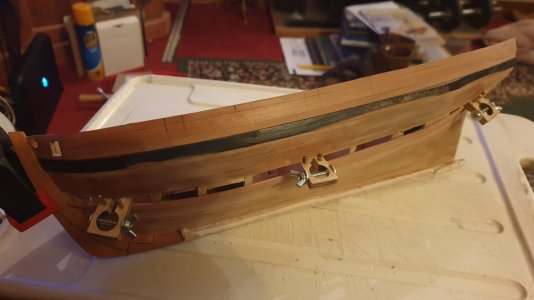
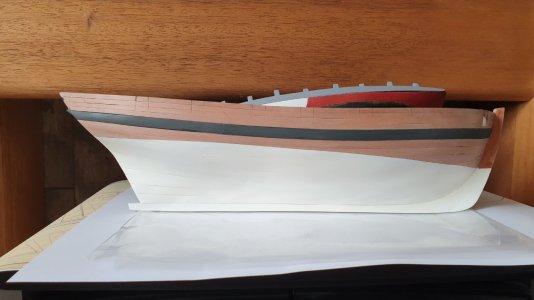
Yes, it does, because most planking and seams on wood planked sailing ships IS VISIBLE. Even when painted over, the seams are usually/often present. That is because the wood planks are not made to be tight together - they cannot be that tight a fit that it wouldn't be noticed. The gap between is chinked with material to prevent leakage, and that material can be slightly above or below the gap, causing planks to be quite visible. Here's an example that shows it:

So IMHO, whether painted or left natural, planking can and even should be visible on a quality model. Except, of course, for modern steel ships.
This is why most top-quality model hulls aren't planked at all but are instead made from a solid block of wood or from laminated lifts ("bread and butter" method.)
Boy do I disagree with that. I'm 83 and have been building models of one sort or another for about 75 of those years. I scratch-built a Xebec from plans and instructions from Popular Mechanics with a bread and butter hull. And stained varnished it. Of course, I could have no below deck detail to speak of, but that's okay. At the time I was extremely proud of the model. But instead of nice planking to be seen on the hull, I saw no breaks in some areas and visible seams in others, due to wood color variations, being nothing like a planked hull. I've also built early model ship kits where the hull was a solid piece of wood roughed out. This was only done in the cheapest, and smallest, of kits. Today's plank on frame results in a more complex build method much closer to the original construction, helps understand how ships were actually built, and gives us satisfaction during and after the build.
If planking seams are to be portrayed, they should be portrayed accurately. This isn't an "ideal." In this world of subjective reality, some things simply remain "right" and some remain "wrong" and aren't subject to opinion or interpretation. "Accuracy" is the hallmark of models....Planking simply is not visible at scale viewing distances in "smaller scales."
You have a lot of opinions, Bob, as do we all, but that doesn't make them all fact. As shown above, planked models ARE being portrayed accurately. I will admit that treenails and/or iron nails are probably not visible, but that's a different subject.
Kit manufacturers design kits to sell at a profit and plank on bulkhead kit model hull construction offers a marketability, and hence profitability, advantage to the manufacturers for which they sacrifice accuracy as well as ease of construction. (Much like IKEA's knocked down "flat packed" furniture, there are savings to be realized from "flat packed" ship model kits.) What "... most smaller scale kits do not expect" is that beginning ship modelers will know the difference.
IMHO that is just wrong. How many of us would buy a solid hull sailing ship kit, whether solid wood or glued up bread and butter (except modern steel ships)? I don't think anyone makes them anymore, and again IMHO that is because we don't want them! They lack the detail and construction we all expect in a kit. You say plank on bulkhead modes are made because it's cheap abut it lacks accuracy. While I prefer PoF construction, PoB can produce exactly the same outer appearance, and far more accurately then a solid hull.