• Win a Free Custom Engraved Brass Coin!!!
    As a way to introduce our brass coins to the community, we will raffle off a free coin during the month of August. Follow link ABOVE for instructions for entering.
  • PRE-ORDER SHIPS IN SCALE TODAY!

    The beloved Ships in Scale Magazine is back and charting a new course for 2026!
    Discover new skills, new techniques, and new inspirations in every issue.

    NOTE THAT OUR FIRST ISSUE WILL BE JAN/FEB 2026

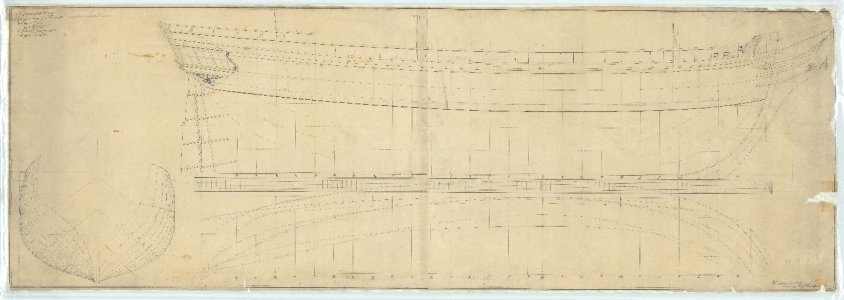
US Frigate “Terrible” — design proposal by Joshua Humphreys, ca. 1796

dear readers and @-Waldemar- I did copy the wrong screenshot with dimensions in my former post! .. It was the dimensions of the 3-masted vessel .. while you were talking about THIS brig:

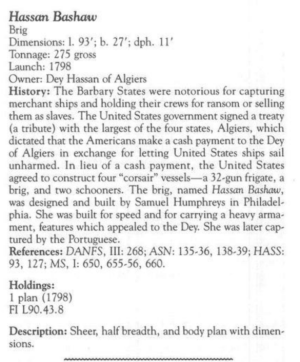
1797 possible Hassan Bashaw - Unidentifed 22 - 24 gun Ship by Samuel Humphreys 05-04-02_08.jpg
and there is the statement pointing on the Bey of Algier - as you described!

This is what´s written in that book I wanted to get (got a digital copy by now):
Hassan-Bashaw_Screenshot 2026-01-02 003259.png

looking forward to your progress !!
 
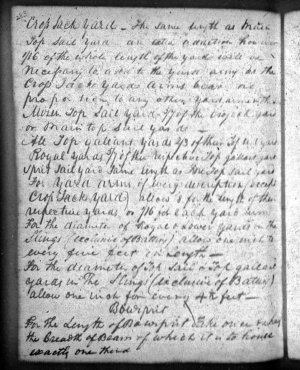
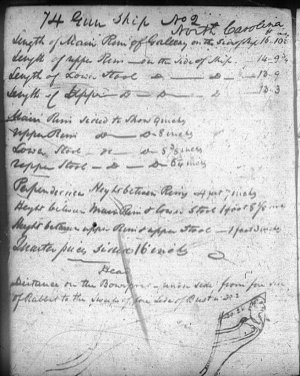
here is Humphrey's day book

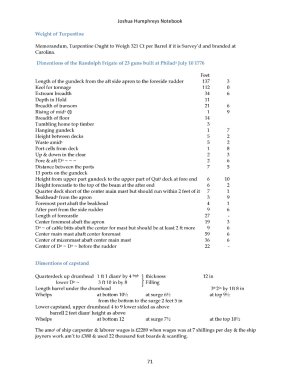
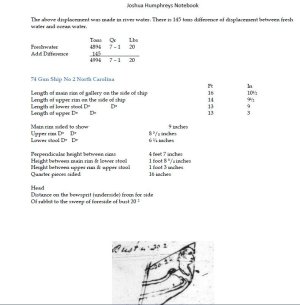
Many thanks, Dave, for posting the transcript of Humphreys' notebook. The thing is, I already had it, and I was going to verify the quality of the transcription for the page with the dimensions of the frigate Randolph (p. 71) by comparing it with the original, because I noticed some suspicious things on that page (and others) in the transcribed document. For example, the frigate Randolph is listed in the transcribed document as having 23 (twenty-three) guns, ‘foremast’ is notoriously confused with ‘foremost’ and vice versa (this applies to the entire transcribed document), and some of the dimensions of the frigate Randolph are very suspicious, both in themselves and in comparison with the preserved plan of this frigate.

The archive (The Historical Society of Pennsylvania) does indeed make a copy of the original available to the public, but only a fragment of it, which, by a malicious coincidence, ends on the page preceding the one containing the specifications of the frigate Randolph.

However, this particular case makes it clear that general, independent use of Humphreys' transcribed notebook, i.e. without verifying it against the original, is too risky. In a sense, this can be compared to attempting to analyse design methods based solely on British-made derivative plans of captured ships. No go.

.​
 
i had the entire book on 8 x 10 photoprints but they were damaged by water and they stuck together. so they were tossed out
i do have the original microfilm or most of it, It's has been 30+ years since i first got the microfilm roll and it was cut into short lengths so i could make photo prints. some sections may be lost, i have not gone through the strips to see if all the pages are there.

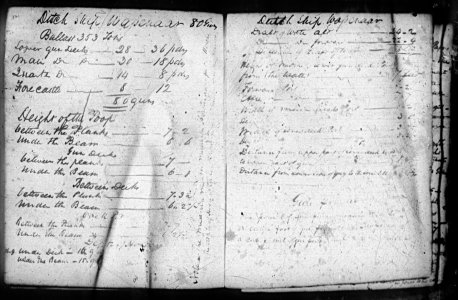
post the page from the transcript you want to see and i will see if i have that page on microfilm. Here is a scan of a page from the microfilm

some pages are difficult to read you have to be able to read old English circa. 1780ish. Some pages are faded and really hard to read

img608 invert.jpg
 
.​
@Dave Stevens (Lumberyard)

Many thanks, Dave. Below is a copy of the transcript page with the specifications of the frigate Randolph 1776. In PDF format and as a bitmap.

The original Humphreys' notebook kept at The Historical Society of Pennsylvania has numbered pages, so I assume your copy should be numbered the same way, and the page in question should be numbered 163 (and possibly a second page with the rest of the frigate's specifications, number 164). These numbers are at the top of the pages in round brackets.

The quality of the copy you show is perfectly adequate, and transcribing English text from around 1780 will be a pure pleasure compared to transcribing Swedish and German text from the early 17th century, and written in Gothic script :).


Page 71 from Humphreys' transcript - Copy.jpg

.​
 

Attachments

@-Waldemar- I need to add more material and confusion here for you !

Found another ship - maybe attributed to Humhpreys - this time Joshua (Senor? Junior?)


The description says again:

Cross Section of USS Constitution​

But I doubt that a lot !

And again the same plan is here as


named:

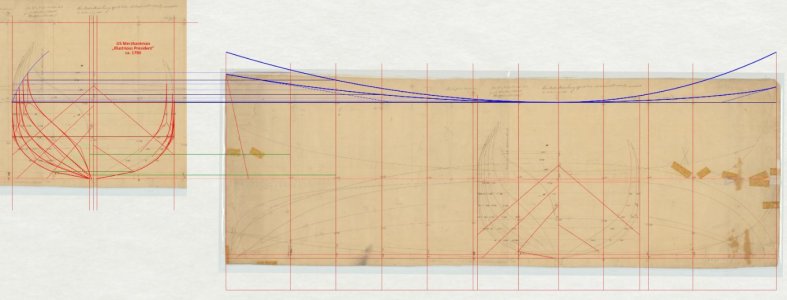
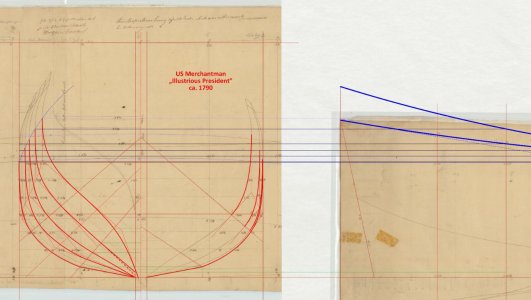
Plans of the U.S. Ship Illustrious President​


View attachment 567854

There is a written statement - I guess written in lead pencil - that this drawing was Joshua Humphreys .. but the handwriting in ink does not really match with the one of The Terrible.
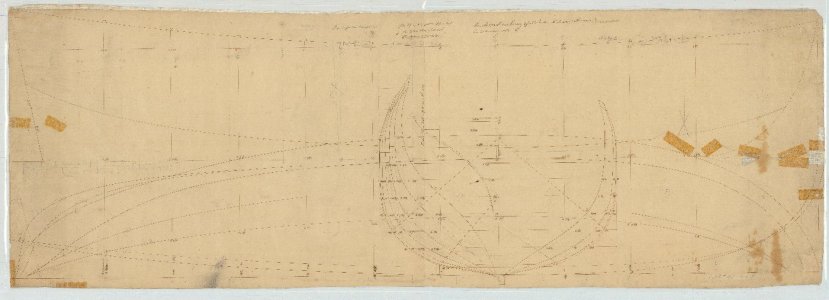
1797 Unknown dated Section Cut 40-15-6F.jpg
Another text on top of the drawing stating
"the ships shear hung 3 feet 10 inch which was rather much - her bottom very well"
and seems to indicate that the person doing that drawing "analyzed" the ship - rather than designing it.. right?

The name of the Ship is mentioned after the text
"for An(i) (?) Clow & Comps called the "Illustrious President".

There was a merchant and shipping company existing in Philadelphia called "Andrew Clow & Co." in about that period ..


The "Illustrious President" is mentioned here as "the American ship Illustrious President"

scroll down and look for "Printed Cottons, c.1780"

The name of the ship seems to be a well known epithet for George Washington as this letter by Capt. Joseph Ingraham of Boston expresses as an example:
"I named the first Washington’s Island in honor of the illustrious president of the United States of America. The other I called Adams’s Island after the Vice President.”

In another Letter - by Brown & Francis to George Washington, 17 February 1793 the ship is also mentioned :
"Cap: Tingey will have the honor of delivring this and will explain the particular manner in which we became sole owners of the Ship Eutrusco now Illustrious President in part pay for our Ship the President Washington of about 1000 Tons."

AND .. it was captured by the british 1795:

"Captured ship: Illustrious President , Dennis Butler, master and sole owner.
History: American merchant ship with largely Danish and Swedish crew bound from Paramaribo (Surinam) to Amsterdam laden with sugar, coffee, cocoa, cotton and Madeira wine, captured on 20 April 1795 when lying off Dover by a boat from the Flora privateer (Allan Peake commanding) and taken into the Port of London."

But it seems to have been free again - and at least reached the US shores ...

Here the ship is also mentioned - its "the largest known colonial merchant vessel to be excavated."
It seems to have been found and identified at Robinson Landing in Alexandria, Virginia

Now if it was build by Joshua Humphreys it would be interesting to see if his design rule was used in the same way as his larger frigate - or if he used different methods for a trading ship.

Curious what you can make of this ... have fun !

PS: newer reports about that archeolgical work .. VERY interesting ..

 
Last edited:
.​

Marcus, many, many thanks again. From the point of view of my specific needs, this is a truly brilliant find, because on this merchantman plan, unlike the plans of all other ships, all the fundamental design lines are left intact. What is more, the numerical coordinates of their points are also given.

Such things make the analysis of this particular plan, and later all the other plans from this batch, more reliable and somewhat easier. And of course, I am modifying the order of evaluation or analysis of American plans — definitely, the plan of the Illustrious President must be examined first.

:)
.​
 
The original Humphreys' notebook kept at The Historical Society of Pennsylvania has numbered pages, so I assume your copy should be numbered the same way, and the page in question should be numbered 163 (and possibly a second page with the rest of the frigate's specifications, number 164). These numbers are at the top of the pages in round brackets.

look at the page i posted in the upper left corner it is marked page 283 so yes the pages are numbered so i will look for pages 163 and 164
 
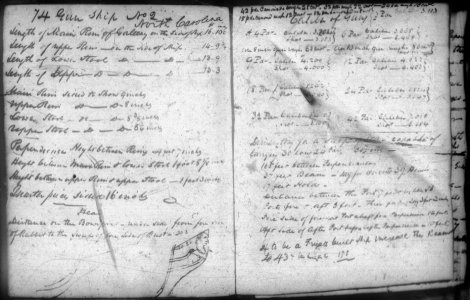
i found the section of the microfilm i need to scan the film at a high res of 1200 then work the file in photoshop and make a readable JPEG at a lower resolution so i can post it so this is a test as you can see some pages are just not readable even at a high resolution of 1200

img617.jpg
 
.​
i will look for pages 163 and 164

Great. Many thanks, but please only when you have time, because I feel I should get back now to the beginning, i.e. Dutch frigates.


you were talking about THIS brig:

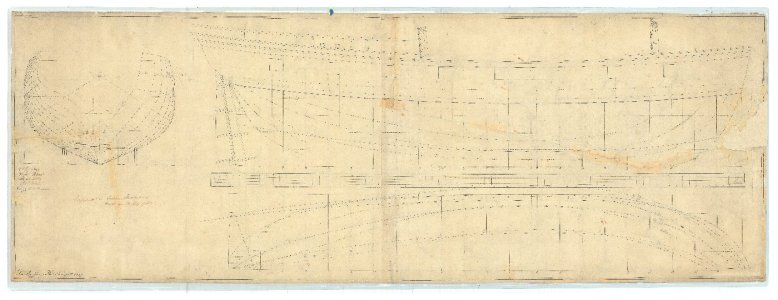
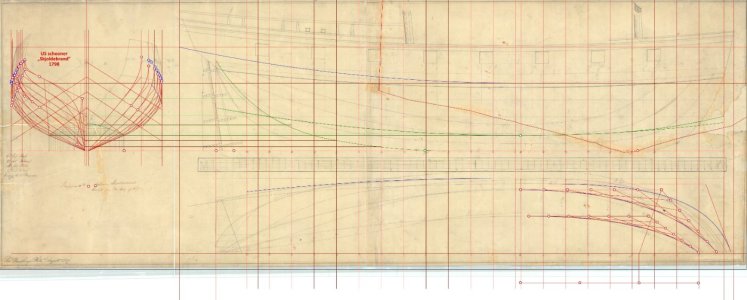
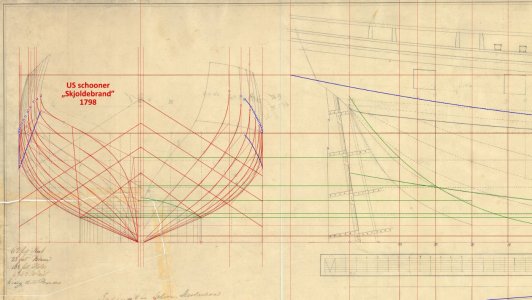
I managed to decipher another fragment of text on the plan of this alleged brig from 1797: ‘schooner Skjoldebrand’. At the same time, I remembered that I also have some works on American ships in my home library, in particular Chapelle's ‘entire trilogy’ (American Sailing Navy, American Sailing Ships, Search for Speed under Sail) and Sailing Warships of the US Navy by Canney. Upon consulting them, it turned out that the first of Chapelle's works mentioned above was particularly helpful, providing more information on this ‘export’ schooner.

.​
 
I managed to decipher another fragment of text on the plan of this alleged brig from 1797: ‘schooner Skjoldebrand’. At the same time, I remembered that I also have some works on American ships in my home library, in particular Chapelle's ‘entire trilogy’ (American Sailing Navy, American Sailing Ships, Search for Speed under Sail) and Sailing Warships of the US Navy by Canney. Upon consulting them, it turned out that the first of Chapelle's works mentioned above was particularly helpful, providing more information on this ‘export’ schooner.
Good old Chapelle - he seemed to have known everything already! So sad that he did not mention his sources too often or precisely.

Interesting I also find his view on the fact that the Americans did build ships especially for the Corsairs they wanted to get rid of. Chapelle on Page 135:
The practice of giving the Barbary corsairs armed ships had long been common with many of the European powers, as part of the continuing conspiracy to employ the Mediterranean pirates against some commercial competitors
and further
In our case, however, the ships were nothing more than a tribute - a sop to keep the peace.
"our case" seems to indicate "the American case" I guess ..
A good deal of care was taken to assemble all the information that could be obtainted from former captives as to the exact requirments of vessels suited to the use of the corsairs and also their likes and dislkes in regard to ship decoration and arrangement. It was thought that the Dey would be pacified and his friendship purchased if the vessels were superior in every way to those he had recieved from European powers.

Sure thing ;) !!! Just the friendship of the Dey .. of course nobody intended the ships to be used against someone else ! ROTF
For me it seems to be the same political and commercial concept as today ! Selling best suitable weapons to someone overseas - just he can use them against someone else. And being good in that opening a market for that product. Well.. as a German I should not complain too much about that - as we have about the 4th biggest "defense industry" ..


Back to ship design:

"Subject to the schooner Skjoldebrand
build for the Dey of Algier"

"Subject to" was the proposal of ChatGPT .. as "according to" refering to the schooner.

Chapelle shows on page 137 (Fig. 17) of his "American Sailing Navy" his reconstruction of "Skjoldebrand, 1798" and it matches the lines Samuel Humphreys was sketching here:
https://catalog.archives.gov/id/365107466
NAID: 365107466Local ID: 40-15-6D

So its obvioiusly not the Brig "Hassan Bashaw" we found there and which was build by Samuel Humphreys at his fathers Shipyard in 1797. It matches the fire power (11 gun ports - 8 on gun deck and 3 on a raised quarterdeck, Chapelle´s provided dimensions and his reconstruction. The "high raised quarterdeck" Chapelle describes as being "out of fashion in American war schooners at the time she was build" .. and he believes it to be a desired feature by the corsairs. He states that the schooner was said to have rowed well and have been a "smart sailer".

If all that is a correct interpretation then Humphreys had taken the lines of the Schooner Skjoldebrand - build by (according to Chapelle) his friend Nathaniel Hutton (and designed by his brother Benjamin Hutton jr.) and we see those lines in this drawing.

Page 140 Chapelle states that Nathaniel Hutton, Jr. and Samuel Huphreys were close friends and were buidling the Hassan Bashaw and the Skjolderbrand in "partnership" - although this has not been officially mentioned. He saw evidence in Humphreys´ drawings where he found references to Huttons designs.

And if that is correct, we might also think about that "unknown frigate" Sam Humphreys was drafting. There is no small frigate known to be build by him or at his fathers shipyard at that time. So why would he do a drawing?

It is possible that he was doing a drawing of the 32-gun friage tribute vessel "Crescent" - later renamed in "El Merikana" which means "the American" - which was build the same time as the biggest of that set of 4 ships for the Dey of Algiers. The frigate was designed by Joshua Fox and James Hackett to build her. She was "a handsome ship as was usual with Fox´s designs" (page 136). At least the moulded beam of 32´0" matches with the drawing.

So .. if Humphreys was doing drawings of the Huttons ships - wouldn´t it be possible that he also did a study of the Fox designed Frigate?
There was no small frigate build in Humphreys shipyard - not by Sam Humphreys nor by his father.
Humphreys obviously did copy others ship design.
This frigate matches in at least some dimensions the description by Chapelle.

In that case THIS
https://catalog.archives.gov/id/518072402?objectPage=2
would in fact be a copy of the drawings of "El Mericana" - the Tribute frigate for the Dey of Algiers.
1798 unknown-frigate-by-Sam-Humphreys.jpg
It does not show the gun decks gun ports - as Humphreys might have been more interested in the ships lines. ...

Can you @-Waldemar- find evidence in this theory by comparing these lines with others made by Fox ? Is that possible?
 
Last edited:
.​
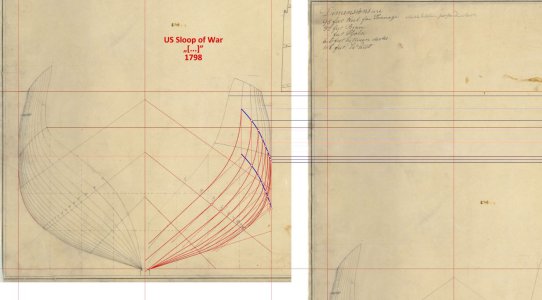
At the moment, I am taking a closer look at the three high-quality plans you have pointed out: the merchantman Illustrious President, the schooner Skjoldebrand and the ship-rigged small ‘frigate’ (of the size of a sloop of war or the equivalent European corvette of that period). In addition, I have reviewed reproductions of other American plans, particularly in Canney's publication, Sailing Warships of the US Navy. It can be concluded that virtually all of the vessels shown were designed in the same general way, i.e. using conical curves, and the differences may concern only minor details. In any case, a very detailed evaluation or analysis of all available plans is a task that would take weeks, if not months.

Against this background, the description of the geometric construction of the ‘midship bend’ in Joshua Humphreys' notebook, consistent with the Mediterranean/English tradition (i.e. using three sweeps: ‘under breadth sweep’, ‘bilge sweep’ and ‘reconciling sweep’) on pages 62 and 64 of the transcript is quite surprising, as it is completely incompatible with any of the preserved plans of American ships from that period. This three-sweeps construction is primarily described in English works by Deane 1670, Sutherland 1711 and Murray 1754. Only in passing does Humphreys mention the possible use of an ‘elliptical mould’ as a substitute. In fact, it can be said that all known American ship plans were drawn up using some kind of ‘elliptical mould’, or what are today called ‘French curves’.


ViewCapture20260106_094832.jpg

ViewCapture20260106_094936.jpg


ViewCapture20260106_100501.jpg

ViewCapture20260106_100617.jpg


ViewCapture20260106_101608.jpg


* * *​

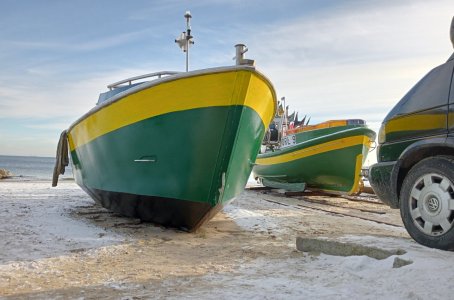
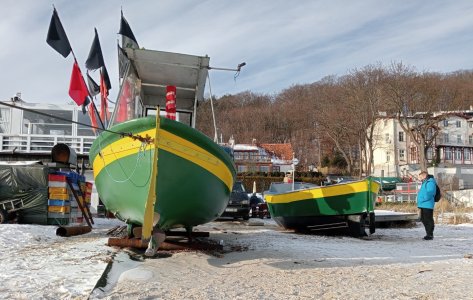
Hopefully, the essence of the parabolic construction of the frames can be seen in the attached diagrams, but I am also including a fairly illustrative photograph that I took on yesterday's walk. The hull of one of the fishing boats is simply welded from flat sheets of metal (bent in only one plane). The cross-sections of such a hull produce straight lines that can serve as arms defining conical curves, such as ellipses or parabolas, in order to obtain a more developed, ‘rounded’ shape, as applied to the second fishing boat visible next to it.


IMG20260105123632.jpg

IMG20260105123806.jpg
.​
 
.​

It should also be emphasised that the entire geometric structure of the underwater part of the hull is based on mathematically or geometrically predefined diagonals (see the above diagram of the schooner Skjoldebrand), in a fashion distinctly reminiscent of the French approach.

If one adds that another design basis for American ships of that period is ‘flat’ as understood in the Northern tradition, there is really nothing left that would link this design method with the Mediterranean/English tradition, and in fact it is an obvious continuation of the North Continental (Northern European) tradition.

.​
 
I am not sure if I got it right: you say in Humphreys notes he describes another way to design the ships sweep curve - equivalent with known british or mediterean tradition.. but the American build ships don't follow?

Do we know which Humphrey was writing his notes by when?

Is it possible that it was written by Joshua Humphreys sen. - and that the "old" guy was still using "older" standards- while his son, Joshua Humphreys jr. already modernized his approach? I think I remeber that the Humphrey Papers "started" before "our " Joshuas birth.. ?
 
.​

The passage concerning the preparation of plans using the English method, pretty inadequate for the American reality of the last decades of the 18th century, is found in the initial part of the notebook, which also contains other information of a general nature, such as more or less up-to-date English establishments of ships' dimensions and armament, tables of spar lengths and the like. It seems to be simply a collection of reference data that young Joshua Humphreys managed to gather at the beginning of his career as a shipwright, some of which is as old as the early 18th century. In this context, the description of how to draw up ship plans may well date from previous decades and be obsolete in the American context already at the time of the notebook's compilation.

.​
 
Back
Top