• Win a Free Custom Engraved Brass Coin!!!
    As a way to introduce our brass coins to the community, we will raffle off a free coin during the month of August. Follow link ABOVE for instructions for entering.
  • SUBSCRIBE TO SHIPS IN SCALE TODAY!

    The beloved Ships in Scale Magazine is back and charting a new course for 2026!
    Discover new skills, new techniques, and new inspirations in every issue.

    NOTE THAT OUR NEXT ISSUE WILL BE MARCH/APRIL 2026

USRC Harriet Lane Build Log

Joined
Apr 19, 2025
Messages
34
Points
58

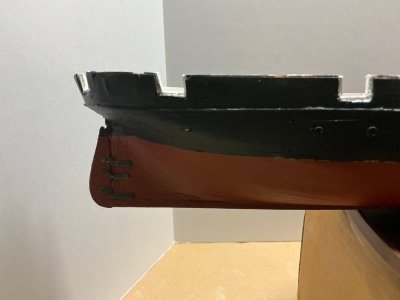
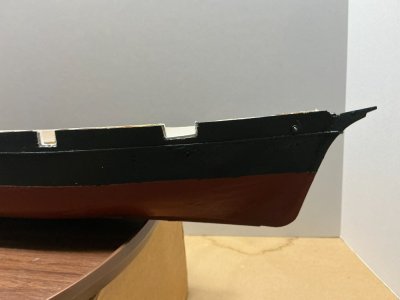
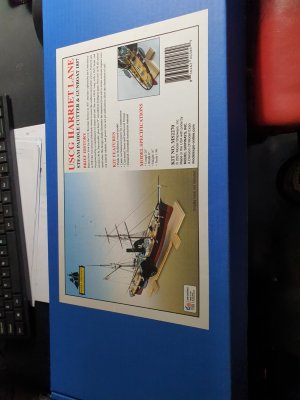
This is my first posting describing my building of Model Shipways MS 2270 USRC Harriet Lane. Model Shipways calls this kit the USCG (United States Coast Guard) while I call it the USRC (United States Revenue Cutter) as the Coast Guard was not formed until 1915, 31 years after the sailing days of the Harriet Lane were over. The ship was part of the Revenue Cutter Service and thus I feel USRC is the more accurate title.

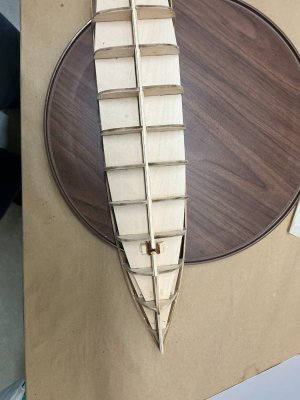
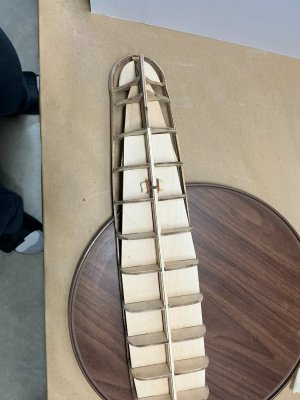
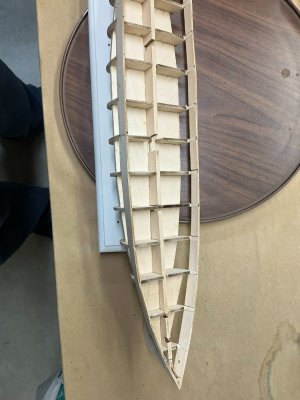
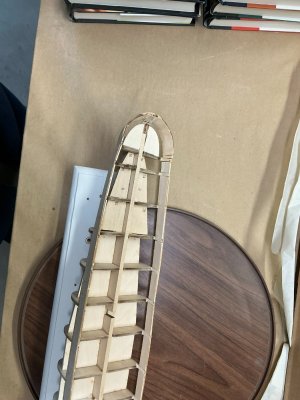
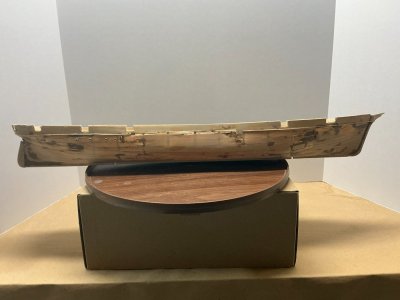
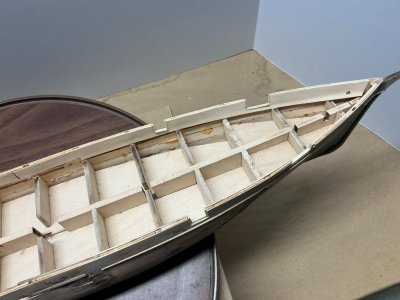
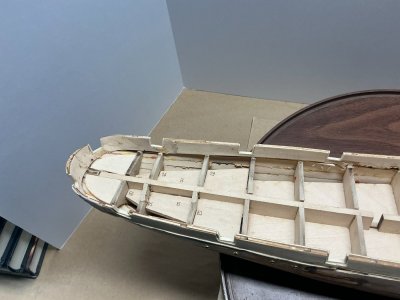
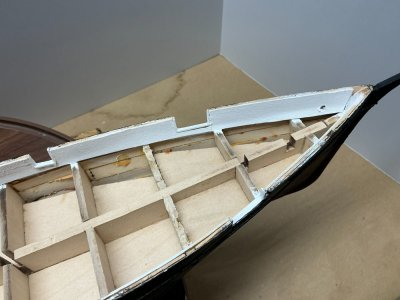
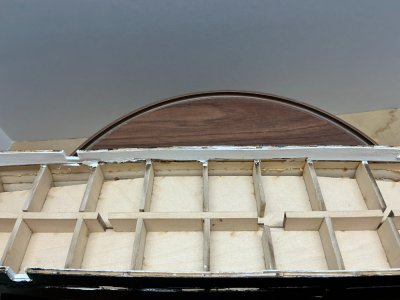
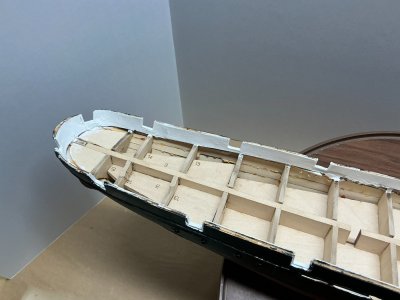
The framework for the hull is complete as are the bulwarks at the top of the ribs (Steps 1 through 10 of the Instruction Manual). I placed some scrap wood around the openings in the hull to better support brass pedestals I was going to buy since the box lid indicated no display base included. After gluing this scrap wood, I found out the kit does contain a display base and that wooden dowels will represent pedestals to attach the ship to its display base.

As with some other build logs of this kit, my kit also did not have marked on the inner stem and stern post the curved lines (see Step 3 of the Instruction Manual). Model Shipways emailed me the necessary template. I suggested they include it for downloading on their website where this kit is listed for purchase.

To achieve the curvature of the stern bulwarks, I soaked the wood strips overnight and used an electric plank bender with its supplied wooden form to get a curve similar to what I needed. If you do not own an electric plank bender, I highly recommend purchasing one.

I could also not find any keystone shaped pieces on Sheet 7 (Step 9 of the Instruction Manual). On that sheet, I did find two strips turned so the grain would go vertical if used as the inner bulwarks. They were longer than I needed. Thus, I assume Model Shipways has replaced the mentioned keystone shaped pieces with these two strips (one for the port side and the other for the starboard) but never updated their Instruction Manual. Similarly, Step 75 of the Instruction Manual lists the bow fairlead as being on Sheet 7 where in my kit it was a separate sheet (WP2270-W) not shown on the Parts List nor on Plan Sheets 4 or 5.

The ship is now ready to be planked, which will be the subject of my next posting.

Please enjoy the attached photos.

All comments or questions appreciated.
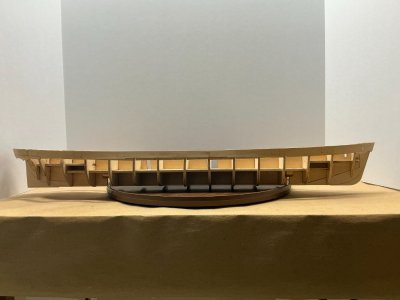
Photo_1.jpg

Photo_2.jpg

Photo_3.jpg

Photo_4.jpg

Photo_5.jpg

Photo_6.jpg

Photo_7.jpg
 
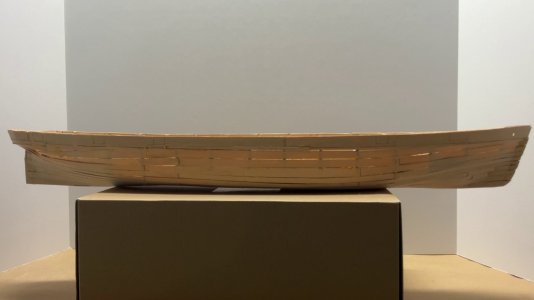
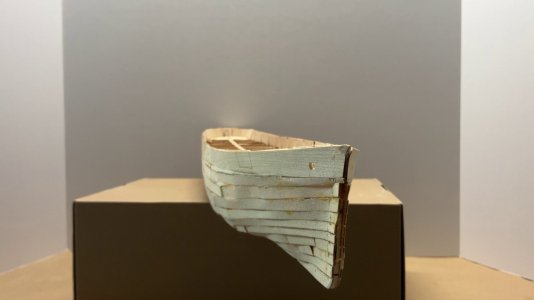
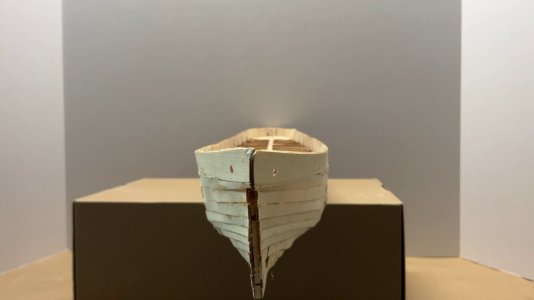
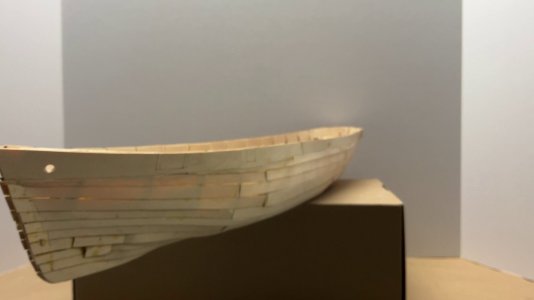
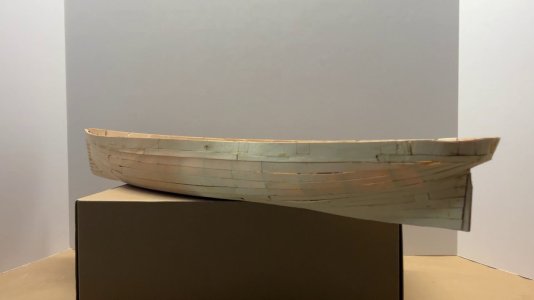
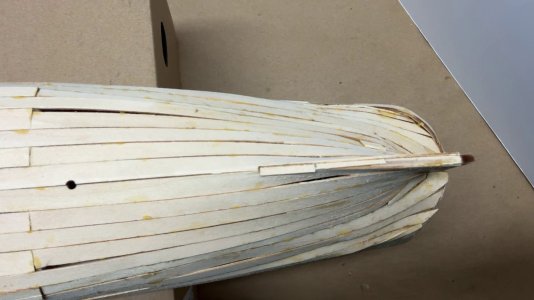
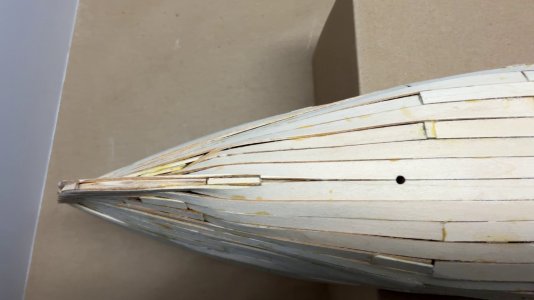
Since my last posting, I have planked the entire hull. To get the hull curvatures, I soaked the plank strips for 30 minutes and then bent them by hand, securing the plank with modified binder clips and alligator clips. Once dry, I glued them in place, using the same clips in the same spots. I started the planking by drawing a line halfway across the width of the bottom of the vertical frame piece. Once I used all the supplied laser-cut planking I still had about 3 mm of planking that needed to be done, so use the scrap 1/32" laser-cut boards to make my own planking.

This posting covers Steps 11 and first half of Step 12 of the Instruction Manual.

The hull is now ready to apply a wood filler to it and then be sanded, which will be the subject of my next posting.

Please enjoy the attached photos.

All comments or questions appreciated.
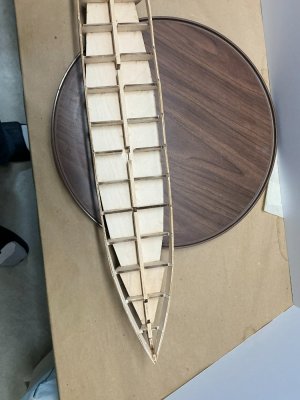
Photo_8.jpg

Photo_9.jpg

Photo_10.jpg

Photo_11.jpg

Photo_12.jpg

Photo_13.jpg

Photo_14.jpg
 
Henry! I have pulled up a chair to enjoy your build of this heroic ship! You've made great progress!

I know you looked at my log - I discovered late that the bulwarks are too short and that Webb's design shows some nice scuppers. If you're not too far along, you might want to think about raising the height of the bulwarks and adding the scuppers. If you don't modify the bulwark height you may find yourself, like some other builders of this ship, with the caprail pressing down on the tops of the cannon even after you tried to shrink the carriages.

I look forward to seeing your progress! Enjoy!

Blessings. Peace. Gratitude.
Chuck
 
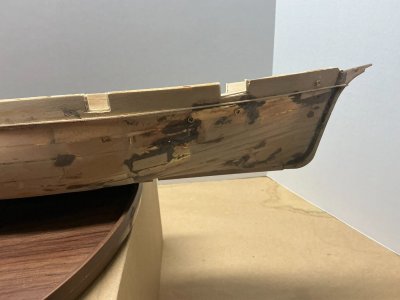
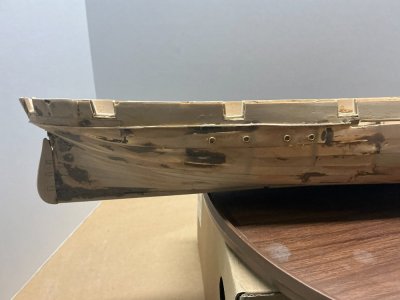
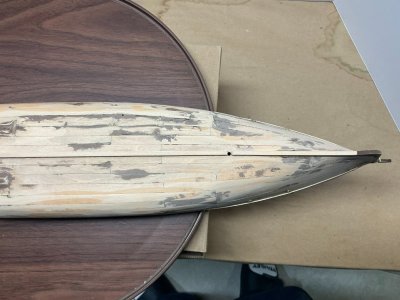
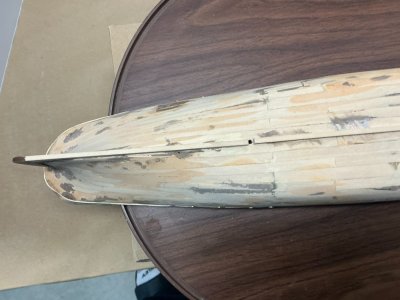
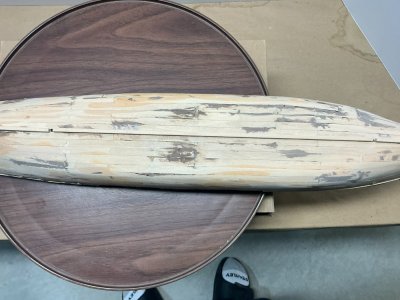
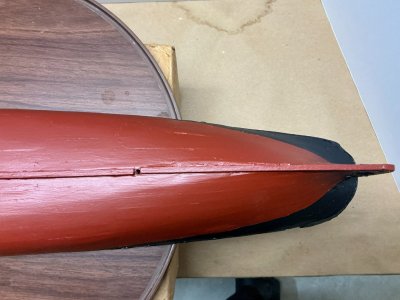
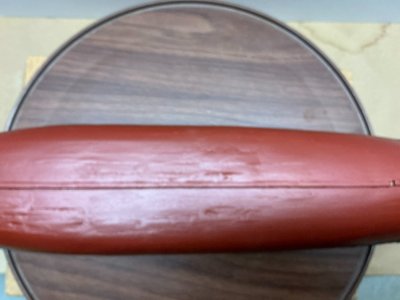
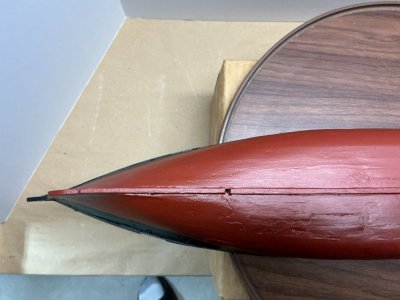
Since my last posting, I applied Minwax Natural Wood Filler from a tub over the entire hull to fill in any small seams between the planking strips and get the shape around the bow and stern to my liking. Then I sanded the entire hull, using a Black & Decker Mouse (palm-sized) Sander and where it would not fit, using a sanding block and then by hand. I started with 80 grit, next 120 grit, then 150 grit and finally 220 grit sandpaper. I then sanded the entire hull by hand with 320 grit sandpaper, to get a very smooth surface. I still had some small areas that needed wood filler; and since the only tube of wood filler I had at that time was Minwax Walnut Wood Filler, I used it as I could better control the amount and where it went on the hull from a tube; plus it was more pliable than the wood filler from the tub. Since the entire hull is to be painted either copper red or black, the darker wood filled areas would not make a difference to the finished look. I sanded the hardened wood filler by hand using the 320 grit sandpaper. As with a complex or large painting that each time you look at it, you see something new, each time I looked at the hull, I found some small holes to be filled. I repeated this process three more times.

I added the keel and the bow stem piece. I filled in some spaces with tube wood filler and sanded it with the 320 grit sandpaper.

I added the rudder. Step 13 of the Instruction Manual suggested using cardstock or paper for the gudgeons, but I decided to use some thin brass sheets I had, cut to the correct shape and size. Since I am going to paint them a different color from the rudder, I have not glued them to the hull and rudder, rather I just marked where they go. Once the hull and rudder are painted, I will glue the brass strips in place already painted.

The inner bulwarks are in position. Cutting out of the gunport openings caused some minor chips of the inner bulwarks, so since the inner bulwarks are to be painted white, I did not want to use my tube of the walnut wood filler. Thus, I bought a tube of the Minwax Natural Wood Filler to fill them in, for the same reasons I used the filler from a tube rather than a tub on the outer hull. Before gluing the inner bulwarks in position, I put the two laser-cut deck pieces in place, to verify I will be able to add the deck pieces later on in the build process, with the inner bulwarks already in place.

I cut the gunport openings and did the optional step of adding stops for the gunport doors pieces (Step 15 of the Instruction Manual for those who have built the kit or plan to do so). There was not enough of the 1/32” x 3/32” wood strip to do all 12 openings (there was enough to do 10), so I did the other two openings using 1/32” thick scraps from the laser-cut planking board, cut to a width of 3/32”.

I curved the spirketting strips using a tray of water and then bending the strip by hand and placed them at the bottom on the inner bulwarks (Step 17 of the Instruction); but did not glue it in place as I thought I might have trouble getting the deck pieces under it, even using the suggested 1/32” spacers. So, I will glue these strips after gluing the deck pieces (Step 38 of the Instruction Manual). I will paint them prior to gluing them in place. Rather than cut the supplied strip into three pieces for each side of the ship as mentioned in the instructions, I decided to just use a single piece for each side of the ship, meeting at the middle of the stern, which worked great.

I hammered the porthole brass ring pieces per the suggestion and glued them in place. I also hammered the hawse brass ring pieces and used my craft long-nosed pliers to make them into an oval per the suggestion and then glued them in place.

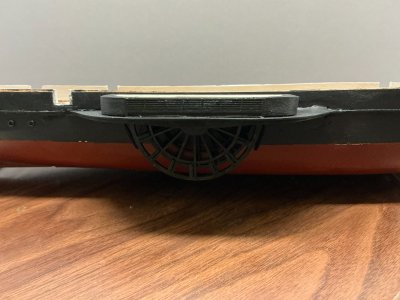
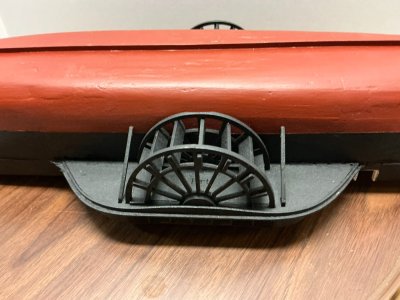
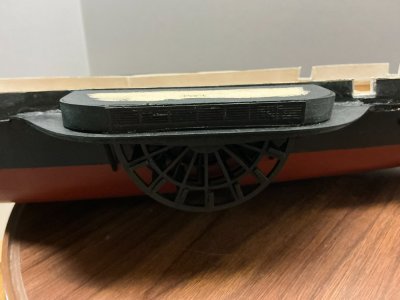
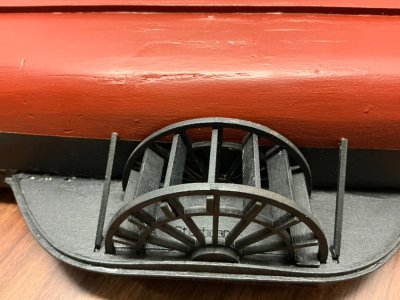
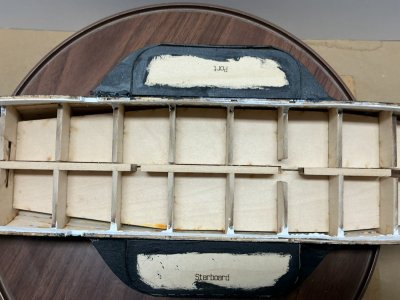
Prior to doing the rub rail, I discovered two mistakes I made and luckily, I was able to correct them. I mention them so others will not follow my lead. The first was I did not leave a slot for the sponson on each side hull of the ship, prior to planking, wood filling and sanding. As far as I can tell, there was no warning of leaving this slot in the instruction manual, until Step 20 of the Instruction Manual which was where the rub rail was added. I had glued the two sponson pieces together while awaiting the wood filler on the hull to dry. I had to use my Xacto chisel to make the slot which caused some of the planking and inner bulwarks to splinter and break. In order to wood fill this damage properly, I decided I needed to fit the sponson in place at this time and then apply my tube wood filler. That was when I discovered my second error. Although the two sponson pieces that were glued together were marked either “port” or “starboard”, the directions where not clear to me how they were glued together. So, I looked at some of the build logs on both Ships of Scale and Model Ship World web sites for guidance. I saw a picture of the two parts glued together and did the same. Well, it turned out, that was in error as the piece for the slots for the exposed paddlewheel was now on the top of the other sponson piece and they should have been on the bottom. Since they were solidly glued together, as I had done so several days prior, I could not now separate them. As the sponson piece that went into the slot had notches to go around the hull ribs, if I just turned the assembly upside down, the slots would no longer line up with the ribs. I did not want to cut new notches, so to correct this error on my part, I fitted the “port” sponson with the paddlewheel slots down to the “starboard” side and vice versa, since they are mirror images of each other. The rest of the port parts of the paddlewheel assembly will go on the port side and the starboard ones on the starboard side. Once this new wood filler was hard, I sanded it and repeated the process until the sponson fit nicely in the slot I had made. Since the lower paddle boxes indicate which was port and which was starboard, I decided to go ahead and make them now and glued them to the sponsons at this time, so when it comes time to glue the sponsons to the hull, I will better know which goes on the correct hull side. I know I will have to do some further wood filling of the inner bulwarks but will wait until the sponsons and lower paddle boxes are glued in place. That will give some wood to which the filler can adhere.

I cut and glued the rub rail in place even with the sponsons’ location. The rail went completely around the hull, other than where the sponsons go. To get the exact location of where to not put the rub rail, I once again fitted the sponsons into their slots and marked where they ended on the hull.

This posting covers the last half of the first Step 12 (the Instruction Manual had two Step 12’s) through Step 20, Step 25 and Step 26 of the Instruction Manual.

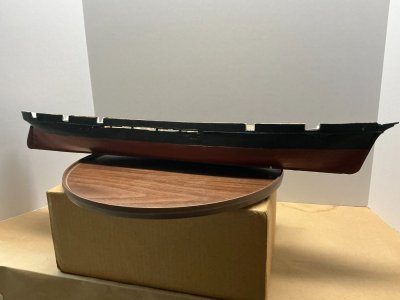
Now the hull, inner bulwarks, gudgeons and spirketting are ready to be painted, which will be the subject of my next posting.

Please enjoy the attached photos.

All comments or questions appreciated.
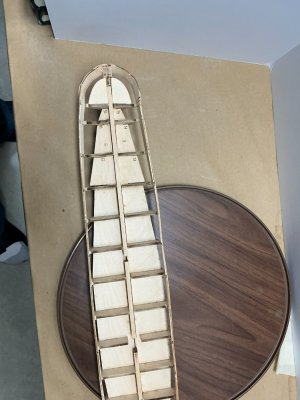
Photo_15.jpg

Photo_16.jpg

Photo_17.jpg

Photo_18.jpg

Photo_19.jpg

Photo_20.jpg

Photo_21.jpg

Photo_22.jpg
 
Back
Top