
• Win a Free Custom Engraved Brass Coin!!!
    As a way to introduce our brass coins to the community, we will raffle off a free coin during the month of August. Follow link ABOVE for instructions for entering.
  • SUBSCRIBE TO SHIPS IN SCALE TODAY!

    The beloved Ships in Scale Magazine is back and charting a new course for 2026!
    Discover new skills, new techniques, and new inspirations in every issue.

    NOTE THAT OUR NEXT ISSUE WILL BE MARCH/APRIL 2026

Viking Longship - tiny Aoshima model

Joined
Sep 12, 2025
Messages
125
Points
78

Location
Melbourne, Australia
While working on my Golden Hind, I thought I would do something a little easier for some light relief. I saw Harry Houdini's video on the tiny Aoshima Greek warship and it looked so cute! It just fits in Harry's hand!
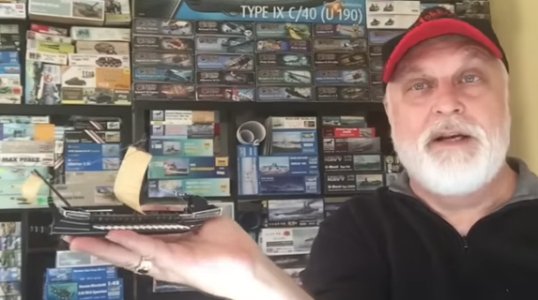
Pic-1024.jpg
He also referred to a similar Viking longship, also from Aoshima. So I had to get one.
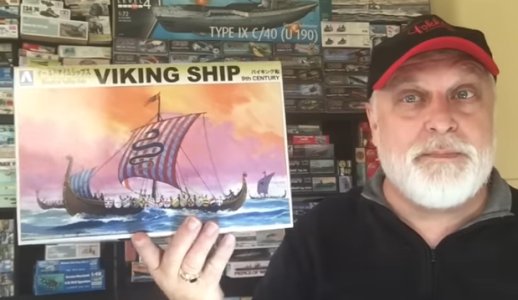
Pic-1023.jpg

And although I am half way through it, I thought I might as well make a build log in case someone else wanted to make this fun model.

Also - I learned a lot about Viking ships (isn't this one reasion why we build these models?) and I thought I could share some references to save newbies (like me) some time.

Firstly - note that it is indeed a small ship!
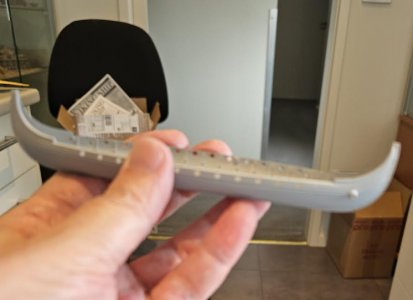
Pic-1025.jpg
 
Last edited:
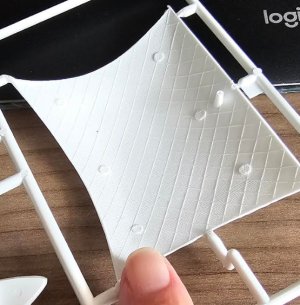
First thing was to paint the sails. I coud make paper or cloth sails but this was supposed to be a stress-free fun build so I went with the (hard!) plastic sail provided. It had some nasty injection marks on the back...
Pic-1027.jpg

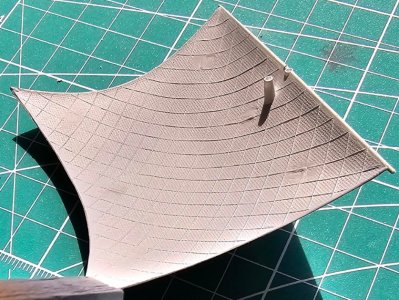
... but with some care I got rid of them without ruining the texture on the sail.
Pic-1026.jpg

I was drawn to the diagonal lines. You sometimes see them depicted on Viking sails. I spent a lot of time trying to find out about them. In summary:
1) the diagonals are often seen on carvings, pictures, coins etc
2) they do not survive on any archaeological examples so far detected
3) the sails are made of wool
4) some recovered fragments have shown red dye so they really were red sails; red was the most common colour found, but there were some blue and some undyed.
5) the diagonal bands are postulated to be leather bands to help reinforce the sails
6) there seems to be no direct evidence for this and it is also thought that they may be purely for decoration

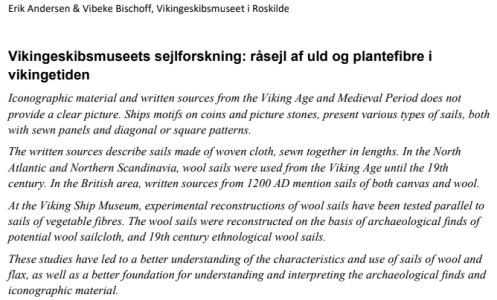
I contacted Vibeke Bischoff of the Viking Ship Museum and they sent me to some good references including one great paper, in Danish (which I was able to translate thanks to Google). Here is the title and the abstract (in English). This paper argues for the diagonals being decoration only. Indeed, it gives many examples where artists of the time drew diagonals on many plain surfaces! So we are perhaps not to take them too literally.Pic-1028.jpg

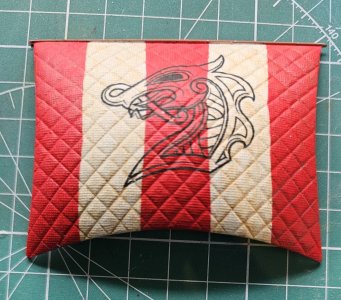
So I decided - red stripes on the sail and no emphasis on the diagonals.

I found some nice Viking dragons and then used decal paper to print one that I liked and applied it to the sail. Some gentle weathering and it is done.

20260412_101412.jpg

Note that the yard is moulded into the sail...i.e. they are one piece.
 
Last edited:
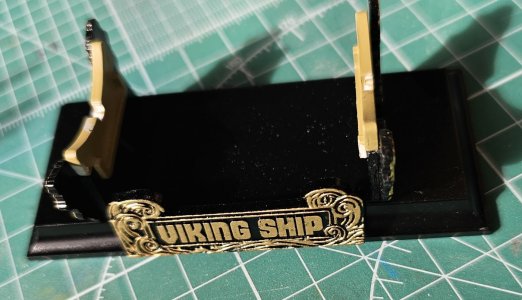
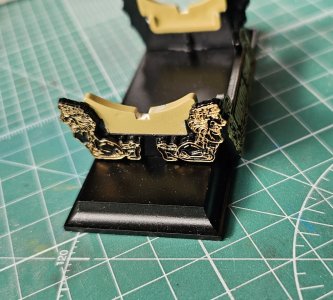
I put the stand together easily, it is just a few pieces. I decided on black with gold on the raised details. That was painted with a cigarette filter dipped into the gold paint. Then dabbed on gently, it is like a stamp that only adds paint to the raised detail. Worked fine.
20260412_101323.jpg20260412_101338.jpg
 
Last edited:
Now to the shields.
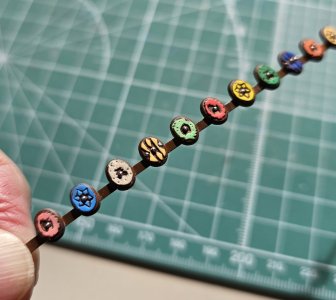
The shields were made of wood so I painted the whole piece dark brown first.
Then the details were painted with posca pens. Very carefully.
The only metal part was the centre, which formed the handle also. So a bit of chrome pen for that to make it nice and shiny. Although I will probably dull it all down with matt varnish when finished. These Vikings had no time for polishing!
20260412_101248.jpg20260412_101252.jpg

I will go back and paint the connection between the shields in a different brown so it is distinct from the shields themselves.
 
Last edited:
The sail is already attached to the yard - they are one piece. But I will add some holes and some line to simulate the bending of the sail to the yard.

The rigging is basic but I might add some more lines to improve it all.
Pic-1001.jpg
 
I sometimes play with AI to test them out. In my last couple of years working I had students using them in exams- strictly forbidden. I am glad I have now retired and won't have to deal with that again.

But it is interesting to see how they succeed and fail. That is not a topic for here, of course. But I was talking with Gemini (I think) about the Viking Ship and it asked if I was going to include a "beitass" which it said is often neglected and will add a touch of realism.

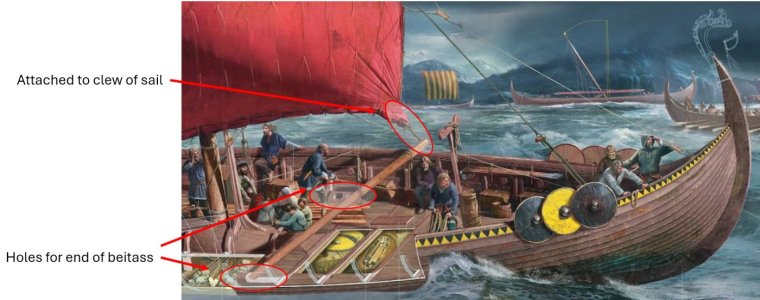
So I have been looking into that. Seems it is just a long pole used to control the sail - a function later taken on by bowlines I think. See item 19 in the figure below.

Anyway, I will report here when I have sorted out some more information.

snekkja.png
 
I think that the braces and the halyards will be best done with blocks. They would need to be very small for this scale ship! The smallest I can get are 2mm so I cut them in half :-)

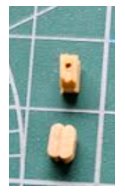
Here are two of the 2mm blocks I have - front view and side view.

Pic-1035.jpg
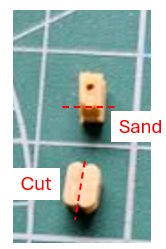
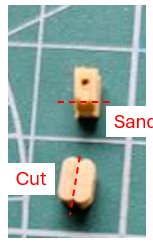
They are quite thick so I thought of cutting them in half, as shown. Then sanding a bit to make them shorter.
Pic-1038.jpg

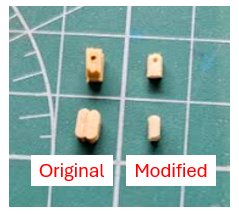
That seems to produce an acceptable result...still probably too big but it should look OK.

Pic-1039.jpg

Pic-1036.jpg
 
Last edited:
I found a very good reference that explains the beitass on this page at the Model Ship World forum; see post 14.

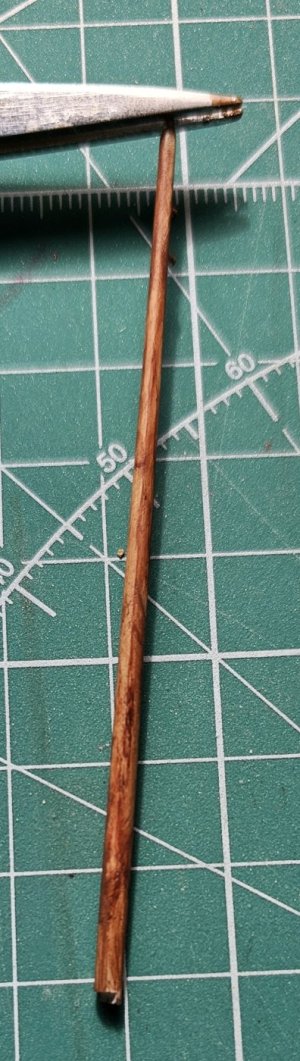
So it is a large pole that fits into slots on one side of the ship, and the other end is tied to the clew of the sail. There are slots on either side so it can be used to control either side of the sail, like a tack line I think. Here is a picture (from above reference) which was in National Geographic at some stage. The annotations are mine and if wrong, they are my error, not Nat Geo.
Pic-1042.jpg


So adding one of these should not be hard. I will add a few lines to it - I think I read somewhere that it took 4 crew members to control it. Fortunately I do not have to worry about that. I will just make some plausible lines to hang from it.

There is a video here that shows one on a reconstruction of a ship.
 
Back
Top