• Win a Free Custom Engraved Brass Coin!!!
    As a way to introduce our brass coins to the community, we will raffle off a free coin during the month of August. Follow link ABOVE for instructions for entering.
  • PRE-ORDER SHIPS IN SCALE TODAY!

    The beloved Ships in Scale Magazine is back and charting a new course for 2026!
    Discover new skills, new techniques, and new inspirations in every issue.

    NOTE THAT OUR FIRST ISSUE WILL BE JAN/FEB 2026

Viking Ship (Sail) - Revell 1:60

Joined
Mar 11, 2021
Messages
68
Points
88

On the box it says 1:50, but measuring it will Reveall ;) it is really 1:60. That will later turn out to be very convenient by the way!
This thread won't be a complete build log. This is where I am at the moment:
20251205_154846.jpg

I wasn't planning to do this ship at all, but I wanted to do a better modelling of a sail, because I was happy, but not completely so with what I had made in this respect:
Vasa
Therefore I bought a very cheap kit, the (fantasy) Viking Drakkar from Směr to experiment with.
I didn't want to use paper again so I tried a cotton handkerchief, but it was not elastic enough.
Therefore I could not get the sails to be neatly filled with the wind.
20251205_083429.jpg 20251205_083437.jpg

However, thanks to the red/ochre banding of the sail I could correct it without it being too conspicuous. Making incisions and glueing them together again gave me nearly the sought after shape.
(With hindsight, I should have made five bands to begin with and glue them together over the whole length, then it would be even better)
20251205_084420.jpg 20251205_143718.jpg
It is not completely faultless, but I can live with it. The sheets have the same direction as the sails at its lower corners.
Overall the shape is good, but the painted cotton material is too coarse for me.
20251205_143731.jpg
 
The instruction had made me attach the one standing rigging line to the foremost cleat, but that cannot be true. I think you cannot wrap tarred lines around a cleat like that. And there are always lines more vertical like on the Bayeux tapestry.
So after a lot of searching I came to the conclusion that the rigging should be attached to either the frames or the gunwale. I can no longer make holes in the spars, and there seems to be none in the real Gokstad as well, so to the gunwale it is then. Chatgpt says 3 lines a side is appropiate for this size ship, so 3 it is.
20251206_154135.jpg
I haven't cut the loose lines yet because I might want to make it look like this eventually:
Saga_Oseberg_Details_shroud-pins_or_vantnales_to_secure_the_shrouds_to_the_hull,_gunwale,_oarh...jpg
 
And I made the deadeyes. The idea is that if you take the top of the horn out of the rope-ring, you can turn it down, and the lower rope glides of. So the shrouds can be detached in seconds.
However, I don't see the added value of doing all the rope work again so I simulate it by de-tarring the lower rope with paint.
20251207_221058.jpg
 
I discovered that the oarsman didn't have benches, but had each their own chest to sit on.
Probably the Oseberg Chest 178
I made some on scale and I planned to put in the oarsman of the Směr ship.
20251207_124656.jpg
However, to my dismay I turned out that the chests should be placed lengthwise.
Logical of course, because else the chest would flip out from under you.
y14Nu0V.jpg
Now I have to separate their legs with a fine saw, and reposition them under heat. :eek:
But I dont think that will turn out great.
Or I could just put them down being happy. Doing some prehistoric wave-like thing. But happy about what?
20251207_124306.jpg
Oh wait, I know! :p
20251207_134837.jpg
So that settles it. No oars. Well, they shouldn't be used with the sail anyway.
But before glueing them all in, I will first do that sail.
 
I am going to use a 3D printed parral (or parrel) to attach the yard to the mast.
20251208_223548.jpg 20251208_223351.jpg 20251208_223353.jpg
The idea comes from an excavated parral out of the Viking village in Dublin.
Capture.JPG
(Source) :
Finds both in the ninth-century Oseberg ship and at the early thirteenth-century Wood Quay excavation in Dublin have produced virtually identical parrels consisting of a flat semi-circle of wood with a single hole on each end.
These parrels were designed to sit on the aft side of the mast with ropes passed through each eye lashed to the yard. This created a closed loop to hold the yard in to the mast.
Binns experimented with another method on his boat Odin’s Raven in which he seized one end of the parrel rope to the yard, but led the other end over the yard from aft to fore, and then down to deck between the sail and the yard. By slacking this running end, he was able to open up the parrel when lowering the yard to keep it from binding.


That is what I am doing in the pictures (except that I didn't bind one end to the yard) and I can say it works. When under tension, the yard doesn't come down!
 
Now what did Viking sails look like?
According to this site, Ship Theory, Viking sails were rectangular, with a width-height ratio of possibly 3.
Now while I found a picture of the Gokstad clone Sigrid Storåda, showing this ratio,
SSc.JPG
I found nothing further about the mentioned Håkan Larsson or Kirk Solberg, which is a pity.
In short, the idea they used square sails is just because someone used a square sail on a replica. But experiments with a rectangular sail shows much better handling in all respects. Then they come up with a sail of 51 feet wide and 16 feet high, but don't tell what their formula's to get to this are.
However, this idea is also backed by contemporary art:
Viking - Detail of a picture stone depicting a Viking ship from the I - (MeisterDrucke-355715)S.JPG Bildstenen_VolundstenenS.JPG

Hammars_S.JPG The-Gotland-picture-stones-show-ships-with-right-angled-square-sails-high-masts-shieldsS.JPG Viking_-_Runestone_lilbjar_depicting_a_drakkar_(stone)_-_(MeisterDrucke-935386)S.JPG
The ratio's in the pictures are between 1.8 and 2.6, so perhaps 3 is a bit high. Besides, with a proposed Yard of 51 feet, the mentioned height gives a sail of only 818 square feet, which is a bit low considering that others have calculated that the Gokstad could carry a 1200 sq. ft. sail. (wiki)
Therefore I will put a sail on my model with the mentioned width, but a bit higher to get a ratio more in line with the shown art.
In the end it will depend on what is most pleasing to my eye.
And there goes the puny (bend-out-of-the-box) Revell-Yard, and here comes the sturdy newly printed serious Viking-Yard! :)
20251211_192715.jpg
 
Last edited:
J
I found this bit a great information while reading up on Vikings. Note the shape of the chest, your 3D prints NAILED It.

1000 years ago, an unknown Viking lost his chest while he traveled across the lake Mästermyr on the island of Gotland.

viking chest.jpg
 
I made a sail, and I did it without sewing.
First I experimented with paper, until I found a scheme for the strips which suited me.20251211_192913.jpg
20251211_193310.jpg
It boiled down to 6 strips at the top 29mm and at the bottom 27mm (2 red, 4 white)
The red middle strip a mm smaller, and 2 red side strips, 29mm at top and bottom, but 33 in the middle.
These are also 1mm skewed.
20251216_135025.jpg
20251216_143410.jpg
Now -> before <- cutting the strips out, I glued all cutting lines with G-S Hypo cement which has a convenient needle applicator.
That will prevent the fraying of the edges.
Then I cut the strips and glued them together with 1mm overlaps.
Of course a lot of gluing has to be done in the air, because the result isn't flat.
20251216_153247.jpg
Then I folded the edges with a string inside for durability.
I would rather not have folded the edges, because at scale you wouldn't be able to see that seam, or it should be so small I would not be able to fold it, but I consider this a regrettable genuflection to longevity. :(
20251216_191941.jpg
I printed a new yard with rings for ease of fixing the robands. (Yes! I have learned my words :p)
Now this is the first trial and the result could have been better, so I think I will make another sail now I am getting the hang of it. After all, I can print yards like 'snap'.
I know, the white should be ochre. I found some thin cotton (70 gr/m2) and I hoped 'creme' would do, but it doesn't.
Ochre-like cotton is on the way. Or I could paint the sail, but I am no fan of that after doing that on the fantasy model.
Now the next step is to make a contraption for the fan + diluted glue trick.
 
Last edited:
By the way, there are no archaeological finds of colours in found fragments of sails.
The vikings used (in clothes and the like) red, yellow and blue, which was made from madder, weld and woad.
color.JPG
Iron Age Dyes
The saga's do mention sails but never their colours; only that in certain cases they were 'striped', 'ornamented' or 'splendid'.
The Bayeux tapestry is the first to show vertical stripes, but a bit late.
Oh, and the stripes were probably only two feet in width, since that seems to be an average viking loom size. But I wouldn't use that on a model.
So anything goes if you want to make a sail. :)
 
So Big Jake (thank you!) came up with the idea of changing the figurehead.
Now I agree that that is a good idea, since the current head is rather strange.
But when looking how to do that in FreeCAD (which is extremely unsuitable) I found Rodin, which creates a 3D model from a single (suitable) picture.
So this picture:
a-beautifully-carved-figure-head-on-a-reconstructed-viking-long-ship-DCA40N.jpg becomes this STL file: Capture.JPG

After printing in two halves, correcting the ears so after gluing there are two of them, and some painting,
20251217_135847.jpg20251217_172424.jpg

I have my new figurehead!
20251218_150603.jpg
 
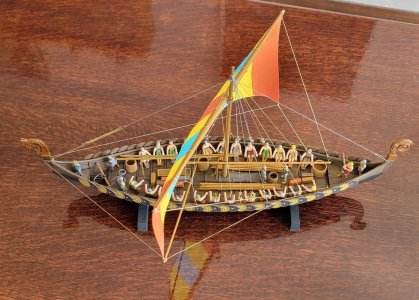
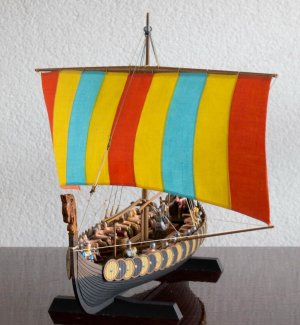
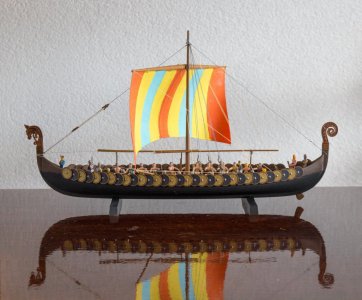
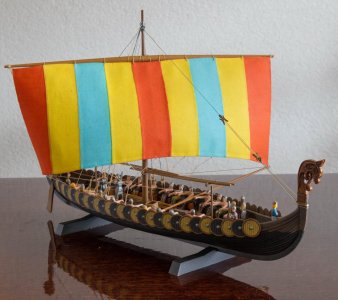
Okay,... I got my sail, but....
I found some cotton which nice colours might believably look like iron aged dyes.
20251231_224735.JPG
Just putting the sail in the airflow proves the lines seen in the contemporary stone carvings are there not for nothing.
20260102_213641.JPG
So I put them in.
20260103_143441.JPG
However, when wet with thinned glue, I had to spread the sheets, or else the sail would have rumpled while drying.
20260103_145011.JPG
And then doing it on the sail which I wanted to use. The problem is that when dried up the surface is bumpy, and that can't be massaged out.
So I have mixed feelings. It is much better (imho) that just a rectangle of crudely stitched linen, but it is not perfect. :(
Glue works with paper, but with cotton, not so much.
I think I should try again, doing it without glue, but with metal wires in the seams. I think.
Perhaps.
I dunno, maybe I should use this sail anyway. Cautious
20260103_171342.JPG
 
Last edited:
Revell were able to 'copy' the faithful replica of the Gokstad ship which sailed across the Atlantic to a 'World Fair' held in the USA in the late 1800's.

I do believe that vessel still exists. Amazing!
 
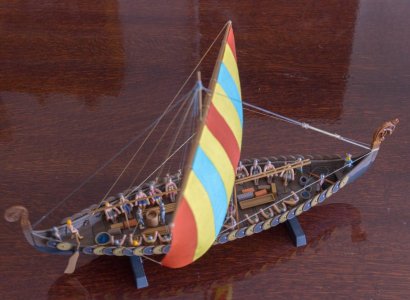
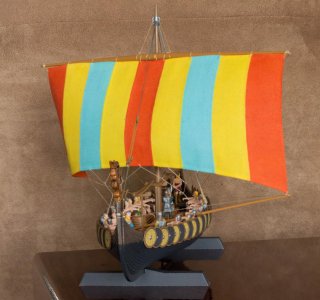
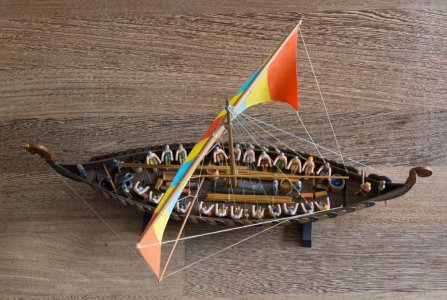
Hoisted the sail temporarily.
I don't really like it, so I am going to try again without glue. Ordered messing (brass) wire. Will take some time though, at least a month.
I do like the colours, so that is not going to change. But it will be interesting to see what Big Jake is going to do, especially with the rigging in the mean time. I might steal some of his ideas. :p

20260104_125441.JPG

20260104_124453.JPG
 
Back
Top