Follow along with the video below to see how to install our site as a web app on your home screen.
Note: This feature may not be available in some browsers.
Ships of Scale has incorportated an extra level of security when you log In. Please follow
on-screen prompts to acknowledge that you are not a robot via a "Check Box" or a "Pictorial Check Box Puzzle". This is needed due
to higher level of AI Activity Security.
The beloved Ships in Scale Magazine is back and charting a new course for 2026!
Discover new skills, new techniques, and new inspirations in every issue.
NOTE THAT OUR NEXT ISSUE WILL BE July/August 2026
Win a Free Custom Engraved Brass Coin!!!
As a way to introduce our brass coins to the community, we will raffle off a free coin during the month
of August. Follow link ABOVE for instructions for entering.
Yes, and this skill largely comes by doing. Looking at something and asking yourself “how do I make this?” Trying different approaches until something works and then adding that knowledge to your memory bank. Even the most skilled model builder was once a novice.
I think that the key factor is having the desire and determination to produce an objectively excellent product.
The barriers that you envision are mostly overcome by the investment of time in developing skills and time spent reading the maps of technique provided by those who have already traveled the same path.
The "metal working" part is a bit perplexing. Most serious metal working involves the process of making new machines - at least that is my observation as regards wooden ships.
There are third party suppliers of wood. Or - for years I got by using a Craftsman 7.5" portable tablesaw and a hollow ground blade. The waste is much higher and requires at the least a homemade thickness sander as a project. For the small scale - again - much waste and a lot of jury rigging, but - TEMU, HF, AliExpress, et al. sell low cost, inaccurate, frustrating quality small tablesaws. They are not the best, or probably not even good, but they are better than nothing. With their use, you will soon get a precise idea about what you do want if and when an opportunity and budget allows.
A lot of the crowing and cheering and enthusiasm about new and or expensive machines is coming from those who had been fighting with absolute crap machines for years. It is the joy of an innocent prisoner being released back into the world.
Model Shipways' posts above of various Model Shipways kit models in various museum collections speaks well for the long-recognized quality of Model Shipways' ship model kits. Like many, I cut my serious ship modeling teeth on a Model Shipways' "Yellow Box" solid hull kit which pre-dated the "plank on bulkhead" kit model fad. However, it is also evidence of the fact that the term, "museum quality," is relatively meaningless because there are "museums" and there are "museums," as well as "ship models" and "ship models" and the quality of a ship model has nothing to do with whether it is built from a kit or built from scratch, or in a museum or not. Every ship model speaks for itself, standing alone on its own merits. A model may end up in a museum for any number of reasons which have little, if any, bearing on the quality of the model per se.
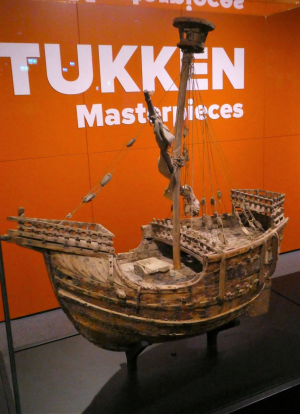
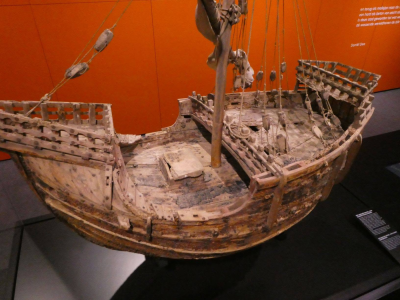
Some ship models find their way into museums not because they are especially good models, but simply because they serve to illustrate a particular vessel or vessel type that is relevant to a particular museum's display requirements, such as the Philadelphia Gunboat made out of Model Shipways kit, displayed at the New York State Military Museum. On the other hand, the below pictured Mataro Model, is the pride of the Maritiem Museum, in Rotterdam, Netherlands. I've studied it in the flesh and have to say that, as ship models go, it's not much to look at, but it is indisputably "museum quality" because it is the oldest known ship model in Western Europe, dating to the early 15th century, and it is the only surviving 15th‑century three‑dimensional representation of a cargo vessel. Radiocarbon dating places its creation in the early 1400s, making it over 600 years old. It is the only fifteenth‑century 3D model of a ship, offering historians and shipbuilders a rare, accurate source for reconstructing late medieval maritime technology. That's why it's in a museum.
Perhaps the best example of the irrelevance of the term, "museum quality," as it is applied to scale ship models is the Royal Museum - Greenwich's collection of contemporary Navy Board or "Admiralty" models from the mid-seventeenth century, when the Royal Navy's administrators began commissioning accurately detailed scale models of its ships. These models were not only functional but were, and remain today, highly prized art objects. Navy Board models are often considered by many to be the pinnacle of ship modeling. They are in many respects valuable contemporary historical evidence regarding ship design and construction methods of their time and the craftsmanship involved in creating these models is often exceptional, making them sought after by collectors and historians alike. Today, many of these models are highlights in collections around the world, valued both for their artistic merit and their historical significance. That said, researchers in recent times have discovered that a surprising number of confirmed original Navy Board ship models in museums and private collections exhibit historical errors and scale inaccuracies, often due to incorrect repairs and restorations over their now 300-plus-year lifespans. (In my opinion, sloppy repainting jobs are the worst of all the insults suffered by original Navy Board models over the centuries.) Others, we must presume, represent either proposals or impressions of vessels which were built differently, if, indeed, they were ever built at all. This isn't to say that Navy Board models don't deserve their six- and seven-figure prices, but only that their claim to "museum quality" isn't only about their absolute historical accuracy or amazing craftsmanship, the level of their quality as models, but also, in very large measure, their quality as historical artifacts in themselves. Some ship models end up in museums because they are primarily very fine models. Others end up in museums because they are very old models (And more than one 300-year-old "contemporary" ship model in a museum was completely re-rigged, or even rigged for the first time, less than a hundred years ago.)
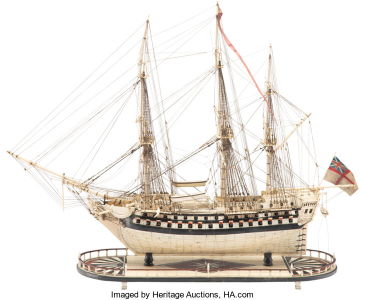
Another type of valuable "museum quality" ship model are those known as "Prisoner of War" models. These were made by naval prisoners of war held in British custody during the Napoleonic Wars, sometimes on a production basis by groups of prisoners for sale to the public as decorator pieces. Frequently made of cast-off beef bones. Their "quality" spans a wide spectrum from what charitably would be called "folk art" through very exquisitely detailed "fine art scale modeling." (A sample of the latter is pictured below.) These models are primarily prized for their inherent value as historical artifacts, not first and foremost for their qualities of historical accuracy or scale fidelity. Few can be classified as "high-quality scale ship models" by today's standards, but all are indisputably "museum quality."
Over a quarter century ago now the NRG devised and promulgated a "fixed and universal" standard to replace the sloppy and meaningless term, "museum quality." Rob Napier recently explained it in depth in his excellent book: Caring for Ship Models - A Narrative of Thought and Application, (2022) Seawatch Books. See: https://seawatchbooks.com/products/...tive-of-thought-and-application-by-rob-napier
"A high-quality scale ship model provides a compelling impression of an actual vessel within the constraints of historical accuracy."
"Historical accuracy" encompasses all the objective, or measurable, standards of technical exactness that might apply to a ship model. These embrace the obvious hull shape and fairness; precision in fittings, rigging, and colors; lack of anachronisms; and so forth. But it also encompasses all aspects of craftsmanship because the lack of craftsmanship creates unrealistic and, therefore, historically inaccurate blemishes on a model. ... The phrase "historically accurate" alone effectively replaces the intention of the now-vapid "museum quality."
"... (A "compelling impression") allows and encourages aesthetic interpretation of a vessel that will help propel the viewers to make the leap of faith that allows a model to work or to willingly suspend the disbelief that keeps a model from working. Both processes help viewers accept the invitation to visit a ship instead of a model. Compelling impression is the result of applying artistic and interpretive decision-making processes... to amplify a model beyond being a mere assemblage of parts."
"It is important to recognize that neither arm of our definition considers how a model was made. There is no assessment of whether entire models or components of them are built from scratch, built from kits, or built by teams of modelers. The main thing is the appearance of the finished model. The ends justify the means."
In this day and age, every experienced ship modeler should recognize the use of the term "museum quality" in ship model kit advertising for the "red flag" it is. The term is meaningless as any expression of a ship model's quality and its use by merchants who know better to describe their products betrays their intention to take advantage of the consumer's ignorance.
I must admit that the now-long-accepted definition of "a high-quality scale ship model" is a bit of a mouthful. For those who desire a "shorthand" version, I propose the term, "investment-grade" ship model, which is to say, "a ship model whose value can be reasonably expected to increase over time." That term is defined by the marketplace, rather than any other standard. Any kit model manufacturer who claimed that an "investment grade" ship model could be built from their kit would not be entirely disingenuous, however difficult realizing such a promise with only what's "in the box" alone might actually be.