Kurt Konrath
Kurt Konrath
When you say DEEP, are you talking knee high boots or waist waders?This topic is getting DEEP, guys. I'm trying to keep up... it's facinating.



 |
The beloved Ships in Scale Magazine is back and charting a new course for 2026! Discover new skills, new techniques, and new inspirations in every issue. NOTE THAT OUR NEXT ISSUE WILL BE MARCH/APRIL 2026 |
|
 |
As a way to introduce our brass coins to the community, we will raffle off a free coin during the month of August. Follow link ABOVE for instructions for entering. |
|
When you say DEEP, are you talking knee high boots or waist waders?This topic is getting DEEP, guys. I'm trying to keep up... it's facinating.

Personally, I have great respect for Longridge and his contribution to the hobby; his work is undeniably influential and has shaped generations of builders. That said, I’m not convinced that any single authority, no matter how respected, should define quality for everyone.Maybe we're hung up on semantics here, but the standard I cited was devised precisely to enunciate a "fixed and universal" standard to replace the sloppy and meaningless term, "museum quality." Napier explains it in depth in his book:
"A high-quality scale ship model provides a compelling impression of an actual vessel within the constraints of historical accuracy."
"Historical accuracy" encompasses all the objective, or measurable, standards of technical exactness that might apply to a ship model. These embrace the obvious hull shape and fairness; precision in fittings, rigging, and colors; lack of anachronisms; and so forth. But it also encompasses all aspects of craftsmanship because the lack of craftsmanship creates unrealistic and, therefore, historically inaccurate blemishes on a model. ... The phrase "historically accurate" alone effectively replaces the intention of the now-vapid "museum quality."
"... (A "compelling impression") allows and encourages aesthetic interpretation of a vessel that will help propel the viewers to make the leap of faith that allows a model to work or to willingly suspend the disbelief that keeps a model from working. Both processes help viewers accept the invitation to visit a ship instead of a model. Compelling impression is the result of applying artistic and interpretive decision-making processes... to amplify a model beyond being a mere assemblage of parts.
"It is important to recognize that neither arm of our definition considers how a model was made. There is no assessment of whether entire models or components of them are built from scratch, built from kits, or built by teams of modelers. The main thing is the appearance of the finished model. The ends justify the means."
Rob Napier, Caring for Ship Models - A Narrative of Thought and Application, (2022) Seawatch Books.
See: https://seawatchbooks.com/products/...tive-of-thought-and-application-by-rob-napier
The import of Napier's definition of a "high-quality scale ship model" transcends the fact of how it was made and eliminates any "scratch vs. kit" issue by focusing on the model without such considerations which are extraneous to the question of whether the model is a "high-quality scale ship model." Napier's definition is designed to qualify a ship model as a "high-quality scale ship model" and nothing more. It does objectively define "high-quality scale ship model" as one which "provides a compelling impression of an actual vessel within the constraints of historical accuracy." That's as far as it goes. It provides no objective standards for judging how high the quality of a "high-quality scale ship model" might be once it is determined to be a "high-quality scale ship model." That assessment must be made in comparison with other "high-quality scale ship models" and is a matter of subjective comparisons, as you suggest. Those considerations are what you cite as "agreed upon and not absolute," and are generally seen as those applied by judges in modeling competitions.
I believe it is worth noting that in many, if not most, modeling competitions, an attempt is made to judge both the model and the modeler by separating the models into classes, e.g., "scratch-built," "semi-scratch built" "kit built," "modified kit built," and so on, with the various classes allowing for bestowing awards for the modeler's skill as well as the comparative excellence of the models in each class. This reflects the perhaps mistake biases of the competition organizers and judges. I expect they recognize that the more prizes there are to award, the more entries they are likely to generate, yet the reality remains, as Napier recognizes, that whether a model was assembled from a kit or built from scratch has nothing to do with the quality of a model.
Now, it may well be the case that in order to produce a very "high-quality scale ship model" from most kits, a modeler must do the same level of research as the scratch builder, and so much "after-market fabrication" and modification of the kit that it might as well have been scratch-built. For this reason, I don't consider the separate judging of scratch built models and kit models to validly recognize any sort of distinction between the skill or effort of scratch or kit modelers at all.
I do believe, however, as a separate discussion entirely, that kits can and should be comparatively evaluated as kits. I suppose that theoretically any kit can serve as the basis of a "high-quality scale ship model" if the corrections, modifications, and additions can be made, but the I submit that some kits are better than others in their ability to serve as a foundation for the creation of a "high-quality scale ship model." To establish and promulgate such evaluations would be a great service to modelers and to the art of "high-quality scale ship modeling" by encouraging a process of "natural selection" that disfavors the proliferation of mediocre ship model kits sold to unsophisticated would-be ship modelers.
Personally, I have great respect for Longridge and his contribution to the hobby; his work is undeniably influential and has shaped generations of builders. That said, I’m not convinced that any single authority, no matter how respected, should define quality for everyone.
Standards evolve. Techniques evolve. Research evolves. Even aesthetic expectations evolve. Longridge’s benchmark reflected his time, his training, and his philosophy of modeling. It was significant, but it was not the only or final word for all time.
I also can’t help noticing that you seem to invoke Longridge in almost every discussion, as if referencing him settles the matter. While his work deserves recognition, repeatedly pointing to one authority risks narrowing what should be a broader conversation.
Quality can certainly be guided by established standards, but it should not be confined to one person’s interpretation, even a great one. Builders pursue different goals: historical replication, artistic interpretation, competition standards, teaching models, or personal fulfillment. It seems reasonable that standards of quality may vary depending on intent.
Respecting tradition is important. Treating it as doctrine is something else.
We have a highly experienced judge among us, Franchesko @Frank48, who has served for many years as a NAVIGA judge. Could you confirm or clarify whether this aligns with NAVIGA’s rules and standards — or offer any corrections if it does not?
For me, it's a innovative construction, a reliable historical approach, and aesthetically pleasing workmanship. I don't condone making a cheap, pre-made model from a kit and then telling people it's an "exhibit"... just because someone replaced rigging ropes and added a few purchased wooden slats...What is it about a model that makes it valuable to the collector community?

For me, it's a innovative construction, a reliable historical approach, and aesthetically pleasing workmanship. I don't condone making a cheap, pre-made model from a kit and then telling people it's an "exhibit"... just because someone replaced rigging ropes and added a few purchased wooden slats...
 . I suggest you save your energy for something more creative...

Thanks for clarifying the source. That context regarding Rob Napier and the historical development of the “compelling impression” definition is helpful. But... my concern, however, isn’t about whether the phrase has a pedigree or has been cited by respected individuals and organizations. Clearly, it has. My question is more fundamental: does repeated citation within a particular circle transform a definition into a universal standard?Jimsky, I haven't mentioned Longridge once in these discussions. I've scrupulously cited the source of the quotations I've posted: Rob Napier in his book, Caring for Ship Models. In fact, in that book, he explains how he and Bruce Hoff, another well-known master modeler and a former director of the Nautical Research Guild, developed the definition of a "high-quality scale ship model" and coined the phrase “a compelling impression of an actual vessel” as part of a lecture given on so-called "museum quality" ship models, presented at the Guild’s 1990 conference and published in Nautical Research Journal in March 1991. In July of 1998, Alan Frazer, noted in his article published in the Hampton Roads Ship Model Society's Logbook that, “`Compelling impression' is often used in the Guild’s confidential Ship Model Review Service reports" which he edited. (See: https://www.hrsms.org/wp-content/uploads/news145Jul1998.pdf) R. Michael Wall, director of the Marine Model Gallery, probably the foremost appraiser of investment quality fine art scale ship models in the United State similarly quoted the "compelling impression" standard to define "museum quality" ship models. (See: https://www.shipmodel.com/faqs/#4) Prior to the publication of Napier's most recent book which I quoted, Tom Lauria did a YouTube video on the "compelling impression" definition called Scale and the Compelling Impression.
Any serious ship modeler who has followed the literature at any time over the last thirty-five years or so should be completely familiar with the "compelling impression" definition as the universally accepted standard for "high-quality scale ship models." I have quoted the writing of one of the two authors of the standard constituting that authority's description of the "compelling impression" standard, but I that definition of a "high-quality scale ship model" has been universally accepted and embraced by the top ship model authorities for over thirty-five years now.
Nowhere have I suggested that it is unreasonable that "standards of quality may vary depending on intent." Quite to the contrary, the definition I have cited expressly applies only to "high-quality scale ship models." Ship models are built for many reasons other than the intention of creating a "high-quality scale ship model" and for that reason the standards by which their quality is measured may vary. An objection to the application of objective standards is inherently specious because subjective judgments are merely unsubstantiated opinion which is no standard at all. Everybody has a right to their own opinions, but nobody has a right to their own facts.

If you are referring to Rob Napier and think he and he alone set the standards for quality ship models you are wrong. I know this because i knew Rob personally way back in the early days of the NRG. The standards Rob is setting forward was at that time the standards set by the 1,220 members of the guild. They based their standards on the work of master builders, marine gallery standards and standards set in the maritime academic world. Rob Napier may be the front man of Quality ship models but he has a lot backing him up. A standard is set it does not evolve or change like "the gold standard" it is the last and final word.


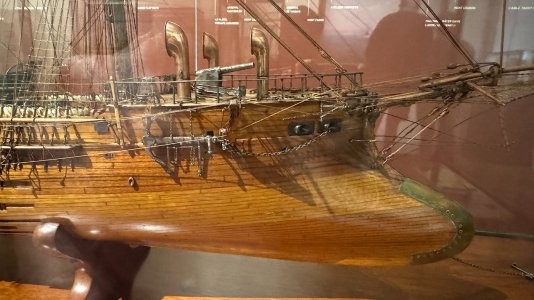

This may all be true but the old days of the NRG and such, have evolved into something totally different today with the popularization of model ship building through social media (essentially forums) where, for many modelers, these standards are unknown or have been moved deep into the basement and forgotten.
But knowing that "good work" is also very subjective, repeatedly publicly quoting an author who like you say has a lot to back him up, make me think that I would expect his most publicly vocal students to walk the walk within the public venues they so readily frequent while showing one art they mastered; the art of the word.

The exercise of assigning intent and then condemning that assigned intent is a strategy you like to employ (I suspect this is a professional talent), but it is unhelpful (misguided?) (disingenuous?).All social media platforms do is provide an unedited soap box for anyone who wants to state an opinion. Just because there are more people who wouldn't know a "high-quality scale ship model" if it snuck up and bit them in the butt, building ship models today doesn't mean that it logically follows that the corresponding increase in substandard ship models must cause some sort of "evolutionary" lowering of the quality standards for scale ship models. However, left unchallenged, it surely could. Neither did the invention of the paint-by-numbers kit work a decrease in the standards of good oil painting. I am glad to see people pursuing an interest in ship models and I would encourage anyone who had the slightest inclination to do so, but I'm not about to start calling mediocre models "high-quality scale ship models" just to attract more people to the art form.
There's nothing "evolutionary" about standards. Call a spade a spade: many of those who have found ways to monetize ship modeling have an interest in getting as many people involved with it as possible because those novices are these marketers' customer base. High-quality scale ship modeling is a demanding discipline requiring serious academic study, extensive manual arts skills, and a substantial investment in tools, time, and temper. Much of the ship modeling "industry," particularly the kit manufacturers, unscrupulously seek to lower the standards in order to make high-quality scale ship modeling more attractive to their customers who would otherwise in large measure seek other less exacting and demanding hobby pursuits if they realized how far below the standards the results of these kit manufacturers' products truly are. It's basically a fraud worked on the novice modelers who, realizing their work isn't what they'd expected, then defensively argue against standards and for a purely subjective definition of ship model quality. There are even those who argue against any standards of quality whatsoever by applied to ship models and God help anybody who has the temerity to say the emperor has no clothes.
There's no greater wrong that can be done to ship modeling and ship modelers than to con a generation of modelers into believing they can only build models if they purchase kits that do much of the work (and thwart much of the artistic creativity) for them at an exorbitant price, yielding a substandard model that they've been led to believe is well done. That is, however, the "state of the art" for internet-influenced scale ship modeling. One needs only a short bit of "surfing" to see just how many "instructional" videos are online purporting to teach people how to build ship models posted by people with little or no background or experience in ship modeling at all.
The whole point of standards is that they are not subjective. "Subjective standards" is an oxymoron. "Good work" is not "very subjective." Work is either "good" or it is not, albeit in varying degrees. A model doesn't speak for its maker. A model speaks for itself. This is the difference between art and craft. Neither is there any requirement for one to compete with another artist to accurately critique their fellow's work. Indeed, evaluating the work of another is more accurately done when the evaluator's work is not presented at the same exhibition.
An integral part of the learning process in any art class is the student's critiquing of each other's work. This is how artists learn. They don't argue that fellow students who critique their student projects are "elitist" or that "standards of quality are subjective" in an effort to discourage others from evaluating their work that they know to be below par. The true artists welcome critiquing, even when it is painful to hear negative constructive criticism because it gives them a perspective of their own work that they cannot achieve any other way. Instead of blowing smoke up inexperienced modelers' tail pipes, those of us who've been around the block a time or two should be urging them to "be better."
Actually, the point several of us are trying to make is that it does not bind us. Surely you can see that everyone does not intend (or desire) to be a master model builder? There is nothing wrong with elevated standards, but they cannot be used as a bludgeon. Some modelers just want to have fun.yes it does bind us WE are that culture in total from rank beginner to master builder we are all included there is no separation.
Excellent point. I agree.as for the builder are you satisfied how you spent your time and that is it in a nut shell
As discussed throughout this thread - excellence in craftsmanship does seem to be part of the 'value' equation.As a buyer it's value is measured by the standards and is it worth the money spent.
I was asked by a visitor to my home how much a particular model was worth. I gently explained that nothing was for sale - - for the reason you just shared, Graham. But as a rule, when people visit, no one even mentions my prominently displayed ship models. They just don't care about them...My builds are invaluable - but only to me. They take me away from the TV, the NEWS and the cesspit that is social media. It is a solitary pursuit and I do not know of any clubs or people with a similar intrest in my area, but I am none the worse for that. Long may it continue for us all.
Well… that’s easy to explain — clearly you’re not building to Napier standards. Once you achieve a fully documented “compelling impression,” visitors will surely form a queue in the hallway.But as a rule, when people visit, no one even mentions my prominently displayed ship models. They just don't care about them...
Now you've hurt my feelings. And the Kingfisher'sWell… that’s easy to explain — clearly you’re not building to Napier standards. Once you achieve a fully documented “compelling impression,” visitors will surely form a queue in the hallway.
.

same here. They don't care about themI was asked by a visitor to my home how much a particular model was worth. I gently explained that nothing was for sale - - for the reason you just shared, Graham. But as a rule, when people visit, no one even mentions my prominently displayed ship models. They just don't care about them...