
-

SUBSCRIBE TO SHIPS IN SCALE TODAY!
The beloved Ships in Scale Magazine is back and charting a new course for 2026!
Discover new skills, new techniques, and new inspirations in every issue.
NOTE THAT OUR NEXT ISSUE WILL BE MARCH/APRIL 2026 -

Win a Free Custom Engraved Brass Coin!!!
As a way to introduce our brass coins to the community, we will raffle off a free coin during the month of August. Follow link ABOVE for instructions for entering.
You are using an out of date browser. It may not display this or other websites correctly.
You should upgrade or use an alternative browser.
You should upgrade or use an alternative browser.


- Joined
- Jul 11, 2023
- Messages
- 438
- Points
- 238

Greeting @Eddieb, I usually use contact adhesive (CA glue) only for very small part that require pretty much instant gluing. For the majority of the build standard PVA glue with various clamps is fine. Recently thought, I started using "Hide Glue". I must say that I'm now completely sold on it for anything involving wood. It is thick so it does not run everywhere, it will grab/hold the pieces after 5-10sec of pressure without slipping much, dry very hard/crystalline so it can be sand easily or wash away with moist cloth, contain little water so the wood does not warp, does not stain wood so it can be finished without blotching and finally it is reversible with steam/heat.... what's not to like! Tidebond sell some in a ready to use format. Drawback: will expire in a couple years - I keep stock in a fridge at 4oc to extend life - and cure time similar to PVA.
Last edited:


many of us also use PVA glue.
- Joined
- Oct 2, 2025
- Messages
- 421
- Points
- 128
This is probably just a poor translation from Spanish.,instructions say use contact adhesive on decking
Contact cement usually means DAP Weldwood Contact cement. Nasty stuff that has no use on a ship model.
PVA is fine.
PVA can become a contact cement. Totally coat both meeting surfaces with a just wet layer. Yellow or white puddles are having too much. Let dry. Position the part. Iron it. The heat activates the PVA and bonds. This obviously does not work with thick wood.
A curling iron may make a good plank bender, but there is no hot business end to iron with.
There are a couple of purpose built plank bending irons - or model aircraft fabric irons.
It looks like the best version - the old Aeropiccola bender is available again reborn as a less well done Chinese version: Wood Board Bending Pliers Boat Models Making Tool Wooden Strips Bender Part for 936 Series Soldering Irons Brand: YWMJZEU (definitely a non-native English speaker who has probably never met a native English speaker - doing the name translation - reminds me of All your base are belong to us.
Going "old school". Before WWII hide glue or nitrocellulose glue was probably all that was available. Before the Civil War it was probably just hide glue. But before 1990 it would have been Hot pot hide glue. Lee Valley sells a water jacket hot pot to keep a constant temp -no cooking the glue. Kept dry, the granules have an indefinite shelf life. If I read it correctly, there is only a short window of time to change your mind about position. 192 is stronger than 251 but is less forgiving about positioning time.I started using "Hide Glue".
- Joined
- Jun 29, 2024
- Messages
- 1,812
- Points
- 488

The more advanced PVA glues will also “grab” fairly quickly when pushed down with your fingers. The bond is also weak enough before fully curing to allow you to move things around if need be.
I don’t know what brands are sold in Great Britain but here in the USA I use Titebond II.
Roger
I don’t know what brands are sold in Great Britain but here in the USA I use Titebond II.
Roger

I'll have to try a little hide glue. Can it be softened and dissolved with isopropanol like PVA can? I end up redoing plenty of glue-ups.Greeting @Eddieb, I usually use contact adhesive (CA glue) only for very small part that require pretty much instant gluing. For the majority of the build standard PVA glue with various clamps is fine. Recently thought, I started using "Hide Glue". I must say that I'm now completely sold on it for anything involving wood. It is thick so it does not run everywhere, it will grab/hold the pieces after 5-10sec of pressure without slipping much, dry very hard/crystalline so it can be sand easily or wash away with moist cloth, contain little water so the wood does not warp, does not stain wood so it can be finished without blotching and finally it is reversible with steam/heat.... what's not to like! Tidebond sell some in a ready to use format. Drawback: will expire in a couple years - I keep stock in a fridge at 4oc to extend life - and cure time similar to PVA.
- Joined
- Jul 11, 2023
- Messages
- 438
- Points
- 238
In fact, it can be soften/dissolve using water and heat. I had better success using steam. In addition, it can glue to itself, so no intensive cleanup and/or sanding. Obviously, it is not waterproof but if you finish with polyurethane, for example, it should. I don't think our ship will see much water though.
Warning: Be careful not to use quick set PVA glues like Aleene's. Fine for arts and crafts but no good for carpentry. I think Titebond has a quick set to watch out for, too. No bueno. The quick set part is nice, but the result is a rubbery glue joint. It's not easy to finish with sanding and staining either. Just a big, clear booger.
I use transparent Titebond PVA with great luck. I like the strength of the glue, it is very similar to Titebond II in application, sands well, and doesn't add any color to the joint if you don't want it. If you do want the color, it can be altered like most other glues: with pigments, dyes, or ink in small amounts. It doesn't need any special treatment other than to stay sealed from air/not releasing moisture.
I use transparent Titebond PVA with great luck. I like the strength of the glue, it is very similar to Titebond II in application, sands well, and doesn't add any color to the joint if you don't want it. If you do want the color, it can be altered like most other glues: with pigments, dyes, or ink in small amounts. It doesn't need any special treatment other than to stay sealed from air/not releasing moisture.


Thanks for this conversation guys.
- Joined
- Jul 11, 2023
- Messages
- 438
- Points
- 238
The water content in PVA glue is primarily what drove me to look for an alternative. As a beginner builder, I truly underestimated the warping effect on wood. Let me show the following example (an excuse to show off one of my past projects - sorry for that!).
I wanted to build a T-track table. With limited tools and space, I decided to build the table without a router by gluing parts together. First pictures show the parts and the last the end results. Look in the corner... Gorilla Glue, like PVA, is a glue high in water content.
When I assembled everything, I noticed 2-3 hrs later some slight warping on top, mostly from the junction of multiple parts - wood expands at the bottom (wet) but not at the top (dry) >> warping. The source... the glue. It took some serious clamping to fix that - partially, if you look very closely.
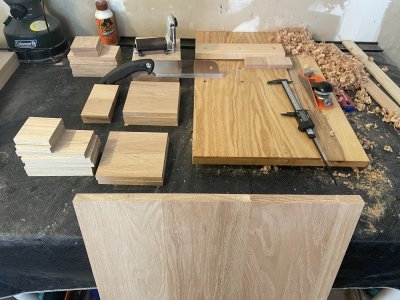
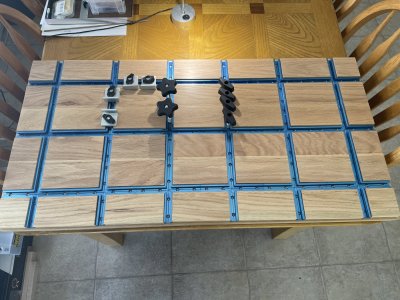
I wanted to build a T-track table. With limited tools and space, I decided to build the table without a router by gluing parts together. First pictures show the parts and the last the end results. Look in the corner... Gorilla Glue, like PVA, is a glue high in water content.
When I assembled everything, I noticed 2-3 hrs later some slight warping on top, mostly from the junction of multiple parts - wood expands at the bottom (wet) but not at the top (dry) >> warping. The source... the glue. It took some serious clamping to fix that - partially, if you look very closely.

Loracs,Greeting @Eddieb, I usually use contact adhesive (CA glue) only for very small part that require pretty much instant gluing. For the majority of the build standard PVA glue with various clamps is fine. Recently thought, I started using "Hide Glue". I must say that I'm now completely sold on it for anything involving wood. It is thick so it does not run everywhere, it will grab/hold the pieces after 5-10sec of pressure without slipping much, dry very hard/crystalline so it can be sand easily or wash away with moist cloth, contain little water so the wood does not warp, does not stain wood so it can be finished without blotching and finally it is reversible with steam/heat.... what's not to like! Tidebond sell some in a ready to use format. Drawback: will expire in a couple years - I keep stock in a fridge at 4oc to extend life - and cure time similar to PVA.
I'm glad you brought up "Hide Glue". Hide glue is another excellent adhesive for wood applications. Including ship modeling!
When there is a need to seperate part/s, keep in mind vinegar can be used to soften hide glue for separation. Apply. Wait. Don't be impatient. Gently seperate part. Then scrape away any remaining glue.
This is a trick known and used, especially for antique restorers willing to share their secret.
- Joined
- Oct 2, 2025
- Messages
- 421
- Points
- 128
NO! Hide glue is a protein. I know that hot ethanol will denature it (kill it). It rolls into little balls that can be rubbed off. I have not done the experiment but I have every confidence that iso will denature the protein just as readily as ethanol.I'll have to try a little hide glue. Can it be softened and dissolved with isopropanol like PVA can?
The Gorilla company seems to have attached "Gorilla" to every type of glue that they can find worth repackaging and selling. But, if you used the Original Gorilla glue? Well this glue is gap filling. It swells and expands. It was likely the glue that did the up pushing.Gorilla Glue, like PVA, is a glue high in water content.
PVA - for a good bond - the surfaces need to be as close together as can be had without crushing the surface of the wood. The wood surface needs some "tooth". Sanding with 220 grit has worked for me so far, but sanding with a finer grit runs the possibility of a failure to bond due to lack of surface area. All that is needed is to completely wet both meeting surfaces - puddles where you can see the color of the glue is having too much.
Not Styrofoam beads, but most other varieties of packing foam and round toothpick handles make good applicators/spreaders - Duco is waterproof, dries quickly, and will keep a toothpick(s) bonded to the foam. Any needed shape and size is between you and a Gem single edge razor blade.
A just wet layer of PVA will be well along its polymerization/evaporation to atmosphere process before enough of it could enter the cellulose fibers and swell them. From a practical standpoint PVA doing wood swelling is not a problem.
PVA glue suitably clamped to avoid cupping is a perfect solution. Gives you a little time to position each piece.
- Joined
- Jul 11, 2023
- Messages
- 438
- Points
- 238
@DAWarden-(Jaager) , that would explain a lot! Thanks for the clarification.
Eddie, I assume by contact adhesive you mean Bostik and the like. The advantage of this is you let it dry and it then sticks instantly without the need of clamps. The disadvantage is spreading it on deck and planks is a very messy process, and removing excess between joins is difficult. You can use super glue (CA) with a thin nozzle but I prefer PVA, let it go off for a couple of minutes and it should stay stuck.

I use PVA and CA glue too but CA glues When it dries, the wood changes color, leaving a white layer. Activator-based adhesives have almost the same properties. What I want to know is, is there an adhesive on the market that doesn't leave marks or discoloration when it dries?