
• Win a Free Custom Engraved Brass Coin!!!
    As a way to introduce our brass coins to the community, we will raffle off a free coin during the month of August. Follow link ABOVE for instructions for entering.
  • PRE-ORDER SHIPS IN SCALE TODAY!

    The beloved Ships in Scale Magazine is back and charting a new course for 2026!
    Discover new skills, new techniques, and new inspirations in every issue.

    NOTE THAT OUR FIRST ISSUE WILL BE JAN/FEB 2026

Why not more kits with spiled planking?

While it won't be as nice a result that can be had by using your own timber / spiling all the planks to their correct shapes, its still possible to get a pretty nice second planking on a kit using kit supplied material. One of the problems with the kit supplied wood is there often is not strips wide enough to properly do the lower planking - garboard, etc.

This is a way that I've used for a number of kits. I start by lining off the hull based on the nominal width of the supplied planking material; typically this is done in multiple belts. Then I choose an appropriate plank length - this is crucial for me as there is little if any chance that I would be able to shape a strip as long as a hull to the correct dimensions. Using shorter strips, allows for almost spiling the pieces; not much more than a taper is needed on a short piece and little edge bending as well. This is a calculus / differential geometry fact in practice; its called linearization! The shaping of each plank does not take long and cementing it to the hull is infinity easier than trying to attach a hull length strip.

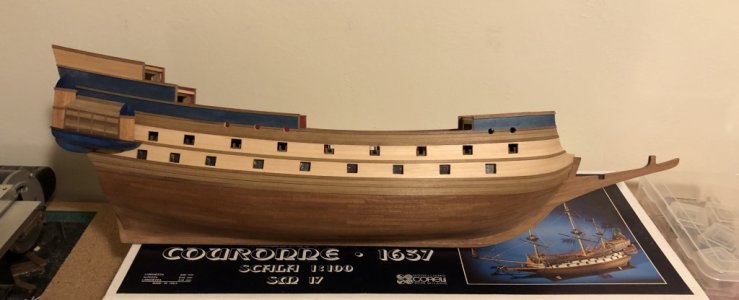
Here are a couple of examples, first is the hull from the Amati Xebec kit, the second from Corel's La Couronne.
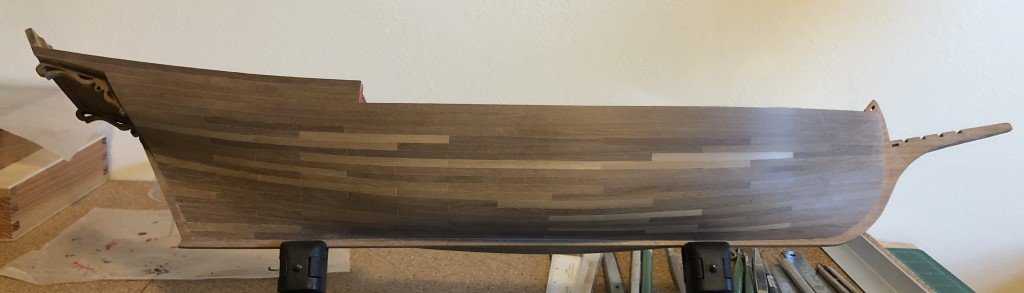
1768765203431.jpeg

1768765268219.jpeg

With this said, and while I still am working thru a stash of kits, my current preference has turned to scratch building for the simple reasons that I find it both easier - no need to try to make kit parts fit, spiling planks is not hard or overly time consuming - more enjoyable, and much less stressful - not to mention it has opened my interaction with the hobby to a vast number of subject choices that cannot be found in kits.
 
While it won't be as nice a result that can be had by using your own timber / spiling all the planks to their correct shapes, its still possible to get a pretty nice second planking on a kit using kit supplied material. One of the problems with the kit supplied wood is there often is not strips wide enough to properly do the lower planking - garboard, etc.

This is a way that I've used for a number of kits. I start by lining off the hull based on the nominal width of the supplied planking material; typically this is done in multiple belts. Then I choose an appropriate plank length - this is crucial for me as there is little if any chance that I would be able to shape a strip as long as a hull to the correct dimensions. Using shorter strips, allows for almost spiling the pieces; not much more than a taper is needed on a short piece and little edge bending as well. This is a calculus / differential geometry fact in practice; its called linearization! The shaping of each plank does not take long and cementing it to the hull is infinity easier than trying to attach a hull length strip.

Here are a couple of examples, first is the hull from the Amati Xebec kit, the second from Corel's La Couronne.

View attachment 571199

View attachment 571200

With this said, and while I still am working thru a stash of kits, my current preference has turned to scratch building for the simple reasons that I find it both easier - no need to try to make kit parts fit, spiling planks is not hard or overly time consuming - more enjoyable, and much less stressful - not to mention it has opened my interaction with the hobby to a vast number of subject choices that cannot be found in kits.


Definitely an acceptable and often used method for thin second planking but it does rely on a well done first planking. Any pictures or comment on how the first planking was done? Often times laying out and applying the first planking is the more difficult task.
 
1 mm birch 3-ply is quite flexible for basic bending. If spiling is used there is no need for edge bending

Quite so. Plywood can be useful in some applications, sub-decking and cabin tops, for example. The important thing with respect to bending it is that plywood is not capable of forming compound curves as are found on round hulls. It will only work for "developed" hard-chine hull shapes designed specifically for plywood (or in some instances sheet metal) construction. It's perfectly suitable for ordinary curved shapes. The use of plywood for any part of a ship model is generally inadvisable for a number of other reasons, however, including but not limited to its lack of suitability for face sanding, the difficulties it poses in obtaining smooth edge cuts, its lack of suitability for edge planing, and its inability to permit fastening into the edges due to its laminated construction. Archival quality and compatibility with natural wood movement are other plywood related concerns.
 
Last edited:
Unwrapping or flattening a 3D surface can be done in software like AutoCAD or Inventor, though even in lieu of modern algorithms - hand spiling and copying the planks is also a possibility.

Random thoughts as to why it's most likely not pursued are:

1.) Cost of updating the kits. Most everything relates to cost but OTOH most things are possible with enough time/money. What is the margin on these ships? What size companies are the likes of Occre and Artesania Latinia? Occre - $7 million/yr * AL - $49 million/yr
2.) Historical. When were most ship models from major manufacturers designed? How old are these models? Are there digital 3D models available or just 2D CAD drawings?
3.) Planking the hull is a ritual or rite of passage (i.e. a learned skill)
4.) Spiling works best with close spaced timbers. Most major manufacturers' models offer widely spaced plywood ribs with the curvatures set in place by the fairing of frames and first planking (not the timbers). A spiled plank on widely spaced un-evenly faired ribs will not fit very well.
5.) One chance. Here's a set of spiled planks, don't make a mistake?
6.) Cater/market to the masses? Which method is easier (i.e. tell the customer how easy it is!)?
7.) Some wood types don't work well with large curvatures (edge bending or rounding) and given the wider widths sometimes necessary with spiling it can make for an extra challenge.
8.) Spiling can be tedious and time consuming... sometimes even more so than drop planking - many modelers may not have the patience.
9.) Material choice - do manufacturers include thin plywood for planking? or do they obtain/make wider widths of other hardwoods?
10.) Skill. Spiling is most likely not as easy to explain in a set of kit instructions as drop planking.

Spiled planks aren't simply a calculation and scribe, they are also an art form/judgement call at the time of spiling. The modeler may not agree with how the kit planks were spiled. They may have liked to use a drop plank or planks of lesser or greater widths.

Drop planking is done for a reason - the first planking establishes the curvature and fairing of the hull on models with widely spaced ribs that may not be faired or assembled perfectly giving the modeler an opportunity to correct any mistakes. With the second planking giving it a "sheen". The smoother the first planking, the easier the sanding, and the more the second planking will be easier to apply and stand out as smooth and even.

Different levels of kits and modelers - artisan vs. apprentice/common. Someone building a ship from scratch using a CNC router for the timbers, etc... would most likely be inclined to spile their planking. Some of those building commercial kits may not even know about spiling.

Without the ability to purchase additional material would amateur and experienced modelers build equivalent/similar double planked hulls from the same kit? Most likely both hulls would be acceptable/similar.
 
Definitely an acceptable and often used method for thin second planking but it does rely on a well done first planking. Any pictures or comment on how the first planking was done? Often times laying out and applying the first planking is the more difficult task.
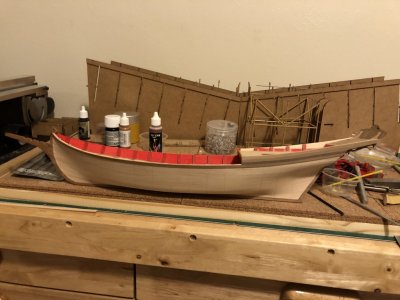
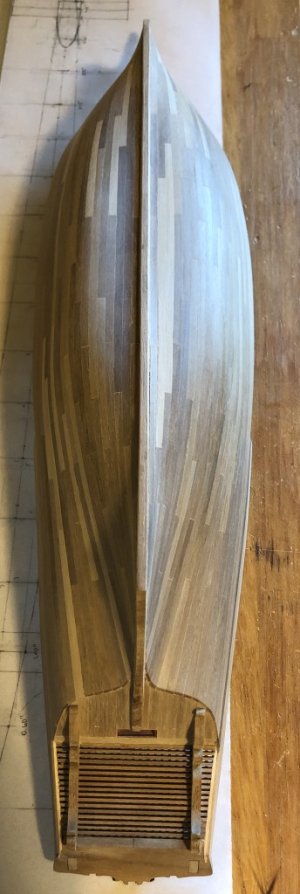
Here the xebec when it was ready for its second planking, and another of the finished planking:
1768770320935.jpeg

1768770352504.jpeg


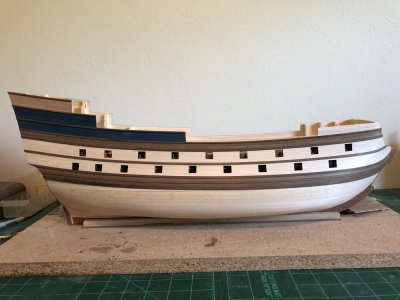
Here is a picture of La Couronne just before the lower / veneer planking was to be added. The upper planking / down thru the wales had been done using full length planks.

1768770543962.jpeg
 
What is sad to me is that the Asian companies do more research on European ships than most, if not all, European kit makers. Resting on one's laurels will catch up with them eventually.
Allan
I've been saying that for 30 years, still waiting! Have you seen the headrails on Mamoli's Surprise? They're having a laugh!
 
Here the xebec when it was ready for its second planking, and another of the finished planking:
View attachment 571225

View attachment 571226


Here is a picture of La Couronne just before the lower / veneer planking was to be added. The upper planking / down thru the wales had been done using full length planks.

View attachment 571227

Thank you! That looks like a normal sanded first planking with the top / bottom using full length strips and some triangles. The middle is then filled in with planks meeting the bottom of the top plank and some formed pieces. Albeit you've done a nice job with little to no putty/filler.

Point being that un-sanded or sanded first planking on a double planked ship generally doesn't look or lay on the hull like spiled planking though it does provide a smooth layer for the thin second planking. The lining off of the hull with the provided nominal width thin planking cut to short strips also doesn't look or lay quite like true spiled planking but both of them still produce nice looking hulls noticeable only to the knowledgeable/trained eye or hidden if painted.

Spile plank a model ship hull then paint over it... o_O Would hate to cover up all that work... maybe if the joints can still be made out.
 
Our hobby is a wonderful and fascinating one. The fact that we have such diverse skills and expectations of ourselves and of the finished models is, in my opinion, part of what makes it so fascinating. We have many members in this forum who are true artists and have my utmost admiration.
I will never achieve that extraordinary skill level. With this in mind, I am personally very curious and excited about any innovation that can make building easier and faster.

Some Chinese and Russian kit manufacturers design their models entirely on the computer first. This opens up new possibilities for both manufacturers and modelers. I ordered the "Polotsk" kit from "Master Korabel" in the USA two weeks ago. I'm really looking forward to this new experience.

I agree with "ubjs" and hope that European and US manufacturers will also release some kits with this type of planking.
 
Last edited:
Kits use veneers because it's cheap, it's not like they cut the stuff, they buy it. Cutting full-thickness planks, even providing boards for you to cut the planks from would be a great deal more expensive, and require more skill than they or their market audience has. But by layering veneers, the kit can almost cold-mold the model making it cheaper, easier, and stronger. They can also use junk wood that happens to finish pretty, because so many folks want a furniture accent rather than a model. These woods are cut into veneers on a massive scale because they're near useless for building or furniture making as boards, so kit makers just buy veneers and have them cut into strips.
The reason the kits don't instruct you to spile the finish layer of planking is because they don't know how to themselves. This would require them practically adding a book on planking to every kit, increase the skill level required, alienating a big chuck of their market all of which means more cost and less income.

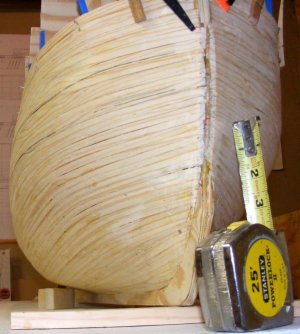
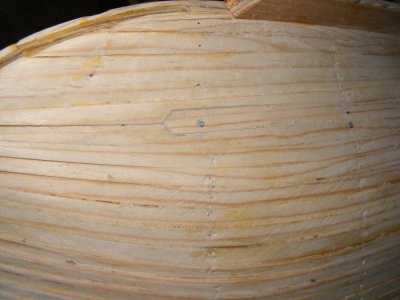
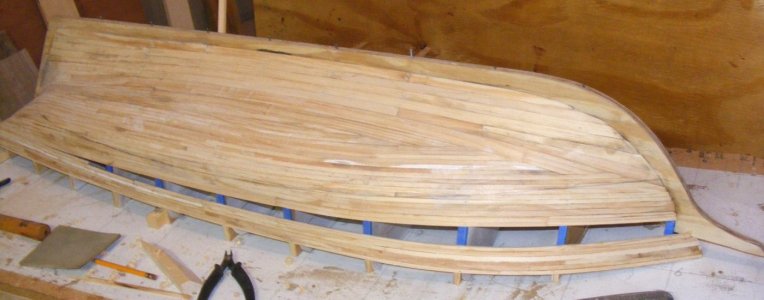
What spiling is often done by modelers isn't spiling, it's tapering and bending - as shown in the pics of my Macedonian.
(click pic for larger image)
mac20111219d.jpg mac20111218n.jpg mac20111216a.jpg
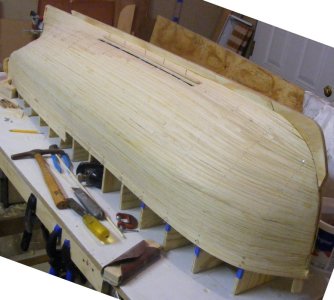
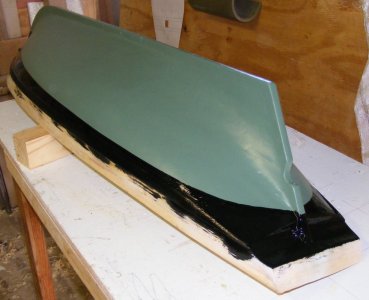
This obviously isn't a kit, or planked in veneers. It's planked in 1/8"x3/8" white pine tapered toward the bow to no less than half it's width, with drop planks where required. None of the planks are full length because then both ends have to be shaped and perfect, and that's adding more work for no good reason. This hull got covered in 4oz glass cloth and will be painted, no-where will the planking be visible except inside the hull.
Planking this way cannot be done with veneers because veneers won't bend that way.

On that note: despite having been involved with the construction of some full-size traditional sailing vessels beginning the original Pride of Baltimore, as well as small boat construction, maintenance (replacing planks, etc), furniture making, home improvements, and finish carpentry, I am not above slip-shod and slap-together model hull construction.
My Pride of Baltimore is one such example;
pri20111030b.jpg pri20120405h.jpg
It's been glassed and painted and no one will ever see this stain on my conscience, unless they look inside the hull. If I live to build another hull, I will never do this again! (Macedonian was built after this one, BTW.) There's nothing wrong with it structurally, it's perfectly serviceable as an RC model's hull, but only because it's glassed. All those plank points would be asking for trouble on a working hull that's only painted.
Planked this way, it obviously could not be finished like a furniture accent and displayed, though we've all seen it done (or done it), far too often, like seeing Santa Claus in a speedo.
 
I think making "spiled" planks as kit parts is problemmatical, since the point of spiling is to derive the flat shape of a plank from the faired shape of the frames. If the faired frames deviate from the theoretical shape even a little, planks cut to patterns will not fit and may be more work to correct, which then makes them narrower than planned, with a cumulative effect. But if the hull is properly faired and the plank is lined (laid out) correctly, then it should be possible to make individual spiled planks from relatively narrow flat stock without a lot of short grain, although the effect of working at smaller scales might be challenging. At full size, we tried to get the spiling correct to within 1/16" (1.5mm) on boats and no more than 1/8" on larger vessels to make shaping go quickly. These kinds of tolerances are not achievable at scale, and I suspect most people would not want to work with scale width planks at smaller scales. But there is nothing to stop you from making spiled planks in larger scales, or from spiling planks that are wider than scale as a concession to size, and it should be possible to do it from normal sheet stock of moderate width.

You bet making spiled planks as kit parts is problematical for precisely the reason you state: each plank must be bespoke to fit the frames upon which it lies and the planks adjacent to it. To prefabricate a plank that will fit requires that all the foundational timbers in the structure upon which it will be hung are precisely predicable in shape and in assembly. That's a tall order and for what? Obviously, spiling the plank to fit after the framework is built is the far easier and more certain road to success.

The simple fact of the matter, as I've mentioned before, is that individual planking on a model smaller that 1:48 scale where the framing is not visible or the hull surface is painted is preferably to be avoided at all costs. It offers no measurable benefit and occasions much more work. The argument that the double planking compensates for the inherent unevenness of a poorly engineered framing substructure is true, but begs the question, "Why plank-on- bulkhead or on-frames at all." If one wishes to present a bright finished planked hull, why not simply veneer planking on a solid or hollowed-solid hull which negates the possibility of any unfairness generated by a bulkheaded or framed substructure?

What seemingly continues to be ignored is the simple fact that carvel plank seams are generally not discernable details at the customary scale viewing distances at scales of 1:48 and below. In a properly maintained carvel hull, the plank seams should not be visible at all, ever. The hull surface is smooth when caulked and stopped and the seams invisible when the smooth hull surface is painted. It seems many modelers are fixated on depicting "detail" that doesn't exist at scale viewing distance, so they include it anyway, creating multiple instances of over-scale detail which destroys the compelling impression of reality that is the defining characteristic of a scale model. (And those modelers who, for whatever reason, maintain that they are not concerned with details of scale accuracy, they need reminding that unscaled artistic representative expressions are surely also a worthy thing, albeit not utterly irrelevant to a discussion of scale models.)

As for hanging scale plank when the scale and presentation of the model demands it, the model presents far less of a challenge that the prototype. Planking a scale model does not entail seemingly endless trips back and forth from the hull where the heavy plank is offered up, to the planking bench for a few licks with the plane, and back to the hull to offer it up again, repeatedly until a satisfactory fit is attained. In full-scale practice, a thin plank might be passably fit with a 1/8" gap inboard and a thick one with no more than a 1/4" gap (although I'd expect a lot of caulkers would grumble if faced with caulking such a planking job.) It's of no moment that "These kinds of tolerances are not achievable at scale." They don't have to be. On a model, an individually planked hull must be planked with tight seams throughout. This requirement is not as onerous as it would be on a full-scale planking job because the small size of the scale model offers many options for fitting which aren't available to the full-scale builder. Planks on a scale model can be rather easily "spiled" using battens, masking tape, and even thread, to lay out the run of the planks and cardstock patterns can be traced directly from the model hull. Tight scale seams can be achieved by running thin single- and double-faced sanding boards (or manicurist's emery boards) between adjacent planks such that the adjoining plank edges are faired to fay perfectly with surprisingly little effort.

It should also be noted that some advocate radically edge-setting scale planking stock with heat. Given suitable bending stock, this is possible and some have turned out very fine scale planking jobs using this technique. On the other hand, Getting the plank out of wider flat stock is a much easier job as it omits without the additional step of having to bend it to shape longitudinally.

In summary, yes, hanging individual plank on a scale model hull is entirely possible, but absent the relatively few instances where the visual presentation of structural framing is required, there is no need or reason to place individual planks on a model that is going to be painted. On rare occasions where scale plank seaming is to be depicted, if ever, plank seams can far more easily, and more attractively, be scribed onto the surface of a solid or hollowed-solid hull and where a bright hull finish is desired, veneer laid as plank on a solid or hollowed-solid hull or sheet material sub-decking produces a more convincing effect with far less effort.

The question asked was, "Why aren't there more models with spiled planking?" The answer is really another question: "Why are there so many scale models with individual planks, spiled or otherwise?" As said repeatedly, and without contradiction as far as I know: "There is no reason to ever hang individual planks on a structural framework of a scale model unless the model requires the depiction of the interior structural framework and there's certainly no hang individual planking twice!" Plank-on-bulkhead or on-frame hull engineering is, from all indications, an artifact and/or convention of the commercial ship model kit industry and has nothing to do with the actual essential techniques of scale ship modeling.
 
I must admit that I find theses discussions rather arrogant and somehow annoying even I am sure it is not meant this way. Personally, I hate planking, haha, even though I could do it, and I am happy about pre-spilled planks. It is true that this technique must be well planned; for example, the last planks should be designed to be a little wider to fill potentially gaps and it is not a self-brainer.


Russian manufacturers such as Falconet and Master Korabel are excellent examples of high-quality kits with spilled planks but there are even some european manufactureres like Dusek and a lot of chinese ons (even the Chinese could do better ;-)).

Examples for spilled planks.


Maria - Dusek (European!):


1f37a600cc4ff325d54b8859b7b8a715.jpg


fe3216c60559d36c627bfe30ee16fa73.jpg


5b7aee7ae684adc2af40d7b62d0118b5.jpg


St. Gabriel - Master Korabel (Russian):

89f2facf8a5042b8171c03b7f6368b94.jpg


97e23704f22434b18bca4ff6a1eaff43.jpg


f28d872eb58ee607d5d891888262738e.jpg


a421dcd16dce5240819668e7ee298ac2.jpg


Russian Gunboat - Master Korabel (Russian):

6633dbdab1ecdf8f669adec211af234e.jpg


f9a9c2c65caa726ce427fe3f2f37070c.jpg


b0d2fb0a79b1700a5d86b2b0abe2c425.jpg


Polotsk - Master Korabel (Russian):

4fa8090cfc904543a31f05c3b88915d9.jpg


f293896e353abd97ef4d1263c00c617b.jpg


77fea47ceb27c25ff53c6421441e8bba.jpg


1a17d3237174745b9b8b086e9032f51c.jpg


Small Boat - Master Korabel (Russian):

de7365976688982488c4cb8a23a36329.jpg


781c2fb770e9e5c50117fa6a64306519.jpg


933b704e023098fd0426d1c3ddd311dd.jpg


553f20f3169656416283cc056ca7153c.jpg


Four Oared Yawl - With clinker built planking - Falconet (Russian):

348a528bd914fdcbde0a3d1d6290.jpg


8f572e613503db44e70485779cb7.jpg


42ed4833dd9b3fba55cb28b52f25.jpg


24840c689c3e86fffcf2e5f999d0.jpg


a546b5cb4447afd4d30ff8bfad38.jpg
 
I propose that kits with pre-spilled planking face a major problem.
There is a rule : Any battle plan goes out the window after the first shot is fired.
The analogy with planking is: Any subsequent planking strake dimensions go out the window after the first strake is laid.
It is mostly futile to tick off every strake before the first strake is bonded. If it is to be six strakes - measure 1/6 for the first stake.
When that one is fitted, measure 1/5 for the next. after it is fitted, measure 1/4 for the next. It saves finding yourself painted into a corner with the last strake that may be way off and not a pleasant shape.
 
From Tudor galleons to Napoleonic warships (before and beyond) there are many repetitive tasks that are essentially common: hull planking, deck planking ratlines, rigging sequence etc. A way of avoiding "here we go again" is to vary the methods used.
For hull planking I have tried single planking, double planking, spliled planking, formally shaped drop planks and (on early models) pointy ended fillers.
For deck planking I have tried whole planks with pencil marks, scale length strips, whole planks followed by chisel cut joints
For ratlines I have tried "on the hoof, bent wire deadeye spacers, off ship jigs, miniature deadeye peg boards and temporary upper chain plates.
For rigging I have tried starting with three complete masts then stays, mast by mast, lower masts first with upper masts + shrouds assembled on the bench.
These variations add interest, increase ones skill level, engender ingenuity and keep me happy. We should be free from diktats on the best or proper way to do things.
 
Back
Top