• Win a Free Custom Engraved Brass Coin!!!
    As a way to introduce our brass coins to the community, we will raffle off a free coin during the month of August. Follow link ABOVE for instructions for entering.

Wrong Paint kit with Model

Joined
Dec 23, 2024
Messages
126
Points
78

Have any of you experienced being sent a wrong paint kit with a model you have ordered ?

I have received my model from the manufacturer along with the paint kit for the model. I have progressed to the point where I needed to paint a few pieces, but when I look at the instructions and work out the colours, which are on cd, I find the paints do not correspond with the manufacturers paints quoted on the cd. Also their reference codes do not match anything I have received.
I am also following a YouTube builder who has built this model and on his video blog he has exactly the same problem. He subsequently uses his own paints.
I have written direct to the manufacturer over the Easter break, which they should receive today, to see what they come up with.

Can I ask what your thoughts are please.
I am a newbie to this wonderful hobby and would like to get the colours right on this challenging build.
 
In order to give advice, it would be good to know which boat it is about or at least which type of boat.
A general advice might be to check similar boats here on the forum or on the web.
 
I ordered the paint set for my OcCre USS Missouri kit, and the number of paint bottle was correct, but numbers on bottles didn't match what was listed in instructions.

When I checked the listed paint numbers from plans online they were obsolete.

This was for there brand new release of the kit, with plans referencing obsolete paint numbers, that is very poor management by the company.
 
In order to give advice, it would be good to know which boat it is about or at least which type of boat.
A general advice might be to check similar boats here on the forum or on the web.
Hi,
Thanks for a quick reply, at this stage I would like to wait from a possible reply from the manufacturer before criticising them on a public platform.
Give them the opportunity.
But, I have sent them a query recently when I started the build and their instructions were not accurate. I did receive a reply thanking me for pointing out their error and they said they would correct it, however, I very quickly found another issue and suggested their choice of wood for the build was not the best. This was a point that was also pointed out by the very experienced YouTube builder that I am following.
Having posted the issue to the manufacturer I have never received a reply.

So hence my reluctance to name the manufacturer at the moment.
 
I ordered the paint set for my OcCre USS Missouri kit, and the number of paint bottle was correct, but numbers on bottles didn't match what was listed in instructions.

When I checked the listed paint numbers from plans online they were obsolete.

This was for there brand new release of the kit, with plans referencing obsolete paint numbers, that is very poor management by the company.
It was not OcCre.
 
My first and only build so far was an OcCre kit and was right, very pleased with OcCre, so have The Black Swan kit ready to start after my current kit from another manufacturer.
 
Ships, other than fancy yachts, are industrial objects. This includes, merchant vessels and to some extent military ones. By this, I mean paints are mixed from common, cheap pigments. For example, the actual color of “ red oxide” paint can vary widely depending on who makes it and where it’s made.

Furthermore prior to the development of the chemical industry, paints were mixed on the jobsite. Naval paint specifications were often indefinite with terms like straw color, drab, etc. while there was an understanding as to what these colors were, specific formulas are missing. For example, drab is mixed by adding white lead pigment to burnt umber. No proportions, color was determined by the mark 1 eyeball.

If your paint kit has furnished green instead of red, I’d buy new paints. If the color is correct but the shade is a bit off, I wouldn’t worry.

OK, you’re building a WWII battleship. My advice above still applies. These ships sailed for weeks at a time under the bright Pacific sun with time spent in advanced fleet anchorages evert 5-6 weeks or so. Crews went ashore for a baseball game and some warm beer (unlike the RN US Navy ships are dry). Had the officers restricted the crew to the ship for a paint job there would have been a mutiny!

Roger
 
Last edited:
Ships, other than fancy yachts, are industrial objects. This includes, merchant vessels and to some extent military ones. By this, I mean paints are mixed from common, cheap pigments. For example, the actual color of “ red oxide” paint can vary widely depending on who makes it and where it’s made.

Furthermore prior to the development of the chemical industry, paints were mixed on the jobsite. Naval paint specifications were often indefinite with terms like straw color, drab, etc. while there was an understanding as to what these colors were, specific formulas are missing. For example, drab is mixed by adding white lead pigment to burnt umber. No proportions, color was determined by the mark 1 eyeball.

If your paint kit has furnished green instead of red, I’d buy new paints. If the color is correct but the shade is a bit off, I wouldn’t worry.

Roger
I will comment further when I hopefully get a reply from the manufacturer, but since you mention RED, the red shown on the model is a dull red, not in your face or outstanding, but what I have been supplied with is very bright, out of context with the build in my opinion.
 
My issue is not the color of paint, but when a company sells a set of paints for a specific kit, I would expect the part numbers of paints sent out match the part numbers of the paints listed in the instructions.

I know changes happen in part numbers, but for a brand new released kit to reference PNs that are now obsolete is a bit of a bad stretch.
 
My issue is not the color of paint, but when a company sells a set of paints for a specific kit, I would expect the part numbers of paints sent out match the part numbers of the paints listed in the instructions.

I know changes happen in part numbers, but for a brand new released kit to reference PNs that are now obsolete is a bit of a bad stretch.
Hi Kurt,
Thanks for your clarification regarding your issue and yes I agree the manufacturer should have addressed this issue before release of a new kit.
But 10 minutes ago I received a reply from the manufacturer who have said that when they released my model which is the Sopwith Camel they did not have their own line of paints which is why there may be discrepancies in the colour references provided in their instructions. I am quoting their words. They further add they have attached a colour reference chart to help me identify the correct paints.
Having looked at the reference chart it all makes sense now and I have to mix some colours as well.
My problem solved now thanks to their reply.

Have you tried doing what I have done and written to manufacturer ?
 
Glad it all came out on the good end.

Having heard of your mixing paints reminds me of the old comedy movie from WWII, "The Pink Submarine" when a crew was trying to lay a primer coat which should have been either red or white oxide by Navy standards, but they only got half of both colors needed, so they mixed them together, but after painting the primer on the sub get attacked and had to move out loosing their grey top coat, and Toyoko Rose called it the pink sub.

Don't know if that was ever based on a real story or just a movie plot.
 
Someone at the kit mfgr should have added an errata to the paint kit explaining the color substitution. These kits are expensive!
 
Someone at the kit mfgr should have added an errata to the paint kit explaining the color substitution. These kits are expensive!
You are right Roger Unfortunately they appear to be selling them knowing this error exists.
Fortunately with my limited knowledge I was left with no choice but to contact them. The experienced builder that I am following with his build on YouTube has plenty of paints and used his knowledge to select the colours.

Thanks everyone who has responded
 
Ships, other than fancy yachts, are industrial objects. This includes, merchant vessels and to some extent military ones. By this, I mean paints are mixed from common, cheap pigments. For example, the actual color of “ red oxide” paint can vary widely depending on who makes it and where it’s made.

Furthermore prior to the development of the chemical industry, paints were mixed on the jobsite. Naval paint specifications were often indefinite with terms like straw color, drab, etc. while there was an understanding as to what these colors were, specific formulas are missing. For example, drab is mixed by adding white lead pigment to burnt umber. No proportions, color was determined by the mark 1 eyeball.

If your paint kit has furnished green instead of red, I’d buy new paints. If the color is correct but the shade is a bit off, I wouldn’t worry.

OK, you’re building a WWII battleship. My advice above still applies. These ships sailed for weeks at a time under the bright Pacific sun with time spent in advanced fleet anchorages evert 5-6 weeks or so. Crews went ashore for a baseball game and some warm beer (unlike the RN US Navy ships are dry). Had the officers restricted the crew to the ship for a paint job there would have been a mutiny!

Roger

Add to that the fact that manufacturers' "paint chips" (color samples) rarely are accurately displayed on a computer screen, or a printed page, for that matter. This is why the "chips" you see at the paint stores are the actual paint color applied to a piece of card stock. Those stock colors can be replicated using specific manufacturers' color formulae. As noted the manufacturers' stock numbers sometimes change, or the manufacturers change their recipe slightly for whatever reason but keep the same stock number!

As Roger explained, the colors on period sailing ships aren't all that exact. In fact, the colors indicated by many kits can frequently be simply conjecture because we don't know exactly how they were painted, especially from time to time, since decoration could even change at a captain's whim. On the other hand, "pink submarines" notwithstanding, modern naval ship modelers can be quite particular about the color of a model because navies did have specific formulae for ship colors which even vary from ship class to ship class during different periods. An Imperial Japanese Navy battleship's "battleship gray," may be quite different from a WWII U.S. Navy ship's "battleship gray" (which were sometimes almost a dark blue/gray at one time during the War.)

Be glad we're modeling ships and usually have some latitude when it comes to color. Pity the model railroaders who have to make sure their "boxcar reds" have to be exactly accurate from railroad to railroad. God help the model railroader who paints his Southern Pacific boxcar "Santa Fe boxcar red" instead of "Southern Pacific boxcar red." There are so many different colors specific to so many railroads, the poor buggers must go broke buying those expensive two ounce bottles of specific shades, but they do. They do!

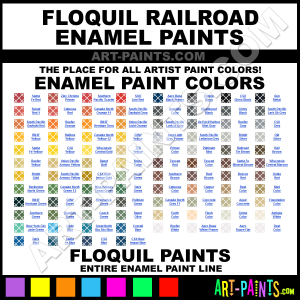
1745459042523.png

Just for grins, I googled "railroad paint colors" and see where this outfit, Art-Paints.com is now selling enamels in the old Floquil colors. Back in the day before its demise in 2013, Floquil had a huge selection of "railroad colors." The search also brought up eBay listings for unopened 2-ounce bottles of real Floquil enamel that now are at least twelve years old. They're going for a "buy it now" price of $100.00! That's more expensive than a lot of top shelf 12 year old Scotch! :D
 
Last edited:
As a fan of floquil paints, Just wondering how the quality of the new art-paints compares to the original. Floquil had wonderful paint characteristics and consistency. Now I at least know how old my paint stash is. Have you tried the new paint yet?
 
Speaking of Floquil paints, does anyone know of a good substitute for Floquil Bright oil #818670. I have used it on spars for years, love it, but am down to my last bottle?
 
Speaking of Floquil paints, does anyone know of a good substitute for Floquil Bright oil #818670. I have used it on spars for years, love it, but am down to my last bottle?

A number of alternate paint manufacturers claim to offer substitutes for the discontinued Floquil colors. Here is an equivalent color chart indicating the type of paint and manufacturer with the new manufacturers' product numbers:
Aside from color, I have no idea of the equivalence of the substitute colors to the other characteristics of the original Floquil paints. Many model railroaders have turned to Tru-color paints as a replacement for the old Floquil solvent-based paints. See: https://trucolorpaint.com/color-charts/

The original Floquil's characteristics were the result of their use of very finely ground high quality pigments and relatively "hot" solvents. Besides Testor's presumed desire to end their production of competing modeling paint lines following their acquisition of Floquil, another rumored reason for Testor's discontinuing the Floquil line was the hazards of Floquil's Xylene (Xylol)-based solvent ("Dio-Sol".)

1745738250001.png
 
Add to that the fact that manufacturers' "paint chips" (color samples) rarely are accurately displayed on a computer screen, or a printed page, for that matter. This is why the "chips" you see at the paint stores are the actual paint color applied to a piece of card stock. Those stock colors can be replicated using specific manufacturers' color formulae. As noted the manufacturers' stock numbers sometimes change, or the manufacturers change their recipe slightly for whatever reason but keep the same stock number!

As Roger explained, the colors on period sailing ships aren't all that exact. In fact, the colors indicated by many kits can frequently be simply conjecture because we don't know exactly how they were painted, especially from time to time, since decoration could even change at a captain's whim. On the other hand, "pink submarines" notwithstanding, modern naval ship modelers can be quite particular about the color of a model because navies did have specific formulae for ship colors which even vary from ship class to ship class during different periods. An Imperial Japanese Navy battleship's "battleship gray," may be quite different from a WWII U.S. Navy ship's "battleship gray" (which were sometimes almost a dark blue/gray at one time during the War.)

Be glad we're modeling ships and usually have some latitude when it comes to color. Pity the model railroaders who have to make sure their "boxcar reds" have to be exactly accurate from railroad to railroad. God help the model railroader who paints his Southern Pacific boxcar "Santa Fe boxcar red" instead of "Southern Pacific boxcar red." There are so many different colors specific to so many railroads, the poor buggers must go broke buying those expensive two ounce bottles of specific shades, but they do. They do!

View attachment 515399

Just for grins, I googled "railroad paint colors" and see where this outfit, Art-Paints.com is now selling enamels in the old Floquil colors. Back in the day before its demise in 2013, Floquil had a huge selection of "railroad colors." The search also brought up eBay listings for unopened 2-ounce bottles of real Floquil enamel that now are at least twelve years old. They're going for a "buy it now" price of $100.00! That's more expensive than a lot of top shelf 12 year old Scotch! :D
AHH! -BUT you cannae paint a boxcar or loco with scotch Exclamation-Mark Now that WOULD be sacrilageExclamation-MarkROTF
 
A number of alternate paint manufacturers claim to offer substitutes for the discontinued Floquil colors. Here is an equivalent color chart indicating the type of paint and manufacturer with the new manufacturers' product numbers:
Aside from color, I have no idea of the equivalence of the substitute colors to the other characteristics of the original Floquil paints. Many model railroaders have turned to Tru-color paints as a replacement for the old Floquil solvent-based paints. See: https://trucolorpaint.com/color-charts/

The original Floquil's characteristics were the result of their use of very finely ground high quality pigments and relatively "hot" solvents. Besides Testor's presumed desire to end their production of competing modeling paint lines following their acquisition of Floquil, another rumored reason for Testor's discontinuing the Floquil line was the hazards of Floquil's Xylene (Xylol)-based solvent ("Dio-Sol".)

View attachment 516096
Before returning to ship modelling, I used Trucolor, mainly MRL blue & BNSF colours, I found them excellent thinned with acetone for airbrushing. I had found a 'friendly' seller in the US who would post with no problem, unlike a certain large distributor. Wonder what it would be like now with a chump in a certain house painted white in a new town called "Trumpton"?ROTF:mad:ROTF (Trumpton was a kidsTV show over here)
 
Back
Top