
• SUBSCRIBE TO SHIPS IN SCALE TODAY!

    The beloved Ships in Scale Magazine is back and charting a new course for 2026!
    Discover new skills, new techniques, and new inspirations in every issue.

    NOTE THAT OUR NEXT ISSUE WILL BE MARCH/APRIL 2026
  • Win a Free Custom Engraved Brass Coin!!!
    As a way to introduce our brass coins to the community, we will raffle off a free coin during the month of August. Follow link ABOVE for instructions for entering.

Yacht Gretel Mamoli 1:54

Joined
Mar 5, 2025
Messages
36
Points
58

Location
Donnersberg
Hello everyone,
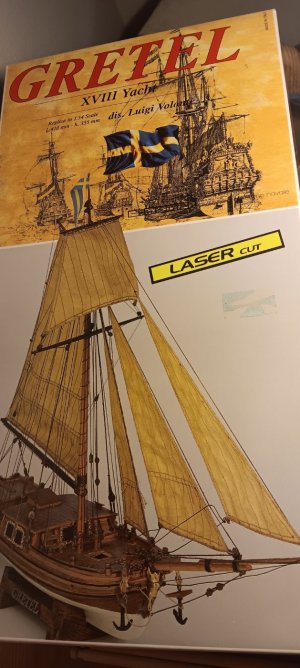
My next little project will be this charming 18th-century Swedish pleasure boat.
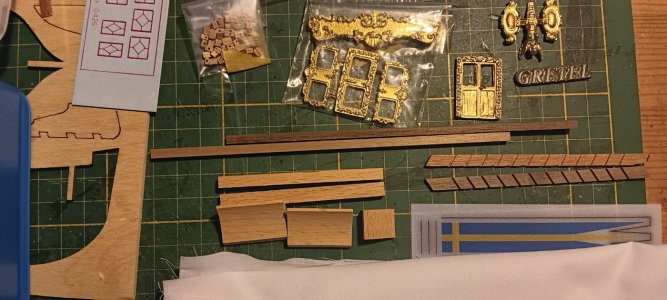
I managed to get the kit online at a bargain price. It’s not the latest version. In the newer versions, the windows and door panels are made of laser-cut wood rather than cast parts.
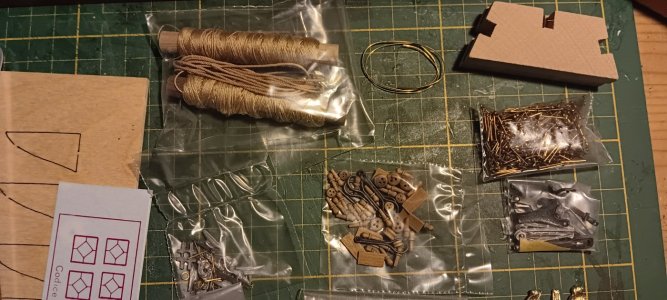
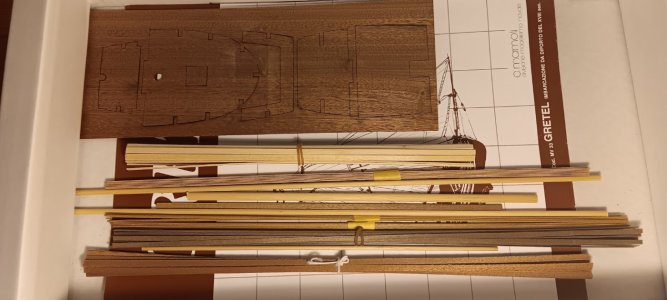
The contents of the box are fairly straightforward; I’ll discuss the quality of the materials in the build stages.
Just to give you a heads-up, I don’t intend to use the cast parts but will reproduce them in an unconventional way. But more on that as the build progresses.
There are two double-sided plan sheets and one 1:1 scale sheet. I won’t be showing these here for copyright reasons.
Don’t be surprised if the written explanation usually appears before the accompanying images.
My English isn’t the best, so I’m using a translator on my PC. The photos are taken on my mobile.
Warm regards from an ever-cheerful Palatinate native

Translated with DeepL.com (free version)
 
Hello Peter,
Cochem is at the other end of our state. I’m from Donnersberg, which you might know because of the Röderhof golf course.
But I also know Cochem from my military service in the Bundeswehr in the late eighties. I was there for basic training in lovely Ulmen.
Well then, have a great time on the Moselle.
Best wishes to the Netherlands

Oh, I almost forgot – my daughter is coming to stay with you on holiday next week.

Translated with DeepL.com (free version)
 
Also,
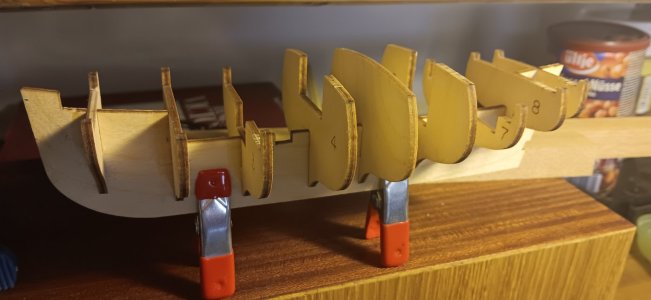
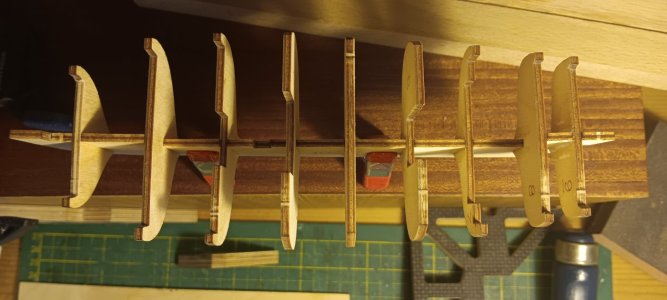
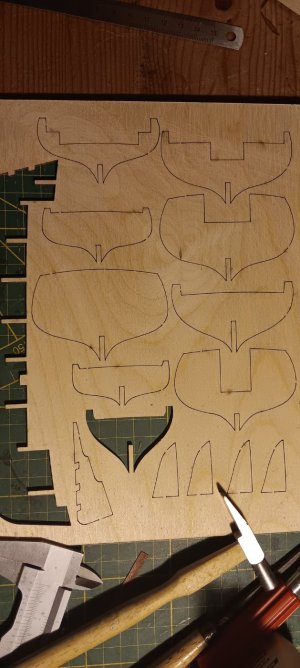
Wie erwartet, siegte gestern meine Ungeduld über mich und ich begann mit dem ersten Teil des Bauprojekts, den ich heute Morgen tatsächlich fertigstellen konnte.
Dies lag vor allem an der hervorragenden Passform der Rahmen für das Skelett.
Sie bestehen aus 3 mm dickem Sperrholz, das mit Laser sehr präzise zugeschnitten wird.
Ich musste nicht einmal irgendwelche Blöcke festklemmen, um rechte Winkel zu gewährleisten.
Ich hoffe, es läuft weiterhin so reibungslos.
Grüße an die Welt

Übersetzt mit DeepL.com (kostenlose Version)

20260607_084958.jpg

20260607_084948.jpg
 
Haha,
I got my hopes up too soon – it didn’t take long for the first little problem to crop up.
It isn’t included in the plans, but I’ve built a pocket into the hull to ensure the mast is perfectly straight.
In doing so, I noticed the poor quality of the dowels in question. The mast dowel, in particular, is more oval than round. However, as I was planning to swap the rather light, soft wood for some walnut anyway, this isn’t particularly dramatic.
Regards

20260607_153013.jpg

20260607_153030.jpg

20260607_153110.jpg
 
Hello Peter,
Cochem is at the other end of our state. I’m from Donnersberg, which you might know because of the Röderhof golf course.
But I also know Cochem from my military service in the Bundeswehr in the late eighties. I was there for basic training in lovely Ulmen.
Well then, have a great time on the Moselle.
Best wishes to the Netherlands

Oh, I almost forgot – my daughter is coming to stay with you on holiday next week.

Translated with DeepL.com (free version)
Hi Pfälzer, never been at Golfclub am Donnersberg. We go two times a year to golfresort Ediger Eller and best wishes to you!
Greetz, Peter

Golfclub am Donnersberg​

 
Haha,
I got my hopes up too soon – it didn’t take long for the first little problem to crop up.
It isn’t included in the plans, but I’ve built a pocket into the hull to ensure the mast is perfectly straight.
In doing so, I noticed the poor quality of the dowels in question. The mast dowel, in particular, is more oval than round. However, as I was planning to swap the rather light, soft wood for some walnut anyway, this isn’t particularly dramatic.
Regards

View attachment 609980

View attachment 609981

View attachment 609982
Haha, a small problem indeed. If that’s all for your project……
 
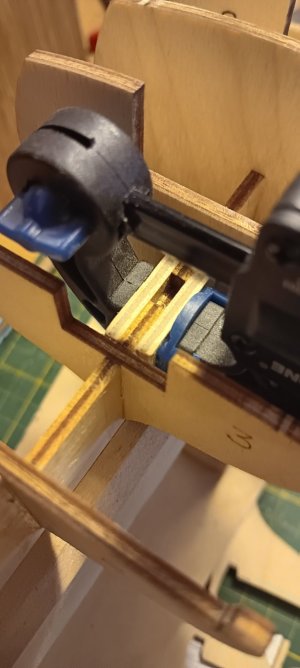
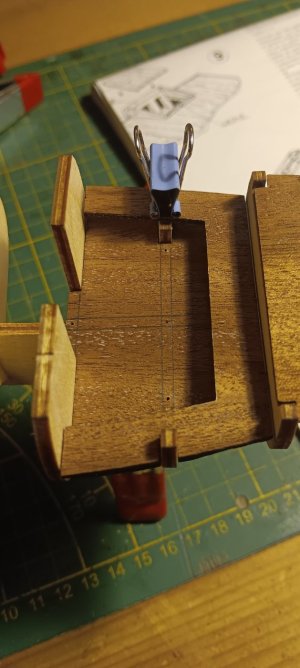
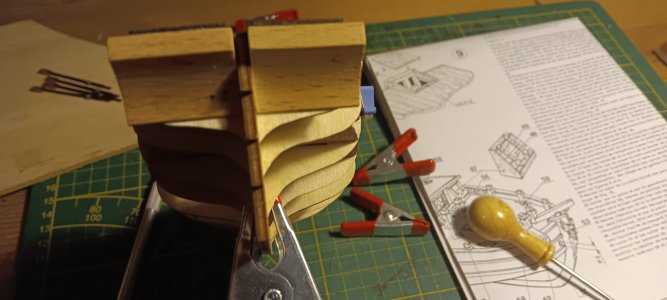
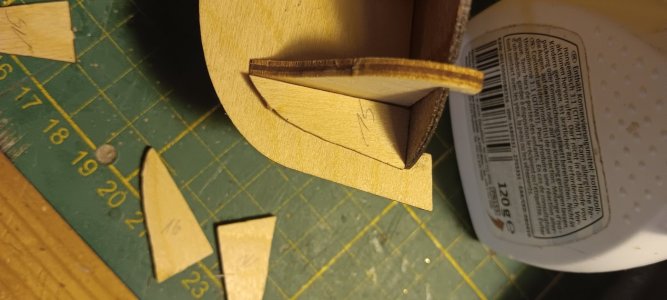
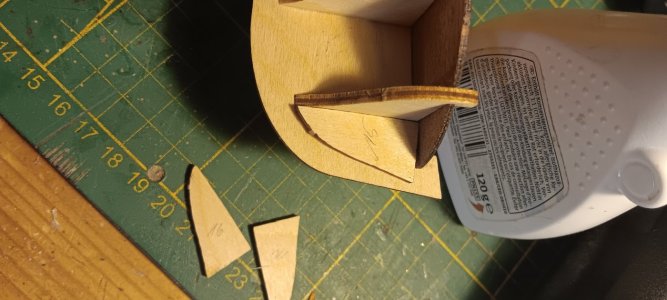
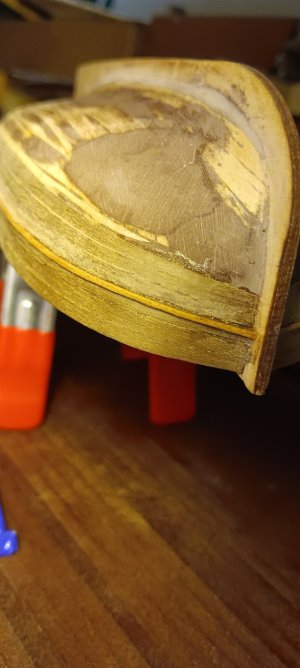
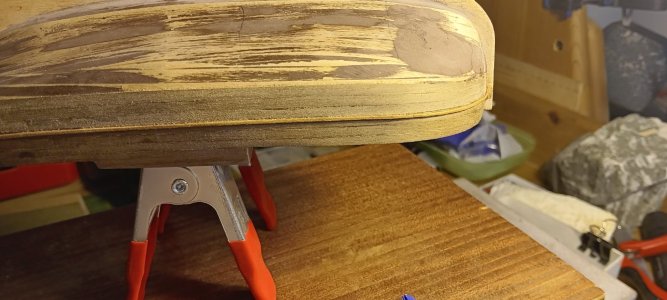
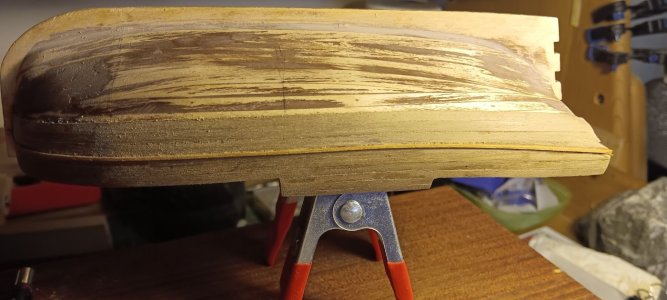
I have now installed the deck planks and stern reinforcements.
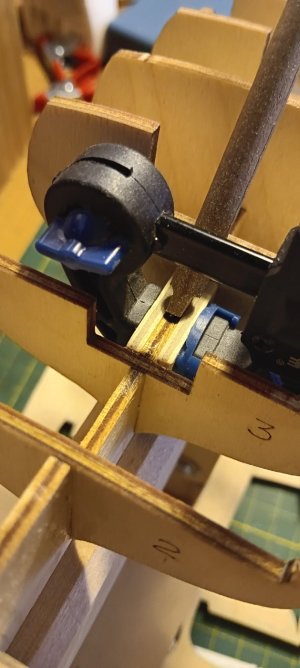
According to Mamoli, the bench seat (see the blue clamp) should also be glued in place at this stage.
However, I don't agree with that approach, as the bulkheads are supposed to be removed later on. Yet, to plank the hull properly, they need to be taken out at this point.
So, I’m going to connect bulkheads six and eight with a walnut strip, which will serve as a mounting point for the bench seat later. This allows me to remove bulkhead seven now, enabling me to proceed with planking the deck and bulkhead eight.

Regards

20260609_045127.jpg

20260609_045113.jpg

20260609_045052.jpg
 
And on we go with the adjustments.
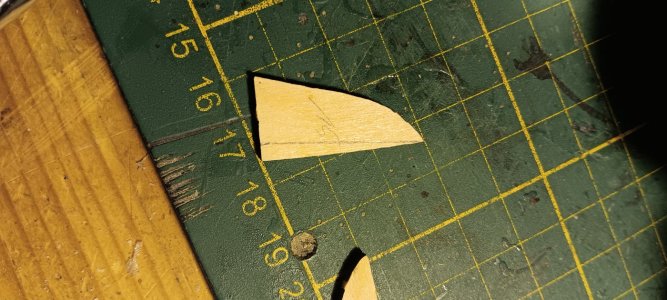
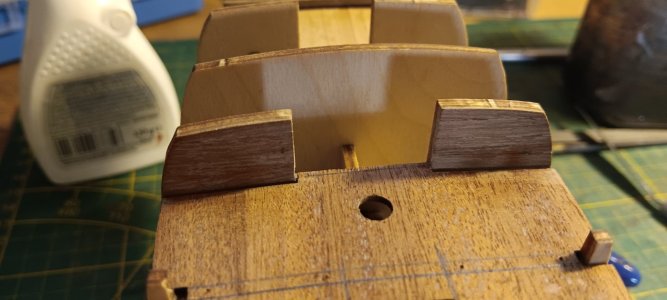
As you can see, the stern fillers didn’t quite fit either.
I had to trim 3mm diagonally across the long side to make them fit.
I then gave the deck section for the bench another think and have glued on a board of the right width, which now needs to dry. Why use thin mahogany planking when you could just build it as a solid wood bench?
More on that later.

20260609_195834.jpg

20260609_195741.jpg

20260609_195725.jpg
 
Hello everyone,
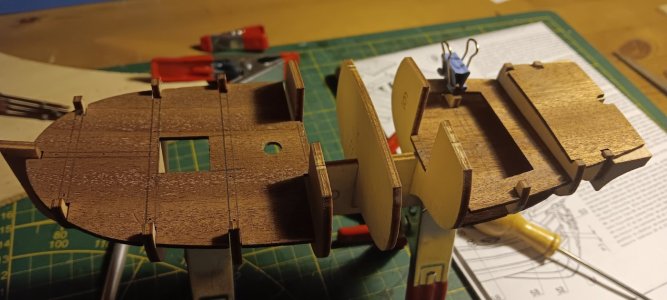
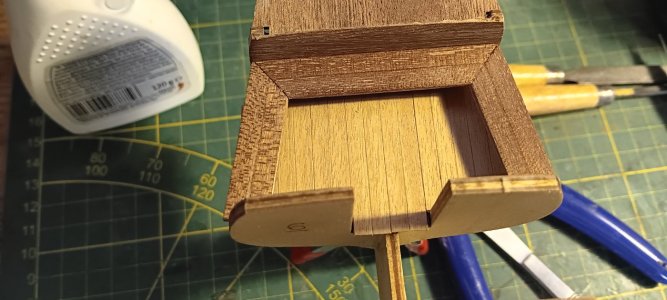
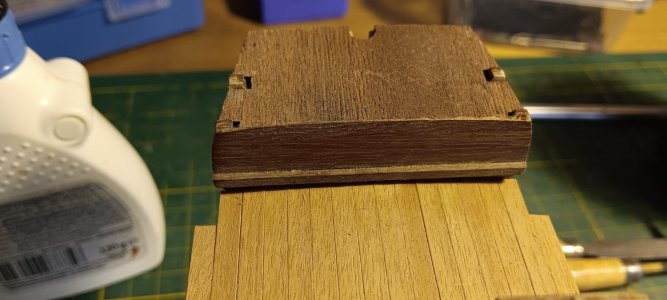
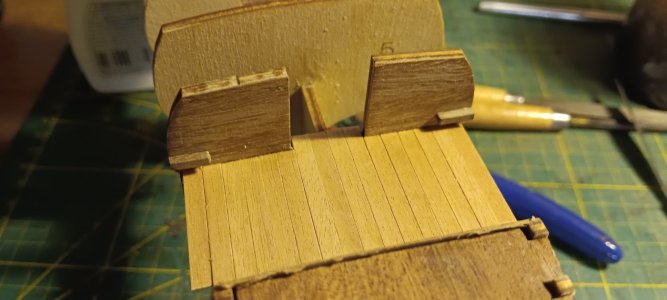
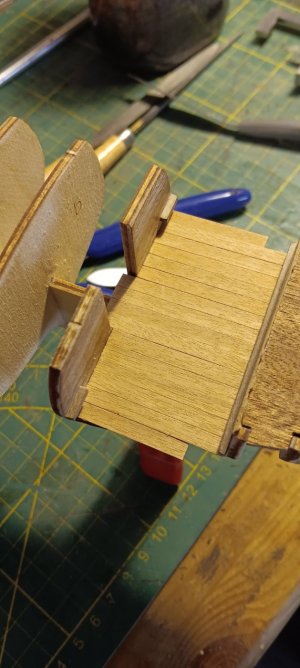
I rummaged through my scrap wood box and clad various bulkheads with walnut.
I used Sapelli, a mahogany substitute, to replace the bench. Mamoli had intended to use planks for this, which I didn’t like.
This bench will also get a nice backrest, into which I might incorporate some brass.
Then I used the first veneer from the box to plank the deck under the bench. It’s 4mm-wide Tanganyika. The wood from Mamoli is very cleanly cut.
At first, I was considering gluing black thread in between as a reinforcement. I’d done that on the Esmeralda and the Ranger.
With this model, however, I’m leaning towards smooth, sanded surfaces, so I left it as it is.
I have also started on the somewhat unconventional reproduction of the first cast part. I am attempting to cast the decorations of the metal castings using a mixture of wood dust and wheat glue. The process is going smoothly so far, but I will only present it once I am sure of its success.

Greetings from the Palatinate

Translated with DeepL.com (free version)
20260612_183403.jpg

20260612_183342.jpg

20260612_183337.jpg

20260612_183328.jpg

20260612_183322.jpg
 
Hello everyone,
I rummaged through my scrap wood box and clad various bulkheads with walnut.
I used Sapelli, a mahogany substitute, to replace the bench. Mamoli had intended to use planks for this, which I didn’t like.
This bench will also get a nice backrest, into which I might incorporate some brass.
Then I used the first veneer from the box to plank the deck under the bench. It’s 4mm-wide Tanganyika. The wood from Mamoli is very cleanly cut.
At first, I was considering gluing black thread in between as a reinforcement. I’d done that on the Esmeralda and the Ranger.
With this model, however, I’m leaning towards smooth, sanded surfaces, so I left it as it is.
I have also started on the somewhat unconventional reproduction of the first cast part. I am attempting to cast the decorations of the metal castings using a mixture of wood dust and wheat glue. The process is going smoothly so far, but I will only present it once I am sure of its success.

Greetings from the Palatinate

Translated with DeepL.com (free version)
View attachment 611382

View attachment 611383

View attachment 611384

View attachment 611385

View attachment 611386
Hi Holger,
Your work looks very clean, and your solution for fixing the mast perfectly straight is quite inventive.
As far as I'm concerned, you shouldn't be afraid to show a failure.
Our members can offer advice to help you succeed, and others can see the pitfalls, allowing them to avoid making the same mistakes or problems.
 
Fantastic, my experiment worked.
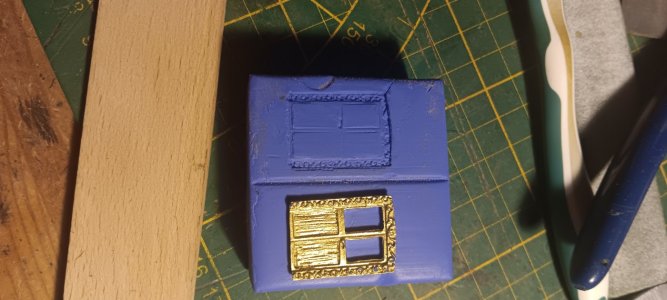
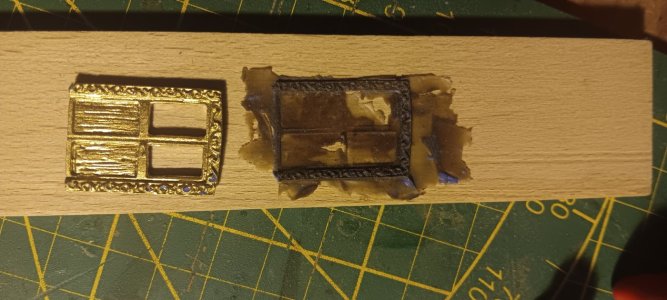
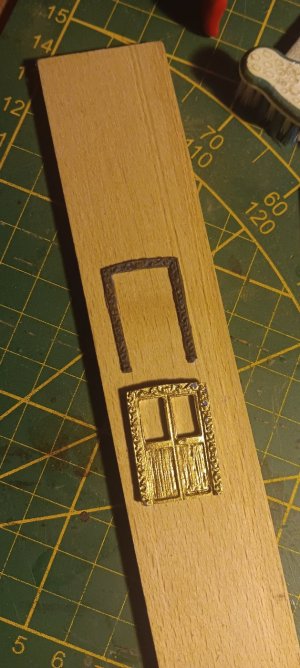
Here you have a perfect reproduction of those ugly cast metal carvings.
I came up with the basic idea because I used to make special silicone chocolate moulds in this way.
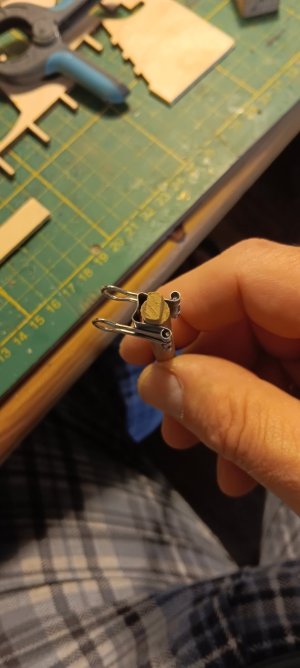
As you can easily see from the pictures, I simply pressed the component in question into modelling clay to make an impression.
Then I took the trouble to grind a piece of walnut into a fine powder.
I mixed the whole thing with a bit of white glue and filled the impression with it.
After allowing it to dry, it was easy to remove from the mould and trim with a scalpel. The modelling clay I used is a special type. You can cure it in the oven using a specific method to achieve a permanent shape.
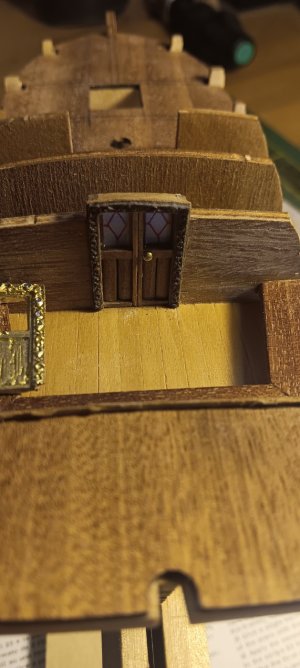
Now I just need to recreate the walnut door and stick on the ‘carvings’.
Originally, the idea was intended for the rear-view mirror. Thanks to the modelling clay, you can achieve the curved shape before casting. This means you don’t have to struggle to bend a cast part in some way.
It’s actually quite simple.
And sorry Peter, my Name is Ralf.

Translated with DeepL.com (free version)

20260613_043118.jpg

20260613_043148.jpg

20260613_043749.jpg
 
For those of you who like to be really precise, I’ve just taken the idea a step further.
If you’ve got a steady hand, you could even go to the trouble of filling in the fine details with gold paint before pouring.
That would really amp up the effect.
Hmmmm, I think I’ll give that a go
 
Fantastic, my experiment worked.
Here you have a perfect reproduction of those ugly cast metal carvings.
I came up with the basic idea because I used to make special silicone chocolate moulds in this way.
As you can easily see from the pictures, I simply pressed the component in question into modelling clay to make an impression.
Then I took the trouble to grind a piece of walnut into a fine powder.
I mixed the whole thing with a bit of white glue and filled the impression with it.
After allowing it to dry, it was easy to remove from the mould and trim with a scalpel. The modelling clay I used is a special type. You can cure it in the oven using a specific method to achieve a permanent shape.
Now I just need to recreate the walnut door and stick on the ‘carvings’.
Originally, the idea was intended for the rear-view mirror. Thanks to the modelling clay, you can achieve the curved shape before casting. This means you don’t have to struggle to bend a cast part in some way.
It’s actually quite simple.
And sorry Peter, my Name is Ralf.

Translated with DeepL.com (free version)

View attachment 611508

View attachment 611509

View attachment 611510
Hi Ralf,
A thousand apologies!
I confused you with another member I was messaging via DM. We were talking about the stern decorations.
Old age comes with its flaws….
 
Back
Top