
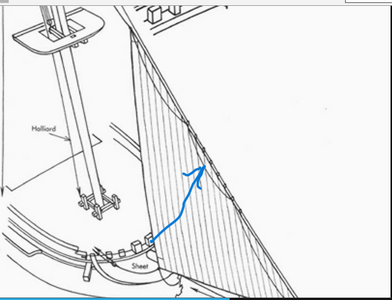
Here's a screen shot from Petersson's book. I'm looking at the rope that the wiggly blue arrow is pointing at. I think it's there to keep the luff from stretching or tearing from stress. Am I right? Does it have a name?

 |
As a way to introduce our brass coins to the community, we will raffle off a free coin during the month of August. Follow link ABOVE for instructions for entering. |
|
 |
The beloved Ships in Scale Magazine is back and charting a new course for 2026! Discover new skills, new techniques, and new inspirations in every issue. NOTE THAT OUR NEXT ISSUE WILL BE MARCH/APRIL 2026 |
|
Hi DonThese books are great but they aren't written for people that have never even seen a square rigged ship.
 Regarding Petersson his sketches with line identification are great but the book, as he explains in the introduction, is specific to a single contemporary model of a 36 gun English ship of 1780 so useless for other ships/eras/nations without further research to confirm what he shows is appropriate.
Sometimes even people who have actually sailed square-rigged vessels find some of the period rigging treatises difficult to follow. One thing that helps a lot is thinking in "full scale" when modeling. Think of yourself as a crewman when you are modeling and have learn the basics of seamanship, then the rest becomes a lot easier to understand and you won't be wondering "what's this for" as often. For example, thinking like a foredeck ape, the downhaul becomes a lot easier to recognize when you realize that hauling a headsail down in a freshening wind by standing on the foredeck and hauling on a downhaul line is a whole lot better way to do it than crawling out on a pitching bowsprit to pull the sail down by the luff when that bowsprit is punching through green water!!These books are great but they aren't written for people that have never even seen a square rigged ship.

I think that's a down-haul rope for bring the sail up or down. I don't see any other reason for it. NorgaleHere's a screen shot from Petersson's book. I'm looking at the rope that the wiggly blue arrow is pointing at. I think it's there to keep the luff from stretching or tearing from stress. Am I right? Does it have a name?
View attachment 462643