• Win a Free Custom Engraved Brass Coin!!!
    As a way to introduce our brass coins to the community, we will raffle off a free coin during the month of August. Follow link ABOVE for instructions for entering.
  • SUBSCRIBE TO SHIPS IN SCALE TODAY!

    The beloved Ships in Scale Magazine is back and charting a new course for 2026!
    Discover new skills, new techniques, and new inspirations in every issue.

    NOTE THAT OUR NEXT ISSUE WILL BE MARCH/APRIL 2026

What is this rope?

Joined
Jul 10, 2021
Messages
1,718
Points
438

Location
Vancouver Island
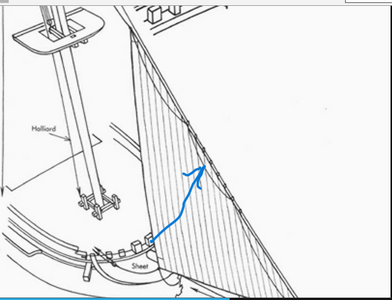
Here's a screen shot from Petersson's book. I'm looking at the rope that the wiggly blue arrow is pointing at. I think it's there to keep the luff from stretching or tearing from stress. Am I right? Does it have a name?

Screenshot (31).png
 
The downhauler. For the staysail it was made fast to the head of the sail then rove down through several hanks, then through a block fixed to the stay by the tack then made fast at the forecastle. There are about ten drawings of the various fore and aft sails showing the downhauler with text to go with the drawings in The Masting and Rigging by James Lees.

Allan
.
 
Thanks Alan, I knew there was a thing called a downhauler and I could see this wavey rope in a lot of pictures but I didn't have anything to tie the two together. In Lees there is no notation on the drawings and the explanation could be anywhere on either page. Actually on the original(Petersson) of the picture I posted It is labeled a little further along but I didn't realize it was the same rope. Not looking close enough, I guess. These books are great but they aren't written for people that have never even seen a square rigged ship.
 
Last edited:
These books are great but they aren't written for people that have never even seen a square rigged ship.
Hi Don
I agree Lees' book can be challenging for someone who is not at least a little fluent in maritimese. Good thing we have sites like SoS to help with translations :) Regarding Petersson his sketches with line identification are great but the book, as he explains in the introduction, is specific to a single contemporary model of a 36 gun English ship of 1780 so useless for other ships/eras/nations without further research to confirm what he shows is appropriate.
Allan
 
Last edited:
If I have a clue as to what I'm working on I first read Lees explanation to see if I can understand it. If not I go to Petersson to get a better idea in my head of what's going on. Then I go back to Lees and see if his explanation now makes sense. If no I go to Darcy Lever(don't know why he gets both names). If still no I go to you guys. Once I have a firmish idea of what I'm doing I go to Steel for block and rope numbers and sizes. That's when I find out that Steel says I need more blocks than I thought so I go back to square 1 and see if there is a tackle involved in this. Sometimes it takes 2 or 3 days of back and forth before I cut anything. And even then I have no idea if I have it really right. Great hobby, keeps my old brain functioning :)
 
These books are great but they aren't written for people that have never even seen a square rigged ship.
Sometimes even people who have actually sailed square-rigged vessels find some of the period rigging treatises difficult to follow. One thing that helps a lot is thinking in "full scale" when modeling. Think of yourself as a crewman when you are modeling and have learn the basics of seamanship, then the rest becomes a lot easier to understand and you won't be wondering "what's this for" as often. For example, thinking like a foredeck ape, the downhaul becomes a lot easier to recognize when you realize that hauling a headsail down in a freshening wind by standing on the foredeck and hauling on a downhaul line is a whole lot better way to do it than crawling out on a pitching bowsprit to pull the sail down by the luff when that bowsprit is punching through green water!!

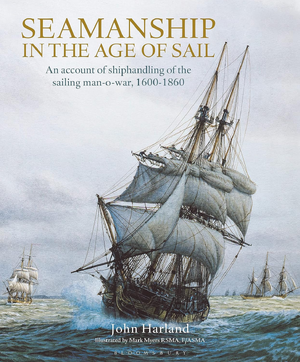
To this end, Seamanship in the Age of Sail: An Account of Shiphandling of the Sailing Man-O-War, 1600-1860 by John Harland is a reference volume that every square rig modeler would do well to have on their bookshelves right next to The Masting and Rigging of English Ships of War 1625-1860 by James Lees. Lees' book tells you what it looks like and what it's called. Harland's tells you how it worked and how they used it. Seamanship... is a must for anybody who's planning to show their model with sails set or as a waterline model on a modeled sea because with the material in the book, you can be sure to avoid the faux pas of incorrect sails set, deck details, and so on, which are unique to the "sailing" model. (Rigging Period Ship Models: A Step-by-Step Guide to the Intracacies of Square-Rig, by Lennarth Petersson is better than nothing, but really isn't even in the same zip code with these two classic reference works.) Seamanship... is a fairly pricey coffee table sized book, but it's fairly easy to find used copies at prices that won't require taking out a second mortgage.

See: https://www.amazon.com/s?k=seamansh...ed1ac8ae374&tag=mh0b-20&ref=pd_sl_cg4ma7iru_p

1722770423308.png
 
Here's a screen shot from Petersson's book. I'm looking at the rope that the wiggly blue arrow is pointing at. I think it's there to keep the luff from stretching or tearing from stress. Am I right? Does it have a name?

View attachment 462643
I think that's a down-haul rope for bring the sail up or down. I don't see any other reason for it. Norgale
 
Back
Top