
-

SUBSCRIBE TO SHIPS IN SCALE TODAY!
The beloved Ships in Scale Magazine is back and charting a new course for 2026!
Discover new skills, new techniques, and new inspirations in every issue.
NOTE THAT OUR NEXT ISSUE WILL BE MARCH/APRIL 2026 -

Win a Free Custom Engraved Brass Coin!!!
As a way to introduce our brass coins to the community, we will raffle off a free coin during the month of August. Follow link ABOVE for instructions for entering.
You are using an out of date browser. It may not display this or other websites correctly.
You should upgrade or use an alternative browser.
You should upgrade or use an alternative browser.


Kurt Konrath
Kurt Konrath

I can't say anything about use of oil based paint, I have never used it.
I do know that proper prep is needed to include a good sealer coat and primer on open poor woods to get a good finish with normal hobby paints.
I do know that proper prep is needed to include a good sealer coat and primer on open poor woods to get a good finish with normal hobby paints.
- Joined
- Jun 29, 2024
- Messages
- 1,813
- Points
- 488

Our resident paint expert is Bob Cleek. Look up his posts using the search function.
The Rolls Royce of non acrylic model paints was Floquil. Other than buying old stock on EBay it is no longer available. There are companies that make substitutes. I have never used these and don’t remember specific names.
Roger
The Rolls Royce of non acrylic model paints was Floquil. Other than buying old stock on EBay it is no longer available. There are companies that make substitutes. I have never used these and don’t remember specific names.
Roger

I use Vallejo and "Warpaint fanatic" from "Army painter". Both acrylic. Works fine for me.
I use it on wood, metal (after cleaning) and resin.
I use it on wood, metal (after cleaning) and resin.

Hi Billy,I've been building for a while, small models dories, lobster smacks etc... But I have not been totally satisfied with water-based paints. Thinking of switching to oil base paints. What are some favorite oil-based paints out there.
The proper surface preparation is the foundation of a good finish. If you’ve got a clean, sanded (or otherwise keyed), well-sealed substrate, many different paint media can/will work.
However, switching to an oil‐based (or enamel/alkyd) paint may bring different working properties, advantages, and drawbacks compared with water-based acrylics. Before jumping ship, here are some thoughts and suggestions.
Here are some things to keep in mind when comparing acrylics (water-based), enamels/alkyds (oil-based), and other media in the context of scale ship modelling:
1. Surface preparation remains critical
If you properly seal or prime the substrate (wood, plastic, or metal), ensure no contaminants (oils, mould release, silicone, dust), and key the surface (sanding, scuffing), then many paints will adhere well. For example, any of the modelling paints would be fine. Seal the wood with clear ("white") shellac and then paint.
- Enamels / oil‐based paints often have longer drying/cure times and may produce harder finishes (which can be good for parts that will be handled or subject to rigging), but also require solvents/cleaning and more ventilation.
- Acrylics dry faster, are more forgiving for fast work, have less odour, but may not level or sand as well in some cases.
Because you’re working on model ships (wood, maybe plastic, lots of fine detail), you’ll likely use primers, sanding sealers, maybe shellac, etc. Some oils/enamels play nicer with certain primers than others. Some acrylics may raise the wood grain or shrink slightly when cured, which can affect fine detail.
4. Scale suitability
At the scales you may work, you want outstanding detail, ultra‐smooth surfaces, and minimal texture. Oil/enamel paints often level out nicely (good for large hull surfaces), but for ultra-fine detailing, you may prefer acrylics (for fast work, less sag) or a hybrid.
5. Colour, gloss, durability, environment
If your model will be in a display case, less handling, maybe acrylic is fine. If you anticipate some handling, rigging friction, glueing or contact, the tougher film of an enamel/oil may be attractive.
Have you ever considered using the Testors brand?
- Testors Flat Sea Blue Enamel Paint: A classic hobby enamel (oil/alkyd based), good for large surface areas (hull sides) with a mature finish.
- Testors Enamel Paint Flat Green: Same series, good for accent surfaces, rigging boxes, etc.
- Testors Enamel Paint (All‑Purpose): A more general-purpose enamel, good to have in your drawer for tests and contrasting colour work.
- AK Interactive ABT035 Oil Paint – Buff: This is more of a true artist-oil/hobby hybrid, may require different thinning/handling, but great for very fine detail or accents.
- Testors Enamel Paint Light Yellow: Another enamel option for your palette; lighter hues often show brush/airbrush handling more, so useful test.
- Testors Flat Tan Enamel Paint: Flat tan is a useful background colour for wooden deck work or weathered surfaces.
If you’re currently dissatisfied with acrylics, switching to enamel is a valid path, just be aware of the trade-offs (ventilation, cleanup, slower drying).
But most importantly: Your surface prep, primer/sealer, and finishing technique will likely have more impact on the final quality than switching from acrylic to oil by itself.
Our resident paint expert is Bob Cleek. Look up his posts using the search function.
He said it, not me!

The selection of paint and other coating options is a matter of personal preference. The two primary choices are oil-based and water-based.
It seems to me that most experienced painters favor oil-based coatings over water-based. While water-based paint is easier to clean up and has little or no aroma, water will soak into wood and "raise" the grain, making obtaining a perfectly smooth surface difficult to obtain.
With the demise of the Floquil brand of oil-based paints, modelers were left with a wide selection of colors in a number of "model paint" product lines. Experienced miniaturists these days seem to avoid "hobby paints," perhaps for reasons of cost and quality. (I have no data on which, or both.) Instead, they use high-quality artists' oil paints which are sold in tubes and have the consistency of toothpaste. Oil colors with the highest pigment content and the most finely ground pigment are the best. Depending on the quality and the pigment color, artists' oils can be seemingly expensive, although they last a very long time in the tube when well-capped and a little bit goes a long way. Artists' oils may be brushed or sprayed, depending upon how they are conditioned by the artist. Gum turpentine, linseed oil, and Japan dryer are the basic conditioners used for thinning and flow control. Note that if raw linseed oil is used, a Japan dryer must be added to accelerate the polymerization of the oil and speed the "drying" of the paint. If boiled linseed oil is used, a dryer may not be required because the dryer has already been added to it at the factory. Artist's oils do not contain added drying agents so that they are very slow to polymerize (become hard or "dry." Oil painting artists favor this property because the work on paintings over a long period of time and sometimes wish to mix colors directly on the canvas or other surface.)
Artists' oil colors, properly thinned and conditioned, may be brushed or air brushed no differently than the already diluted bottled hobby paints.
The advantages of artists' oils are:
1. Archival quality. Good oil paint will be dependably color-fast and will not crack, peel, and flake if the model is properly cased and kept out of the sunlight.
2. Scale thickness: as explained in the text below, finer pigment means less paint is required to "cover" the surface adequately. A thinner coating avoids the loss of crisp detail on the model, whether spraying or brushing.
3. Economy: Anything with a boat on the label is going to automatically cost you 25% more. The 1- and 2-ounce bottles of "model paint" that are everywhere can and will dry up in short order once the bottle is open. Fortunately, most ship modeling does not require a large number of colors or very critical color accuracy. Most models won't require more than three or four colors and any color required can be mixed from primary colors, if necessary. Think of artists' oils as concentrated paint that the user thins to suit the task and environmental factors of the moment.
4. Easy sourcing: Artists' oils are available online and in art supply stores, which today are far more numerous than hobby shops.
Remember that wood to be coated should be sealed beforehand. I prefer Zinnser Bulls Eye brand clear pre-mixed shellac for all sealing tasks. Shellac is thinned with denatured alcohol. Shellac is very quick drying. It provides a strong moisture barrier, and which is a good thing for a lot of reasons. (A small touch of shellac can also be used to seal rigging knots and stiffen rigging to form catenaries. Thickened shellac is also a useful adhesive.)
If you are interested in acrylic paints, there are artists' acrylic paints in tubed paste form which use alcohol as their primary solvent, rather than water. They are usually identified as such on their labels. The use of alcohol as a solvent seems to negate, or at least greatly reduce, the grain-raising effects of water-based acrylic paints.
It is critical to always use compatible coating formulations. Do not mix different coating types or even different coating brands or apply them one on top of the other, without first testing for compatibility. Coating compatibility issues result from antagonistic chemical reactions that produce things like "crackle finish," "orange peel finish," cracking, peeling, and failure to polymerize ("dry.") It is, in fact, a wise practice to always maintain a coating schedule test "chip" as you proceed with a model. A "test chip" is simply a piece of the base material, be it wood or metal, that is coated exactly as you intend the model to be coated before you commit to applying the coating to the model! If you are using concentrated paste artists' oil colors, it is worthwhile to keep meticulous color-mixing records and measure your mixtures by the length of extruded paste and chemist's measurements for liquids using a graduated plastic syringe and applying a sample of the color to an index card with the recipe on it. Such recordkeeping will make it much easier to replicate colors later if you want to use them again on another model.
While Floquil paints are no longer made, their product literature lives on and their excellent manual on painting scale miniatures remains available online in PDF format. Every serious miniaturist would do well to download the PDF and save it for future reference. It's the best painting instruction book for models I've ever seen. Painting miniatures is a bit different than painting board fences, so it's a well-invested bit of time to study and learn its contents. See: https://www.paulbudzik.com/tools-techniques/floquil-paint/Floquil Painting Miniatures.PDF
Here's a video on how to work with tubed paste oil paint. There are lots of them on YouTube now because the miniature figures modelers and the plastic planes and armor guys have rediscovered artists' oils in the wake of Floquil's discontinuation. (Sorry about the guy's accent. Bear with it. He knows his stuff!)
Last edited:
Thank you for the detailed response, I am already sealing before and after, so maybe more attention to detail and perhaps more careful sanding.Hi Billy,
The proper surface preparation is the foundation of a good finish. If you’ve got a clean, sanded (or otherwise keyed), well-sealed substrate, many different paint media can/will work.
However, switching to an oil‐based (or enamel/alkyd) paint may bring different working properties, advantages, and drawbacks compared with water-based acrylics. Before jumping ship, here are some thoughts and suggestions.
Here are some things to keep in mind when comparing acrylics (water-based), enamels/alkyds (oil-based), and other media in the context of scale ship modelling:
1. Surface preparation remains critical
If you properly seal or prime the substrate (wood, plastic, or metal), ensure no contaminants (oils, mould release, silicone, dust), and key the surface (sanding, scuffing), then many paints will adhere well. For example, any of the modelling paints would be fine. Seal the wood with clear ("white") shellac and then paint.
2. Compatibility with primer/adhesion systems
- Enamels / oil‐based paints often have longer drying/cure times and may produce harder finishes (which can be good for parts that will be handled or subject to rigging), but also require solvents/cleaning and more ventilation.
- Acrylics dry faster, are more forgiving for fast work, have less odour, but may not level or sand as well in some cases.
Because you’re working on model ships (wood, maybe plastic, lots of fine detail), you’ll likely use primers, sanding sealers, maybe shellac, etc. Some oils/enamels play nicer with certain primers than others. Some acrylics may raise the wood grain or shrink slightly when cured, which can affect fine detail.
4. Scale suitability
At the scales you may work, you want outstanding detail, ultra‐smooth surfaces, and minimal texture. Oil/enamel paints often level out nicely (good for large hull surfaces), but for ultra-fine detailing, you may prefer acrylics (for fast work, less sag) or a hybrid.
5. Colour, gloss, durability, environment
If your model will be in a display case, less handling, maybe acrylic is fine. If you anticipate some handling, rigging friction, glueing or contact, the tougher film of an enamel/oil may be attractive.
Have you ever considered using the Testors brand?
In short: “medium doesn’t matter so much if the prep is right”, but the medium still matters in terms of working properties (flow, drying, finish quality, compatibility with your workflow).
- Testors Flat Sea Blue Enamel Paint: A classic hobby enamel (oil/alkyd based), good for large surface areas (hull sides) with a mature finish.
- Testors Enamel Paint Flat Green: Same series, good for accent surfaces, rigging boxes, etc.
- Testors Enamel Paint (All‑Purpose): A more general-purpose enamel, good to have in your drawer for tests and contrasting colour work.
- AK Interactive ABT035 Oil Paint – Buff: This is more of a true artist-oil/hobby hybrid, may require different thinning/handling, but great for very fine detail or accents.
- Testors Enamel Paint Light Yellow: Another enamel option for your palette; lighter hues often show brush/airbrush handling more, so useful test.
- Testors Flat Tan Enamel Paint: Flat tan is a useful background colour for wooden deck work or weathered surfaces.
If you’re currently dissatisfied with acrylics, switching to enamel is a valid path, just be aware of the trade-offs (ventilation, cleanup, slower drying).
But most importantly: Your surface prep, primer/sealer, and finishing technique will likely have more impact on the final quality than switching from acrylic to oil by itself.
Thanks for your reply, I seem to be doing several things right, maybe more attention to detail.He said it, not me!
The selection of paint and other coating options is a matter of personal preference. The two primary choices are oil-based and water-based.
It seems to me that most experienced painters favor oil-based coatings over water-based. While water-based paint is easier to clean up and has little or no aroma, water will soak into wood and "raise" the grain, making obtaining a perfectly smooth surface difficult to obtain.
With the demise of the Floquil brand of oil-based paints, modelers were left with a wide selection of colors in a number of "model paint" product lines. Experienced miniaturists these days seem to avoid "hobby paints," perhaps for reasons of cost and quality. (I have no data on which, or both.) Instead, they use high-quality artists' oil paints which are sold in tubes and have the consistency of toothpaste. Oil colors with the highest pigment content and the most finely ground pigment are the best. Depending on the quality and the pigment color, artists' oils can be seemingly expensive, although they last a very long time in the tube when well-capped and a little bit goes a long way. Artists' oils may be brushed or sprayed, depending upon how they are conditioned by the artist. Gum turpentine, linseed oil, and Japan dryer are the basic conditioners used for thinning and flow control. Note that if raw linseed oil is used, a Japan dryer must be added to accelerate the polymerization of the oil and speed the "drying" of the paint. If boiled linseed oil is used, a dryer may not be required because the dryer has already been added to it at the factory. Artist's oils do not contain added drying agents so that they are very slow to polymerize (become hard or "dry." Oil painting artists favor this property because the work on paintings over a long period of time and sometimes wish to mix colors directly on the canvas or other surface.)
Artists' oil colors, properly thinned and conditioned, may be brushed or air brushed no differently than the already diluted bottled hobby paints.
The advantages of artists' oils are:
1. Archival quality. Good oil paint will be dependably color-fast and will not crack, peel, and flake if the model is properly cased and kept out of the sunlight.
2. Scale thickness: as explained in the text below, finer pigment means less paint is required to "cover" the surface adequately. A thinner coating avoids the loss of crisp detail on the model, whether spraying or brushing.
3. Economy: Anything with a boat on the label is going to automatically cost you 25% more. The 1- and 2-ounce bottles of "model paint" that are everywhere can and will dry up in short order once the bottle is open. Fortunately, most ship modeling does not require a large number of colors or very critical color accuracy. Most models won't require more than three or four colors and any color required can be mixed from primary colors, if necessary. Think of artists' oils as concentrated paint that the user thins to suit the task and environmental factors of the moment.
4. Easy sourcing: Artists' oils are available online and in art supply stores, which today are far more numerous than hobby shops.
Remember that wood to be coated should be sealed beforehand. I prefer Zinnser Bulls Eye brand clear pre-mixed shellac for all sealing tasks. Shellac is thinned with denatured alcohol. Shellac is very quick drying. It provides a strong moisture barrier, and which is a good thing for a lot of reasons. (A small touch of shellac can also be used to seal rigging knots and stiffen rigging to form catenaries. Thickened shellac is also a useful adhesive.)
If you are interested in acrylic paints, there are artists' acrylic paints in tubed paste form which use alcohol as their primary solvent, rather than water. They are usually identified as such on their labels. The use of alcohol as a solvent seems to negate, or at least greatly reduce, the grain-raising effects of water-based acrylic paints.
It is critical to always use compatible coating formulations. Do not mix different coating types or even different coating brands or apply them one on top of the other, without first testing for compatibility. Coating compatibility issues result from antagonistic chemical reactions that produce things like "crackle finish," "orange peel finish," cracking, peeling, and failure to polymerize ("dry.") It is, in fact, a wise practice to always maintain a coating schedule test "chip" as you proceed with a model. A "test chip" is simply a piece of the base material, be it wood or metal, that is coated exactly as you intend the model to be coated before you commit to applying the coating to the model! If you are using concentrated paste artists' oil colors, it is worthwhile to keep meticulous color-mixing records and measure your mixtures by the length of extruded paste and chemist's measurements for liquids using a graduated plastic syringe and applying a sample of the color to an index card with the recipe on it. Such recordkeeping will make it much easier to replicate colors later if you want to use them again on another model.
While Floquil paints are no longer made, their product literature lives on and their excellent manual on painting scale miniatures remains available online in PDF format. Every serious miniaturist would do well to download the PDF and save it for future reference. It's the best painting instruction book for models I've ever seen. Painting miniatures is a bit different than painting board fences, so it's a well-invested bit of time to study and learn its contents. See: https://www.paulbudzik.com/tools-techniques/floquil-paint/Floquil Painting Miniatures.PDF
Here's a video on how to work with tubed paste oil paint. There are lots of them on YouTube now because the miniature figures modelers and the plastic planes and armor guys have rediscovered artists' oils in the wake of Floquil's discontinuation. (Sorry about the guy's accent. Bear with it. He knows his stuff!)

If you would like to stain the hull (wood), would you still need to shellac it before hand?
Hi Don,If you would like to stain the hull (wood), would you still need to shellac it before hand?
If your goal is to stain the wood, then no, do not shellac beforehand. Shellac will seal the surface and prevent the stain from penetrating, resulting in a blotchy or uneven finish.
The correct sequence, IMHO:
- Sand the hull progressively (180 → 240 → 320 grit).
- Apply the stain directly to bare wood.
- Let it dry completely (several hours to overnight).
- Then apply shellac or varnish as the protective top coat.
If the wood is very soft or blotchy (basswood, pine, poplar), you may use a diluted shellac wash coat (1:4 shellac to alcohol) before staining to even absorption. This is called a pre-stain conditioner, but it must be extremely thin or the stain won’t take.
Thank you. I wanted to stain this, then primed it instead. I bought a lamp and discovered the planking wasn't as smooth as I thought. It seems passable, but not as good as the builds here. For a first planking, ok. So far I've spent as much time repairing goofs as in actual building, but each goof and repair are teaching moments.Hi Don,
If your goal is to stain the wood, then no, do not shellac beforehand. Shellac will seal the surface and prevent the stain from penetrating, resulting in a blotchy or uneven finish.
The correct sequence, IMHO:
With only one exception:
- Sand the hull progressively (180 → 240 → 320 grit).
- Apply the stain directly to bare wood.
- Let it dry completely (several hours to overnight).
- Then apply shellac or varnish as the protective top coat.
If the wood is very soft or blotchy (basswood, pine, poplar), you may use a diluted shellac wash coat (1:4 shellac to alcohol) before staining to even absorption. This is called a pre-stain conditioner, but it must be extremely thin or the stain won’t take.
On some of the sections I noticed that when the primer goes on those panels seem to warp a little. Next model, I'll put water on the other side to see it that will prevent that warp.
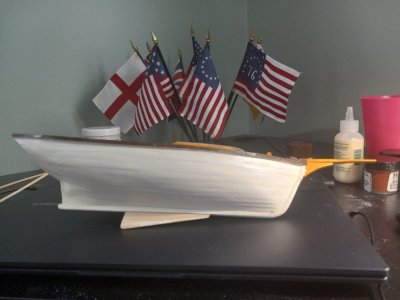
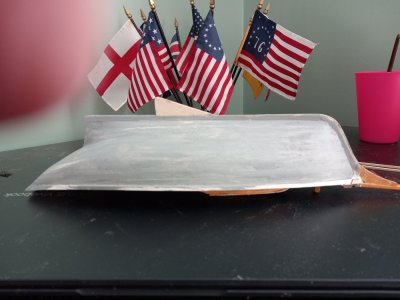
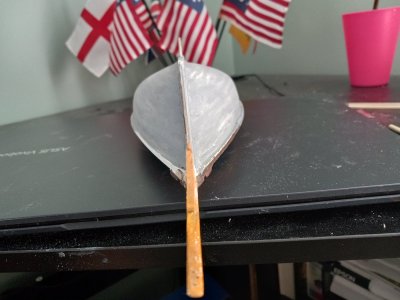
Primed again, sanded smooth, hull ready to paint after drying. Used gray primer this time.
Last edited:
It seems passable
"Passable" is a relative term. It can mean a lot of things, most being excuses for a lack of attention to detail which, after all, is one of the essential elements of ship modeling. What's "passable" for one person may well not be for another, or for most. Without agreement on what's "passable," there's no basis to dispute another's assessment of what is or is not "passable." On the other hand, if we set the concept of "passable" aside, I expect there are benchmarks which can be used to evaluate the quality of a ship model. How about, "Does it look like the prototype subject from a scale viewing distance?" That's the generally accepted standard for any ship model. In this instance, the answer is "no," and I understand that you have found that "passable."
Be that as it may, all that is required to have this model look "excellent" to the eyes of all experienced ship modelers is to finish the job correctly. In this case, that is a very easy task. Simply apply "surfacing putty" to the hull and sand it perfectly fair. Surfacing putty can be purchased wherever professional painting supplies are sold. It is always available in chandleries and auto body and fender repair supply houses. It comes in cans and tubes and is a paste about the consistency of peanut butter or toothpaste. It usually uses an acetone solvent and dries to a hard sandable surface very quickly. It sands "like butter." Use it to fill all the seams, dings, and divots in your hull and sand it fair down to about 320 grit using a flexible sanding batten until the surface of the entire hull is as smooth as a baby's bottom. Use your fingertips to ensure the surface is perfectly smooth. Fingertips are a lot more sensitive than eyeballs. Dust and tack well with a clean tack cloth and apply your finish coats. It's an easy thing to do.
The essence of ship modeling is attention to detail. Phrases like "perfect is the enemy of good enough," and adjectives like "passable," should send the dedicated ship modeler recoiling in horror. Ship models built by those who feel justified in cutting corners when it comes to attention to detail in matters of authenticity and execution speak volumes more about their builders than they ever do about the vessel they portray.
Don't give up the ship when she's worth saving. Hang in there. It's called "surfacing" putty, "finishing putty," and "glazing putty." Its job is to harden to an easily sandable material that fills surface imperfections and provide the perfect surface for final finishes. There are many brands. Try to avoid the "two-part" polyester or epoxy-based types that require mixing.
See: https://defender.com/en_us/interlux-surfacing-putty-y257-pt (Expensive marine product - you always pay more for the picture of the boat on the can. Good stuff, though. Thins with acetone.)
https://durhamswaterputty.com/ (Heard great reviews about this stuff from another modeler. Haven't used it myself, though. Cheap!)
https://www.amazon.com/Elmers-Produ...281-bc2a-366acc20e108&pd_rd_i=B0149ISTCY&th=1
https://www.amazon.com/12240-Painters-Putty-White-Professional/dp/B000BQYDX8?th=1
https://www.autozone.com/sandpaper-..._0_0?msockid=1a45835c5c0660e9175295c55d5861f5
Last edited:
- Joined
- Jun 29, 2024
- Messages
- 1,813
- Points
- 488
I’m the official SoS Durham’s Rock Hard Water Putty promoter that Bob’s referring to. I have no relationship financially or otherwise with the company.
In, your case, however, you have painted (primed) the model. I’m not sure whether it would bond to a painted surface. The acetone thinned products that Bob is recommending will.
Roger
In, your case, however, you have painted (primed) the model. I’m not sure whether it would bond to a painted surface. The acetone thinned products that Bob is recommending will.
Roger
Thanks, that is exactly what I wanted to hear, some constructive criticism. I will get some surfacing putty, as you can see, this surface leaves a lot to be desired.
I intend to finish this in as well a state as I can.
Again, thank you
I intend to finish this in as well a state as I can.
Again, thank you
My wife collects a dollar per cuss word, so I am striving for efficiency. I had bought a jar of wood filler, what is rhe difference between wood filler and sanding putty?Thanks, that is exactly what I wanted to hear, some constructive criticism. I will get some surfacing putty, as you can see, this surface leaves a lot to be desired.
I intend to finish this in as well a state as I can.
Again, thank you.
On the hull I pictured, would sanding putty be better?
Also, I am using Model Expo Acrylic paint, I keep seeing mention of artist's acrylics that come in tubes. Do these cover better? Hobby Lobby has quite a selection of these. I do not like the Model Expo acrylics, they seem watery and do not cover well...though not being used to them, I may be applying them incorrectly.
Is it normal for planking to not set in smoothly? I was afraid to sand these planks down too much as they are so thin.
Last edited:
I put my first coat of filler on the hull on the port side, much smoother now, only 3 low spots to fill. Starboard side is next. I am using small thin coats of fillers instead of a thick coat. Shining a flashlight along the hull reveals a lot of spots, but the fingers reveal the lesser spots.
I am not so good at painting so I think some masking tape is needed. Trending towards Tamiya.
I am not so good at painting so I think some masking tape is needed. Trending towards Tamiya.
Trending towards Tamiya.
3M Fine Line tape is probably a lot less expensive. Shop before you spend. With smaller packages such as Tamiya, you're spending more on packaging. You can buy 3M Fine Line in 1/4" width. That's all you need for masking sharp edges. Use blue 3M painter's tape on top of the 1/4" Fine Line tape for the rest of your masked area. Any sort of fine line tape is somewhat costly, so you get to economize that way. Using 1/2" or thicker fine line tape like it was regular masking tape gets expensive pretty fast.
Tape lasts very well if stored in a ziplock airtight plastic bag. (Never lay a roll of tape down on its side on the workbench. It will pick up dust and dirt with the adhesive on the edge of the tape and ruin the tape's ability to create a razor-sharp paint separation line without running under the tape edge.)
I had bought a jar of wood filler, what is rhe difference between wood filler and sanding putty?
On the hull I pictured, would sanding putty be better?
While manufacturer's names for their products vary and there are no hard and fast rules, "wood filler" is usually a "slurry" material painted onto bare unfinished wood which is then wiped off across the grain with a piece of burlap or rough cloth to remove the excess on the surface and leave behind the "filler" material in the wood grain pores of porous wood species. When dry, it can be sanded smooth. "Surfacing putty" is a material with the consistency of peanut butter that is applied (usually to a primed wood surface) to fill deeper dents, dings, and unfair areas and, when dry, is easily sanded. In many ways, it is similar to drywall "mud," except that the plaster chalk in drywall "mud" is not as finely ground and the vehicle in the drywall "mud," which is primarily water, is more prone to cracking and more slow to dry than the surfacing putty which usually uses acetone as the thinning solvent. For fairing your hull, you should use surfacing putty to build up a thicker "plaster" coating that can be sanded down to a fair curve over the large uneven surfaces you have there.
Also, I am using Model Expo Acrylic paint, I keep seeing mention of artist's acrylics that come in tubes. Do these cover better? Hobby Lobby has quite a selection of these. I do not like the Model Expo acrylics, they seem watery and do not cover well...though not being used to them, I may be applying them incorrectly.
I've never used Model Expo paints so all I can say is that I have never heard a good word said about it and that's never surprised me because Model Expo isn't a paint manufacturer. It's also an acrylic, which has its limitations, depending upon the quality, which, considering the cost, probably isn't all that good.
Whether a paint "covers" is a function of:
1) How evenly the primer color has been applied. If there is any unevenness in the color of the primer coat, it will show through a finish coat (or require a lot of coats to obtain a uniform color) because finish coats are not intended to "cover" over uneven color. (There are special "high-hide" primers made for this purpose.)
2) How much pigment is in the paint. Pigment is expensive and cheap paint has less pigment.
3) How much the paint has been thinned to condition it for application.
Several coats of properly conditioned (usually thinned) finish paint will be necessary to obtain a fine finish. Never paint over a coat until it is fully dry. Sand between every two or three coats to remove any imperfections. (E.g., dust) Use about 600 grit for sanding between paint coats. The surface must be perfectly fair. When sanding finish coats, take care not to sand off the coat(s) that have dried. (This is a common beginner's mistake: "I put eight coats on it, but it's still not covering." when, in reality, there's only a coat and a half left after over aggressive sanding.
Artists' tubed acrylic paint will generally be of a much higher quality (i.e. pigment quality and amount) than bottled paint and why anybody would pay what they charge for bottled paint that will dry up in the bottle once it's opened when it's eighty percent water instead of tubed paint that's concentrated and of higher pigment content and quality is beyond be, but they do. Tubed paint is more expensive, but a little bit goes a long way and, if kept properly capped, the paint in the tubes lasts a very long time. It is advisable to buy a high-quality tubed paint that has high opacity. This will be indicated on the product packaging. Much tubed paint is sold in varying levels of opacity, or, in other words, varying levels of pigment. Get the highest and finest pigment you can. Cheap paint is a poor way to save money.
Mixing tubed artists' acrylics (or better yet, IMHO, tubed artists' oils, for use in a brush or air brush requires some learning and, meaning no insult to you, but I don't have the time right now to try to teach somebody to condition paint right now. In fact, it's something that you almost have to "show and tell" and have somebody practice. There's more to it than just adding whatever solvent is appropriate. It is often necessary to also add driers, or "retarders" to speed or slow drying times and "flattening agents" to reduce gloss. Read and follow these instructions and then practice on expendable material before proceeding to paint your model itself. See: https://www.paulbudzik.com/tools-techniques/floquil-paint/Floquil Painting Miniatures.PDF (Floquil paints are no longer made, but their instructions are as good as anybody's ever published as far as I know.)
Remember that most paints and other coatings are full of unique proprietary chemistry and often one brand or type of paint will not be compatible with another, resulting in paint that will not dry (cure), will "orange peel," or "crackle," or peel, and so on. Always read the product instructions and always test your paint before proceeding to apply it to your model.
If you are using brushes, use good ones. Cheap brushes leave brush marks or worse, loose bristles, on your finish. Oil-based paints should be applied with natural bristle brushes. (Water soaks into the natural bristles and ruins the job, or so they say.) Synthetic (water-based) paints should be applied with synthetic bristle brushes. (Synthetic bristles don't hold oil-based paint as well as natural bristles, or so they say.)
Last edited:

- Joined
- Nov 16, 2023
- Messages
- 180
- Points
- 113

For wooden ship models, not a fan of water-based paints either. Never found a brand I was happy with, especially airbrushing. I have some old Floquil but primarily use Testors and Humbrol enamel paints. It's easy enough to mix the colors you need.