


- Joined
- Oct 1, 2023
- Messages
- 2,300
- Points
- 488

Thanks, I’ve been too sick to work on my model. I miss it. Thankfully this siteha a bunch of good build logs and friends to make up for it

 |
The beloved Ships in Scale Magazine is back and charting a new course for 2026! Discover new skills, new techniques, and new inspirations in every issue. NOTE THAT OUR NEXT ISSUE WILL BE July/August 2026 |
|
 |
As a way to introduce our brass coins to the community, we will raffle off a free coin during the month of August. Follow link ABOVE for instructions for entering. |
|
This is really outstanding woodworking. You don’t need any paintWhat ho, shipmates!
I finished the hard part of the head! Not perfect. But then, what is? I took great advantage from seeing the pics of Constellation that Jerry shared as well as his very very nice modelling of the complex curving of the planking covering the timbers between the main rail and the upper cheek.
Using L'Orenouqe's plans to determine wood dimensions, I made the main rails of 1/8" square stock and heat hent them just a bit to achieve a slight curve. The cheeks are 1/16" x 3/16". I decided to thin them once the Titebond II had dried over night - the additional width gave ne a better handle for placement. I heat bent these pieces as well. The timbers and planks are all 1/8" x 1/32" stock. I know the timbers would have been much stouter, but I couldn't get anything thicker to take the curves necessary to form the landing spots for the planks and at 1:100 scale it's a tight fit in there. Also, let's be honest, this construction will be covered with grating and will be painted black. I'm pretty happy how things came out!
View attachment 533945
The dotted line is the line of the lower cheek based on the plans - 1/16" in from the front of the stem.
View attachment 533946
View attachment 533944
Now you can see that I bad mathI don't know how I managed to get the port side forward chase port wrong. But I managed it. I'm going to measure twice cut once a lot more going forward on this build.
View attachment 533943
View attachment 533948
Since the starboard side isn't the money shot for display purposes, I did my experimenting on that side. Here you see 2 of 3 timbers notched into the top of the main rail. The timber farthest aft that you can't see I notche into the bottom of the rail - I really can't explain that choice. I think that choice accounts for the gap between the aft end of the top plank and the main rail. On the port side, no pics, I notched all of the timbers into the top of the rail and had better luck with the gap.
View attachment 533949
Ta da!!!
View attachment 533947
Next placement of the grating - the kit part is nightmarishly thick - we'll see what happens with that. Then the upper head framing and planking and finally ornamentation. Maybe this all happens in the next couple of days!!!!!
Thank you for looking at this, commenting on it and mainly for contributing to it!
Blessings. Peace. Gratitude.
Chuck



Ted! I hope all's getting better with you!This has been one of the most entertaining build logs I’ve read. Excellent informative work mixed with humor. Bravo
.
 Hopefully by the end of the week, I'll put in my order for the aftermarket rigging materials. I need them to be able to do the guns.
Thank you and Happy Thanksgiving to all..Ted! I hope all's getting better with you!
Thank you for the lovely compliment! I'm glad you've enjoyed the journey so far!
I'm just back from celebrating my wife's birthday in Kansas City. I spent my down time planning the rigging, a combination of studying the works of Lennarth Petersson and my riggining on my Harriet Lane build. Believe it or not, the plans I developed call for more expense in dead eyes, hearts and blocks than I paid for the kit
I am about the head to the shipyard. Next up, another bateaux-tambour. I also need to make the openings I made in the sponson tops a bit more narrow. And then I will work on the inboard sections of the sponsons, the ladders and the bridge! Then there's the funnel and all of the deck fixtures and rigging the guns - not necessarily in that order. It's a big to-do list.
In the meantime, I wish you well and a Happy Thanksgiving!
Blessings. Peace. Gratitude.
Chuck


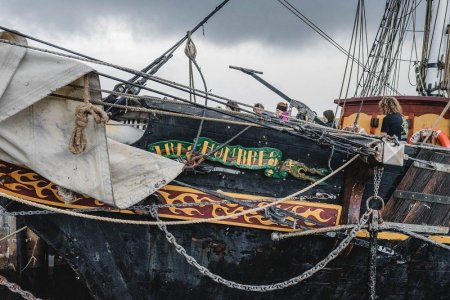
Grant Tyler! Thank you - I'm working on developing my mojo!Good morning Chuck. My friend this is excellent. You are totally owning this Le Orenoque. Cheers Grant
Martin! Thank you so much! Now there's absolutely no question - hotrod flames sur tout and laissez les bons temps rouler! A Cajun classicHey, look ,Chuck, forget about rigging...historical proof for hotrod flames...!View attachment 559739
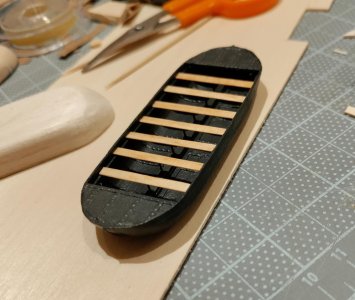
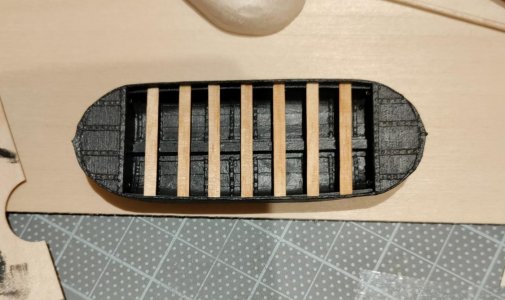
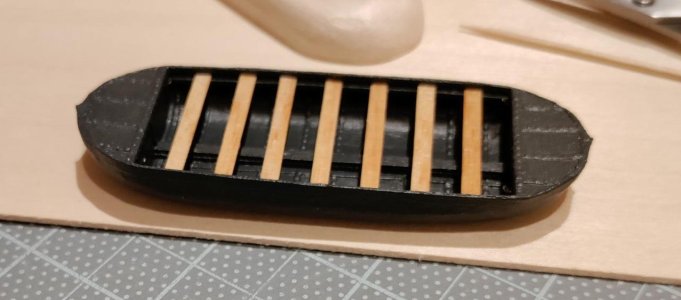 - I am also going to use very fine chain for the rigging which will also add to the impression of weight and will avoid the problem of the rigging line twisting.
 I used the dot-of-glue method to simulate the rivets. Although I am not using the kit-supplied boats, I like the kit-supplied oars! I'll see how well they hold up under the stress of sanding them into shape. On that note, I am not quite finished with the bateaux - the plan shows thole-pins. I need to add them. BTW, that beam running fore and aft in the last picture was a temorary way to hold the benches until the bench supports were glued in place.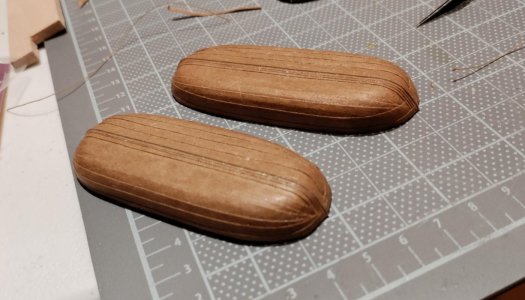
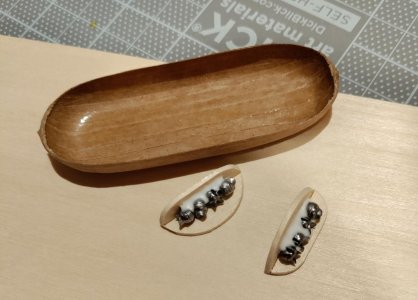
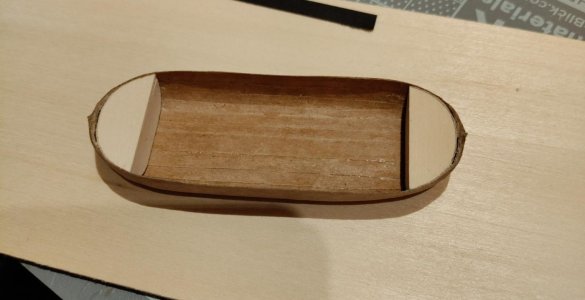
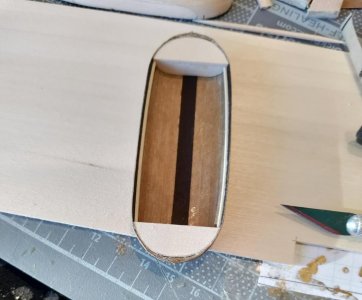
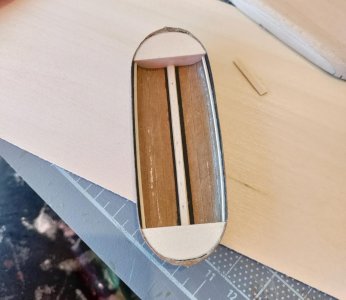
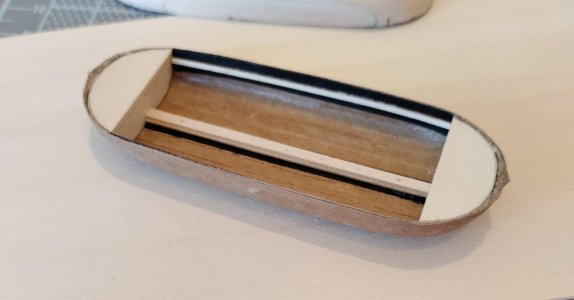
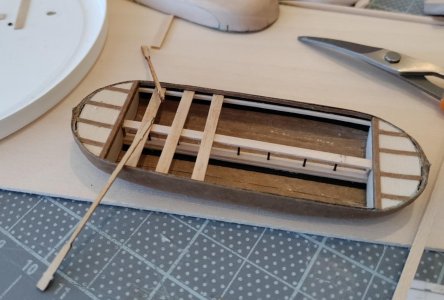

Thank you, Paul! Good shipmates are necessary for success! I'm positive that I would never have thought of paper, much less grocery-bag paper.Amazing construction. Congratulations to you for your execution and to those who tipped you off on this technique.
Good thing you're not in California, they outlawed our paper bags. To there saving the world. A Confederacy of duncesThank you, Paul! Good shipmates are necessary for success! I'm positive that I would never have thought of paper, much less grocery-bag paper.
Blessings.
Chuck
California? Never. Not for me. Besides, I got the best thing California ever produced - my wife!Good thing you're not in California, they outlawed our paper bags. To there saving the world. A Confederacy of dunces
.
Would have loved to see a YouTube video of you making both the boats and formsCalifornia? Never. Not for me. Besides, I got the best thing California ever produced - my wife!
If you ever need brown paper grocery bas, Ted, just sem me a pm and I'll get them in the mail to you!
Blessings.
Chuck
Martin! Many thanks, shipmate! I'm pretty happy with the result - so far . . .They look really good ! You've caught the steel riveted construction perfectly , i can almost hear them clank against the davits ! Bravo !!
The good news is that there's so much left to do!
Ted! I had my "15 minutes of fame" during the academic year 2015-2016. I haven't ever posted anything outside of SOS and LinkedIn and I am about to quit LinkedIn. Although it is less upsetting now to know how many pictures of me are out there including misinterpretations of my words and down-right misquotes, I could never YouTube.Would have loved to see a YouTube video of you making both the boats and forms

