• Win a Free Custom Engraved Brass Coin!!!
    As a way to introduce our brass coins to the community, we will raffle off a free coin during the month of August. Follow link ABOVE for instructions for entering.
  • PRE-ORDER SHIPS IN SCALE TODAY!

    The beloved Ships in Scale Magazine is back and charting a new course for 2026!
    Discover new skills, new techniques, and new inspirations in every issue.

    NOTE THAT OUR FIRST ISSUE WILL BE JAN/FEB 2026

Will this work?

Thanks Bob!
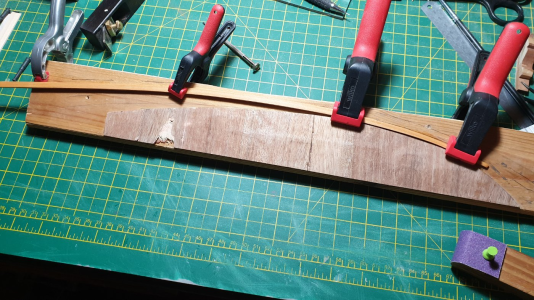
You are using the same process for edge bending that I now use whenever I can. I mark out the hull, plane, file and/or sand them to the necessary taper of their breadth then soak them. Once in the jig which is basically the same as yours, I hit it with a hot air gun. I can usually do 5 or 6 planks a day that way as the drying time with the hot gun is minutes rather than hours.
Thanks again, I appreciate your reply and the photos. (I am with you, no copper sheathing so I try to stay with British vessels launched before about 1780)

Allan

Don't worry about the date mate. Contemporary models show planking and framewok, that's what they're for, an aid to building. I'm doing an 1818 cutter, The hull below the waterline is white, Off white means messing around with an airbrush so I used a rattle can. My choice! We are free from criticism! We work hard to perfect our planking, why cover it up with spangles and sparkles (my description of copper plating!!)
 
With respect to edge setting plank, I see an awful lot of planks that are wildly over scale length. Trees of a given species only grow so big. In scale modeling sizes, spiling plank that is of scale length is much easier, and wasteful of material, than spiling a scale plank that is two or three times as long as it would be in real life.


1770064060213.png

1770064125473.png
 
With respect to edge setting plank, I see an awful lot of planks that are wildly over scale length. Trees of a given species only grow so big. In scale modeling sizes, spiling plank that is of scale length is much easier, and wasteful of material, than spiling a scale plank that is two or three times as long as it would be in real life.


View attachment 575140

View attachment 575141
Hello Bob
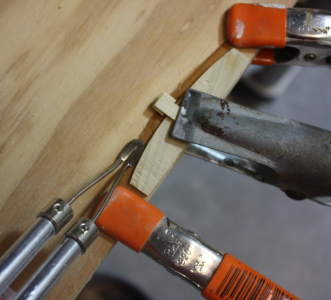
Once a strake fits along it's length, it can be divided to suit the planking pattern. In my photo the plank isn't spiled, It's just tapered from my stock lengths so there's no waste apart from trimming angles at stem and stern. If I was spiling a measured section from sheet stock there's going to be far more wastage. I don't tend to spile very much, probably just a last plank on each side of a hull. The above is simply a short cut. But I'm not too sure what your point is here? The actual plank length on the ship (20 or so feet scaled) or the waste of material?
Much of what we do is for artistic effect, and I'm no purist! My stitching on sails is a .03 grey graphic pen line since you can't scale sewing. It works.. My caulking is a rattle can of blackboard paint on a timber board before I mill to planks. Kortes cuts strips of plastic, more labour intensive but a better effect. Once we've got the wood and string mastered it's all about new tricks. And since I import my timber from Estonia at considerable cost I'm miserly and resentfully aware of wastage!! (we don't do timber of value in the UK, The navy used it all 250 years ago!)
Cheers
Bob
 
Last edited:
Don't worry about the date mate. Contemporary models show planking and framewok, that's what they're for, an aid to building. I'm doing an 1818 cutter, The hull below the waterline is white, Off white means messing around with an airbrush so I used a rattle can. My choice! We are free from criticism! We work hard to perfect our planking, why cover it up with spangles and sparkles (my description of copper plating!!)

Good for you! I'd have to say that the most laborious way I can imagine of cheapening the overall impression of a scale ship model is to attempt to apply realistic scale copper sheathing to the hull. Only on very rare occasions have I ever seen it been done acceptably well.

But I'm not too sure what your point is here?

I suppose I got ahead of the discussion while reading it. There are those who advocate edge-setting model ship planks because they consider spiling wasteful of stock. My point was that in scale lengths the waste tends to be far less than if one tries to get out a plank that's sixty or eighty scale feet long.
 
Good for you! I'd have to say that the most laborious way I can imagine of cheapening the overall impression of a scale ship model is to attempt to apply realistic scale copper sheathing to the hull. Only on very rare occasions have I ever seen it been done acceptably well.


I suppose I got ahead of the discussion while reading it. There are those who advocate edge-setting model ship planks because they consider spiling wasteful of stock. My point was that in scale lengths the waste tends to be far less than if one tries to get out a plank that's sixty or eighty scale feet long.
I assume you've seen Kev Kenny's videos building HMS Thorn. He confirmed with me a couple of years ago that only his last plank was spiled. I had previously assumed all of them were!
 
I assume you've seen Kev Kenny's videos building HMS Thorn. He confirmed with me a couple of years ago that only his last plank was spiled. I had previously assumed all of them were!
Yes, that's not surprising. Depending upon the scale and the size of the shape of the hull, it can be the case that the planks are of such a size that there's not a lot of spilng to be done.
 
Back
Top