
-

Win a Free Custom Engraved Brass Coin!!!
As a way to introduce our brass coins to the community, we will raffle off a free coin during the month of August. Follow link ABOVE for instructions for entering. -

SUBSCRIBE TO SHIPS IN SCALE TODAY!
The beloved Ships in Scale Magazine is back and charting a new course for 2026!
Discover new skills, new techniques, and new inspirations in every issue.
NOTE THAT OUR NEXT ISSUE WILL BE MARCH/APRIL 2026
You are using an out of date browser. It may not display this or other websites correctly.
You should upgrade or use an alternative browser.
You should upgrade or use an alternative browser.


- Joined
- Sep 23, 2021
- Messages
- 305
- Points
- 238
Yes, that's correct. The holder just keeps the distance beween the deadeyes while you set the length if the shroud. Once you have the length of the shroud correct the holder can be removed and then when you lace up the deadeyes the shroud will pull to the correct tension. Some people just use some wire through the holes of the deadeyes which works OK but the little holders are simple and help speed things up.Thanks a lot Peter and DOM. This could really help. One question though... Would one take each deadeye off the holder to pass the thread through each hole? I guess the holder is really just to get the spacing correct. Is that right?
- Joined
- Sep 23, 2021
- Messages
- 305
- Points
- 238
Thanks a lot Peter and DOM. This could really help. One question though... Would one take each deadeye off the holder to pass the thread through each hole? I guess the holder is really just to get the spacing correct. Is that right?
You can see how to do this on "Tom's Modelling in Motion" Youtube channel. He has a whole series of builds that are excellent to watch. This is the link to his HMS TERROR build and he uses the same technique.
- Joined
- Sep 23, 2021
- Messages
- 305
- Points
- 238
I glued mine in with a few drops of wood glue. I used a small plumb bob hung from a shelf to just to check that the masts were perpendicular and not leaning to one side and you need to be careful to check by eye that the masts are orientated so that the cross trees are square to the deck, no going back once the glue sets! Some people leave the masts unglued on models and use the rigging to hold them in place but I think that risks accidentally moving them and upsetting the rigging tension.This is probably obvious but I don't know whether the masts should be glued inside the holes they are inserted into on the deck.
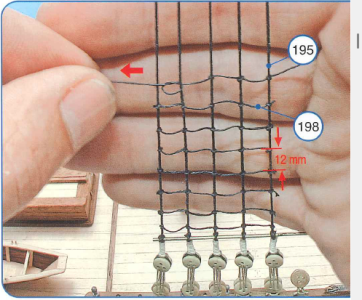


Two tweezers is how I do it. They become an extension of your hands once you use them enough!Is there some magic tool to use to tie the strings that make the rungs of the ladder? I can't see how the fingers of any human over two years old could be thin enough to tie those.
View attachment 582996

- Joined
- Sep 23, 2021
- Messages
- 305
- Points
- 238
You have reached the stage that is the bane of every sail ship modellers life!Is there some magic tool to use to tie the strings that make the rungs of the ladder? I can't see how the fingers of any human over two years old could be thin enough to tie those.
View attachment 582996
Two pairs of fine tweezers and if you have one, a pair of screw adjustable compasses helps. Most modellers use a clove hitch to tie the rat-lines.
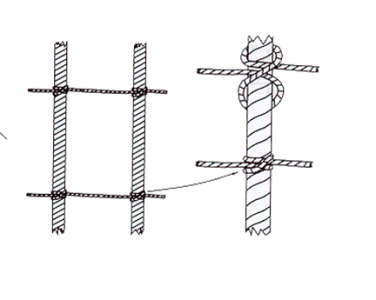
They should not be so tight so that they pull the shrouds together and the foot rope should have a very slight sag in the middle between the shrouds. Tie the knot and then slip it into position and check the distance between the rows using the compass tips set to 12mm (some people use a piece of lined paper clipped behind the shrouds as a guide, but I found that it gets in the way). Do one row and when you are happy with the position you can fix the knots with a tiny bit of CA using a fine needle tip dipped in the glue and then move up a row.
It is unfortunately very tedious work, do a few rows, walk away, and come back later to do a few more!
If it's any consolation, my current project needs 1700 knots to be tied!
Dom
- Joined
- Sep 23, 2021
- Messages
- 305
- Points
- 238
Thanks guys.
Wow 1700 knots, and you are still sane?
Would you use the same style of knot on the outer shrouds? My knots on the outer shrouds keep coming untied. Is that where the glue comes in?
Where would you buy tweezers that fine?
You can buy precision point tweezers on ebay easily enough for not much money, I suggest you buy a couple of different types or sets of straight and bent tip, they always come in handy for positioning small parts. I generally use clove hitches when tying the lines and also for attaching sails, they have less tendency to come undone when you are sliding them into position and then use the CA to fix them. You only need to wipe the end of a needle dipped into CA across the knot and it will stay put, try not to use too much CA or the knot can look very plasticky.
Probably lost my sanity years ago doing these models!
- Joined
- Sep 23, 2021
- Messages
- 305
- Points
- 238
Well I've tried tying those but with or without tweezers the result looks like heck. I guess this is as far as I can go. I don't think it's worthwhile continuing.
Thanks folks for all your help over the past months.
Don't give up, they are a pain to do, but after a few you will get through!
A good way to practice is to get some scrap wood and put a row of long panel pins top and bottom leaving about 25-30mm of the pin showing so that you can then just tie some lengths of thread between the nails to emulate the shrouds and then practice tying the knots.
If you are still struggling with the knots, a really quick and dirty way of doing the lines is to use a very fine needle threaded with the fine thread you are using for the rat lines and just push that through the shroud lines where you want the rat line to run, when its in the correct position just use a fine needle wetted with some CA and touch it to the thread where it runs through the shroud which will hold it in place and then trim the thread ends. You can practice doing that like above and if you are OK with the result it should work fine on the model.
Dom