
• Win a Free Custom Engraved Brass Coin!!!
    As a way to introduce our brass coins to the community, we will raffle off a free coin during the month of August. Follow link ABOVE for instructions for entering.
  • SUBSCRIBE TO SHIPS IN SCALE TODAY!

    The beloved Ships in Scale Magazine is back and charting a new course for 2026!
    Discover new skills, new techniques, and new inspirations in every issue.

    NOTE THAT OUR NEXT ISSUE WILL BE MARCH/APRIL 2026

Harold Hahn

By connection dots of information from notes in Harold's library, talking to him, unpublished writings of his and the people he was associated with. Here are some thoughts as to why Harold Hahn framed his models the way he did.

The model that i made from those plans, was built to suit my own personal interests as a ship modeler. Whether others share my interpretation of the subject, does not concern me.
I am the captain of this ship and she pleases me.
quote 1992 Harold Hahn

The first reference books Harold use for the framing of a hull were The Built up Ship Model by Charles Davis and the second book was Plank on Frame models by Harold Underhill. In both these sources the modelers used a room and space defined as the frame and the space are equal. When Harold started work on the shipyard diorama he consulted Howard Chapelle, he had gone to meet Chapelle at his home on a few occasions.

The way Howard explained how colonial ships in the small yards along the east coast were built the builder erected a platform called a "scrieve-board", which can be seen in this diorama.
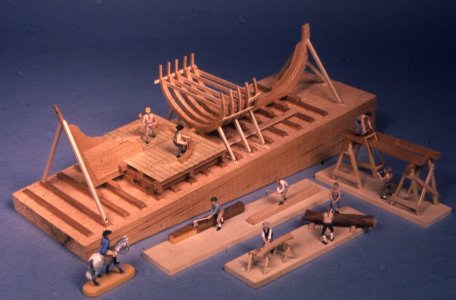

File0002.jpg

He then built mold frames and set them up along the length of the hull. Once the mold frames were set up planking began at the keel and filler chunks of timber were added between the mold frames held in place by the planking. This method was also described in the book the Built up Ship Model. Davis referred to the method as "framed on ribbons" he continued to say "Unless you have a keen eye for fairness in sighting the curves, you had better stick to the safer method of sawing each frame shape taken from the plans." Howard Chapelle also told Harold the bigger yards with mold lofts and trained draftsman and marine architects used a different system. They were laying out each frame and making mold patterns to build the frames. This system was the big bang of model ships, it gave birth the use of 1/2 models. The designer built a model and the draftsmen took measurements from the model and created a table of offsets. The term lofting a frame is the process of taking those measurements and drawing them full scale on the floor of the mold loft. The catch to it is the designing, drafting and lofting of the shapes was a totally different operation to what went on in the ship yard. What went on in the yard was the builder placed the mold frames at his whim, they could be every 3rd or 4th or 5th frame, they could be evenly spaced or set anywhere along the keel. As for the sawn frames they were built and spaced totally random, some frames were thinner some heavier and spacing varied from 1 to 4 inches. This information led Harold to the conclusion building a hull can be totally random but designing a hull is another method.

A correspondent wrote to ask me how he could secure detailed information which would enable him to duplicate exactly the original framework of a colonial schooner. His concern was that eighteenth century ships were not built as i show them with my framing design. My answer was he asked for an impossibility. Research will uncover records that give scantlings in general terms, there are certain number of contemporary framing plans proposed for a particular ship. However, while this information will enable one to approximate a duplication of the original ship, no model built from eighteenth century plans can be more than a reconstruction. So where do we draw the line? to me, it is a compromise with a practical approach to what the "purist" would consider absolutely correct, although unattainable. An individual who insists that a model should be framed right side up like a real ship, and the frames must be built up of futtocks pieces together end to end with chocks and reduced in thickness as they rise up the side of the hull, I can't fault the method if a person is determined to follow it. If this labor of love gives the builder true satisfaction, then it is time well spent. In my case the plans i developed for my own models and for the use of other builders, it is important they should be recognized for what they do and do not offer. The frame scantlings are reasonably close to what might of been expected in the original ship though they may not duplicate actual construction practices. The plans provide a practical approach without sacrificing options for introducing details.

Equal room and spacing of frames was seen everywhere Bob Bruckshaw use it in his models as well as Crabtree use it and a number of other model builders even the builders of the Navy board models used it. Not only was it used in model building but also used in actual hull construction. There seems to be more to it than just a random method. Keeping in mind Harold Hahn was an engineer by trade and accomplished artist one thing all engineers and artists know is the golden mean. This is a ratio of geometric proportion that is used in architecture, art, engineering and even in the natural world. This proportion is said to produce the most aesthetically pleasing results. Equal room and space framing in ship models is the starting point of design the balance between art and engineering.

 
This is all well and fine Harold set the groundwork for scratch building plank on frame models and engineered a method. There is a major stumbling block in the idea.
In order to build the models following the plans as is or altered, you need tools. Many builders were kit builders wanting to expand their knowledge and building better models. The problem was they did not have the power tools to rip down lumber and mill it to scale dimensions. To fill this gap the "timbering set" was invented.
Many in the ship modeling community scoffed at Hahn and belittled him for his methods and ideas. But now his ideas of a jig are used in kits and the "timbering set" is now used as the in between kit and scratch. Those who poo poop his "timbering set" are now using it. So coming up lets talk about it
 
for those concerned about the wood being wasted there are thing you can do to reduce the waste. Harold used 1 inch wide framing stock to build the blanks you can reduce the one inch to half an inch cutting the wood use in half. however by doing this the blanks Harold drew will not work you will have to make your own blank patterns. Also using narrower wood you have to be careful not to have enough width to fit the frame.
Another alternative is to break down the frame patterns and lay out all the frame futtocks on sheet stock. That would be a lot of work. The original idea for the Hahn system is to make building a plank on frame model possible for a first time scratch builder.

frame layout.jpg
I did my first POF using Hahn's method. I sought a method that is less wasteful of frame stock - my first was a 1:48 brigantine whaler. I was a beginner. Books and journals were it for any direction. Bluegrass KY is not exactly a hotbed of nautical knowledge. As close as it came was the Summer weekend Buckeye navy. A whole lot of really rich colored Black Walnut framing stock went for kindling. (I did not know better than to not use it. It was low cost and easy to get then.) I really investigated a method that utilized stock as efficiently as the above. I use a scroll saw so the patterns were not as closely packed. I think it would take a laser to work within the above tolerances.
I could not find a method to align the timbers. Pins thru the body of a bend pair of frames defaces the frame and will only work for a very few bends in the middle where there is no bevel. A picket fence of pins at the periphery was too much work. It also makes it difficult to apply clamping pressure. Cam disks at the edges sounded good on paper. In practice the curvature of the frame made it too crowded on the inside to have proper placement.

I found a different solution, but with the above: How DO you assemble these timbers into a bend?
 
Last edited:
The idea of a semi kit came from Milt Roth who owned the ship modeling business the Dromedary. Milt and i discussed some sort of building system and kit that would bridge the gap between the plank on bulkhead kits and the plank on frame scratch built model. The concept would also teach a builder how it was done so the information can be used on any new project a model builder wanted to build. What came to my mind was Harold Hahn because for one thing he produced plank on frame model plans and all that was needed was a kit. I approached Harold with the idea of a kit and the answer was no! i didn't take no for a final answer and asked why not? he spelled it out to me in no uncertain terms. He said his plans and body of work was never intended for the average hobby builder. His plans were for the more serious builder who wanted to learn the craft and for the semi advanced builders who wanted to build plank on frame models. A serious builder needed to start with the basics of learning to work with wood, read and understand plans and use research, learn patience and take things slow and easy model ship building requires repetitive work and a development of a certain temperament a kit skips over the basics and ends with just building a kit.
Now that i knew what the parameters were and what Harold had in mind i sat down and created the first timbering set for the Hannah, I took it over his house and we talked about it. I knew Harold was into reproducing series, every one of his etchings were about creating the master etching and making a limited edition of each from 5 to 100 copies. His model building from the start was about a system for others to follow i just needed to come up with something a builder could learn from and end up with a reproduction of the original. I left the timbering set with him and about a week later he called and asked can you stop over i have some things to say about the timbering set and oh by the way bring a few pieces of Ebony. Harold the artist was not at home but Harold the engineer was there, and this is what happened. First every timbering set produced had to include a set of his plans that way he sold plans with every timbering set, ok no problem. Harold did not like the term "kit" so he suggested "timbering set" ok fine with me. He told me not to provide finished wood this takes away the element of the builder learning to use the material. The heavy cutting and milling was fine because he knew many builders did not have the tools to cut down lumber into usable sizes. A rougher dimensioned wood was fine this way a builder learns how to fit and finish pieces and make adjustment to the framing. To him providing someone with perfectly milled and finished material was someone wanting to rush to the finish line, someone taking the time to fit and work with wood and finishing the pieces is someone taking the time to learn a craft and that is what this is all about. Next was no fittings either figure out how to make them or finding a source for them. The big no, no was to reduce any of his plans to plank on bulkhead construction and no precut parts. One last issue was the laser cutting, i said the laser cutting was not the final piece it still needed to be adjusted so i got the ok for laser cutting. We went back and forth on the deck beams he felt the builder should make them and he provided a pattern on the plans, i thought that cutting them was just an added a convenience and they still needed to be finished so deck beams got included. The Hahn timbering set went into production, and it did not take long for the feedback of why the wrong framing.
Later i talked to Harold about the timbering set and builders were asking me about the framing and why it was used so i asked him about the framing. He seemed a bit irritated with the question no doubt because he was asked the same question over and over despite giving the answer over and over. because model ships should be built starting with the keel and framed right side up. The basis for the technique was to use a jig to provide a solid base and a reference point to take measurements, while keeping the frames square and in place. The idea first appeared in print in the spring of 1972. The first use of the jig was during the construction of the shipyard diorama. The ship hulls were only about seven inches long and Harold needed a way to hold the tiny framing in place while the hull were being worked on. At the completion of the diorama Harold did wonder if the jig idea could be applied to larger scale hulls so he was given a set of plans for the Confederacy by Bob Bruckshaw and tested out the idea. It worked out, and from that time on all his ships were built upside down in a jig.
 
Saying the frame blank method is a waste of wood seemed odd to me. In what respect is a "waste of wood" my brother and i once owned Skyline Tree service. I saw Cherry logs cut up for firewood Cherry wood run through a chipper, all kinds of wood dumped and left to rot. Tons of usable wood gone to waste, so what was used to build a fine model ship seems insignificant. But on the other side a model builder spending $30.00 a foot on some imported exotic wood then yes a waste of wood is a factor to consider. you would want to use as much of the wood you possibility can. But what is the advantage of using expensive exotic wood when less expensive wood works just as well.
 
Probably heresy but if you were going to plank the hull, clear pine would work for the framing.

Roger

way back in my days of industrial arts i worked in a shop that made wooden parts to use to make sand casting molds for metal. The wood used was what the guys called pattern pine or southern yellow pine a hard durable pine.
So yes i think you can use Pine to frame up a hull.
 
But what is the advantage of using expensive exotic wood when less expensive wood works just as well.
If you are speaking of the Hahn way of making frames that is probably true as Roger points out. If the hull is to be planked over, why bother with a fully framed hull to begin with? Half the number of frames or just go with POB and save a lot of aggravation. But, can that be said for everything? Try planking with sapele compared to castello, pear, or boxwood as just one example. Not every wood is ideal for every application.
Allan
 
I approached Harold with the idea of a kit and the answer was no! i didn't take no for a final answer and asked why not? he spelled it out to me in no uncertain terms. He said his plans and body of work was never intended for the average hobby builder. His plans were for the more serious builder who wanted to learn the craft and for the semi advanced builders who wanted to build plank on frame models. A serious builder needed to start with the basics of learning to work with wood, read and understand plans and use research, learn patience and take things slow and easy model ship building requires repetitive work and a development of a certain temperament a kit skips over the basics and ends with just building a kit.

The more you share about Harold Hahn's philosophy of scale ship modeling, the more I realize my own conclusions mirror his. This doesn't mean I'm anywhere near as skilled or accomplished as Hahn, of course, but rather that the "parallel evolution" of our modeling philosophies, one by a master and one by an Ordinary Joe, tends to demonstrate the validity of both. Your description of Hahn's analysis is a succinct explanation of what's wrong with kits. There's no art to "just building a kit."
 
Your description of Hahn's analysis is a succinct explanation of what's wrong with kits. There's no art to "just building a kit."

you are right Bob to say kit building is not an art it is as Harold said a paint by number version of the art. However and i stress wooden ship model kits are complex in their own right they may not be art but they require a degree of skill. The kit can also be considered the entry level of the art the starting point. I would say the majority in this hobby started with a kit that has to be recognized. Personally i did not start with a kit i started with Harold Underhill's Leon and i was fortunate to be able to have a master builder to consult. I brought my attempt to Harold Hahn and he said point blank nice try but it is rubbish. i returned a comment ok then show me how and he did.
 
here's no art to "just building a kit."
Another thought, devil's advocate, etc.......most of us in this hobby do not call ourselves artists nor aspire to that lofty title, Mr. Hahn or not. We are not understudies of some renaissance painter or Harold Hahn, so could care less about Mr. Hahn's opinion regarding art versus hobby/pastime. Both sides (art/hobby) are good if they meet the needs and fulfill the desires of the person making the journey down their chosen path.
Allan
 
Both sides (art/hobby) are good if they meet the needs and fulfill the desires of the person making the journey.

Allan

i believe it is not for us to judge art or hobby or what a builder wants to get out of this it is our job to help in the journey so builders do not wonder aimlessly in the wilderness, get frustrated and quit. But a degree of restraints are in order and not to pass along bad advice or information it is better to say "i do not know" rather than fill in the blank with a guess or anything, then we have the blind leading the blind and going nowhere fast. There are rules and standards, but they are not mandatory.
 
Taking Harold's philosophy on model building and a real world application. Milt Roth suggested a building system and kit that would bridge the gap between the plank on bulkhead kits and the plank on frame scratch built. Is a kit by any other name still a kit? If the design is more about the process, a kit becomes a teaching aid as long as it is teaching "model ship building". There are two major steps to consider. First step is all about cutting wood and prepping the material the second step is the building process. you can skip the first step and jump right into the building but we are inching our way to the kit concept.
using Hypnagogia as an analogy
Hypnagogia is the transitional state between wakefulness and sleep Many artists, writers, and scientists have harnessed the hypnagogic state for inspiration. Notable figures like Salvador Dalí and Thomas Edison have used techniques to induce hypnagogia, allowing them to tap into this unique mental space for creative problem-solving and idea generation. The fluidity of thought during this state can lead to innovative insights that might not emerge during full wakefulness

We are in the "in between state" of a mass produced kits that are not built like a real ship and actual scale model ships. Problem with the Hahn system is you have to have enough experience to fully understand and the use system as he said " his plans and body of work was never intended for the average hobby builder." I see that as a problem and an issue it is like a grade school student wanting to jump into college level and skip everything in the middle. I know this can be debated model builders who want to skip all the reading and learning and just want to build a finer scale model or bash a kit into something better. It is all about the how to and not defining the end result.

Can something be designed as a learning kit but not a kit? or a breakaway from the standard commercially made POB kits. Can a builder go from grade school to college and skip everything in between and build on a need to know basis? i think so

kits can and should be considered a valuable learning and teaching aid. That is as long as they provide workable materials.
 
Last edited:
I build hardcore scratch POF. By hardcore, I mean that I start with original plans and loft my own timber patterns.
I began my entry into scratch POF using Hahn's method.

Once the introductory steps ( most commonly kits, but it is prudent to chose the proper sort of kits ) and intermediate steps ( probably best is a scratch carved hull ) I believe that a scratch build using the Hahn method is the efficient path to reach POF.
Hahn's presentation is actually two separate methods.
#1 is the assembly of bends - paired frames. It is a near fool proof way of assembling frame timbers into frames. The price is the inefficient use of timber stock. At 1:96 scale this loss is insignificant. At 1:48 the loss get painful.
There are other more economical frame assembly methods. These frames are just as appropriate for the second part.
#2 is the assembly of the hull. The bend orientation jig is near fool proof if the building board is dead flat. The upside down vs traditional frames up controversy/argument is silly and pointless. The hull is not going to stay upside down. The Hahn method is an easy way to deal with a hull with significant drag. Hahn's method of hull assembly works for frames assembled using almost any method currently in use.

The frame placement is also independent of the method. The width of the spaces is independent of the method. The shifting of bends to frame the ports is independent of the method. These are all choices that Hahn made for his builds. If Hahn's plans are used, then your are pretty much stuck with replicating his choices. If you choose a monograph for its already lofted frame patterns, the Hahn method is still a way to get a hull. Limiting yourself to monographs just severely limits the possible choices of vessels to build. If you loft your own frames, the choice of subjects is limited only by the available plans.

Hahn is not ultimate method for me. It was an important stepping stone. It was a pretty much necessary stepping stone. I strongly advocate a step by step progression to develop skills and insight. The choice of subject along the way is of lesser importance. Once you know that you are ready, then pick a subject that is an obsession.

It is my observation that a rank beginner who dives directly into the Mariana Trench complexity of an obsession subject will have one of two usual outcomes. The first is a rather quickly determined realization that the task is beyond their ability and they seek an easier hobby. The second is that the time they take stretches into many many years. This is a valid option but it is akin to depending on winning a lottery to pay your bills.

A ship is the ultimate product of its civilization. The task deserves proper respect. It requires effort and skill. This is necessary for a proper replication. The individual steps along the way are not difficult. More often than not it requires shifting into reverse and doing it over as many times as it takes. After all the material involved is from trees.
 
Can a builder go from grade school to college and skip everything in between and build on a need to know basis? i think so

I'd say that depends greatly upon the "builder," "everything in between," and what's the "need to know basis." I don't think it's a principle of universal application by a long shot.

The first thought that comes to mind is improvisational jazz music. Ask any musician how to become a good improvisational jazz musician and they will probably tell you, "Learn your instrument backwards and forwards and then learn everything you can about music." The quality of the end result is very often dependent upon "everything in between," without which one has no way of knowing what they "need to know" in the first place.

Another example in the nautical realm was the prefabricated assembly line procedures Henry J. Kaiser designed for his shipyards just prior to WWII. Kaiser was able to take a person with no prior experience whatsoever and train them to read blueprints and cut and weld sheet steel to MARAD welding specs in eight weeks. Those Kaiser Shipyards welders turned out a Liberty Ship every fifty days on average, and even much less just to prove they could. However, those shipyard welders only knew "what they needed to know" about ship building. Few had a clue how to do what workers outside their immediate crew did. None were naval architects who could design an entire ship. Were they "builders?" Of course we could say that "Wendy the Welder," "built" ships, but in actuality, she only built a part of the ship.

Ship models surely have been built by crews of modelers, just like Liberty Ships. The famous Gibbs and Cox Model Department is the foremost modern example of that, although in their time, most every shipyard of any consequence had their own "model room" crew keeping pace with the crews building the prototype in the stocks. That's not the sort of modelmaking that we're talking about here, though.

I expect a pretty good kit "builder" could be taught "everything they needed to know" about building a particular kit, and "skipping everything in between," in eight weeks, too. But that training would only be for that one kit they were trained to build, or one very much like it, and their work, as much as they tried, could in the end never be any better than the plans they'd been trained to follow. This manufacturing model is productive only in mass production environments like shipyards and factories. Additionally, it becomes correspondingly less efficient as the number of individual decisions the assembly line worker must make to complete their assembly station assignment increases. Therefore, I would conclude that, unless one were intending to build the same ship model kit over and over again, a competent ship modeler "needs to know" "everything in between." Anybody might be trained to build a particular kit and so claim to be a "ship model builder," if that's how you want to define it, but that's not always how it's defined. Lee Iacocca used to say he "made the Mustang." So did my buddy, Joe Sixpack, who screwed nuts on lug bolts all day long on the Ford assembly line. Of course, eventually fired Iacocca and Joe's now collecting a fat pension thanks to the UAW, so ya pays yer money and ya takes yer chances, I guess. :D

I'd say it's not essential to "know everything in between" to call yourself a ship model builder, but the more of what's "in between" you do know, the more of a ship model builder you will be.
 
Back
Top