

- Joined
- Dec 1, 2016
- Messages
- 6,681
- Points
- 728

By connection dots of information from notes in Harold's library, talking to him, unpublished writings of his and the people he was associated with. Here are some thoughts as to why Harold Hahn framed his models the way he did.
The model that i made from those plans, was built to suit my own personal interests as a ship modeler. Whether others share my interpretation of the subject, does not concern me.
I am the captain of this ship and she pleases me.
quote 1992 Harold Hahn
The first reference books Harold use for the framing of a hull were The Built up Ship Model by Charles Davis and the second book was Plank on Frame models by Harold Underhill. In both these sources the modelers used a room and space defined as the frame and the space are equal. When Harold started work on the shipyard diorama he consulted Howard Chapelle, he had gone to meet Chapelle at his home on a few occasions.
The way Howard explained how colonial ships in the small yards along the east coast were built the builder erected a platform called a "scrieve-board", which can be seen in this diorama.
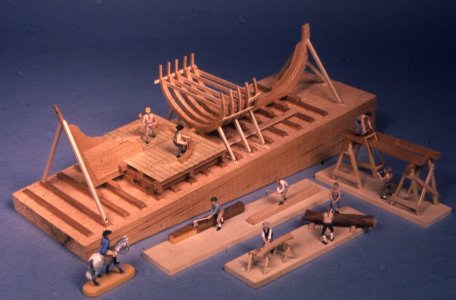
He then built mold frames and set them up along the length of the hull. Once the mold frames were set up planking began at the keel and filler chunks of timber were added between the mold frames held in place by the planking. This method was also described in the book the Built up Ship Model. Davis referred to the method as "framed on ribbons" he continued to say "Unless you have a keen eye for fairness in sighting the curves, you had better stick to the safer method of sawing each frame shape taken from the plans." Howard Chapelle also told Harold the bigger yards with mold lofts and trained draftsman and marine architects used a different system. They were laying out each frame and making mold patterns to build the frames. This system was the big bang of model ships, it gave birth the use of 1/2 models. The designer built a model and the draftsmen took measurements from the model and created a table of offsets. The term lofting a frame is the process of taking those measurements and drawing them full scale on the floor of the mold loft. The catch to it is the designing, drafting and lofting of the shapes was a totally different operation to what went on in the ship yard. What went on in the yard was the builder placed the mold frames at his whim, they could be every 3rd or 4th or 5th frame, they could be evenly spaced or set anywhere along the keel. As for the sawn frames they were built and spaced totally random, some frames were thinner some heavier and spacing varied from 1 to 4 inches. This information led Harold to the conclusion building a hull can be totally random but designing a hull is another method.
A correspondent wrote to ask me how he could secure detailed information which would enable him to duplicate exactly the original framework of a colonial schooner. His concern was that eighteenth century ships were not built as i show them with my framing design. My answer was he asked for an impossibility. Research will uncover records that give scantlings in general terms, there are certain number of contemporary framing plans proposed for a particular ship. However, while this information will enable one to approximate a duplication of the original ship, no model built from eighteenth century plans can be more than a reconstruction. So where do we draw the line? to me, it is a compromise with a practical approach to what the "purist" would consider absolutely correct, although unattainable. An individual who insists that a model should be framed right side up like a real ship, and the frames must be built up of futtocks pieces together end to end with chocks and reduced in thickness as they rise up the side of the hull, I can't fault the method if a person is determined to follow it. If this labor of love gives the builder true satisfaction, then it is time well spent. In my case the plans i developed for my own models and for the use of other builders, it is important they should be recognized for what they do and do not offer. The frame scantlings are reasonably close to what might of been expected in the original ship though they may not duplicate actual construction practices. The plans provide a practical approach without sacrificing options for introducing details.
Equal room and spacing of frames was seen everywhere Bob Bruckshaw use it in his models as well as Crabtree use it and a number of other model builders even the builders of the Navy board models used it. Not only was it used in model building but also used in actual hull construction. There seems to be more to it than just a random method. Keeping in mind Harold Hahn was an engineer by trade and accomplished artist one thing all engineers and artists know is the golden mean. This is a ratio of geometric proportion that is used in architecture, art, engineering and even in the natural world. This proportion is said to produce the most aesthetically pleasing results. Equal room and space framing in ship models is the starting point of design the balance between art and engineering.
The model that i made from those plans, was built to suit my own personal interests as a ship modeler. Whether others share my interpretation of the subject, does not concern me.
I am the captain of this ship and she pleases me.
quote 1992 Harold Hahn
The first reference books Harold use for the framing of a hull were The Built up Ship Model by Charles Davis and the second book was Plank on Frame models by Harold Underhill. In both these sources the modelers used a room and space defined as the frame and the space are equal. When Harold started work on the shipyard diorama he consulted Howard Chapelle, he had gone to meet Chapelle at his home on a few occasions.
The way Howard explained how colonial ships in the small yards along the east coast were built the builder erected a platform called a "scrieve-board", which can be seen in this diorama.
He then built mold frames and set them up along the length of the hull. Once the mold frames were set up planking began at the keel and filler chunks of timber were added between the mold frames held in place by the planking. This method was also described in the book the Built up Ship Model. Davis referred to the method as "framed on ribbons" he continued to say "Unless you have a keen eye for fairness in sighting the curves, you had better stick to the safer method of sawing each frame shape taken from the plans." Howard Chapelle also told Harold the bigger yards with mold lofts and trained draftsman and marine architects used a different system. They were laying out each frame and making mold patterns to build the frames. This system was the big bang of model ships, it gave birth the use of 1/2 models. The designer built a model and the draftsmen took measurements from the model and created a table of offsets. The term lofting a frame is the process of taking those measurements and drawing them full scale on the floor of the mold loft. The catch to it is the designing, drafting and lofting of the shapes was a totally different operation to what went on in the ship yard. What went on in the yard was the builder placed the mold frames at his whim, they could be every 3rd or 4th or 5th frame, they could be evenly spaced or set anywhere along the keel. As for the sawn frames they were built and spaced totally random, some frames were thinner some heavier and spacing varied from 1 to 4 inches. This information led Harold to the conclusion building a hull can be totally random but designing a hull is another method.
A correspondent wrote to ask me how he could secure detailed information which would enable him to duplicate exactly the original framework of a colonial schooner. His concern was that eighteenth century ships were not built as i show them with my framing design. My answer was he asked for an impossibility. Research will uncover records that give scantlings in general terms, there are certain number of contemporary framing plans proposed for a particular ship. However, while this information will enable one to approximate a duplication of the original ship, no model built from eighteenth century plans can be more than a reconstruction. So where do we draw the line? to me, it is a compromise with a practical approach to what the "purist" would consider absolutely correct, although unattainable. An individual who insists that a model should be framed right side up like a real ship, and the frames must be built up of futtocks pieces together end to end with chocks and reduced in thickness as they rise up the side of the hull, I can't fault the method if a person is determined to follow it. If this labor of love gives the builder true satisfaction, then it is time well spent. In my case the plans i developed for my own models and for the use of other builders, it is important they should be recognized for what they do and do not offer. The frame scantlings are reasonably close to what might of been expected in the original ship though they may not duplicate actual construction practices. The plans provide a practical approach without sacrificing options for introducing details.
Equal room and spacing of frames was seen everywhere Bob Bruckshaw use it in his models as well as Crabtree use it and a number of other model builders even the builders of the Navy board models used it. Not only was it used in model building but also used in actual hull construction. There seems to be more to it than just a random method. Keeping in mind Harold Hahn was an engineer by trade and accomplished artist one thing all engineers and artists know is the golden mean. This is a ratio of geometric proportion that is used in architecture, art, engineering and even in the natural world. This proportion is said to produce the most aesthetically pleasing results. Equal room and space framing in ship models is the starting point of design the balance between art and engineering.