
• Win a Free Custom Engraved Brass Coin!!!
    As a way to introduce our brass coins to the community, we will raffle off a free coin during the month of August. Follow link ABOVE for instructions for entering.
  • SUBSCRIBE TO SHIPS IN SCALE TODAY!

    The beloved Ships in Scale Magazine is back and charting a new course for 2026!
    Discover new skills, new techniques, and new inspirations in every issue.

    NOTE THAT OUR NEXT ISSUE WILL BE MARCH/APRIL 2026

HMS Beagle - Occre by TedR

The doors look great now they're installed- and already well hidden in the build- there really is no point in spending hours on these details, when there's more exciting stuff to be moving forwards with.

Planking. One of the dark arts of model building. You could spend days researching planking techniques. Experts, purists and those with years of experience would say that you need to taper and heat-bend every plank correctly, all part of the learning experience, working towards an advanced level of craftsmanship. Which would be the way to go if you were at home in your own workshop.....
If you're going down that road, you'd probably need to make an edge-bending station, a travel iron, and perhaps buy heat-bending tools... the best guide to the technique is Chuck Passaro's:


My feeling is that you're working in limited conditions and although Occre's suggestions on planking go against everything that the experts hold dear, Occre's simplified planking technique might be just what you need right now. The method in the instructions will reduce the amount of complicated bending that you need to do.
I'd suggest loads of pva glue to hold the planks onto the bulkheads- and- importantly- to glue the planks to each other. And don't hammer the pins fully in- just enough to hold the planks in place while the glue dries fully for 24h- then pull the pins out. If you leave the pins in place, it'll be a nightmare to sand them down to get ready for 2nd planking.

Hope this helps.
 
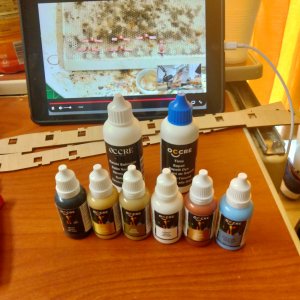
Just received the OcCre paint set for the Beagle. I can't believe sixty bucks with taxes
The doors look great now they're installed- and already well hidden in the build- there really is no point in spending hours on these details, when there's more exciting stuff to be moving forwards with.

Planking. One of the dark arts of model building. You could spend days researching planking techniques. Experts, purists and those with years of experience would say that you need to taper and heat-bend every plank correctly, all part of the learning experience, working towards an advanced level of craftsmanship. Which would be the way to go if you were at home in your own workshop.....
If you're going down that road, you'd probably need to make an edge-bending station, a travel iron, and perhaps buy heat-bending tools... the best guide to the technique is Chuck Passaro's:


My feeling is that you're working in limited conditions and although Occre's suggestions on planking go against everything that the experts hold dear, Occre's simplified planking technique might be just what you need right now. The method in the instructions will reduce the amount of complicated bending that you need to do.
I'd suggest loads of pva glue to hold the planks onto the bulkheads- and- importantly- to glue the planks to each other. And don't hammer the pins fully in- just enough to hold the planks in place while the glue dries fully for 24h- then pull the pins out. If you leave the pins in place, it'll be a nightmare to sand them down to get ready for 2nd planking.

Hope this helps.

Thanks for the advice. I'll keep it simple
 
Just got the Occre paint set. Can't believe it's $50 plus bucks for this little bit of paint. Note Olha in the background working on her gunboat. IMG20260328111008.jpg
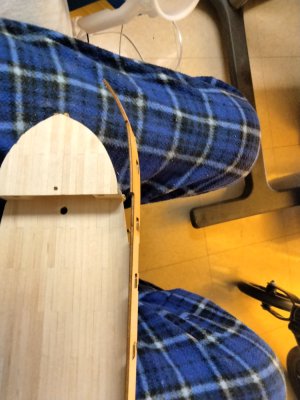
Spent most of the morning bending the bulkwarks for installation. Don't know why I've been dragging my feet in this one 17747249033408337571672384369361.jpg
 
Last edited:
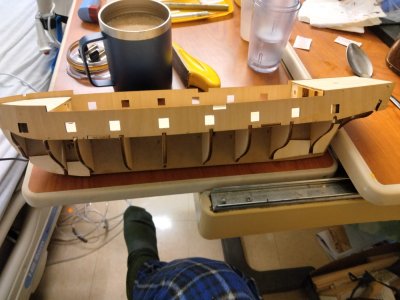
I tried to shape the plywood bulwarks but was only partially successful. I tp.nailed them into place.ans wet.them.down slightly. I'll let this dry overnight and then this morning I removed the nails and glued the parts in place. 17747929176383206992372647477623.jpg.
 
Looking good! You don't have to worry about those little gaps; the interior planking will cover most of them and- I can't emphasise this enough- there is so much going on with deck fixtures and fittings that you won't be able to see the gaps once everything is in place. But yup, see how you feel when you've done the internal bulwark planking and then maybe add waterways?
 
Looking good! You don't have to worry about those little gaps; the interior planking will cover most of them and- I can't emphasise this enough- there is so much going on with deck fixtures and fittings that you won't be able to see the gaps once everything is in place. But yup, see how you feel when you've done the internal bulwark planking and then maybe add waterways?
Safe advise my friend. I'm probably the last person that will look at the model that closely anyway. I've always been a perfectionist while at the same time I'm pragmatic. So I shoot for perfection and accept getting close. I wish I was as skilled at modeling as I am at building homes or restoring airplanes and cars.
 
I wish I was as skilled at modeling as I am at building homes or restoring airplanes and cars.
You weren't skilled when you first started working on houses, cars, and airplanes, either... but you got there! You'll do the same with your ship modeling! It's funny that you mention that. I've helped folks out with sheet metal and welding projects concerning the restoration of a few old WWII warbirds. That's always been fascinating and also extremely fulfilling stuff to do for me! I'm now recently retired and starting to build an experimental airplane of my own, from scratch. Never before had the time, nor the energy while I was working full time... but now I do! :) The working-class grind is now over... "let the fun begin!"
 
Last edited:
You weren't skilled when you first started working on houses, cars, and airplanes, either... but you got there! You'll do the same with your ship modeling! It's funny that you mention that. I've helped folks out with sheet metal and welding projects concerning the restoration of a few old WWII warbirds. That's always been fascinating and also extremely fulfilling stuff to do for me! I'm now recently retired and starting to build an experimental airplane of my own, from scratch. Never before had the time, nor the energy while I was working full time... but now I do! :) The working-class grind is now over... "let the fun begin!"
What are you building? How about some photos
 
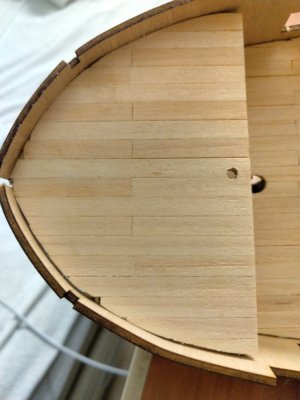
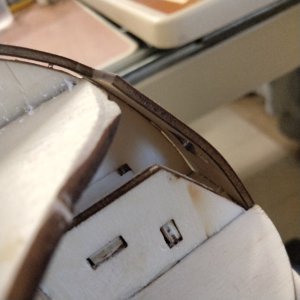
I've got these two spots at the bow where the bulwarks aren't tight to the frames. Dog gone it. I'll put some water and the bending iron to it this morning so I can finish the fairing.IMG20260330082054.jpgIMG20260330082014.jpg
 
I don't know if it is inappropriate to mention on this site but I'm asking for your prayers for my wife. The doctors told her they think she has lung cancer. I don't have any.other details. I'm absolutely devastated. I'm 78 but she is only 62. It just isn't fair.
 
I'm not sure how to fair the blocks at the 17749775829197309633248429425220.jpgkeel in the back of the boat. I'm assuming I need to cut away.the parts at the bottom marked with a x
 
Yes, it's just like you say, sand down the bits with the orange x-marks so they blend into the keel part..... On the paper instructions, on sheet D, the third photo along gives a reasonable idea of how to fair those blocks at the stern. (You need to remove so much material that it's better to sculpt it with a hobby knife to start with.)
I wish I'd taken more photos of my build as I went now!
 
Back
Top