
• SUBSCRIBE TO SHIPS IN SCALE TODAY!

    The beloved Ships in Scale Magazine is back and charting a new course for 2026!
    Discover new skills, new techniques, and new inspirations in every issue.

    NOTE THAT OUR NEXT ISSUE WILL BE MARCH/APRIL 2026
  • Win a Free Custom Engraved Brass Coin!!!
    As a way to introduce our brass coins to the community, we will raffle off a free coin during the month of August. Follow link ABOVE for instructions for entering.

Muscongus Bay Lobster Smack - Kitbashed from Model Shipways

Joined
Nov 13, 2025
Messages
167
Points
113

I'm midway through this build, but I thought it might be worthwhile to start a build log for it here. The complete story is on MSW.

Several months ago, I started building a heavily kitbashed version of the Model Shipways Muscongus Bay Lobster Smack. I had initially tried to buy the kit as my third build, after having started with the Model Shipways Dory and a scratch-built Trajinera canal barge, as it seemed like a useful learning experience. However, I had difficulties shipping to Mexico, and so I ended up not receiving it until I was back in the US. By the time I could start it, I had already come to feel fairly confident in my modeling (at least with simple vessels) after having already done several kits and scratch-builds. Nonetheless, I wanted to build this kit. As a modeler, I'm mostly interested in vernacular workboats. Moreover, the kit had a reputation for being relatively accurate, so it seemed like a good basis for some kitbashing to make a more accurate and unique model. Finally, the scratchbuilds I was working on, while rewarding, were in pretty slow stages, so I wanted something faster-paced.

To summarize, my main modifications to the kit are the following:
- Rescale from 1:24 to 1:32 (in order to match my other builds)
- Employ lapstrake rather than carvel planking
- Build out the cockpit with more accurate framing, benches, etc.
- Plank the deck
- Go with an unstayed mast

My research for this project is described in more detail on the other forum, but to be brief, I'm kitbashing in accordance with several sources. The most important source is the writings and plan drawings of Howard I Chapelle, especially in American Small Sailing Craft (1951) but also in The National Watercraft Collection (1960). Both include discussions and images of the Muscongus Bay centerboarders. Also vital was Willits D. Ansel's "The Boat as Record," pp. 19-26 in Lipke, Spectre, and Fuller's Boats: A Manual for Their Documentation (1993), which discusses the construction of the sloop Ranger and its modification from a fishing boat to a yacht. Roger F. Duncan's Coastal Maine (1992) and Lincoln Paine's Down East (2000) provided useful context on the history of Maine's fisheries. There is further useful information in Volume 5 of François-Edmond Pâris's Souvenirs de Marine, and in Volume 3 of G. Brown Goode's The Fisheries and Fishery Industries of the United States (1884-1887). For visual sources, I've especially employed the Penobscot Marine Museum's digitized photo collections. Finally, I have also drawn on many existing build logs for this model, some of which discuss the type's history/design/construction in detail and which have provided inspiration for kitbashing.

To summarize the history of this vessel type: in the years after the US Civil War, boatbuilders along the shores of Muscongus Bay in Maine began adding centerboards, sloop rigs, and partial decks and cuddies to rowboats, creating a vessel well-suited to inshore fishing in the summer months. These early Muscongus Bay sloops were often fairly small (16-25 feet long) with lapstrake planking, although carvel planking came into use as well by the 1880s. In the 1880s, the type began to undergo substantial changes. The expansion of railway lines made Boston's markets accessible to Maine fishermen, fueling demand for a more seaworthy vessel for all-year fishing, while changing fashions in the offshore fishery away from clipper schooners toward deeper and safer hulls impacted inshore fishery designs as well. This led to the emergence of the Friendship Sloop, a larger (30-40 ft) vessel with a deeper keeled hull, doing away with the centerboard and trading shallow-water abilities for greater seaworthiness and capacity. The Friendship Sloop became a popular yacht design, leading to a great deal being written about it.

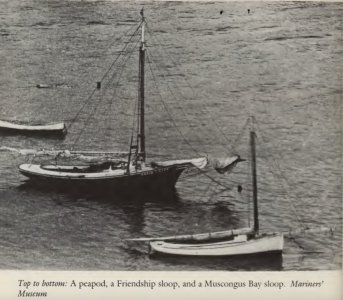
Below: A Friendship Sloop, at center, and a smaller vessel identified as a Muscongus Bay Sloop, at bottom.
Screenshot_20260306_210637_Chrome.jpg
Source: Duncan, Coastal Maine, p. 430.

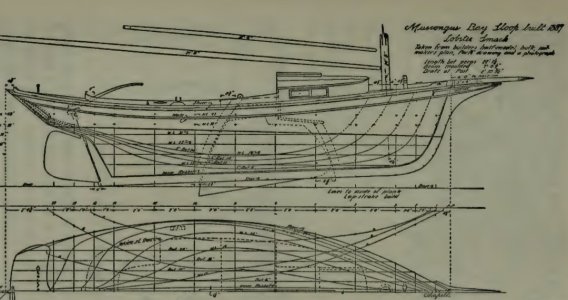
The late 1800s and early 1900s, then, saw a great variety of small sloops in Muscongus Bay. As the lapstrake centerboard sloop developed into the carvel Friendship Sloop, builders experimented with a variety of styles and design concepts. The Muscongus Bay Sloop is a moving target, sharing some general characteristics but with plenty of different possibilities. Chapelle's plan of a Muscongus Bay Sloop, for instance, which amalgamates several models and hulks, shows a vessel that is essentially a miniature Friendship Sloop with a centerboard (below).
Screenshot_20260306_210746_Chrome.jpg
Source: Chapelle, American Small Sailing Craft, p. 267.

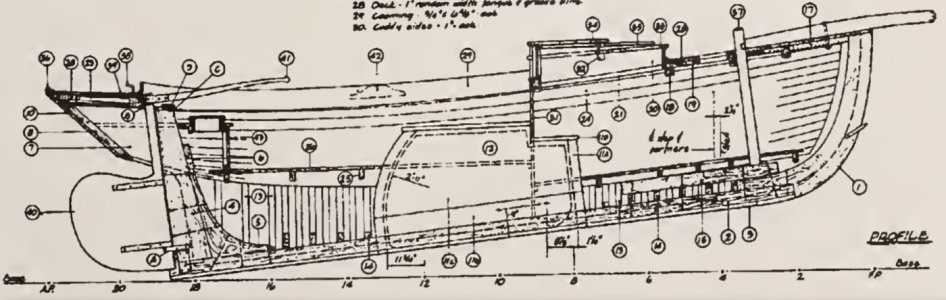
Although he said it was lapstrake planked, some vessels like this (including the hulk he examined) were carvel planked. Other Muscongus Bay centerboarders could look quite different. The Ranger, for instance, was about the same size and carvel planked, but had more drag, included a stayed mast, and lacked the clipper bow (below).
Screenshot_20260306_123617_Chrome.jpg
Source: Ansel, "The Boat as Record," p. 26.

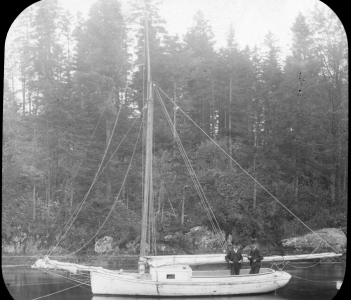
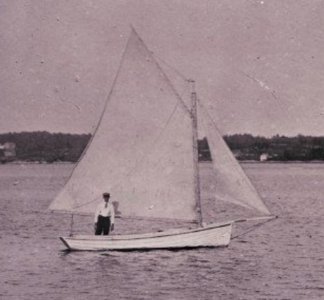
Photos show other designs, as well. The small vessel below has lapstrake planking, a small cuddy, and a vertical stem.
Screenshot_20260306_123725_Chrome.jpg
Source

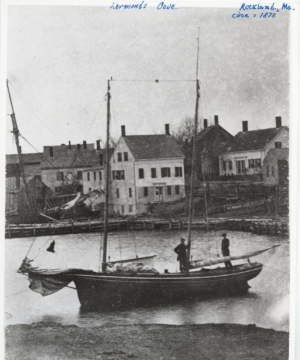
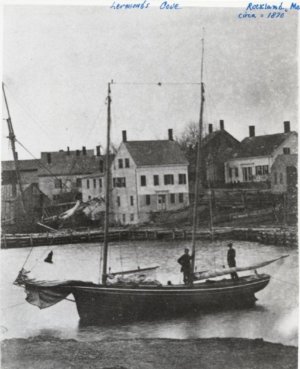
And finally, the vessel below from the 1870s is of a type Chapelle briefly mentions, having a schooner rig on a lapstrake hull that appears to be quite similar to that of the sloops.
Screenshot_20260306_123848_Chrome.jpg
Source

While Chapelle's plan has provided the basis for a lot of understandings of Muscongus Bay Sloops (including of most models), the type was really quite diverse. There was no single vessel type, but a constellation, with individual vessels' build styles probably depending on builder preference, intended use, and possibly local variations.

All of which is to say, there's a lot of room to modify the kit into something a bit different. Of course, not all modifications are equally possible. For example, while it would have been interesting to give my model a plumb bow, as some actual vessels had, doing so would require reshaping the spine and bulkheads so much that it would be easier to build from scratch, so I kept the beakhead (which is certainly a plausible option as well).

This post is already pretty long, so I'll get into the build itself in the next post.
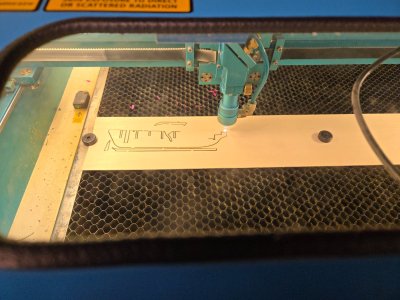
 
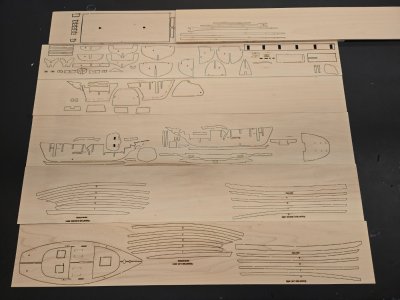
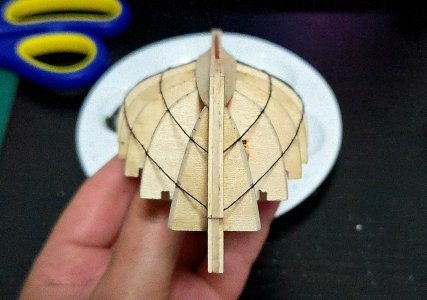
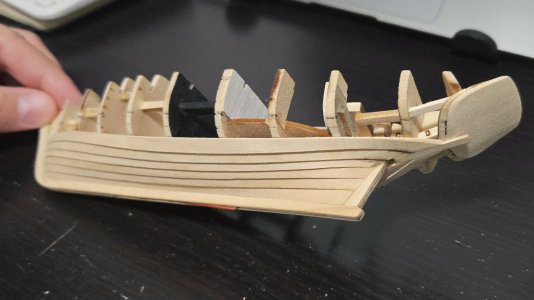
As I mentioned above, I rescaled the model to 1:32 from the kit's 1:24. The smaller model is easier to display and matches most of my other builds. To rescale, I scanned all the part sheets, then transferred them into Lightburn, made necessary corrections, then cut them out on basswood sheets. I used the public library makerspace while visiting family in the US. I had to make some adjustments to wood thickness to take scale into account.
20241204_152848.jpg

20241205_153356.jpg

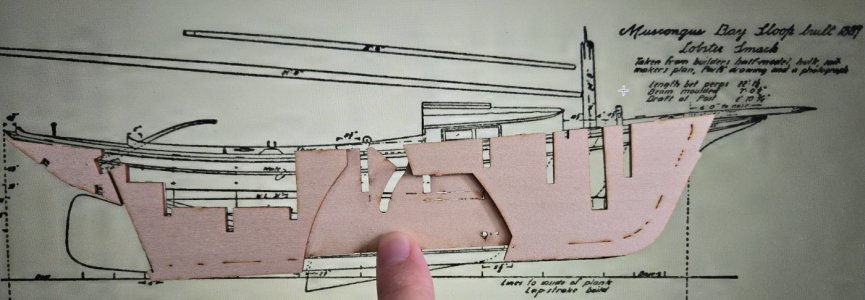
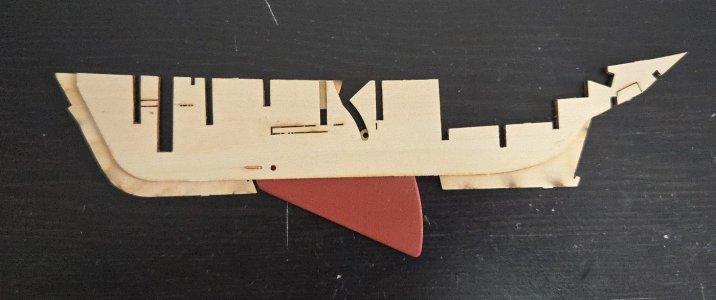
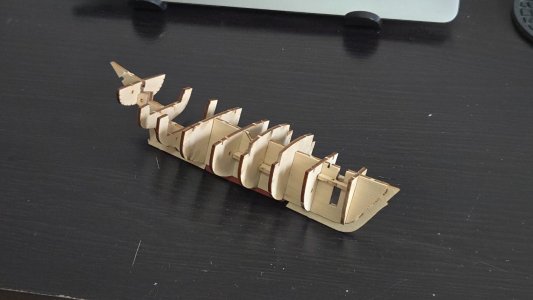
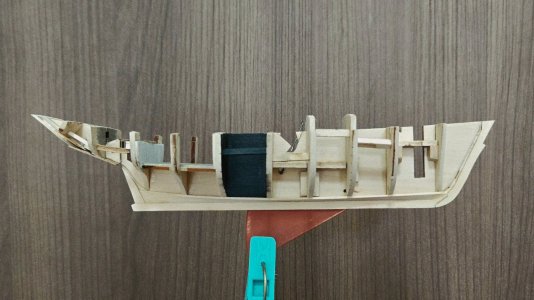
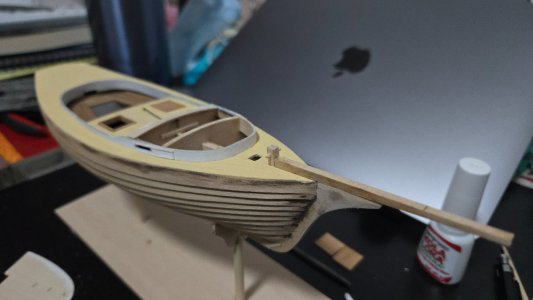
A while after that, I got started with the model. As can be seen, the spine structure matches up pretty well with the Chapelle plans. The main difference is that, while the centerboard case on the Chapelle plans protrudes into the cockpit a bit, the kit design pushes the foreward cockpit bulkhead back a little, simplifying construction. The basic framework came together pretty well, although the notches needed some tweaking.
20250812_131838.jpg

20250812_164556.jpg

20250815_105738.jpg

Below, the 1970s reconstruction of Chapelle's design. You can see the protruding centerboard case.
Screenshot_20250902_150853_Chrome.jpg
Source

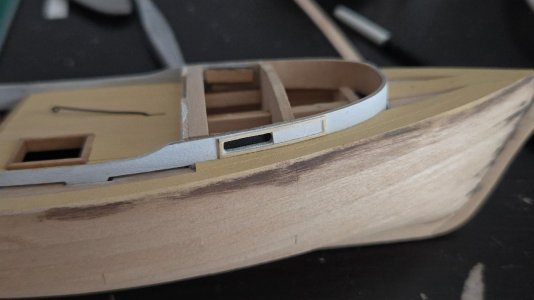
The first modification I made was to the cockpit. Following the example of the Ranger, I dropped the cockpit floor slightly, and also raised the benches a bit (which are very low in the kit design). I planked the cockpit bulkhead, as can be seen below, and made provisions to remove the sides of the cockpit bulkheads after planking in order to add proper-looking framing.
20250902_090242.jpg

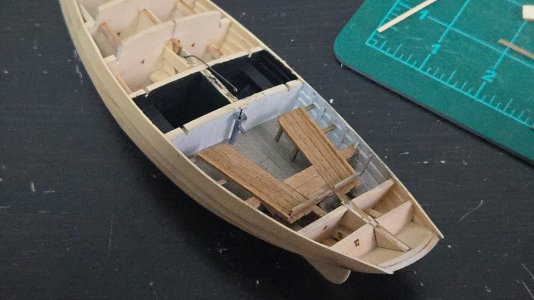
I also planked the floor (going with weathered boards). For the benches, rather than placing them on top of blocks as in the kit, I decided to build them from separate planks with framing holding them in place. I only partially made the benches for now and didn't attach them, as I didn't want them in the way during planking.
20250905_124338.jpg

My cockpit design was inspired by this photo (although it's a somewhat larger Friendship Sloop).
Screenshot_20250902_152303_Chrome.jpg
Source

As the cockpit bulkheads needed to be removeable, I couldn't glue the deck in place before planking. Instead, I added supports between bulkheads. I also painted the fish well areas black, as I planned on leaving one fish well partially opened. For the garboard, I used the kit-designed spiled plank, but I trimmed the top edge to get a somewhat different shape.
20251006_101929.jpg

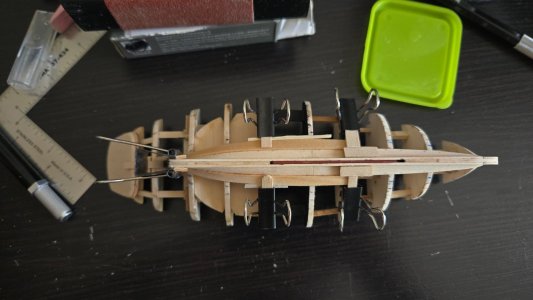
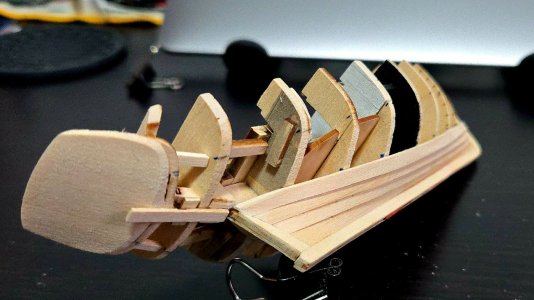
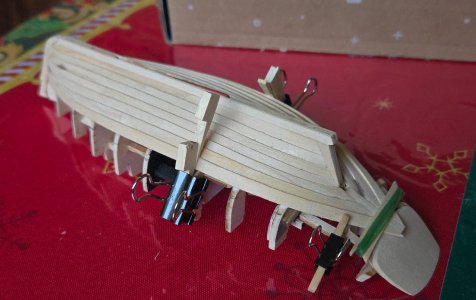
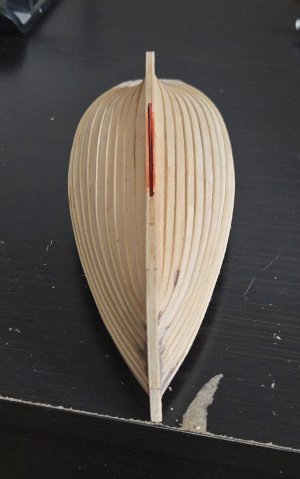
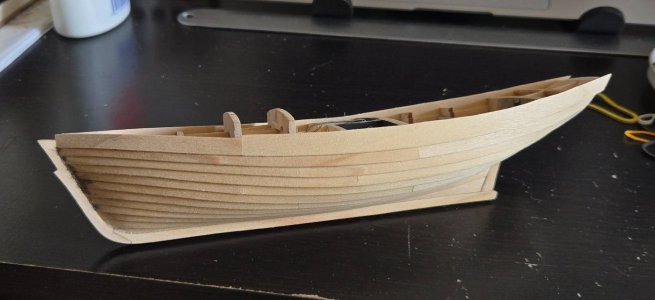
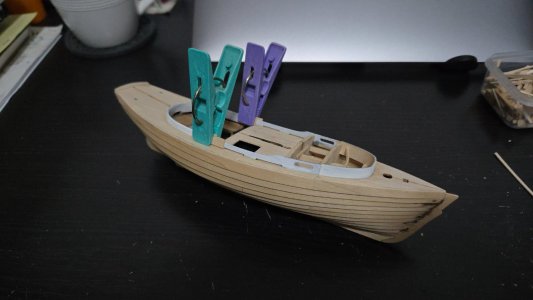
The biggest difference between my build and the kit is the hull planking. The kit provides spiled planks, which is a great way to help beginners understand planking concepts. However, following the examples given in many of the sources mentioned previously, I wanted to use lapstrake planking. This meant that I ultimately wasn't able to use the kit planks--in hindsight, I should have saved the wood and not laser-cut them. I took a lot of care while lining out the hull, especially as the overhanging stern is a challenging shape to plank.
20251015_222118.jpg

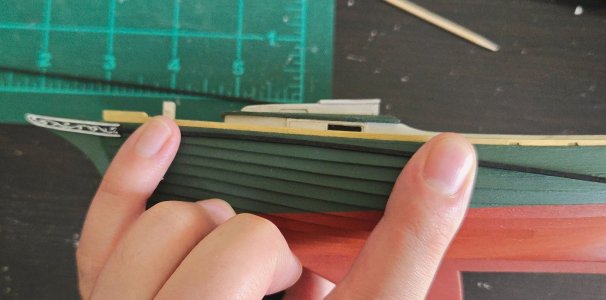
To plank, I marked out the overlap on the lower plank, sanded the lands with a small sander (the width of a plank, with sandpaper only on one side), then marked out the shape with tape to cut the wood to size. I then soaked and clamped in place to get the right curve and twist.
20251017_092608.jpg

20251026_175459.jpg

20251113_185120.jpg

20251226_091322.jpg

I was really pleased with how the lapstrake planking came out. It had its own challenges, especially around the stern, but it wasn't much harder than carvel planking. If anything, it may have been slightly easier because the planks overlap, meaning that I didn't have to do a really precise butt joint between them.
20260118_160957.jpg

20260125_143634.jpg

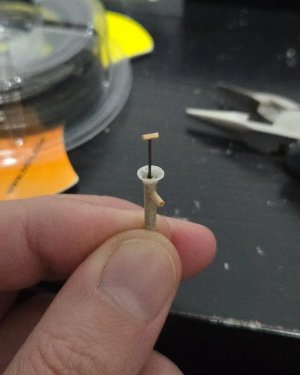
I also added a small bilge pump to the cockpit, drawing on some simple examples. I made it from a toothpick, card, and a bit of wire, painted to resemble galvanized metal. It's just temporarily fitted, as it's pretty fragile, so I'll be leaving it off for a while.
20260124_003953.jpg

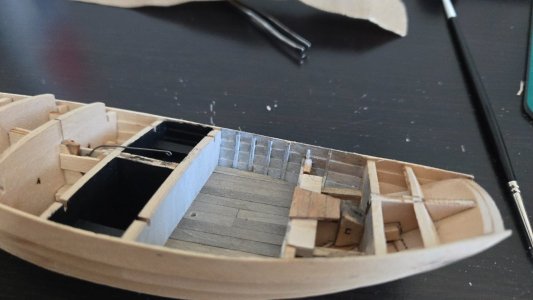
With planking finished, I was able to remove the cockpit bulkhead tabs and add more accurate-looking frames made from scrap. Once that was complete, I could finish the benches.
20260127_085942.jpg

20260127_174301.jpg

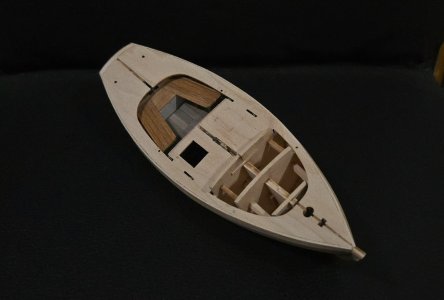
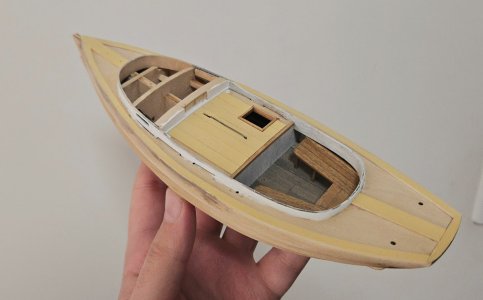
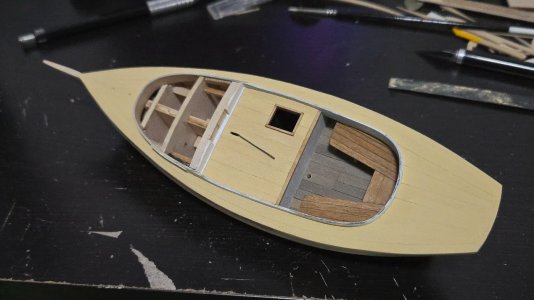
The kit deck didn't quite fit properly, due to the modifications I had made, leaving a gap in the center. As I planned on planking it, I was fine with this. I also opened up one of the fish well hatches--the other will be closed, so no need to model more than the hatch on it.
20260215_221145.jpg

The coamings were a real challenge. I ended up cutting off the forward portion of the coaming and replacing it with a strip with the grain running vertically, making it much easier to curve.
20260219_215025.jpg

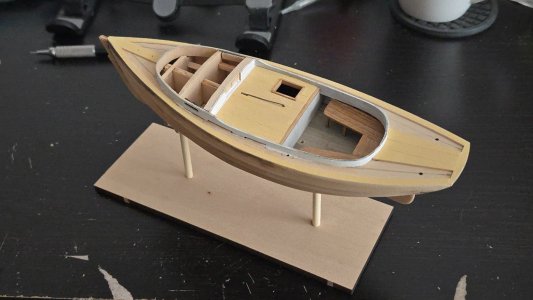
I then began adding deck planks. To avoid getting paint on the coaming, I'm painting each plank individually before gluing (then lightly sanding/scraping the joint afterward and touching up the paint job). I'm not really sure how accurate my deck plank layout is. It's a very challenging shape to plank due to the large coaming in the middle. The only clear photo I could find was of a yacht from the 1970s which used a lot of narrow curved strips for the deck, but that struck me as excessively complex for a simple fishing boat from 100 years prior. So, I started with king planks and covering boards. From there, I'm laying out the planks with an eye to avoiding really thin slivers, which would be very difficult to nail down, and minimizing the number of seams to caulk. This has resulted in nearly every plank being irregularly-shaped, which would certainly drive up the price, but the actual decked area is pretty small, so this might be acceptable. As can be seen, I also framed the open fish well hatch.
20260228_091559.jpg

20260306_094823.jpg

So, that's the current state of the model. This has been a very informative and fun build so far, and I'm looking forward to continuing.
 
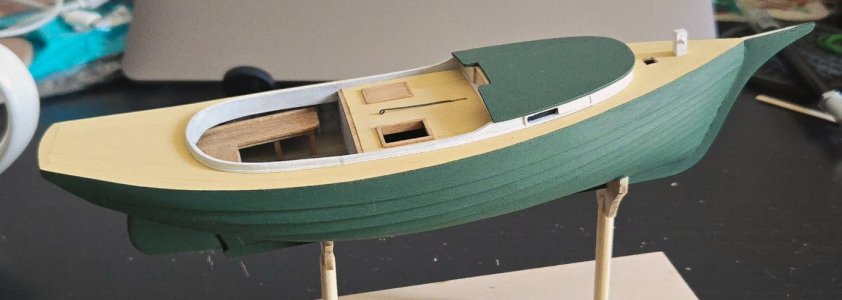
I've made a bit more progress on this build. I was able to finish up the deck planking, add the dummy port fish hatch framework (which will be covered by the hatch itself), and add window covers, among other parts.
20260310_224326.jpg

20260307_095549.jpg

20260308_223028.jpg

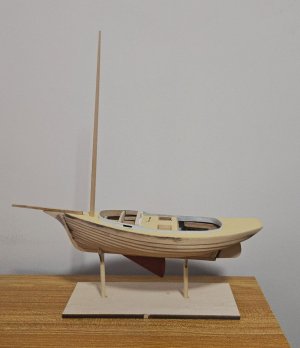
With the mast dry-fit:
20260310_172504.jpg

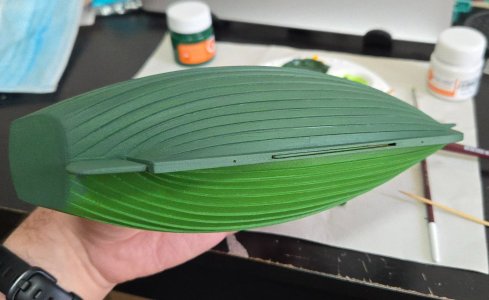
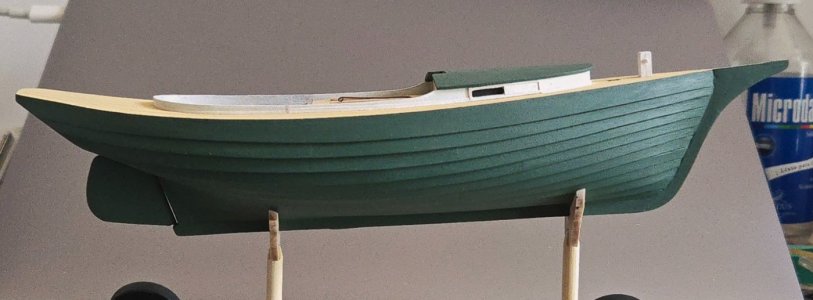
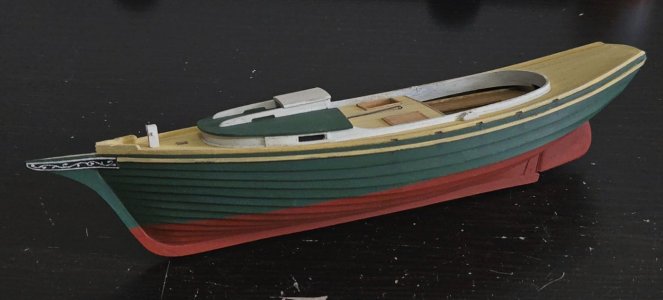
I started painting the hull a light green color, but decided it was too vibrant, so I repainted the hull a darker green. Below, the contrast between the two shades is clear.
20260318_093035.jpg

I've also added the cuddy roof. So far, I'm happy with how it's turning out, although I really need to weather the model a bit (so far only the cockpit is weathered). Right now it looks too yacht-like.
20260319_130827.jpg

20260319_130811.jpg
 
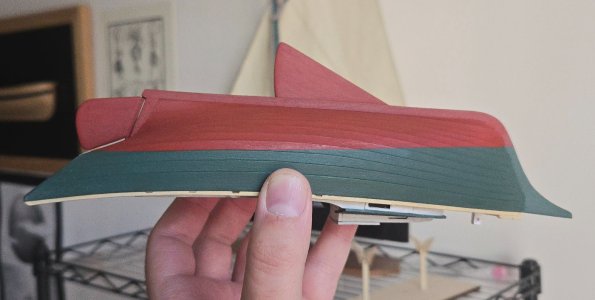
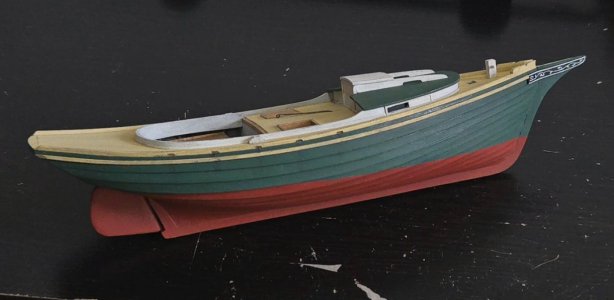
Not much to report, but I painted below the waterline. Due to the overlapping strakes, I wasn't able to use masking tape. I tried cutting it into wedges to fit properly, but it was extremely slow, and I realized that the narrow, tapered tips were 1) really hard to get straight, and 2) would barely provide coverage at the end. So, instead, I freehanded it. I used my usual brush to get up to just below the waterline, then I used a very tiny detail brush and a magnifying loupe to carefully paint the waterline, little by little. I regularly looked down the length of the hull to make sure it looked straight. In the image below, it's nearly there, just a little more to touch up.
20260330_083642.jpg

The red really makes the hull pop.
20260331_092910.jpg

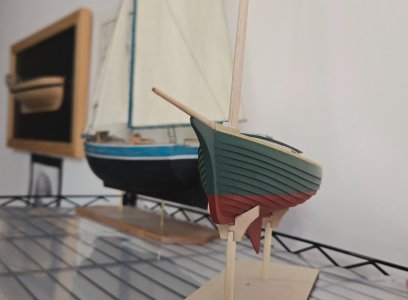
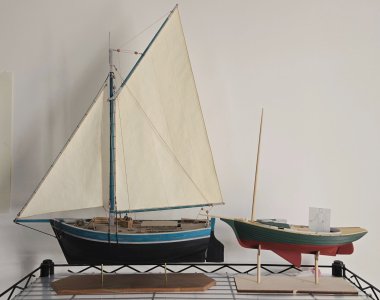
Anyway, here's the Lobster Smack (with a scale figure in the cockpit) alongside my Lancha Chilota scratchbuild in the same scale. Although broadly similar sloops, the differences in hull form and mast height are notable.
20260331_092837.jpg
 
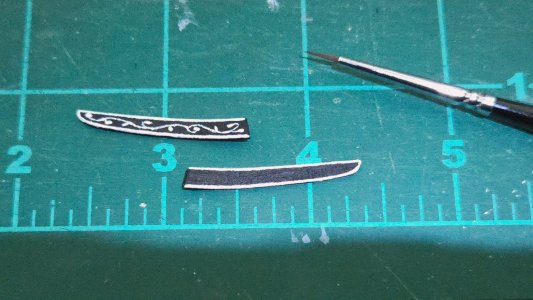
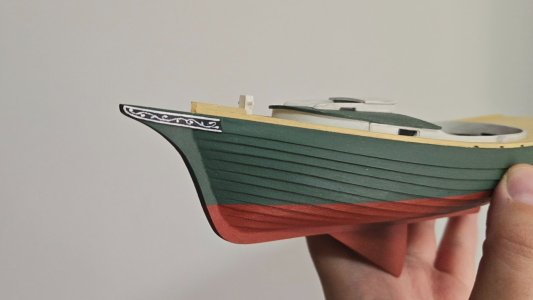
Next up, I painted the trailboards, borrowing a design I saw in some photos (although a few leaves ended up reversed). Getting them even on both sides was tricky and I had to do a few redos. I used my smallest brush and a magnifying loupe.
20260414_225218.jpg

They really add a nice touch to the model.
20260415_113652.jpg

Next, the rub rail. I initially was thinking of doing this in black, in continuity with the trailboards.
20260415_113818.jpg

But I wasn't thrilled with the look. I had been concerned that using the same cream color as the toe rail would be too jarring a transition from the trailboards, but it ended up looking all right. I then began weathering the hull: sanding some edges here and there, applying dark and light acrylic washes, and dry-brushing stains below the scuppers.
20260416_124424.jpg

20260416_124521.jpg

Still a ways to go, but I'm pleased with how it's coming along.
 
Stovepipe Design:
One tricky question had to do with the stove pipe (which @Kenchington at MSW helpfully clarified was termed a “Charlie Noble”). What design to follow? As shown below, I took a rather circuitous path and could have been much more efficient in my research, but I ended up finding a good model to follow.

When I first looked through my folder of images, not much seemed useful—where the pipes appeared, they were often very blurry or a kind of indistinct shape. The image below, for instance, from 1890: how exactly to read that? And why does it look so different from most other pipes I’ve seen elsewhere?
Screenshot 2026-04-27 at 9.42.52 AM.png
Source

While in the image below, it’s obviously a rather taller structure, but none of the details are really visible.
Screenshot 2026-04-27 at 10.34.03 AM.png
Source

The construction drawing of the sloop Ranger and Chapelle’s plans for a Muscongus Bay Sloop and Friendship Sloop didn’t show anything either, other than Chapelle’s Friendship Sloop noting that the stovepipe would be on the starboard side. So, I began to look elsewhere in Chapelle’s work. First, his American Fishing Schooners does include a few drawings on page 622 (shown below), but being intended for much larger vessels, the sizes seemed a bit excessive to me. Some aspects of the drawings were a bit confusing to me, as well, and the textual description on the following page was very brief.
Screenshot 2026-04-27 at 9.01.35 AM.png
Source: Howard I. Chapelle, The American Fishing Schooners, 1825-1935 (1973), p. 622.

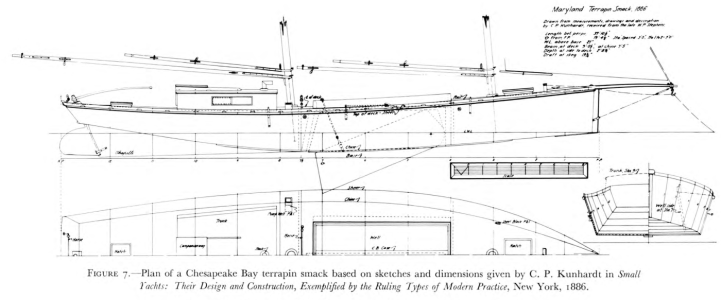
Poking around a bit more, I found two different types of stovepipes depicted in the plans of sharpies in The Migrations of an American Boat Type, from around the same period as the vessel I’m modeling (although much further south). This 1886 Chesapeake Bay terrapin smack, for instance, has a simple 90-degree angled stack on the aft cabin.
Screenshot 2026-04-27 at 9.04.10 AM.png
Source: Howard I. Chapelle, The Migrations of an American Boat Type (1961), p. 142.

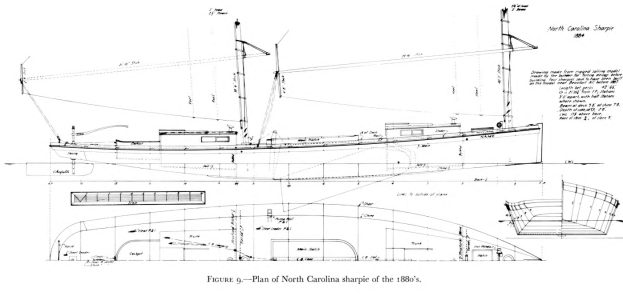
While the 1884 North Carolina Sharpie has a rather different design, apparently with a sort of pivoting half-tube placed over the top of the stovepipe (on both cabins). Notably, this same stovepipe design shows up in Chapelle’s drawing of a catboat on p. 253 of American Small Sailing Craft, as well.
Screenshot 2026-04-27 at 9.04.46 AM.png
Source: Howard I. Chapelle, The Migrations of an American Boat Type (1961), p. 143.

It’s worth noting here that Chapelle has often been accused of occasionally filling in details in his plans when his sources were unclear or conflicting on certain points. The plan above apparently was developed from a rigged sailing model, and I have no idea whether it included the stovepipes or those are an addition by Chapelle. That said, it seems like there were relatively few designs used for stovepipes, and his additions can be thought of as plausible possibilities here.

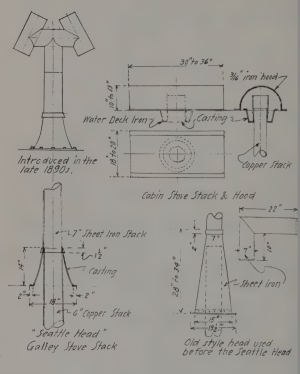
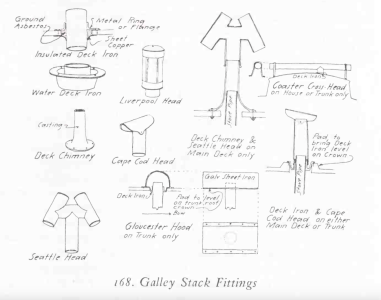
The clearest and most helpful description was actually in Chapelle’s Boatbuilding. Here he shows a large number of stovepipe designs with labels, and the accompanying text (p. 534-536) is fairly detailed and relatively clear, although it does make me realize that there’s a lot about how coal/wood-fired stoves work that I don’t fully get. As he notes, the chief difficulty has to do with installing the stove such as to get a proper draft, which is especially difficult in sailing vessels where the stack height usually can’t be simply increased. He states that the cylindrical Liverpool Head is not really suited for sailing vessels, which often use the Seattle Head, the pivoting Cape Cod Head, or other designs. He also discusses the stepping of the stack on a Water Deck Iron to prevent water from entering.
Screenshot 2026-04-27 at 9.11.16 AM.png
Source: Howard I. Chapelle, Boatbuilding (1969), p. 535.

So, armed with a better understanding of the different stovepipe types, I decided to take a closer look at photos of Muscongus Bay and Friendship Sloops to see if I could better identify what they used. I also realized that I had several links to images in my “image list” document that I had not screenshotted, and so did not have in my file. One interesting image was of this model of a Friendship Sloop. It shows an interesting arrangement with a single center-located fish hatch and a stove on the port side, using a Seattle Head. The model is also interesting in showing a bilge pump coming up to the port side of the cockpit coaming, as well as showing an anchor at the bow. The boom also appears to have lazyjacks fitted. The stove is interesting, but the Seattle Head looks a bit bulky for my liking.
Screenshot 2026-04-27 at 10.55.33 AM.png
Source

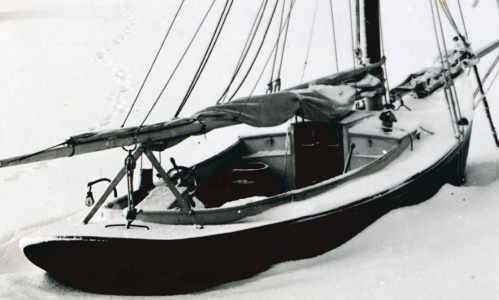
This photo, dated to 1918, is also interesting, showing a number of vessels in an iced-over harbor. Unfortunately, I can’t quite figure out what’s going on with the stovepipe (which is on the starboard side of the cuddy roof). It doesn’t really look like any of the designs Chapelle showed, and looks a bit haphazard—perhaps it was damaged, or this is some sort of temporary winter covering? I’m not really sure what to make of it, other than that the stovepipe does indeed appear a bit wider than I would have expected.
Screenshot 2026-04-27 at 9.38.23 AM.png
Source

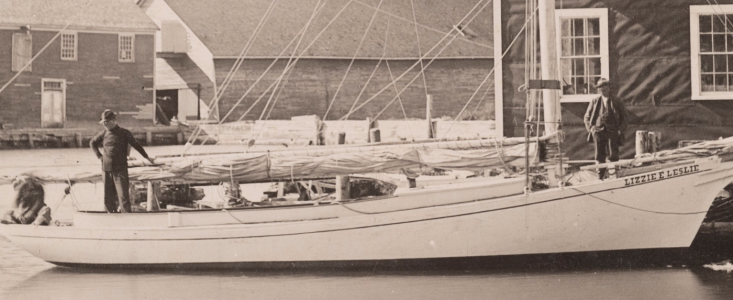
Thankfully, I was able to find a clearer image elsewhere. This photo of the Morse-built Friendship Sloop Lizzie E. Leslie quite clearly shows a pivoting Cape Cod Head on a fairly short stack coming out of a thin pad on the cabin roof.
Screenshot 2026-04-27 at 9.37.19 AM.png
Source

As a result, I think I can make the following conclusions:
  • The stovepipe should be a bit wider in diameter than I had realized—for some reason I had thought that a pretty thin one would work, but I suppose proper drafting and venting purposes requires a wider one.
  • Muscongus Bay and Friendship Sloops seem to have employed a wide range of stovepipe types, rather than fixing on a single type, reflecting the wide range of stove types available on the market.
  • Given this, I think that a Cape Cod Head-style pipe, as fitted on the Friendship Sloop Lizzie E. Leslie and shown in Chapelle’s 1884 North Carolina Sharpie plan, is a perfectly reasonable option for my model.
  • Although taking screenshots of all the relevant images I come across to collect in my research folder does take a lot longer than simply including links, it’s worth it because it makes it far easier to find images with specific details later on.
 
I had started this build log on MSW, and unfortunately did not make a backup before the site went under. Quite a lot of useful information and unique builds over there now gone, what a loss for the hobby! (Whatever your views on moderation policies).

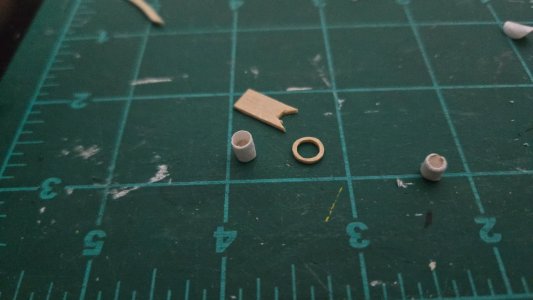
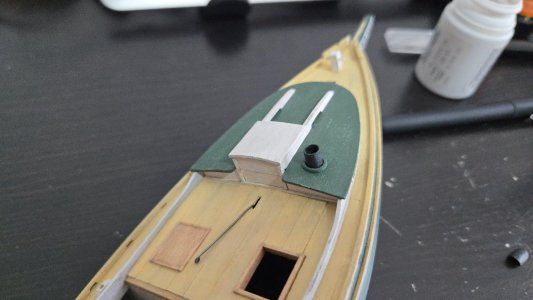
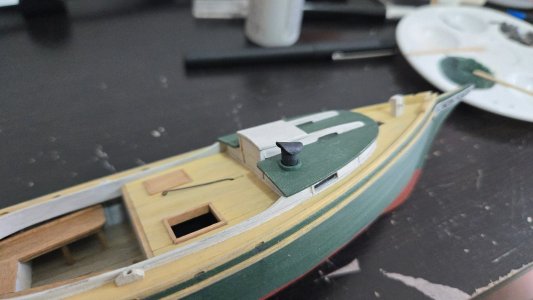
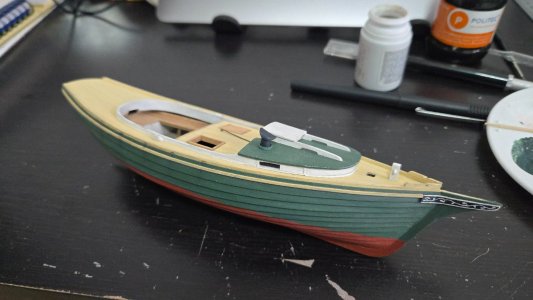
Anyway, the stovepipe, or "Charlie Noble." I knew I wanted to model a Cape Cod-style head. I don't particularly enjoy working with metal, so I decided to make it from card and wood. I started by making a card cylinder extending off a short length of dowel, the bottom of which I beveled to match the curve of the cuddy roof. To make the pad for the water deck iron, I decided to make a thin wooden ring slightly wider than the cylinder. This way, there would be a tiny gap between the stove pipe and the cylinder, as shown in the Chapelle drawings in the previous post, which I could paint black to represent the water deck iron. The pad ring was a real challenge. I ultimately soaked a bit of basswood in super glue and let it dry before drilling out the hole and then cutting off the excess to make a ring. Unfortunately I forgot to take photos until it was nearly finished, but below you can see the cylinder, the ring (nearly finished), and the chunk of scrap it was cut from. Also a failed first try at the cylinder at right (I should note that my first two tries at the ring both failed too).
20260427_235954.jpg

I then painted the cylinder a greyish black, made by mixing black, white, and vallejo gunmetal acrylics. I made the cap by curving a circle of card and painted it the same. I then painted the ring to match the hull/cuddy roof, and black on the interior. Next I glued the ring in place, added a bit of black paint where the cuddy roof would be visible, and glued the stovepipe cylinder in place.
20260502_121338.jpg

Finally, I glued the cap in place.
20260502_121856.jpg

I think the results capture the somewhat chunky look of many of the stovepipes in the photos in the previous post.
20260502_121909.jpg
 
Thanks, glad to see you are continuing your build as well!

While I'm glad I have at least partial build logs for a couple builds here, I have to admit that the prospect of remaking my previous logs, here and at a revived MSW, is pretty daunting and I'm not really sure when I'll get to it.
 
I know, I feel your pain. I think for now, I will simply upload the old pictures I have saved. As for the text it's long gone. Posts can always be edited down the road to add text back, but I doubt I would ever go that far. I was only able to salvage page 1 of my pram build, not much, but not a total loss at least.
For what it's worth, I did a search on internet archive and managed to bring up the first page of 7 of your builds (so almost all of them). It's not much, but I hope it helps at least reduce the loss a little. I will DM you the links.
 
Very nice work and an interesting take on this subject! I agree with your design of the stove stack. Murphy is alive and well at sea and lines like mainsheets can and will snag on anything close by. A mainsheet snagging on an obstruction while tacking could easily knock over a centerboard craft like this.

Roger
 
I know, I feel your pain. I think for now, I will simply upload the old pictures I have saved. As for the text it's long gone. Posts can always be edited down the road to add text back, but I doubt I would ever go that far. I was only able to salvage page 1 of my pram build, not much, but not a total loss at least.
For what it's worth, I did a search on internet archive and managed to bring up the first page of 7 of your builds (so almost all of them). It's not much, but I hope it helps at least reduce the loss a little. I will DM you the links.
Thanks so much! Fortunately I have pdfs up until last June, but as I just did "print-save as pdf," they're not really in a format that's easy to copy from.

Very nice work and an interesting take on this subject! I agree with your design of the stove stack. Murphy is alive and well at sea and lines like mainsheets can and will snag on anything close by. A mainsheet snagging on an obstruction while tacking could easily knock over a centerboard craft like this.

Roger
Thanks! I think it's pretty nice as far as kits go, and really lends itself to some modifications, as there was such a variety of broadly similar but distinct vessels within this type. I agree that a simple smokestack makes sense for a vessel like this.
 
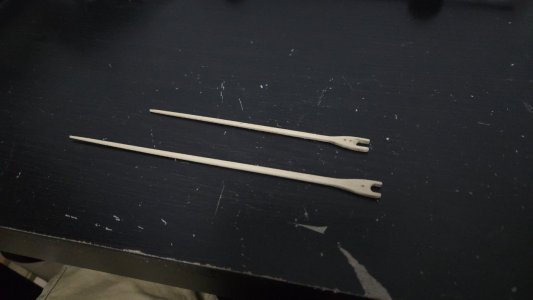
Next up, I rounded off and shaped the gaff and boom. This was pretty straightforward, the only tricky part was that the jaws keep you from getting the plane all the way at the fore end so those areas have to be only sanded. (Well, I suppose I could have used an exacto knife, but I find the plane much easier to control to avoid slipups.)
20260510_210412.jpg
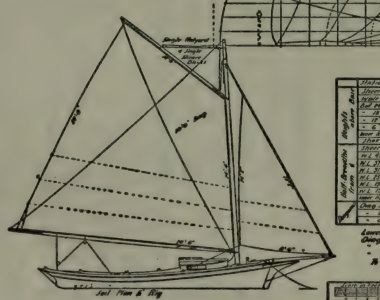
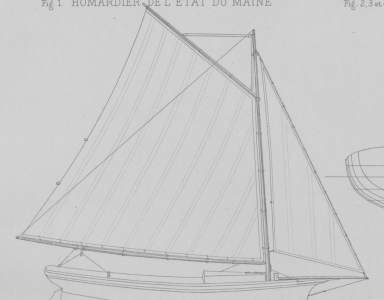
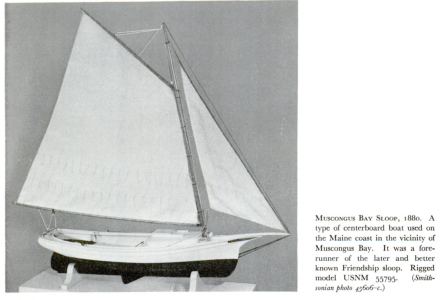
Before I start adding fittings to the mast, gaff, boom, and bowsprit, I need to work out the rigging. The kit has a pretty simple setup of one peak halyard and one throat halyard, each running through two single blocks. This is a perfectly workable arrangement, but it may not be totally accurate. According to Chapelle, “the gaff was hoisted by a single halyard quite different in reeving than has been seen elsewhere” (Chapelle, American Small Sailing Craft, 266-268). His rigging plan is developed from the drawing included in Pâris’s Souvenirs de Marine, and shows a single halyard running through four single blocks.

Below, Chapelle’s rigging plan:
Screen Shot 2025-04-17 at 2.24.50 PM.png
Source: Chapelle, American Small Sailing Craft, 267.

Some details of the rig are maybe a bit clearer in the sail plan from Pâris, although some aspects are a little different:
Screen Shot 2025-04-16 at 4.54.11 PM.png
Source: Pâris, Souvenirs de Marine, Vol. 5, plate 244.

And, finally, a photo of an 1880-ish model in Chapelle’s The National Watercraft Collection, which looks pretty similar to the Pâris (and Chapelle) plan.
Screen Shot 2025-04-16 at 5.18.43 PM.png
Source: Chapelle, The National Watercraft Collection, 254.

Besides the single halyard, these sources also differ from the kit design in showing the boom attached with a gooseneck rather than jaws (and hence not having the associated boom rest), and in lacking stays.

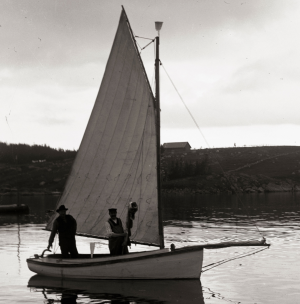
So, these three sources combined should provide a pretty accurate representation of how these things were rigged, right? Well, not necessarily. As has been the case for other aspects of these vessels, there seems to have been some variation in practice. Some of this variation, it must be said, may be due to the difficulty in distinguishing between a Muscongus Bay Centerboard Sloop and a small Friendship Sloop in photos, as they could look nearly identical above the water, but some small vessels (presumably centerboarders) also show variations.

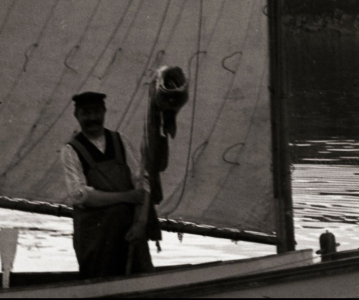
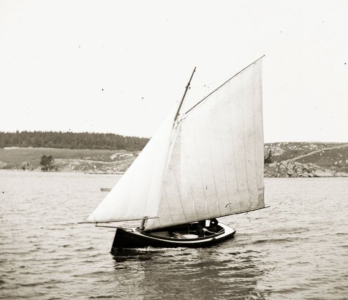
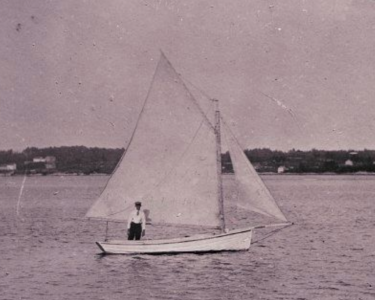
First up, let’s look at this sloop. I can’t be certain if it has a centerboard, but it has a plumb bow and lacks stays and a cuddy, and is clearly pretty small. Also, it seems like the Penobscot Marine Museum uploaded a higher quality image since the last time I checked, which is very nice.
Screenshot 2026-05-10 at 10.07.23 PM.png
Source (for this and subsequent detail images)

First, zooming it, it looks to me like the boom has jaws. You can also see the very thin, presumably metal, mast hoops. Second, at this point I was distracted by the fish that guy’s holding. Seriously, what the heck is that? The mouth is the size of that guy’s head! Look at that thing!
Screenshot 2026-05-10 at 10.01.27 PM.png

Weird fish! I definitely didn't notice it in the blurry version of the photo I saw earlier. Anyway, back to the boat.

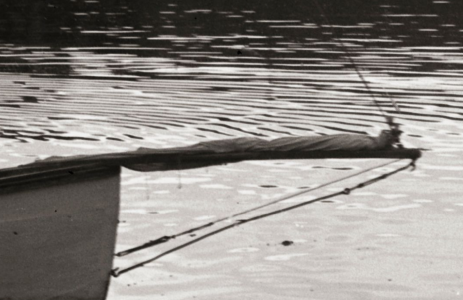
The bowsprit appears to show that the forestay runs through the bowsprit and is fixed to the stem, with a metal rod below further stabilizing the bowsprit from upward pressures. At MSW, I think that a poster named Kenchington, who was also building this kit, noticed something similar and was going to incorporate it into his build (which I hope is going well!).
Screenshot 2026-05-10 at 10.06.42 PM.png

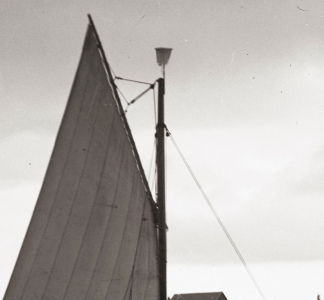
There’s what may be a weathervane at the masthead? The halyard arrangement is a bit different than that given by Pâris and Chapelle. Instead of the halyard originating from the upper mast block and running through four single blocks before being tied off, here it starts at the gaff itself, runs through a double block at the masthead, then to a single block on the gaff, back through the double block, and from there… it’s a bit unclear. It may run through another single block at the gaff throat, then another single block on the mast, and from there down to be tied off. Or, it may indeed have separate throat and peak halyards. The tie-off locations are also unclear.
Screenshot 2026-05-10 at 10.06.08 PM.png

What about other small sloops? The Secret also has a very different halyard arrangement. Although again it’s tricky to say definitively, it looks like there may be a single halyard, but I can’t tell if it originates at the top of the mast, or if it originates on a block and passes through a sheave at the masthead before going down to be tied off. The foresail is also interesting, being mounted on a pivoting boom attached to the bowsprit.
Screen Shot 2025-09-24 at 11.13.15 PM.png
Source

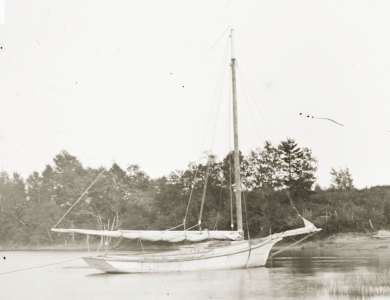
Below, I’ve shared an image of not a sloop, but a schooner. It’s a small lapstrake-planked schooner from around 1870, of the type that Chapelle describes as being very similar in design to the Muscongus Bay sloops. It’s hard to see all the details of the rigging, but it seems plausible to me that the foremast gaff is rigged similar to in the Chapelle and Pâris plans. The blocks at least all look the same size, none obviously stand out to me as double blocks.
Screen Shot 2025-04-16 at 9.01.34 PM.png
Source

Looking at larger vessels, some of which are likely Friendship Sloops instead of centerboarders, this one quite clearly has two double blocks at the masthead, and I think it has separate peak and throat halyards. I can’t figure out where the peak halyard line is tied off at, though. Also notable is that the topping lift appears to be a single line running from the tip of the boom to a metal hook at the masthead.
Screenshot 2026-03-20 at 8.56.12 AM.png
Source

This interesting sloop from the 1890s also appears to have separate throat and peak halyards, as well as the hook for the topping lift. It also has a much more complex arrangement for the foresails, as well as a topmast.
Screenshot 2026-03-20 at 9.06.32 AM.png
Source

Finally, going back to a smaller boat: much of the rigging it too blurry to really distinguish, but it does look to me, at least from the angle, that the topping left is also set on a hook at the masthead.
Screen Shot 2025-09-24 at 11.00.52 PM.png
Source

Considering the different options that I’m seeing here, I ultimately think that I’ll go with something like the Chapelle/Pâris plans, but with jaws on the boom instead of a gooseneck, the forestay running through the bowsprit all the way to the stem, and the topping lift set on a sort of hook at the masthead. I think that, as with so many other aspects of these vessels, there was a lot of variation in practice in how they were rigged, and the rigging for the larger Friendship Sloops—for which there is a lot more clear photographic evidence—doesn’t necessarily translate to the smaller centerboarders. Although I haven’t found clear photos definitively showing the same arrangement as in Chapelle and Pâris’s rigging diagram, I don’t think they’re wrong—their plans and the related model are valid evidence—but I do think that what they depict was one arrangement out of many. So, I think that the choices I’m planning on making are valid. At the same time, they’re also a little different from what I’ve done before, which will add interest for me—after all, the last model I finished was also a small gaff sloop, so it’s a nice bonus to change some things up.
 
One issue I have with the build so far is the centerboard pull rod. At the moment, it's just a wire sticking out of a small opening in the deck. A better way to handle it would be with a chain or rope, but it's too late to go that route, as I'd have to open up the deck. Plus, having a solid rod helps with extending the centerboard, which otherwise would be stuck in the up position due to friction.

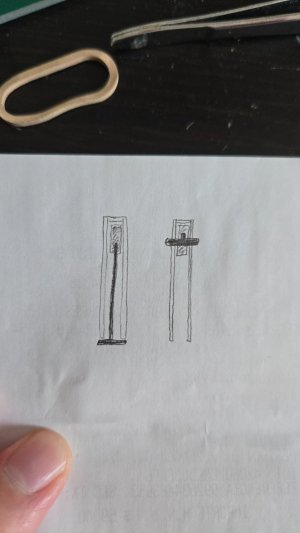
So, I was trying to think of ways to deal with this, and finding little to nothing useful in photos. It struck me that a bit of a frame around the centerboard rod might be an acceptable way to handle this--maybe not the most typical arrangement, but better than the current situation. I tested the idea of painting this frame on the plank and rejected it, so instead my idea is a frame that is low but just above deck. Below, a quick sketch of the top-down view. In the raised position, at left, the pull rod handle is against the open aft end of the frame, holding it in place. When lowered, the handle slides forward over the frame to the opening.
20260513_111405.jpg

I've begun making the parts. Of course, they would be properly parallel, and I still need to add the handle to the pull rod (and the frame piece at the fore end).
20260513_104956.jpg
20260513_104855.jpg

Any thoughts? In hindsight I really should have given this mechanism more attention earlier in the build process. I think this would look better than it currently is, although it isn't the most accurate option.
 
What the heck?!
It's definitely an interesting rig. I am not totally sure when the Secret was built, I seem to remember from when I first saw the photos that it was early 1900s but I can't find that information now. I haven't seen a foresail like that on other Maine vessels, but I think I remember that something like that was in use in the Chesapeake and elsewhere.
 
I added the centerboard rod slides. First, trimmed the rod so it was just barely protruding when extended. Then I added a handle. My first attempt was too small to drill a hole into, so it was just held in place by a blob of superglue. I decided this was too fragile.
20260513_222721.jpg
So I pulled it off and made a thicker one. This time I drilled a hole in the handle, so it's much better secured to the rod.
20260513_225304.jpg
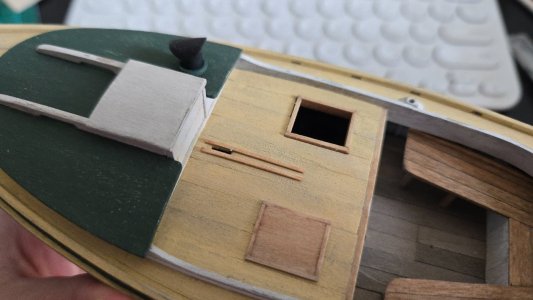
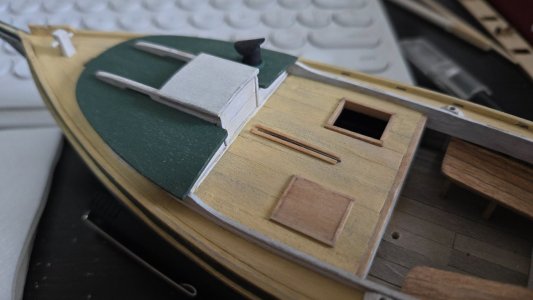
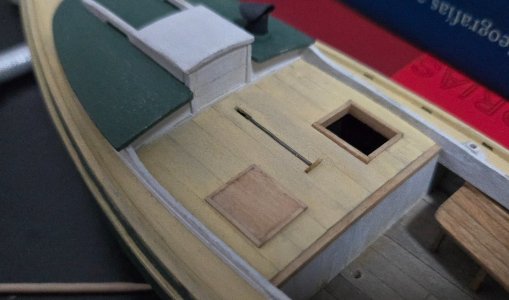
I then glued the case/slides in place, taking care to keep them parallel. Below, photos of the centerboard in the raised and lowered positions, with the pump and fish hatch covers dry-fit.
20260514_120904.jpg

20260514_120842.jpg
 
I added the centerboard rod slides. First, trimmed the rod so it was just barely protruding when extended. Then I added a handle. My first attempt was too small to drill a hole into, so it was just held in place by a blob of superglue. I decided this was too fragile.
View attachment 602966
So I pulled it off and made a thicker one. This time I drilled a hole in the handle, so it's much better secured to the rod.
View attachment 602967
I then glued the case/slides in place, taking care to keep them parallel. Below, photos of the centerboard in the raised and lowered positions, with the pump and fish hatch covers dry-fit.
View attachment 602964

View attachment 602965

Love the weathered look.
 
Love the weathered look.
Thanks! The paint is cheap craft acrylics, with the exception of a bit of vallejo gunmetal on the pump. On a past build, I weathered the deck with successive acrylic washes (highly diluted paint), but the water made the planks shrink and expand a bit, so I wanted to go a different route this time. The cockpit floor was done with successive washes, but each plank was painted separately before gluing. Elsewhere, the weathered effect comes from some dark and light washes, a bit of light, selective sanding with a high grit, and dry-brushing accents and stains. The "natural" wood is nearly all basswood stained with a minwax cherry stain pen, with a dark acrylic wash added.
 
Thanks! The paint is cheap craft acrylics, with the exception of a bit of vallejo gunmetal on the pump. On a past build, I weathered the deck with successive acrylic washes (highly diluted paint), but the water made the planks shrink and expand a bit, so I wanted to go a different route this time. The cockpit floor was done with successive washes, but each plank was painted separately before gluing. Elsewhere, the weathered effect comes from some dark and light washes, a bit of light, selective sanding with a high grit, and dry-brushing accents and stains. The "natural" wood is nearly all basswood stained with a minwax cherry stain pen, with a dark acrylic wash added.
JC - Do you mainly work with basswood? How is the supply of good modeling wood in Mexico City? After this build I am going to stop building with basswood and balsa wood except in emergencies.
 
Back
Top