
• SUBSCRIBE TO SHIPS IN SCALE TODAY!

    The beloved Ships in Scale Magazine is back and charting a new course for 2026!
    Discover new skills, new techniques, and new inspirations in every issue.

    NOTE THAT OUR NEXT ISSUE WILL BE MARCH/APRIL 2026
  • Win a Free Custom Engraved Brass Coin!!!
    As a way to introduce our brass coins to the community, we will raffle off a free coin during the month of August. Follow link ABOVE for instructions for entering.

USF Confederacy 1778 Model Shipways 1:64

Joined
Mar 28, 2026
Messages
16
Points
48

Location
Maryland
Chapter One

Assembling the bulkhead former, keel and stem

I purchased the USF Confederacy kit nearly four years ago. Now that I've gotten a few projects off my desk, I decided it was time to get started. If you've read through any Confederacy build logs, you'll find my comments on the kit likely sound familiar. I welcome critiques of my work as I consider myself a novice at best and appreciate any areas for improvement. The only model I've actually finished was the Bluenose II in 1994, over 30 years ago!

Initial disappointments:
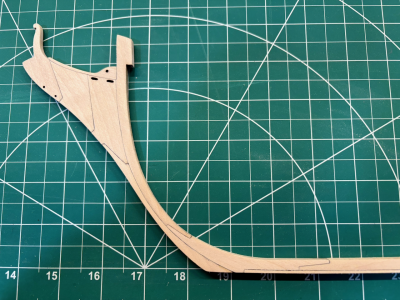
  • The bulkhead former and some of the bulkheads were quite warped. I tried to remove the most egregious warps by steaming and weighting with some success.
  • Many of the laser cut parts (so far) seem to have been cut with the laser not perpendicular to the board's surface. I don't know if this was a slight misalignment of the laser, the boards being slightly warped when cut, debris preventing the board from sitting flat, or something else. I first noticed this when assembling the stem and while the parts fit nicely on one side, the other side revealed large gaps.
  • The curvature of the stem does not match the curve of the bulkhead former.
I completed the stem using wood glue and black tissue paper. I have not applied any stain or sealer yet.

IMG_3649.png

To get the pieces to fit together nicely, I used a table-mounted disk sander on the flat edges and a rotary tool mounted vertically for the curved edges. I laid the pieces flat on the wooden block adjacent to the drum and lightly sanded until the char was nearly gone. This resulted in all of the pieces having flat edges at right angles to their faces. I assembled the stem while temporarily attached to the bulkhead former but removed it and put it aside to keep it from becoming damaged.
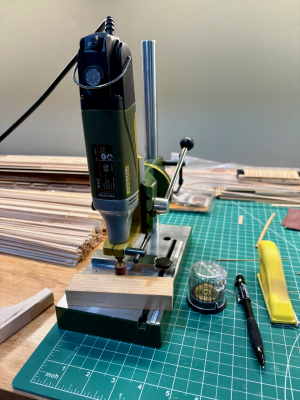
IMG_3651.png

For the scarf joint, I used bamboo. I tried some bamboo skewers but they nearly disintegrated in the draw plate. My best success was from cheap bamboo plant supports. It slices cleanly and makes great tree nails. I used a #69 drill bit for the holes and a draw plate to make the nails. The nails measure 0.70 mm. I drilled all the way through and used eight long nails. The material between the keel pieces and between the keel and false keel is black tissue paper.
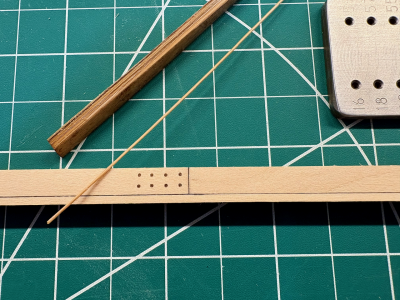
IMG_3650.png

So far I'm enjoying the build. Despite some of the initial material disappointments, the kit is going together nicely.

 
Impressive joinery, Philip. I'll pull up a chair.
Thanks Paul. My first attempt at the stem was dismal due to my not noticing the slightly angled laser cuts. Lesson learned. I requested a replacement part and the second attempt was much better. I very much appreciate Model Shipways' replacement policy!
 
Chapter Two

Bulkheads, Fillers, and Basswood Bow Blocks

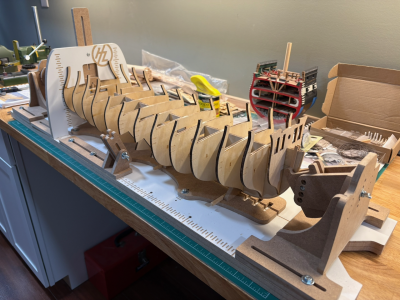
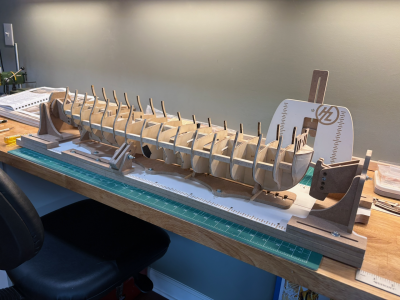
I bought a HobbyZone Professional Building Slip. I was ready to build my own but for $100 including shipping, it was an easier route. Several of the nuts have been replaced with wing nuts from the original design but the functionality remains the same. I also bought an aerosol can of water-based poly to protect the MDF. For me, the slip was well worth the price.

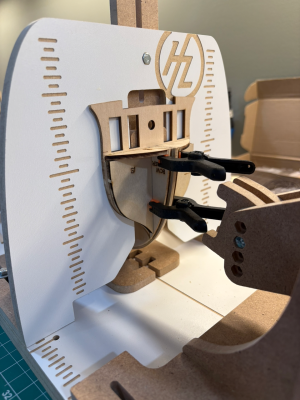
I use thin planks on the fore and aft clamps to keep from deforming the MDF more than necessary. I also used some small square timbers above the keel clamp to raise the bulkhead former enough for the frames clear the clamp (because I removed the stem and keel assembly).

(My neglected USS Constitution cross section model sits in the background until I decide how to address the red paint I thought I would like but didn't.)

IMG_3635.png

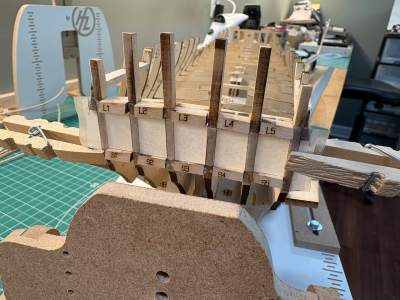
The slip made it easy to check that the frames were square to the bulkhead former.

IMG_3636.png

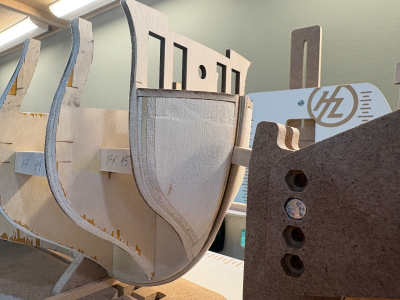
I also added bow fillers because I'm having trouble visualizing the fairing here. I faired the bow leaving the BFDs and aft edge of frame G untouched. I think I'm getting close?

IMG_3662.png

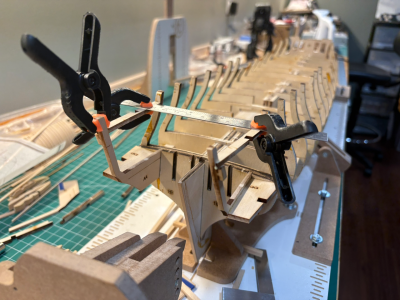
Even with the fillers, the frames still had enough warp that I used some basswood block to cut braces to fit between each of the frames. I started from the bow working back and the stern working forward always measuring from the same point at the bow and stern respectively so there was no accumulating error. Some slight sanding and shimming of the braces and all of the frames' outer edges are now within ~0.5 mm of the frames' center.

I'll remove the temporary braces when the sweep ports go in. Had I given it more thought, I should have just completed the sweep ports now and saved the extra work.

IMG_3660.png
 
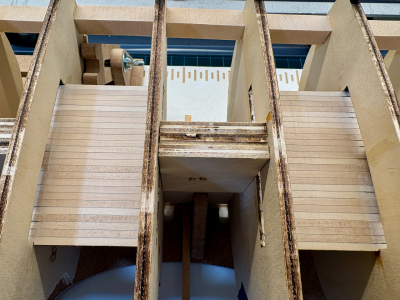
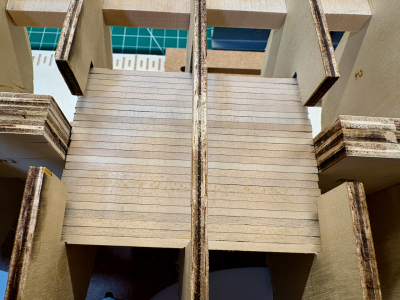
Planking the sub-gun deck platforms

Lower gun decks planked. I didn't notice how differently colored the planks could be (despite Chuck's warning). No stain yet; still considering options. I used black tissue for the caulking.

IMG_3663 11.06.21.png

IMG_3664 11.06.21.png
 
Assembling the ship’s frames for the cut-away

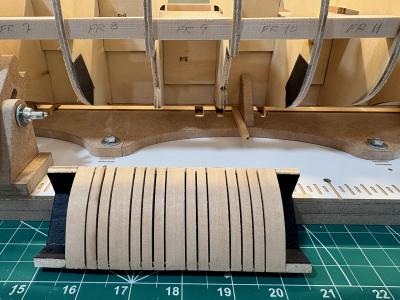
I slightly beveled shadow box parts 30 and 31 to improve their seating against the backing piece. This reduced the amount the frames stood proud of the bulkheads, minimizing fairing work required to bring them flush. After assembly, I removed the unit from the hull and set it aside to prevent damage during subsequent work.

One thing I would do differently is mix up the frames rather than assemble them in order as numbered on the sheet. If you look closely, it almost appears as though it's a single piece of wood with narrow slits cut into it.

IMG_3665.png
 
Chapter Three

Framing the Stern


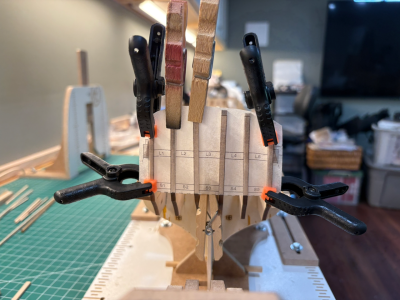
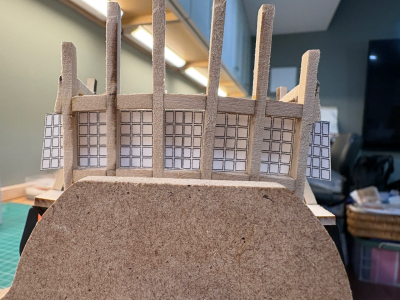
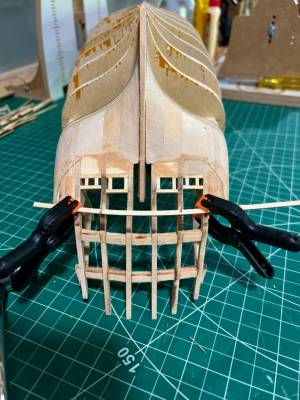
I started the stern construction using a template printed on tracing paper. I used a small machinist's square and metal ruler to ensure frame AA was perpendicular to 8b and HH was perfectly flat.

IMG_3675.png

IMG_3677.png

Although the tracing paper was okay, it would have been better to print the template on heavy cardstock. Once the sills were in position, the lintels could have then been more confidently pushed against the card to build more accurate window openings.

IMG_3678.png

IMG_3681.png
 
Stern ports on the lower counter and filler blocks

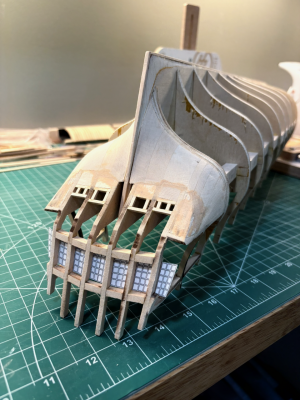
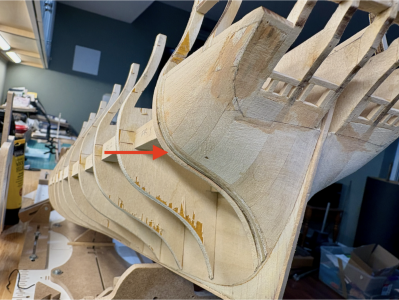
The stern ports were straightforward. I used a scan with tracing paper to verify their locations. The time-consuming part was fairing the stern filler blocks. I have studied numerous builds and reviewed the instructions, but I still find it difficult to visualize the correct fairing for the bow and stern sections. I believe I am close.

All frames appear to be properly faired except frame 8, which looks like it may require a shim from near the keel up to the false deck.

IMG_3690.png

Looking ahead, I loosely positioned a plank along the lower counter and the curvature appears somewhat exaggerated. However, alignment with the surrounding structure looks correct, which suggests the shape may be acceptable.

IMG_3693.png
 
The False Decking

After spending a lot of time fairing the hull (I ended up with two shims, one on either side of
frame eight), I'm calling that exercise completed (for now).

Screenshot 2026-05-09 at 9.32.21 PM.png

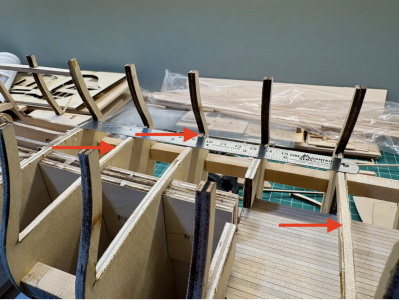
I then faired the tops of the bulkheads and ended up with thin shims spanning 4 and 7, and a shim on one side of 6. The metal ruler does not sit exactly flat as there is a slight rise from around bulkhead 4 to 8.

Screenshot 2026-05-09 at 9.33.04 PM.png

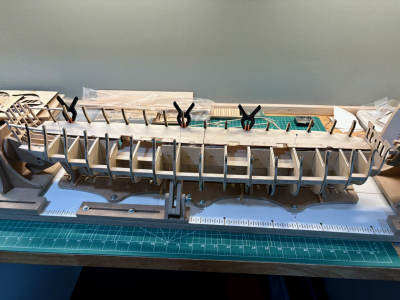
Several notches in the false decking required widening and I trimmed the aft edge of the decking slightly. The decking fits nicely and makes contact with the tops of all of the bulkheads. The false decking is only pinned in place as I want to paint some of the interior black and have to make a decision on finishing the decking below.

IMG_3700.png
 
Back
Top