
• SUBSCRIBE TO SHIPS IN SCALE TODAY!

    The beloved Ships in Scale Magazine is back and charting a new course for 2026!
    Discover new skills, new techniques, and new inspirations in every issue.

    NOTE THAT OUR NEXT ISSUE WILL BE MARCH/APRIL 2026
  • Win a Free Custom Engraved Brass Coin!!!
    As a way to introduce our brass coins to the community, we will raffle off a free coin during the month of August. Follow link ABOVE for instructions for entering.

Muscongus Bay Lobster Smack from Model Shipways by DocTom - Build Log

Post 9 - Chainplates and Cleats

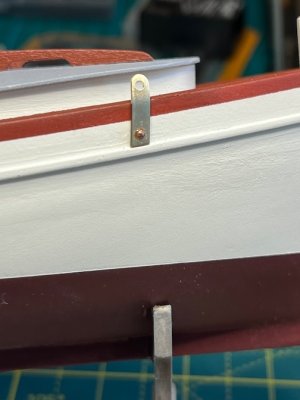
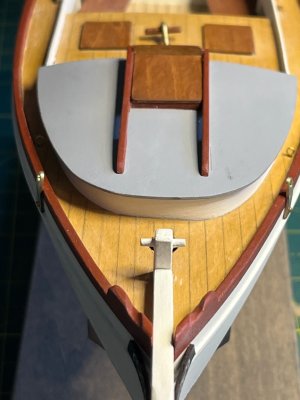
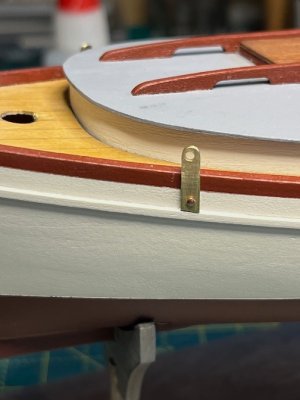
It was a glorious weekend here in New England, so most of my time was spent outside, in the yard or on my real boat. I did manage to make the second chainplate (and center the holes much better) and install them both. I bent them before installing them 2.25" behind the trail boards. I marked and drilled holes using a #70 drill bit, and trimmed the brass nails before inserting them. They are only going through the sheer strake, so are mainly there for show. I used CA glue to attach the chainplates before inserting the nails.
Port chainplate.jpeg Starboard (1).jpeg
Head on.jpeg

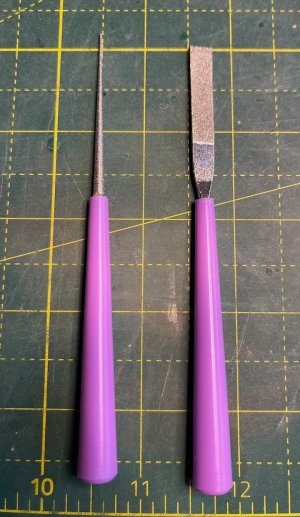
I then cleaned up the cleats using diamond jewelers files. They did a great job. You can get a set of 5 different shapes very cheaply on Amazon.
Jeweler's files.jpeg

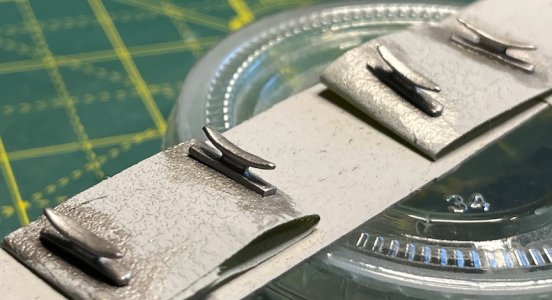
I sprayed them with gray primer, and then painted them with Folkart Metallic Nickel craft paint, hoping to mimic galvanized iron. My research indicated that bronze was also used, but I that seems excessive for a working boat. I understand the iron would eventually turn black, or be coated in tar, but I think of my model as a boat fresh off the "assembly line," as it were. Plus, I like the color.
Painted.jpeg

I used 5 minute epoxy to attach them. I'm glad I did, because it took some fiddling to get them where I thought they should be. I did the bowsprit cleat first, as that seemed easiest.
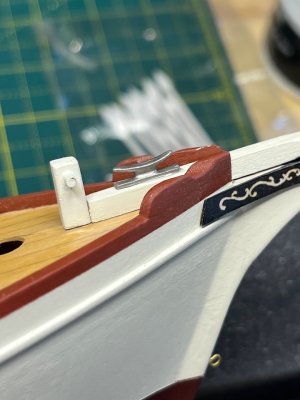
Bowsprit cleat.jpeg

I tried to line the side cockpit cleats with the top of the deck over the wet wells.
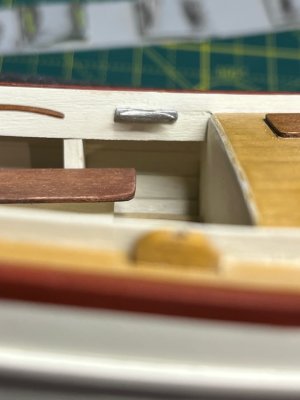
IMG_5148.jpeg

I very slightly bent the base of the cleat over the tiller, as recommended in the instructions. It didn't need very much. The final result:
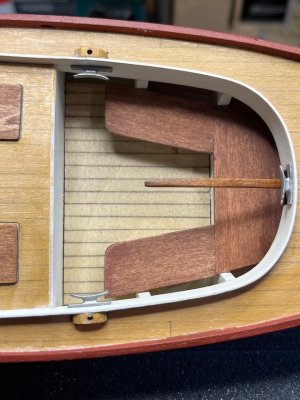
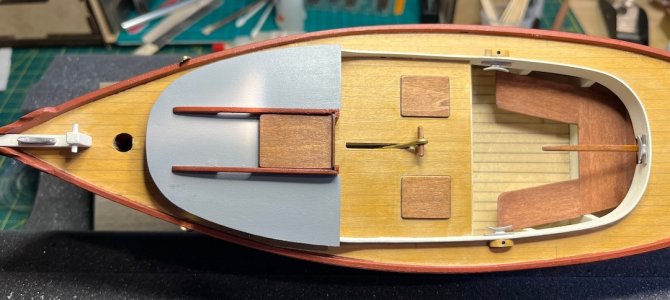
cockpit cleats.jpeg
IMG_5149.jpeg

The instructions have you attach the turnbuckles now, but I can't think why. They will only be in the way and continually fall off. I will add them at the appropriate time during the rigging. However, I will clean them up and paint them now, before moving on to the mast.
 
Post 10 - Spars

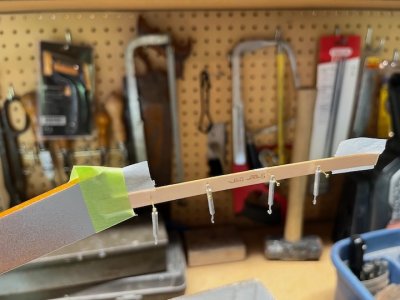
I spent the last several days making the final wooden pieces of the model, the mast, boom and gaff. I first cleaned up and painted the turnbuckles using a jig made of pins, scrap basswood and a paint stirrer
Painting turnbuckles.jpeg

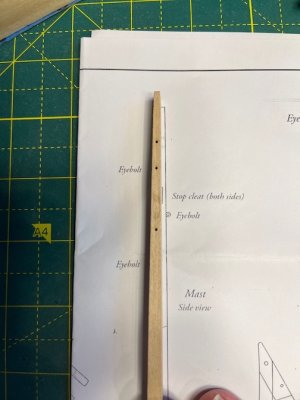
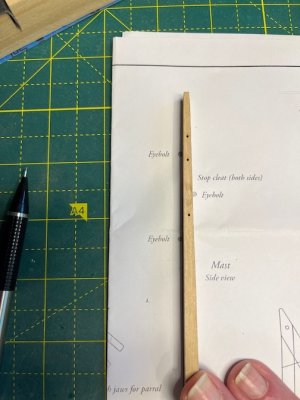
The mast pointed up one of the recurring issues with these Model Shipways kits - the supplied parts don't always match the plans or the instructions. My mast is several mm taller than the scale drawings, and the hole for the eyelets are in completely different places:
Too tall.jpeg Hole discrepensies.jpeg

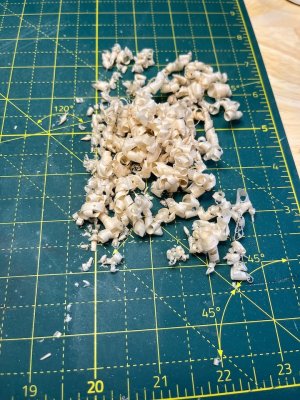
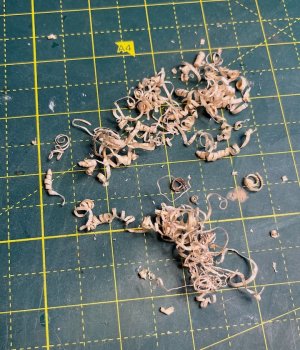
The holes, however, match the pictures in the instructions, so I did not change them. I decided to leave the extra height alone. On my previous model with a mast (the Model shipways Norwegian Sailing Pram) I used sandpaper to shape the spars. However, after reading a post by @Bob Cleek exhorting us to use sharp objects to cut wood and sandpaper to make final adjustments, I made the rectangular mast 4 square with a mini Stanley plane, finishing off with sandpaper. It made lots of nice curls!
Shavings from 4 square.jpeg

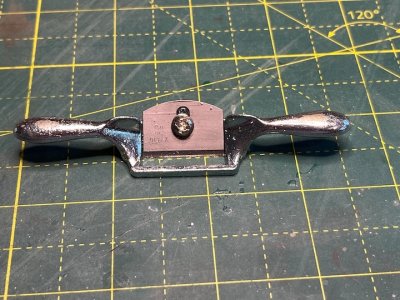
This was relatively easy, as the two flat sides (with the holes) are wider than the tapered, laser-cut sides. I took equal amounts off each flat side until it was square at the foot, and then began to taper the distal end, based on where the taper began on the laser cut sides as well as the plans. I used a digital caliper to monitor my progress. I made it 8 square using a spoke shave that is part of an old Xacto set I picked up cheap on Ebay.
Shavespoke.jpeg
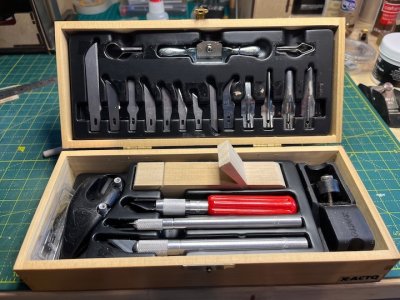
I think it's from the '80s. Lots of scary looking sharp implements! And a really great sanding block!
Xacto kit.jpeg

It worked like a charm, and made more skinny curls.
Shavings from 8 square.jpeg


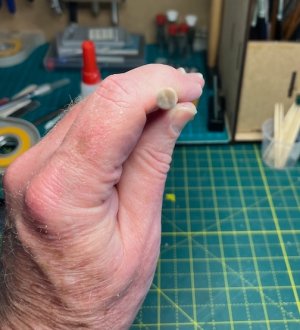
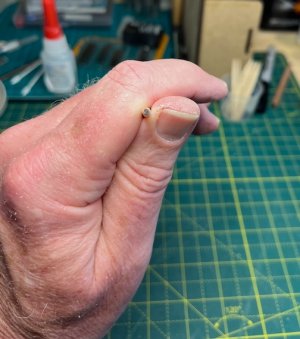
I started to round the mast in a vise, as recommended, but it felt like a set up for a broken mast, so I rounded it by pinching a piece of 220g sandpaper and rotating the mast by hand. Ended up pretty round
Round bottom.jpeg Round top.jpeg
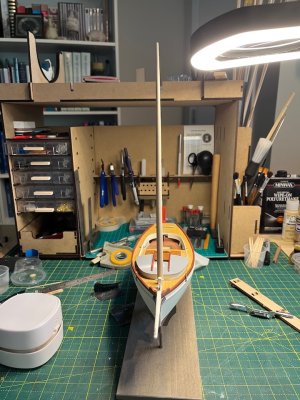
Round mast.jpeg

And it fit snuggly in the hull
Rounded mast in place.jpeg

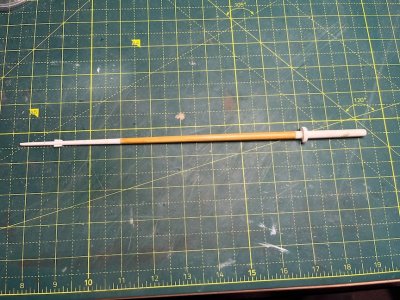
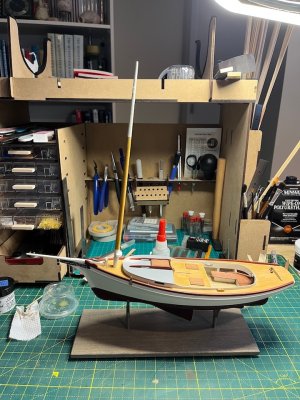
I carefully glued on the stay cleats (I don't know how I did it, but I did, and cut them as well - St. Rosalie came through again).My initial plan was to stain the mast, but then I saw @JacquesCousteau's picture of his painted mast, which I really like. Some quick internet research indicated that Muscongus Bay lobster smacks usually had masts painted white (to be seen in the fog) except for where the hoops for the mainsail were. That area was usually unpainted, but treated with something like pine tar and linseed oil to protect the wood. The boom and gaff were usually white, sometimes with black tips. I decided to do that. I used the plans to determine where the sail would be attached, and painted above and below that Warm White. I used the Tom Lauria paint/stain technique with DecoArt Faun mixed with a little FolkArt Camel craft paint to simulate the unpainted wood. I shellacked the unpainted areas.
Painted mast.jpeg
Almost there.jpeg


I will add the halyard cleats tomorrow. I'm still deciding if I should glue on the eyebolts, or wait until after I have attached the blocks. I'm thinking of buying the new interntally stropped blocks from Syren, but need to determine the size and configuration.

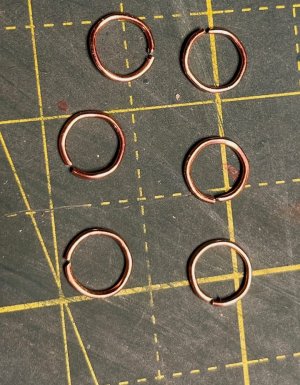
I then made the mast hoops
Hoops.jpeg

Although the instructions don't mention this, I may try to soft solder them as practice, and paint them brown to look more like wood. I know I will need to learn how to hard solder one day.

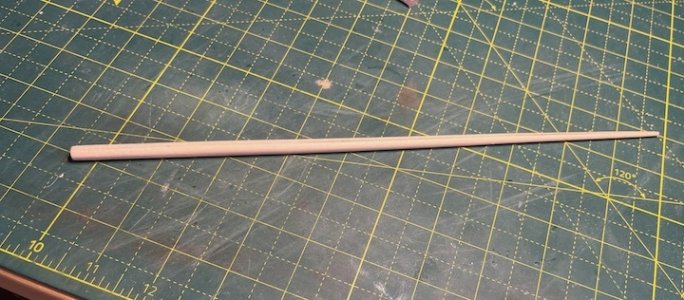
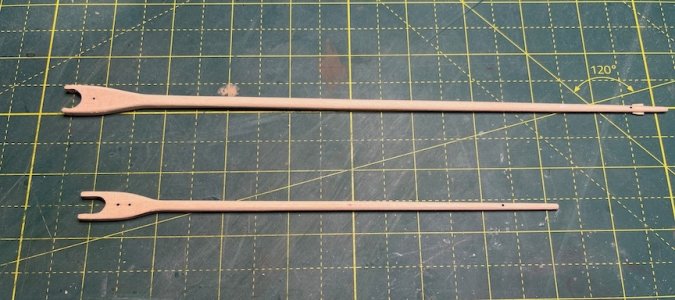
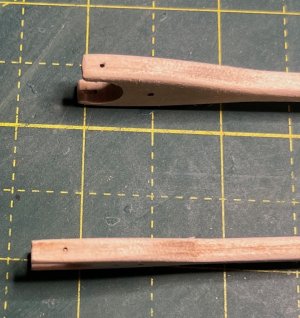
On to the boom and gaff. Again, discrepancy between the instructions and parts supplied. The instructions show spars of even diameter until near the end, but the supplied parts start to taper about 1/2 way down the spar. I decided to do an even taper along the length of the boom and gaff. The boom was a challenge to make 4 square, as the width was wider than the height. This meant I had to plane all four sides - the laser cut sides nearer to the jaws, and the flat sides nearer to the end. After rounding it I added the very small and very thin stop cleats (again, through the intercession of St. Rosalie - she never lets you down!). The gaff, like the mast, needed to be thinned down along the entire length of the flat sides before tapering. I ended up with two very nice looking round spars.
Boom and gaff.jpeg

Another Model Shipways WTF, the plans show stop cleats on the gaff, but there are no supplied parts, and they are not mentioned in the instructions. Why don't they take the time to clean up the printed matter to match the kits?

Anyway, my mini drill press made quick work of the holes for the parrels.
Parrel holes.jpeg

Tomorrow I'll prime and paint the boom and gaff, and then go to Michael's in Pittsfield to buy black seed beads for the parrel trucks before contemplating making the mainsail.

This was my first experience making round spars from rectangular wood, and I really enjoyed it. As has happened over and over with me, I was intimidated by a new technique (using a plane), but once I had the wood and tools in my hands it was easy. My thanks to @Bob Cleek for prodding me to do this.

Thanks for dropping on.
 
Post 10 - Spars

However, after reading a post by @Bob Cleek exhorting us to use sharp objects to cut wood and sandpaper to make final adjustments, I made the rectangular mast 4 square with a mini Stanley plane, finishing off with sandpaper. It made lots of nice curls!

View attachment 605052

It worked like a charm, and made more skinny curls.
View attachment 605053


View attachment 605046


I will add the halyard cleats tomorrow. I'm still deciding if I should glue on the eyebolts, or wait until after I have attached the blocks. I'm thinking of buying the new interntally stropped blocks from Syren, but need to determine the size and configuration.

I then made the mast hoops

View attachment 605048

Although the instructions don't mention this, I may try to soft solder them as practice, and paint them brown to look more like wood. I know I will need to learn how to hard solder one day.

Another Model Shipways WTF, the plans show stop cleats on the gaff, but there are no supplied parts, and they are not mentioned in the instructions. Why don't they take the time to clean up the printed matter to match the kits?

This was my first experience making round spars from rectangular wood, and I really enjoyed it. As has happened over and over with me, I was intimidated by a new technique (using a plane), but once I had the wood and tools in my hands it was easy. My thanks to @Bob Cleek for prodding me to do this.

Thanks for dropping on.

And wasn't it nice to just sweep those shavings into the wastebasket instead of having turned them into fine sawdust that spread all over everything in your entire shop? ;)

You're certainly doing a great job of it! It makes me feel good to see that somebody has benefited from a tip I gave them. The care you are taking with your build really shows. That's really what ship modeling is all about: a collection of separate tasks done carefully!
I'm always worried that my offering a suggestion will annoy the recipient, but I'll offer a couple more and you are free to ignore them if you wish.

First, you expressed some frustration with using copper wire. Actually, it's great stuff for the tasks you've tried to use it for, but the problems you are having are the result of your using wire that's much too large. Think in terms of scale. For stropping blocks, try to find some very fine copper wire. (You can do the math and get a measurement if you want.) Sometimes copper wire is hard to come by, but for stropping blocks the size you are working with, you can always get some "telephone" wire, the stuff with the multi-colored insulation that often comes in huge bundles of wires for big office phone systems. (Back in the day when everything was hard-wired.) You can then strip the insulation off of the copper wire and you're good to go. A yard of that stuff will keep you in copper wire for the rest of your modeling career! I think the gauge is 22 or 28, but I know it's the diameter of a #78 drill bit because that's what I always use to drill holes for it. If you can find some thinner copper wire, so much the better. The properly scaled wire will be much easier to work with than the thick stuff you've been using.

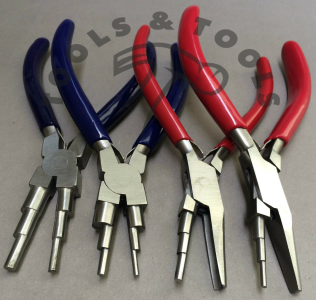
If you haven't gotten one yet, you should buy a jeweler's "bail making pliers." They come in various configurations and sizes and they're cheap. I like the "stepped" ones pictured below which will make a range of diameter rings on one pair of pliers. If you don't have "bail making pliers," you can also take a properly sized drill bit and wrap the wire around the shank to get a perfectly round "eye." With fine wire, you can make eyebolts by twisting the "pigtails" with a pliers around with the wire bent around a drill shank and nip off the end leaving the "shaft" of the bolt (the twisted pigtails). This will actually form a bit of a thread that permits the eyebolt to be screwed into a properly sized hole with a drop of adhesive. If you want to "fake" a mast band, you can glue a strip of black construction paper around the mast and then drill two holes through the paper into the mast and glue a "U" shaped piece of wire into the holes. It will look just like a forged mast or bowsprit band when you are done.

1779250517215.png

Now, one reason I prefer copper is that it is soft, unlike brass or ferrous metal, which can be springy. That makes it easy to work with. If the copper you have is too stiff, you can always anneal it by heating it until it starts to glow, then quench it in cold water. It will then be soft and easy to bend when it's cooled. (Copper will harden if it's "worked," i.e. bent or hammered. If that poses a problem, just anneal the piece again as your work progresses, although annealing shouldn't be necessary for stropping blocks or making eyebolts.)

The other advantage of using copper is that it can be left to oxidize and over time (a year or more) it will turn "penny colored," which is perfect for portraying bronze fittings. (Shiny brass is never used for marine fittings, despite what the kit manufacturers would have you believe. The only brass on a ship will be decorative trim, like binnacles, clock and steam gauge cases and indoor handrails. It's too much work to polish!)
To portray wrought iron on period vessels, which doesn't rust, but rather turns black, copper can easily be "blackened" using liver of sulfur. This is a chemical familiar to jewelers which is diluted in water and can be painted onto clean and bare copper. It leaves no residue surrounding the copper when the water dries, so you can do all the copper fittings on a painted spar and then "blacken" the copper fittings and they will look perfect, unlike painting fitting which is a tedious exercise that often makes a mess. Check out YouTube for "liver of sulfur" and you'll find instructions for its use. It's readily available from jewelers' supply houses. (There are other "blackening" chemicals, such as those used for "bluing" firearms, which can also be used but they can be trickier to use than liver of sulfur.)

Now, to really make you crazy, I'm going to suggest that you take a pass on using wire rings for your mast hoops. Mast hoops in real life are made of wood. Metal mast hoops would tear the mast up and to prevent that (as is done on bowsprit headsail tack messenger hoops) if they were metal, they'd have to be covered with leather sewn on with a baseball stitch. Here's how you can make real wooden mast hoops very easily, believe it or not.

Take a short piece of softwood plank a foot or two long and an inch or so thick. Pine or poplar would be fine. Stick it in a vise with the long edge up. Determine which way the grain is running and plane off long, thin shavings with the grain using a sharp plane. (Which is how you should be planing, anyway.) This will produce a pile of long curled shavings the width of the edge of the plank. Then take a dowel a little thicker than the diameter of your mast and smoothly cover it with tinfoil or plastic wrap that wood glue won't stick to. Then wrap the dowel with a piece of copy paper held tightly against the dowel with rubber bands wrapped around the paper and the dowel. Now, take a curled shaving and, without breaking it (depending on the wood species, you may want to soak the shavings in warm water for a half hour or so to soften them.) brush PVA glue on one side of the shaving and wrap it tightly in the direction of the curl to a thickness a smidgen thicker to what you want to represent a scale mast hoop (to allow for a bit of "clean up" sanding later.) You should do it with a single shaving which would require a four- to six-inch shaving. Then secure the wrapped shaving with a rubber band around it. Do this for as many mast bands as you'll need, plus a couple for "insurance." Given the narrowness of a scale mast hoop, you can get more than one mast hoop from a shaving that's an inch or more wide, but you'll want to make more in case you break a few. Allow the rings to dry well on the dowel overnight. When dry, sand the outside of the glued-up shavings so they are fair and round, which shouldn't take much. Then you cut the mast hoops on the dowel. If you have a lathe, this is a piece of cake. You just mount the dowel and as it turns you lay a sharp knife or fine saw on the dowel and cut straight down the depth of the glued-up shaving. If you don't have a lathe, you can chuck the dowel in a drill motor and put the drill motor in a vise or whatever and cut the rings as it turns, or, if you must, just roll the dowel and cut the hoops that way, but you have to cut straight and not create a spiral cut! Once the rings are cut to the width of your mast hoops, slide them off the dowel without breaking them. (They'll be surprisingly strong once they are laminated up with the PVA adhesive.) The hoops will be stuck to the paper somewhat, but not to worry. Simply put the dowel in water (but be sure the PVA is dry.) and the paper will soften when it gets wet. When the hoops come off, clean them up on the inside by scraping with a hobby knife or a bit of sandpaper and sand the edges to "soften" them a bit so they look good. They can then be stained and shellacked, or not, as you think looks best. (Mast hoops aren't commonly painted.) These mast hoops can then be attached to the sail with a stitch over the bolt rope as in actual practice. This method is actually easier to do than it is to describe in words and, in my opinion, produces a killer effect on a model.

Don't feel too frustrated that the kit's instructions and plans don't correspond exactly with the "parts." Back in the day, a "kit" was just some plan drawings, a rough carved hull block, and a bundle of sticks and dowels. Sometimes, if you got any sheet stock, they might have printed the parts on it for you to cut out, but that was it. Now, many modelers, particularly those who were used to cutting plastic parts off sprues and everything fit together perfectly, are surprised that wooden kit building requires cutting and shaping parts to fit, but that's how it has to be done if one is going to make a good model like you're doing.

Keep up the good work!
 
Last edited:
And wasn't it nice to just sweep those shavings into the wastebasket instead of having turned them into fine sawdust that spread all over everything in your entire shop? ;)
It certainly was! Thanks for all the words of wisdom. I'm not sure I'm up to making my own mast hoops (yet), but with my next project (which I plan to be a real ship, the Model Shipways Harriet Lane) I will strive for more historical and scale accuracy. I think of these 3 Model Shipway kits as tools for learning basic modeling techniqures that happen to produce a nice looking display piece.

The inaccurate instructions drive me crazy partly because it would be so easy to correct, and partly because my being-a-doctor-related obsessive tendencies make me want to do things by the book (12 years of Catholic school education with nuns doesn't help - I do what I'm told!).
 
Post 11 - A Quick Update and some Newbie Questions

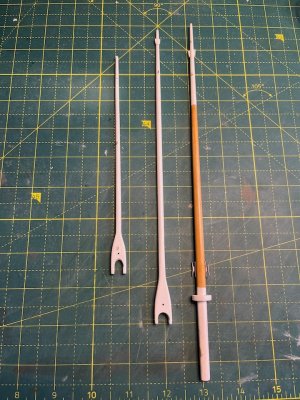
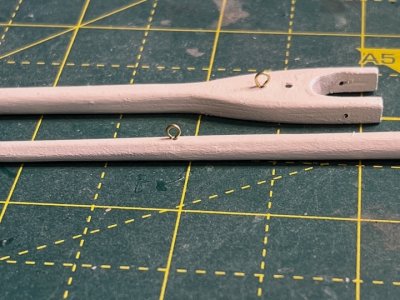
I finished manufacturing the spars today. Model Expo neglected to include the proper number of brass eyelets, but it was easy enough to make my own from the stems I clipped off the eyelets to get them to fit in the spars. I used the smallest diameter of my jeweler's pliers.

Spars.jpeg

Eyelets (1).jpeg

I made the one in the jaws.

My questions:

I'm about to start stropping the blocks. I don't like the supplied copper wire - it's too big and they should be stropped with rope. What would be the appropriate diameter scale rope to strop 1:24 scale blocks? The supplied blocks are 7 mm (probably shaped down to between 5-6 mm). I have 5 mm blocks from Syren that I plan to use. How about the gauge of wire to make the hooks? I also understand that a ship of this period probably had internally stropped blocks. I'm thinking of buying them from Syren Ship Models as an experiment. They come in 1/8, 3/16 and 1/4 inch sizes. Which would be in scale? Chat GPT tells me smacks had 5 or 6 inch blocks for the halyards, and a larger block for the traveler, so I'm thinking 3/16" blocks and 1/4" for the traveler if I go that route.

I also plan to add parrels. I know to use seed beads (the instructions show black, I think) but what is the appropriate size? I am thinking 2 or 3 mm. Any input from the collected wisdom of the foum would be appreciated.
 
You’re doing a great job!

By the late 1800’s when this boat would have been built, internally stropped blocks were used. The sheave rotated in a fork shaped iron or steel frame and the line was spliced to this frame too. A pair of wooden cheeks covered each side. These cheeks were not grooved. The blocks were often painted.

Roger
 
Last edited:
The inaccurate instructions drive me crazy partly because it would be so easy to correct, and partly because my being-a-doctor-related obsessive tendencies make me want to do things by the book (12 years of Catholic school education with nuns doesn't help - I do what I'm told!).

Tell me about it! I had 16 years of the same, and Jesuits, to boot! (I've got the ruler-scarred knuckles to show for it. :rolleyes:) That was followed by nearly fifty years of trial and appellate law practice in which everything I wrote had to be thoroughly researched and backed up with citations to authority, which really turned me into a pedantic pain in the ass to those for whose highest standard was "close enough for government work!" ;) The problem you're describing isn't caused by wanting to do things by the book. The problem is caused by an inherent defect in the book you're following. Unfortunately, failing to correct that which should easily be corrected is a characteristic of many, if not most, ship model kit packages to one degree or another. This is antithetical to high-quality scale ship modeling as a fine art, of course, but the model ship kit industry is profit-driven and, while capitalism isn't necessarily a bad thing, when profit and art are concurrent objectives, both cannot occupy the same space at the same time and it's art that always gets the hind teat. There are those modelers who find satisfaction alone in assembling kits and some do it very well, although in the case of most kits, in order to do them very well, one must virtually throw "the book" out and build from scratch to achieve the level of craftsmanship and accuracy to which the modeler's skill and experience are capable. Simply put, anybody who can do a high-quality ship model from a kit almost certainly has a skill level well above that which the kit manufacturer contemplated when designing their product.

By the late 1800’s when this boat would have been built, internally stropped blocks were used. The sheave rotated in a fork shaped iron or steel frame and the line was spliced to this frame too. A pair of wooden cheeks covered each side. These cheeks were not grooved. The blocks were often painted.

As Roger pointed out with far more grace than I ever could, there's more to be "easily corrected" in your kit than you've already discovered on your own. It's just such attention to detail which distinguishes the high-quality scale ship model from other ship models, however attractive to the inexperienced eye the others may be. I'll mention in passing that it was expressing such observations that caused the kit manufacturers who control the MSW forum and have a vested interest in keeping novice modelers building kit after kit as if that were all there was to ship modeling which got those of us in SoS who adhere to recognized standards of quality "banned" from the kit manufacturers' MSW forum!
"A high-quality scale ship model provides a compelling impression of an actual vessel within the constraints of historical accuracy."

"Historical accuracy" encompasses all the objective, or measurable, standards of technical exactness that might apply to a ship model. These embrace the obvious hull shape and fairness; precision in fittings, rigging, and colors; lack of anachronisms; and so forth. But it also encompasses all aspects of craftsmanship because the lack of craftsmanship creates unrealistic and, therefore, historically inaccurate blemishes on a model. ... The phrase "historically accurate" alone effectively replaces the intention of the now-vapid "museum quality."

"... (A "compelling impression") allows and encourages aesthetic interpretation of a vessel that will help propel the viewers to make the leap of faith that allows a model to work or to willingly suspend the disbelief that keeps a model from working. Both processes help viewers accept the invitation to visit a ship instead of a model. Compelling impression is the result of applying artistic and interpretive decision-making processes... to amplify a model beyond being a mere assemblage of parts.


Rob Napier, Caring for Ship Models - A Narrative of Thought and Application, (2022) Seawatch Books.
See: https://seawatchbooks.com/products/...tive-of-thought-and-application-by-rob-napier


I realize that for many modelers, kit modeling is an end in itself, and they don't seem to mind that the upper limits of their accomplishments may be limited by their kits' manufacturers. If they enjoy modeling, that's always a good thing. But I also know some become very defensive when any mention of objective standards of quality are mentioned. Many "see red" when comparisons between ship model kits and "paint-by-number" painting sets are mentioned. Others will assert a "right" to build their models to whatever subjective standard they please. I won't knock people who strive for self-defined perfection in making their kits, though, because that is certainly a challenging enterprise in any event. I've seen some admirably high-quality kit-builds, but, I'm just saying that, in my opinion, such accomplishments rank right up there with the proverbial "rich man's getting into heaven." Since you are a medical doctor, I'll offer a simile from your own profession and say that a modeler who builds kits is a lot like a doctor who relies upon Artificial Intelligence for their diagnostic impressions. (Although, not being a doctor, I have no idea if that reference might raise the ire of doctors as much as the former does the ire of some kit modelers! :D)

It is obvious from your build log that you have the basic skills and attention to detail required to be a very accomplished scratch builder. There is a natural progression in naturally predisposed accomplished ship modelers from building a kit or two, through "kit bashing" a kit or two to raise to the level of their own higher standards, to, finally, pure scratch-building free of any dependence upon prepackaged kits. The sooner one gets to the end of that evolution, the better off they'll be, so I'm just taking this opportunity to give you a bit of a nudge in that direction. Don't hesitate to use your current build to accelerate your evolution to independent high-quality scale ship modeling. If you do that now, you will be that much far ahead when you get to your Joe Lane build. The more you learn from the model you're building now, the more you'll know when you build your next one.

As for adding to the skill and experience you already have, you will find the School for Model Ship Building section of this forum a treasure trove of basic information specific to ship modeling. Read and learn. You should also start building a library of basic ship modeling reference books. Use this forum's search engine to find recommendations. (Anything by Davis, Chapelle, or Underhill will stand you in good stead for openers.) Once you have a good grasp of reading naval architectural drawings, you'll be able to build anything from the literally thousands of plans available in public records and books, without buying a kit.
 
Last edited:
Back
Top